
Which Australian app partner fits your build? The answer rarely sits in a glossy portfolio. It depends on your product stage, risk profile, technical scope and the support you'll need after launch. A consumer MVP, a regulated workflow and an AI-heavy platform may all need mobile development, but they demand very different delivery habits.
This shortlist compares seven app development companies in Australia by the kind of partner a buyer needs. You'll find a mobile-first product builder, startup studios, broad product engineering firms and enterprise teams. No single company wins every brief. Each profile covers its strengths, delivery model, technical depth, location, pricing visibility, cautions and the next due-diligence step.
The market matters to NZ buyers too. New Zealand's tech sector contributed $23.8 billion to GDP in 2024, represented 8% of the national economy and employed 119,520 people, according to the State of App Development ANZ report. NZ Apps is a regional directory and editorial resource for founders and operators comparing app and technology companies across Australia and New Zealand.
Bilue is the strongest fit here for a founder who wants a polished mobile product backed by serious engineering. The Sydney and Melbourne firm works across mobile apps, cloud platforms, backend systems and DevOps, so the app isn't treated as a shiny front door with a shaky building behind it.
Its native iOS and Android capability suits products where platform detail matters. That includes complex user journeys, demanding integrations and domains where reliability and data handling carry real weight. Bilue also brings product strategy into the engagement, which helps teams make hard calls before development turns those decisions into expensive code.
Practical rule: Ask Bilue who will remain on the account after launch, not only who will lead discovery.
The firm's case-led approach is useful for NZ founders who need to compare architecture choices with real delivery examples. Its in-house hiring model should also help with continuity across a multi-release roadmap. That's a better shape for a product business than a one-off handover, especially when the first release is only the opening lap.
Pricing is quote-based, with no public rate card. A boutique capacity model can also mean a longer wait when demand is high. Before choosing Bilue, ask for a proposed team structure, named technical leads, expected release rhythm and a clear maintenance scope. For wider planning, the app development cost guide for Australia is a useful companion, but treat any broad estimate as a starting point rather than a quote.
Best for: Native-quality apps, complex cloud architecture and founders planning several releases.
Location: Sydney and Melbourne.
Budget signal: Bespoke pricing. Expect detailed scoping.
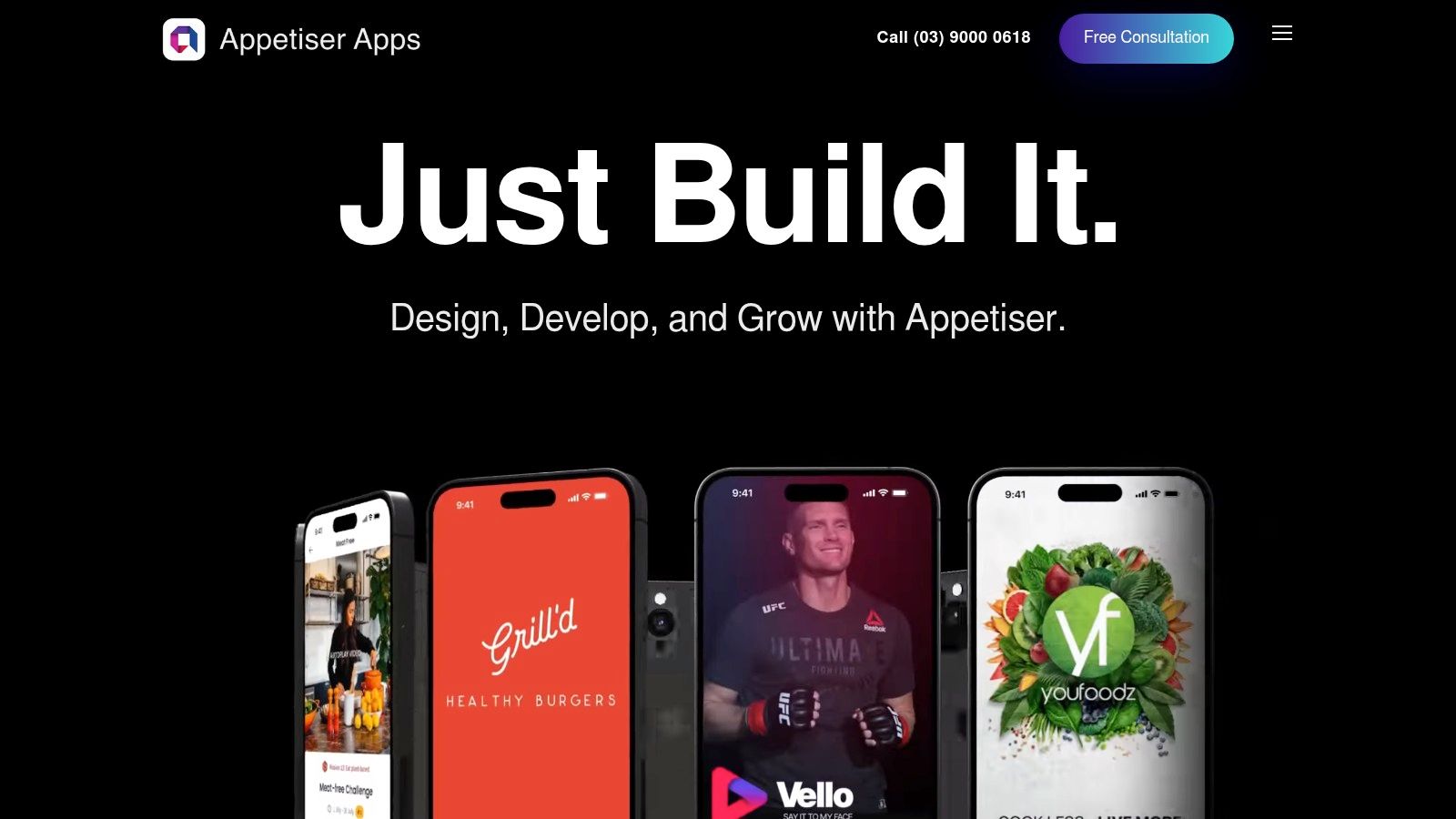
Appetiser makes more sense for an early-stage founder who needs momentum, design confidence and a path from first release to growth. Its work spans mobile and web development, product strategy, UX/UI, analytics and growth marketing, giving a young product team fewer handovers to manage.
The studio's startup orientation is the main attraction. Its discovery and MVP processes are designed to reduce the fog around a first build, while packaged offerings such as the App Growth Starter Kit give new founders a clearer entry point. That matters when you're buying software for the first time and every meeting seems to produce another decision.
Appetiser also has a strong consumer product sensibility. Its app work and App Store presence are relevant if your product lives or dies on onboarding, interaction design and repeat use. A beautifully engineered app with a clumsy first-run experience still loses the room, so design deserves a seat at the table from day one.
The trade-off is pricing clarity after the initial package. Engagements are mostly quote-based, and some reviewers have pointed to the need for more upfront detail around long-term costs and maintenance. Put that question in writing. Ask what happens after the launch sprint, who manages analytics, how bug fixes are charged and whether growth support sits inside the delivery team or beside it.
Appetiser's multi-city team is larger than many Australian boutiques, which can help with parallel design, engineering and marketing work. Still, don't confuse a broad service menu with a finished product strategy. Your brief should state the one behaviour the MVP must prove.
Best for: Startup MVPs, consumer apps, polished UX and early growth support.
Location: Australia, with a multi-city team.
Budget signal: Entry packages may simplify the first conversation, but final pricing is scoped.
DreamWalk is the practical choice when you want to test an app idea before committing to a large build. The Melbourne specialist, founded in 2008, focuses on iOS and Android products for startups and Australian brands, with a delivery style built around proof-of-concepts, agile work and clear commercial boundaries.
Its public app cost calculator is a useful pre-sales tool. It won't replace a proper technical estimate, but it gives founders a way to think about feature weight, platform decisions and product ambition before the first formal proposal arrives. That small bit of visibility can stop a planning session from becoming wishful arithmetic.
DreamWalk's flat-fee agile model is another point in its favour. Agile work can become a polite excuse for an open cheque book when change control is weak. A flat-fee structure creates a firmer frame, provided the scope, assumptions and acceptance criteria are written clearly.
The firm's fast proof-of-concepts suit founders who need evidence, not theatre. A clickable prototype or narrow working slice can expose a weak user journey early, before engineering teams build the rest of the house around it.
DreamWalk also has a longstanding local presence and many repeat engagements, which may appeal to buyers who value continuity. The caution is capacity. A boutique team may struggle to run several large workstreams at once, and the calculator only provides indicative guidance. Final pricing still depends on the build.
Ask for the calculator assumptions behind your proposal. Then request a release plan showing what is included, what is excluded and how a change moves through approval. That document is more valuable than a friendly estimate delivered over coffee.
Best for: Proof-of-concepts, mobile-first products and founders who want clearer budgeting.
Location: Melbourne.
Budget signal: Public calculator for early guidance, scoped pricing for delivery.
Appello Software fits buyers whose “app project” is really a wider digital product programme. The firm covers product strategy, design, mobile, web, emerging technology and long-term maintenance, with teams across Sydney, Melbourne, Brisbane, Perth and the Gold Coast.
That breadth can be useful for a scale-up with several products, a government supplier working through procurement or an enterprise replacing an ageing workflow. Appello has experience with government procurement and enterprise engagements, and its AI capability is referenced in Australia's National AI Centre directory.
A broad partner can reduce coordination work. It can also bring too much machinery to a lean MVP. If you need a small iPhone and Android release to test one commercial assumption, a wide discovery programme may feel like bringing a site crew to fix a dripping tap.
Appello is better suited to a roadmap with several moving parts: a customer app, an internal web console, backend integrations and a support model that continues beyond launch. Its full-stack coverage means the conversation can include operating workflows rather than stopping at the app store submission.
The main pricing caution is simple. Estimates usually follow discovery, so don't expect a firm number from a loose idea. Bring a clear problem statement, known integrations, target users and any procurement constraints to the first meeting.
For regulated or public-facing products, ask how Appello records decisions, manages access controls, tests integrations and handles ownership of delivery artefacts. Those details rarely look exciting in a portfolio. They matter when the product meets real users.
Best for: Scale-ups, government-facing work, multi-product roadmaps and enterprise procurement.
Location: Sydney, Melbourne, Brisbane, Perth and the Gold Coast.
Budget signal: Discovery-led estimates. The service breadth may exceed a lean MVP.
Moonward is a sensible pick for a non-technical founder who needs product discipline as much as code. Based in Brisbane, the studio delivers design, mobile, web and AI through a 100% in-house model, using a structured path from Discovery to Build to Launch and Growth.
That sequence is reassuring because it separates learning from construction. Moonward uses a fixed, time-boxed Discovery phase before giving a build estimate, which gives both sides a chance to test the product shape before the main spend begins. Founders often want a quote immediately. They usually need better questions first.
The studio supports former WorkingMouse customers and has experience with consumer and B2B apps for ANZ clients. Its playbooks and internal processes are aimed at rapid prototyping and close collaboration. For a founder juggling customer interviews, fundraising and product decisions, that operating rhythm can be worth more than a long technology list.
The best discovery phase should make the build smaller, clearer or both.
Moonward's Brisbane base offers a simple time-zone experience for NZ founders and keeps communication close to home. The limitation is physical reach. Its presence is concentrated in Queensland, so buyers who need frequent meetings in other Australian cities should check how the team works remotely.
Pricing is bespoke, and scoped estimates follow discovery. Ask what discovery produces, who owns its artefacts and which findings could stop or reshape the build. Also ask who stays involved during Launch and Growth. A product partner should have a view of the next release, not only the first invoice.
Best for: Non-technical founders, rapid prototypes, ANZ products and structured product management.
Location: Brisbane.
Budget signal: Bespoke pricing after a fixed, time-boxed discovery phase.
DiUS is built for products where mobile is only one part of the engineering problem. The Sydney and Melbourne company combines UX, software engineering, cloud, data and AI/ML, with experience across connected products, IoT, wearables and data-rich applications.
That makes it a strong candidate for a product that must ingest device data, connect to a cloud platform or support intelligent features without turning the mobile codebase into a junk drawer. Its cross-functional squads can also embed with a client team, which suits product leaders who already have internal staff but need extra technical lift.
DiUS uses modern mobile delivery patterns, including Flutter toolkits designed to reduce duplicated work across platforms. Cross-platform development can compress delivery, but it isn't a magic wand. Native modules, hardware features, performance-sensitive screens and platform-specific accessibility work still need careful handling. The cross-platform framework guide for NZ and Australian startups can help frame that discussion.
DiUS is usually priced for scale-ups and enterprise work, so it may sit above an early MVP budget. That isn't a flaw. It's a mismatch if your product still needs to prove its core behaviour.
For a connected or AI-enabled app, ask DiUS to explain the architecture in plain English. Where does data live? Which model or service handles inference? What happens when a device is offline? Who owns the deployment pipeline? A good partner won't hide behind jargon, and a good buyer won't accept “AI” as a complete technical plan.
The firm's project-based scoping means you'll need a defined brief before the commercial picture sharpens. Bring the product roadmap, data sources and integration map. If those are still blurry, pay for learning before you pay for a large squad.
Best for: Data-rich apps, IoT, wearables, AI/ML integration and connected products.
Location: Sydney and Melbourne.
Budget signal: Scale-up and enterprise positioning, with project-specific pricing.
Concentrix Catalyst, formerly Tigerspike, is the enterprise option for programmes with security demands, legacy systems, several vendors and a long list of stakeholders. Its Australian heritage gives the team local context, while Concentrix provides global scale and broader delivery capacity.
This is not the first call I'd make for a small consumer MVP. It is a better fit when the mobile experience must connect to backend platforms, loyalty systems, travel services, identity layers or older enterprise technology that refuses to retire gracefully.
The team brings experience design and engineering together, with large multidisciplinary groups suited to complex programmes. It also has an Australian presence and familiarity with government procurement. Those traits matter when the buyer must satisfy procurement, security, legal, operations and technology teams before a release can leave the station.
Large delivery structures can coordinate complexity, but they add process and cost. Concentrix Catalyst uses programme-based scoping and doesn't publish pricing, so the initial proposal should be read as an operating model, not only a feature list.
Ask how many people will work on your account, which roles stay local, how subcontractors are managed and who has authority to approve technical changes. Clarify integration ownership too. Multi-vendor work fails when every supplier owns a narrow slice and nobody owns the seams.
For NZ organisations assessing a larger external team, the guide to outsourcing app development provides useful context for questions about governance, communication and handover. The right contract should cover source code, cloud accounts, documentation, monitoring, support and exit arrangements.
Best for: Regulated industries, complex integrations, government work and enterprise mobile programmes.
Location: Australian teams with global Concentrix support.
Budget signal: Enterprise pricing, scoped by programme.
Visit Concentrix Catalyst
| Company | Implementation Complexity (🔄) | Resource Requirements (⚡) | Expected Outcomes (⭐) | Ideal Use Cases (💡) | Key Advantages (📊) |
|---|---|---|---|---|---|
| Bilue | 🔄 Medium–High, native apps + cloud architecture, ongoing roadmap work | ⚡ Moderate, boutique in‑house teams; potential lead times | ⭐ High-quality native apps with enterprise-grade reliability | 💡 Founders needing native-quality, regulated/complex domains and a long-term partner | 📊 Native iOS/Android expertise; team continuity; proven enterprise delivery |
| Appetiser | 🔄 Low–Medium, packaged MVPs and consumer-focused builds | ⚡ Low, startup-friendly packages and multi-city team | ⭐ Strong design quality and fast time-to-market | 💡 Early-stage startups seeking rapid MVP + post-launch growth support | 📊 Clear entry packages; strong UX/UI; App Store track record |
| DreamWalk | 🔄 Low, flat-fee agile model with fast proof-of-concepts | ⚡ Low–Medium, boutique capacity, focused local delivery | ⭐ Predictable budgeting and de-risked product validation | 💡 Founders needing quick POCs, budgeting clarity and governance | 📊 Public cost calculator; flat-fee model; consistent mobile craft |
| Appello Software | 🔄 High, full-stack, multi-product strategic engagements | ⚡ High, multi-city coverage and procurement familiarity | ⭐ Strategic, scalable cross-platform roadmaps and enterprise solutions | 💡 Scale-ups and enterprises requiring procurement-savvy partners | 📊 Enterprise procurement experience; AI capability; broad service breadth |
| Moonward | 🔄 Medium, structured Discovery → Build → Launch with playbooks | ⚡ Moderate, 100% in‑house but regionally concentrated | ⭐ Rapid prototypes and collaborative, faster launch cycles | 💡 NZ founders wanting same-timezone collaboration; non-technical founders needing PM discipline | 📊 In-house continuity; rapid prototyping; disciplined discovery |
| DiUS | 🔄 High, engineering-led stacks with AI/ML, IoT and Flutter toolkits | ⚡ High, cross-functional squads for complex, data-rich builds | ⭐ Robust, scalable connected products with strong engineering discipline | 💡 Products requiring AI/ML, IoT, wearables or complex integrations | 📊 Deep engineering, cloud and data/ML expertise; Flutter to compress time-to-market |
| Concentrix Catalyst (Tigerspike) | 🔄 Very High, enterprise-scale programs, security and legacy integration | ⚡ Very High, large multidisciplinary teams and global scale | ⭐ Enterprise-grade, secure and integrated mobile/web experiences | 💡 Regulated industries, large multi-vendor programs and government procurement | 📊 Ability to coordinate complex integrations; strong enterprise governance and scale |
A shortlist helps, but it doesn't choose the partner for you. Match the firm to the product stage first. Appetiser and DreamWalk make more sense when you're shaping an MVP or testing demand. Bilue and DiUS suit products where native mobile craft, cloud architecture, data or connected systems carry more weight. Appello and Concentrix Catalyst belong in conversations where procurement, integration and stakeholder management are part of the job. Moonward is a strong middle path for founders who need structured product guidance without building an internal team first.
Platform choice deserves a separate conversation. Ask whether the product needs native iOS and Android work, Flutter, or a mixed approach. A shared codebase can reduce duplicated effort, but native capabilities may still matter for hardware, performance, accessibility and deep platform integration. Don't let a preferred framework drive the product. Let the product drive the framework.
The regional labour picture adds pressure to delivery planning. The same ANZ report says international ICT visas fell 67% year-on-year, a practical signal that firms serving NZ clients may face a tighter senior-talent market. Ask each finalist how it handles hiring gaps, team continuity, retention and offshore delivery capacity before a deadline turns into a scramble. The ANZ app development market report provides the wider context.
Request these items from every finalist:
Test communication during discovery. Does the team ask about user behaviour, data, risk and operations, or does it rush toward screens and feature counts? Polished sales material can't answer that. The quality of the questions usually tells you more than the polish of the pitch.
Australia's app market is substantial, with the sector estimated at A$2.8 billion in 2026, 667 businesses operating in the industry and a 4.4% CAGR from 2021 to 2026, according to IBISWorld's smartphone app developers industry data. The wider app economy also includes design, maintenance, support and adjacent digital roles, not only coding, as the Progressive Policy Institute's Australia app economy report shows.
Use those facts as context, not as a reason to buy quickly. The right partner is the one whose delivery model fits your risk, whose technical decisions you can understand and whose support plan still makes sense after the launch party is over. NZ Apps can help you research the wider Australian and New Zealand technology ecosystem, including companies beyond this shortlist.
NZ Apps maintains a curated directory and publishes practical guides for founders comparing app and technology companies across Australia and New Zealand. Visit NZ Apps to research regional providers, app development resources and companies that may fit your next product brief.
Add your NZ or Australian app or tech company to the NZ Apps directory and get discovered by founders and operators across the region.
Get ListedReach tech decision-makers across New Zealand and Australia. Sponsored and dofollow editorial links, permanent featured listings, and sponsored articles on a DA30+ .co.nz domain.
See Options