
A small team can spend Monday preparing a launch, Tuesday chasing trial users, Wednesday running a product event, and Friday wondering why nobody followed up with the leads. Meanwhile, the marketing stack grows one connector at a time, until nobody knows which system owns the customer record.
The best marketing automation software depends on what comes next, not on the longest feature list. Your sales motion, channel mix, data maturity, budget band, and business model all matter. A SaaS company tracking product events needs a different setup from an ecommerce brand recovering abandoned carts. A services firm may get more value from enquiry follow-up and quote nurturing than from a large enterprise suite.
This ranking weighs team stage, customer journey complexity, data needs, local relevance, and implementation effort for founders in New Zealand and Australia. It includes short use cases, practical trade-offs, pricing bands based on publicly described plan structures, and tests to run before signing. For regional app and tech coverage, NZ Apps serves founders and operators comparing technology across New Zealand and Australia. You can also compare these platforms with other budget-friendly automation tools for ecommerce.
New Zealand has a long history of treating martech as a core capability. A 2019 survey found that 80% of marketers used web analytics, 75% used CRM, and 71% used a CMS, while 51% called martech critical to success. Yet 44% used only one to three vendors, and 85% used fewer than seven, which points to a preference for a compact mixed stack rather than a forced platform replacement. (Adobe's New Zealand MarTech survey)
HubSpot takes the top spot for teams that want marketing, CRM, sales context, and reporting to live together. It suits a startup moving towards a more considered B2B sales motion, as well as a scale-up that needs a shared view of every contact without stitching five specialist tools together.
Its visual workflows handle lead nurturing, form submissions, lifecycle changes, scoring, chat, advertising audiences, and follow-up tasks. The native CRM gives each contact a timeline, while landing pages, forms, testing, campaign reports, and attribution sit inside the same environment. That reduces hand-off friction for small teams where the same person may write the campaign, qualify the lead, and review the report.
The free entry point makes early exploration less risky, and the upgrade path is clear. Non-technical marketers can usually build useful workflows without waiting for an engineer. The partner ecosystem also helps when you need local implementation support, custom integrations, or a hand with migration.
The trade-off arrives as the database and team grow. Contact volume, seats, add-ons, and higher-level features can push total spend up quickly. HubSpot is broad rather than specialised, so a product team with unusual event logic may eventually find that a specialist tool gives it more control.
Practical rule: Build one real journey before buying. Try a form submission that creates a contact, updates the CRM, alerts sales, and sends a follow-up. If the data hand-off feels awkward at small scale, growth won't make it easier.
For a plain-language explanation of the underlying category, see what marketing automation means for NZ businesses. HubSpot is strongest when your next stage needs one operating layer for marketing and sales, not merely a better newsletter tool. Visit HubSpot Marketing Hub to inspect the current product and plan boundaries.
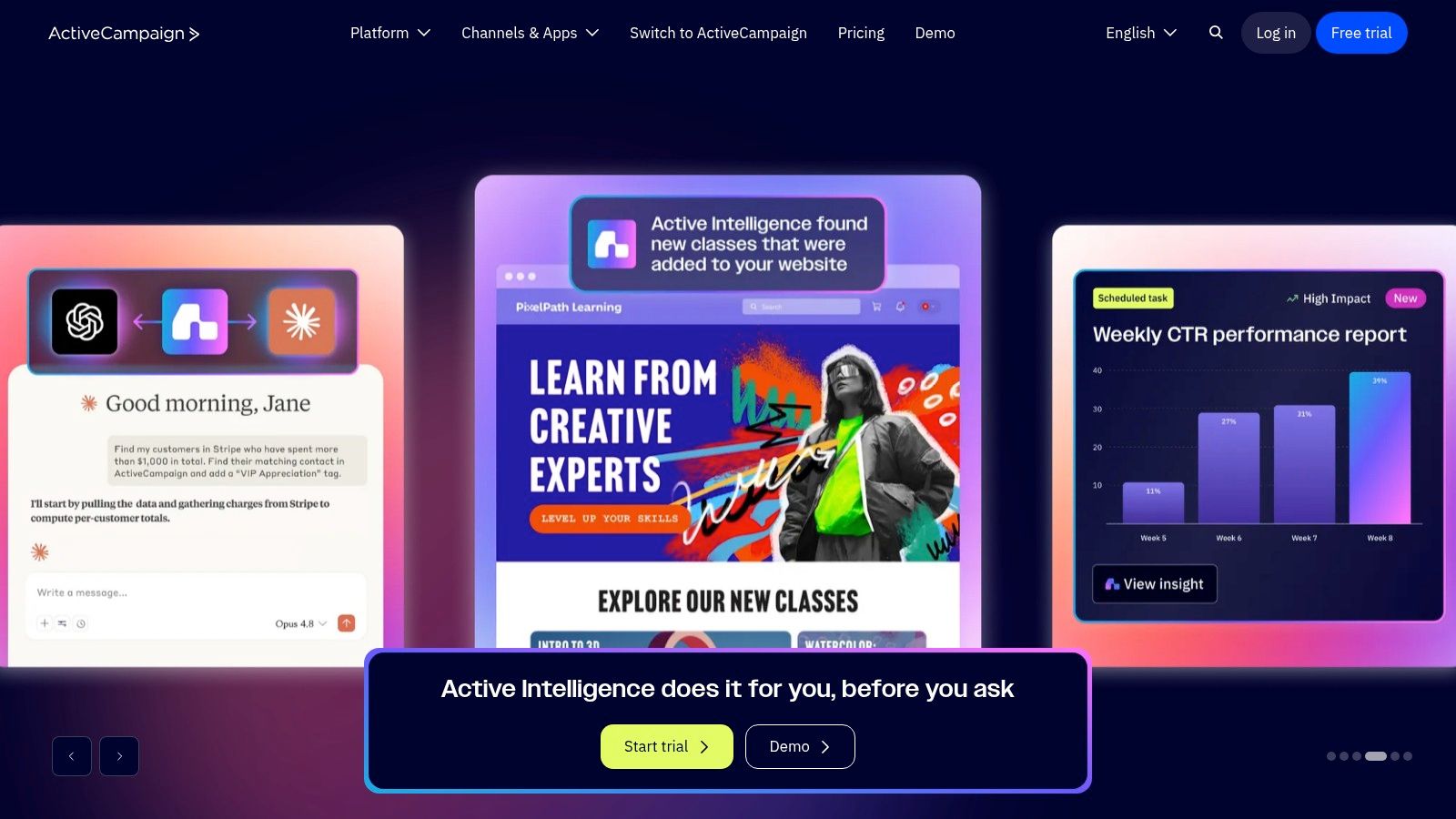
ActiveCampaign is a strong fit for lean SaaS, services, and membership teams that need richer email journeys without taking on a large enterprise system. It earns second place because it gives smaller teams meaningful behavioural automation, segmentation, and CRM functions while keeping implementation within reach for a capable generalist marketer.
The visual builder supports triggers based on actions and events, with tags, site tracking, branching, split tests, forms, landing pages, and follow-up sequences. A services company could route a new enquiry into an educational series, alert a salesperson after a high-intent visit, and move cold prospects into a reactivation journey. A SaaS team could separate trial users by engagement and send different messages to active and inactive accounts.
ActiveCampaign's automation-to-cost ratio is appealing at early and growth stages. Its journey templates and recipes shorten the path from a blank screen to a working sequence. It also fits teams that already use a separate product, payment, or scheduling system and need marketing to respond to those signals.
The interface can feel dense at first. There are many controls, and a poorly named tag structure becomes a junk drawer surprisingly fast. Its CRM is capable for a lean sales process, but a larger organisation with complex account structures may outgrow it as a central revenue system.
Before committing, test whether your most important event arrives with the right properties. Don't settle for “the integration exists.” Confirm that a trial start, consultation request, payment, or cancellation can trigger the exact branch you need.
ActiveCampaign is the practical middle ground for teams that have moved beyond basic drip email but aren't ready for heavy implementation work.
Mailchimp remains a sensible first platform for small NZ and Australian teams that need campaigns, simple journeys, forms, and ecommerce connections without a lengthy setup project. It is familiar to agencies and contractors, which can matter when a founder needs help quickly rather than another software certification to chase.
Customer Journeys can handle branching logic, while templates, forms, landing pages, audience management, reports, testing, and ecommerce integrations cover the everyday work of a small marketing function. It is a comfortable starting point for a shop sending post-purchase messages, a community building an event list, or a startup nurturing a modest prospect audience.
Mailchimp's low friction is also its main strength. A generalist can get a campaign live, understand the reports, and hand the account to another person without a long explanation. Paid plans include support, though usage limits vary by tier.
The ceiling is lower than it first appears. Advanced event-driven journeys are less flexible than those in ActiveCampaign, Customer.io, or Klaviyo. Pricing and limits relate to both contacts and monthly sends, so a growing database or a busy campaign calendar can change the economics.
A clean audience beats a clever journey. If your contacts are duplicated, poorly tagged, or mixed across consent states, Mailchimp will make the mess easier to send, not easier to fix.
Before purchase, build a welcome journey, a purchase or enquiry follow-up, and a reactivation path. Check how easily you can exclude recent buyers, suppress unsubscribed contacts, and pass campaign activity into your CRM. Good email open rate guidance for NZ teams can help, but the key test is whether your data structure supports useful follow-up.
Read the current Mailchimp subscription costs, then compare the contact and send assumptions with your own list. Mailchimp works well when email is the main engine. It strains when product behaviour, account hierarchies, or several messaging channels become central.
Klaviyo is built for ecommerce brands that have enough customer and order data to make lifecycle messaging worthwhile. Shopify and BigCommerce stores in New Zealand and Australia can use purchase history, browsing activity, product interest, and customer value to create flows that feel tied to the store rather than bolted onto it.
Its strength is the combination of deep ecommerce events, detailed segmentation, email and SMS orchestration, and revenue reporting. A store can separate first-time buyers from repeat customers, send different post-purchase education, and create retention journeys based on product category or buying behaviour. That is a more useful model than sending the same newsletter to everyone.
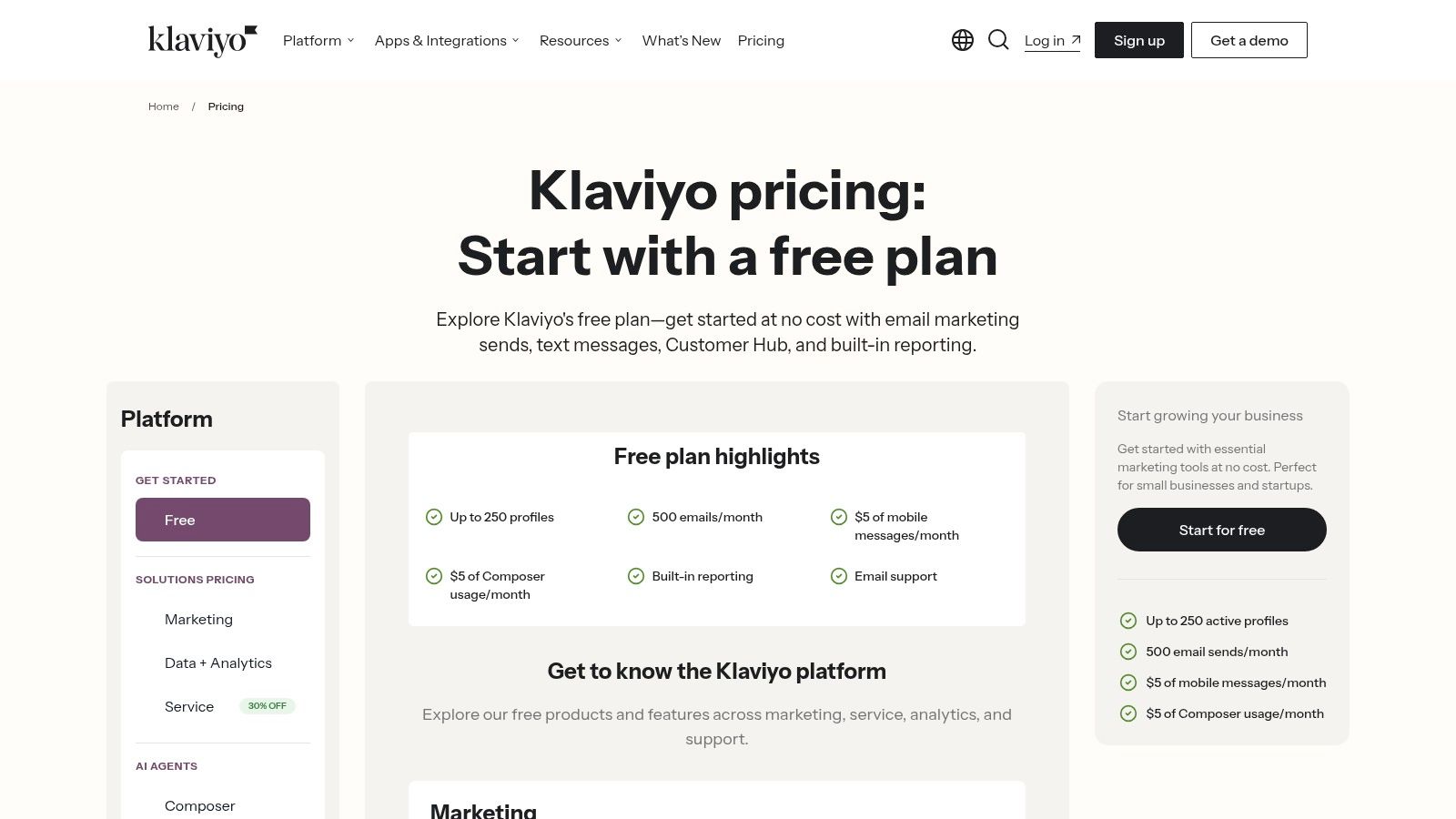
Klaviyo's free entry tier can suit a small profile base. Its larger value appears once the brand has enough traffic, transactions, and product variety to support detailed segments. The platform also offers predictive and AI-assisted features, but those features still depend on sensible event data and thoughtful customer definitions.
Costs can rise with active profiles and message volume. For a non-commerce SaaS company, local service firm, or simple newsletter programme, the platform may add complexity without adding much insight. A founder shouldn't pay for a warehouse-sized engine to power a bicycle.
Test three things before migration: whether every important order event arrives correctly, whether SMS consent is stored separately from email consent, and whether revenue reports match the store's own records. Also check how profiles merge when one customer uses different email addresses or devices.
The New Zealand installed base reflects this email-first, ecommerce-friendly pattern. A 2025 measurement found automation platforms on 10.4% of NZ websites, with Mailchimp at 68.3%, Klaviyo at 19.1%, and Marketo Engage at 2.3% of detected platforms. (NZ website technology data from WMTips)
See Klaviyo's plans before modelling growth. Its place in this list comes from customer data depth, not from being the right answer for every business.
A two-person ANZ team can build polished campaigns in Campaign Monitor without turning email into a separate operations project. Its Australian roots make it familiar in the region, and the platform suits small businesses, agencies, nonprofits, and organisations that value presentation over complex behavioural orchestration.
The drag-and-drop editor and branded templates help teams produce consistent emails without relying on a designer for every revision. Journeys cover standard automation, while send-time handling, website and landing page tools, signup forms, reporting, and defined send limits support a predictable campaign routine.
Campaign Monitor works well for a small team that needs to create a polished campaign, set up a welcome or reminder sequence, and hand routine work to another operator. Professional services and education-focused organisations may also value its accessible setup and supporting resources when internal capacity is limited.
The trade-off appears as customer journeys become more complex. A product-led company sending messages from many in-app events may find the automation too limited for its data model. Customer.io offers greater event-driven depth, while Klaviyo is more focused on commerce use cases. Subscriber and send limits also deserve careful modelling as the list grows.
Run a real campaign during evaluation rather than a dummy welcome email. Test a time-zone-sensitive launch, a form submission, an unsubscribe, and a suppression rule. Then review the report with the person who will use the platform each week. That process exposes practical gaps faster than a feature checklist.
Campaign Monitor's pricing page sets out the current plan structure. For ANZ teams that want good-looking email without a heavy operations project, Campaign Monitor is easy to understand, though it is not the deepest engine in the group.
Ortto is a particularly interesting fit for ANZ SaaS and product-led teams that need customer profiles, event-based journeys, reporting, and messaging in one place. Its regional roots and support coverage can make the buying and implementation conversation feel closer to home than a large overseas vendor.
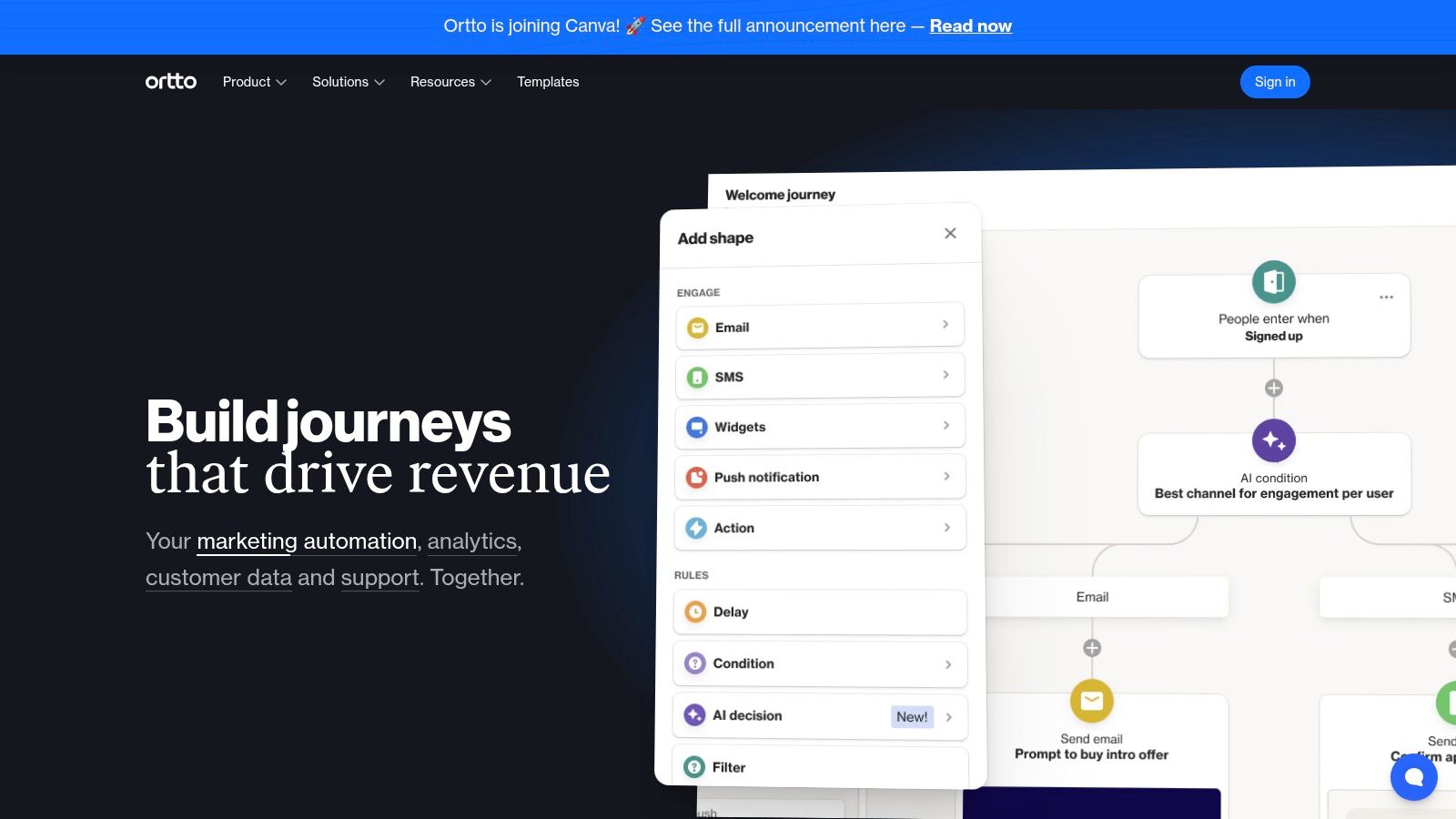
The platform combines customer data, dashboards, visual journeys, playbooks, email, capture widgets, analytics, and product-led messaging. A SaaS team can connect product events to onboarding, education, expansion, or reactivation. An ecommerce brand can use the Shopify app, while a growth team can inspect customer behaviour without moving between a data store, an email tool, and a reporting screen.
Ortto sits between a simple email service and a heavyweight enterprise engagement platform. It offers more data structure than a basic ESP, while keeping the journey builder approachable for marketers who don't want to write every rule by hand. That balance is useful for a founder-led company adding its first marketing operations discipline.
The compromises are real. Feature depth varies by plan, and the ecosystem is smaller than HubSpot's or Salesforce's. A team with unusual data models should test imports, event naming, identity resolution, and export access before treating the unified profile as a settled fact.
Data visibility isn't data quality. A profile screen can look complete while the underlying event names, consent fields, and source values remain inconsistent.
Build a trial journey from signup to product action to sales hand-off. Check what happens when an event arrives late, a user has no email address, or an account contains several people. Guidance on CRM and automation development in New Zealand is useful context for teams weighing local implementation help.
Ortto is a good candidate when customer behaviour is central and an ANZ-friendly vendor relationship matters. It may strain when the business needs the vast ecosystem or governance depth of an enterprise suite.
A SaaS startup can have a clear activation event, several account types, and different messages for users who stall, upgrade, or invite teammates. Customer.io suits that operating model, especially for SaaS, marketplaces, and mobile products where product behaviour should trigger communication. It is an event-driven messaging platform for teams that can define those behaviours and connect them to dependable product data.
Journeys can combine email, push, in-app messages, SMS, webhooks, and transactional or API-driven messaging. Marketers can branch flows using events, segments, account attributes, and custom objects. Liquid logic supports detailed personalisation for plan type, usage, location, and account status. That flexibility helps complex customer journeys, but it gives a lean team more implementation work than a basic newsletter tool.
Customer.io gives technical teams room to shape the data model. The team must agree on event names, properties, identity rules, and ownership before marketers build heavily. A visual journey still breaks when “completed onboarding” has different definitions in the product and analytics systems.
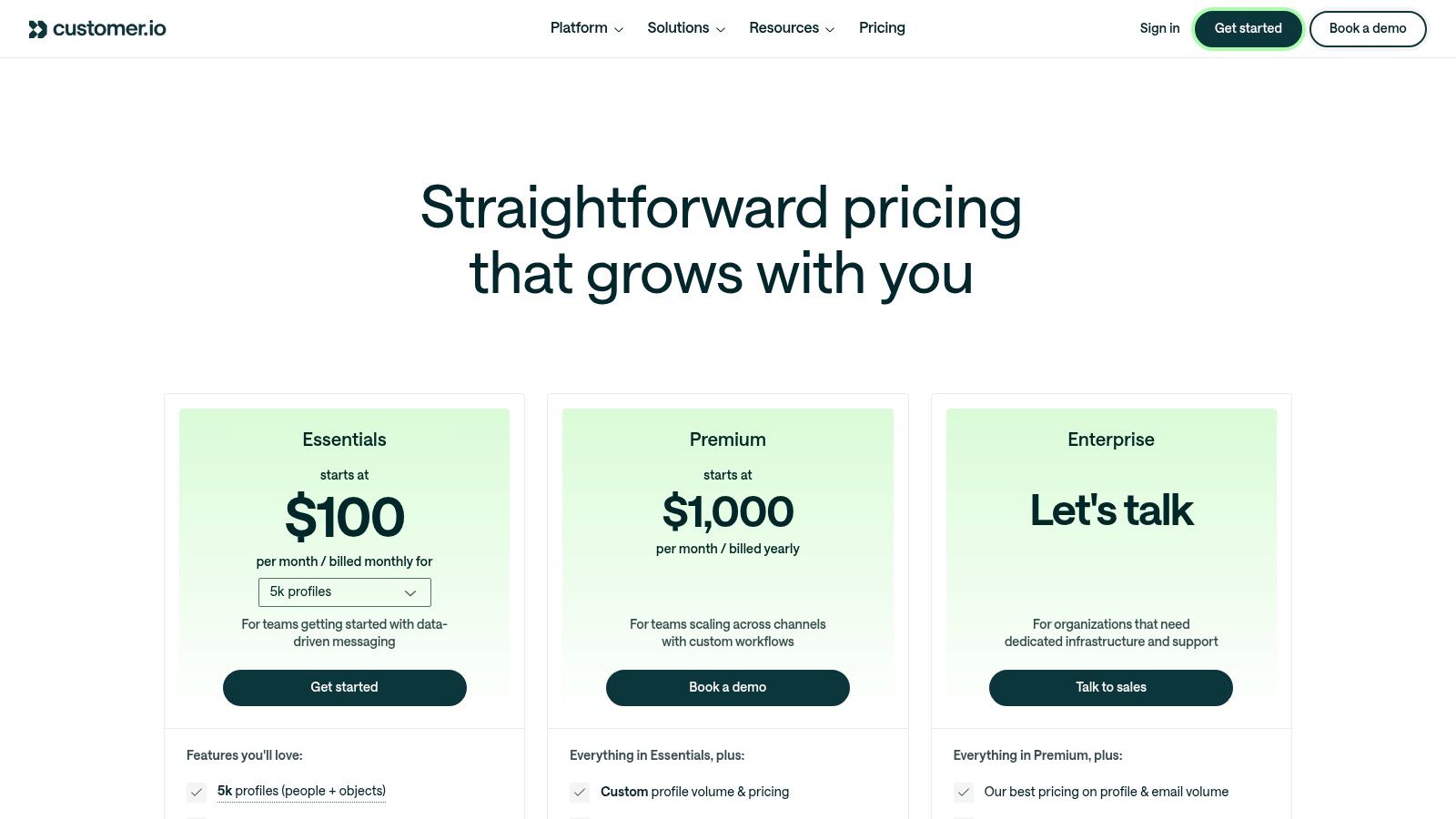
The platform supports multi-workspace setups and provides higher-tier features for specialised requirements. Eligible startups can access a programme offering up to twelve months free, according to the vendor's stated plan information. That can help an early-stage team control initial spend, but future profile and message costs still need review.
Start with one valuable product journey, such as activation or failed-payment recovery. Send test events from a development environment, inspect payloads, and confirm that a user cannot enter the same flow twice by accident. Check current eligibility and plan boundaries on Customer.io's pricing page.
Customer.io is a strong fit when engineers and marketers share ownership of lifecycle messaging. It will strain a team that wants to upload a list and build every campaign without working with event data.
Braze is designed for scaled consumer apps, retailers, and mobile-first businesses that need timely, personalised engagement across push, in-app, web, email, and SMS. It makes sense when a customer may receive a product message inside the app, a push reminder, and an email based on one live behaviour.
Its journey orchestration and BrazeAI capabilities support real-time triggers, segmentation, personalisation, and experimentation. Different editions serve different growth stages, while a flexible credits model can spread spend across communication channels. That structure may suit a consumer brand with changing channel demand.
Braze's power is also its warning label. A team needs reliable identity data, event definitions, consent handling, message governance, and people who can maintain the system. Without those foundations, real-time automation can send the wrong message faster and across more channels.
Implementation and pricing are enterprise matters. A founder shouldn't choose Braze because the demo looks impressive. Choose it when mobile engagement is a core revenue or retention motion and the business can support the operating work behind it.
Run a test with a real app event, a quiet period, a control group, and a clear stop rule. Verify that push tokens, email addresses, preferences, and account identifiers remain connected after a user changes device. Also ask who owns campaign QA once the initial implementation ends.
Visit Braze for current editions and pricing information. It is a serious platform for serious consumer engagement, but it will strain a small team still working out its first welcome sequence.
Iterable suits fast-growing B2C, B2B2C, and marketplace businesses with complex customer journeys, multiple channels, and a strong need for experimentation. It sits in the mid-market and enterprise part of the list because its value depends on data feeds, integration work, and a team that can manage a complex lifecycle programme.
The visual journey builder covers email, mobile push, in-app, and SMS. Advanced segmentation, catalogues, data feeds, testing, and AI-assisted optimisation help teams tailor messages to products, behaviours, and customer states. Its integration approach also supports businesses that need to bring data from several systems into a common messaging layer.
Iterable can handle a lot, but the business must be ready to define the rules behind that breadth. A marketplace might need different journeys for buyers, sellers, inactive users, and high-value accounts. Without clear ownership, those journeys can overlap, compete, or send contradictory messages.
Implementation expertise matters more here than a polished drag-and-drop screen. Ask about data ingestion, catalogue updates, identity matching, testing workflows, permissions, and reporting exports. Self-serve pricing isn't public, so budget planning requires a direct conversation with the vendor.
If the vendor can't show the data path, don't approve the campaign path. Ask where an event starts, how it is transformed, which rule receives it, and how the result appears in reporting.
Build one journey with a catalogue item, a behavioural trigger, a suppression rule, and an experiment. Then ask the team that will maintain it to make a change without vendor help. That exercise reveals more than a guided demo.
Iterable is a strong choice for a data-rich lifecycle programme with several channels. It is too much machinery for a founder who mainly needs newsletters, lead follow-up, and a clean CRM hand-off.
Adobe Marketo Engage is the specialist choice for complex B2B sales motions, account-based marketing, lead management, scoring, and revenue attribution. It fits larger organisations with several products, long buying journeys, multiple stakeholders, and a CRM environment that may already include Salesforce and Adobe tools.
Marketo supports lead and account nurturing, dynamic content, personalisation, landing pages, forms, scoring, lifecycle models, and attribution. It can help a marketing operations team manage different audiences and buying stages without forcing every prospect through the same linear sequence.
The platform is highly customisable, but that doesn't make it easy. Implementation, data governance, campaign architecture, naming conventions, scoring rules, and ongoing maintenance all need experienced owners. Smaller NZ and Australian teams may spend more time managing the machine than improving the customer journey.
Pricing is quote-based and typically enterprise-level. That means the buying process should include more than a feature demonstration. Ask for implementation scope, data migration work, CRM dependencies, training, support, and the cost of changing the structure later.
A sensible test is a full account journey. Start with an identified account, add engagement from several contacts, score meaningful actions, pass a qualified signal to sales, and trace the result into revenue reporting. If the team can't explain the model in plain language, the system isn't ready for production.
Adobe Marketo Engage is a powerful fit for mature B2B operations. It isn't a sensible first purchase for a small founder team still proving its audience, offer, and sales process.
| Tool | Core features (✨) | Best for (👥) | UX / Quality (★) | Pricing & value (💰) | USP (🏆) |
|---|---|---|---|---|---|
| HubSpot Marketing Hub | Visual workflows, native CRM, forms, landing pages, ads, attribution | Startups → scale-ups; ANZ teams | ★★★★☆, user-friendly, low-code | 💰 Free → Enterprise; costs rise with contacts/add‑ons | 🏆 All-in-one CRM + marketing stack; large partner ecosystem |
| ActiveCampaign | Visual automation, site tracking, tagging, segmentation, email/forms | SMBs & lean teams; SaaS/services | ★★★★☆, powerful automations for price | 💰 Affordable tiers; good automation ROI | 🏆 High automation-to-price; many journey recipes |
| Mailchimp | Customer Journeys, templates, forms/landing pages, ecommerce plugins | Small NZ/AU teams, agencies | ★★★☆☆, low friction, familiar | 💰 Free → paid; watch contacts & send limits | 🏆 Huge integration library & easy onboarding |
| Klaviyo | Deep ecommerce integrations, email+SMS, predictive segmentation, revenue reporting | DTC ecommerce (Shopify/BigCommerce) | ★★★★★, ecommerce-first metrics & flows | 💰 Free tier; costs grow with active profiles | 🏆 Best-in-class ecommerce journeys & attribution |
| Campaign Monitor | Drag-and-drop builder, templates, journeys, time-zone sends, landing pages | SMBs, nonprofits, agencies in ANZ | ★★★★☆, polished design & deliverability | 💰 Clear tiered plans; subscriber/send limits | 🏆 Strong design/UI and dependable deliverability |
| Ortto | CDP-style profiles, visual journeys, reporting, Shopify app | SaaS & PLG teams in NZ/AU | ★★★★☆, balanced data + journey tooling | 💰 Free → paid; features vary by plan | 🏆 ANZ roots with unified customer data for PLG |
| Customer.io | Event-driven workflows, transactional/API messaging, advanced segmentation | Product & lifecycle teams; SaaS, marketplaces | ★★★★☆, flexible but developer-focused | 💰 Startup program; higher starting price | 🏆 Granular event orchestration & engineering-friendly |
| Braze | Real-time cross-channel journeys, mobile push/in-app, BrazeAI, flexible credits | Scaled consumer apps & retailers | ★★★★★, enterprise omni-channel power | 💰 Enterprise/quote-based (credits model) | 🏆 Mobile-first, real-time engagement at scale |
| Iterable | Visual multi-channel journeys, advanced segmentation, AI optimization, experimentation | Fast-growing B2C & B2B2C brands, marketplaces | ★★★★★, strong for complex, data-driven programs | 💰 Mid-market/enterprise pricing (quote-based) | 🏆 AI-assisted optimization + experimentation tooling |
| Adobe Marketo Engage | Lead/account nurturing, ABM, scoring, revenue attribution, dynamic content | Large B2B organisations with complex sales | ★★★★★, deep B2B automation & customization | 💰 Enterprise, quote-based | 🏆 Mature ABM, scoring and revenue modelling for enterprises |
The right choice is usually the lightest platform that can handle the next meaningful stage of the customer journey. That may be Mailchimp or Campaign Monitor for a small list and regular campaigns. It may be ActiveCampaign when behavioural follow-up and sales context start to matter. It may be Klaviyo for an ecommerce brand, Ortto for a product-led ANZ team, or Customer.io when product events drive the message. HubSpot earns its place when marketing and sales need one shared system. Braze, Iterable, and Marketo belong in conversations where data, channels, and governance already justify enterprise implementation.
A platform doesn't create maturity by itself. Recent New Zealand reporting found that 57% of SMEs use AI or AI-enabled software, yet 56% still lack meaningful AI use that changes how customers discover, compare, and choose businesses online. (NZ small-business AI reporting from IT Brief) The gap matters here. Buying a larger system won't fix a journey that nobody has mapped, a CRM nobody maintains, or a follow-up process that sales doesn't trust.
Before signing, check:
Email fundamentals still deserve attention. NZ-focused guidance cites automated emails generating 320% more revenue than standard campaign emails, while email returns are reported at $36 to $42 for every $1 spent. (NZ and Australian small-business email data from Scoop) Those figures don't guarantee results for your business, but they point to a useful order of work. Get consent, segmentation, timing, deliverability, and follow-up right before adding a maze of channels.
Privacy belongs in the build, not in the final approval meeting. New Zealand's Privacy Act 2020 covers public and private sectors and regulates the collection, use, storage, access, and disclosure of personal information through 13 Information Privacy Principles, overseen by the Office of the Privacy Commissioner. (New Zealand privacy guidance from Chambers) The Unsolicited Electronic Messages Act requires commercial electronic messages to rely on express, inferred, or deemed consent, include accurate sender details, and provide a working unsubscribe option. (New Zealand electronic messaging guidance from Linklaters) Targeted advertising needs care too. IPP 10 generally restricts reusing data collected for one purpose, such as analytics or account management, for an unrelated purpose such as targeted advertising, where consent will generally be needed. (New Zealand guidance on targeted advertising and IPP 10)
Run one real workflow before you commit. Use a genuine form, product event, purchase, enquiry, or renewal signal. Watch the record move between systems, inspect the consent state, test the suppression logic, and ask the person who will maintain the automation to change a step without help.
The cleverest platform is not much help if the team can't keep it clean, useful, and connected to how customers buy. Choose the system your next stage needs, then give it clear ownership and room to earn its keep.
NZ Apps covers app and technology companies across New Zealand and Australia, including SaaS, AI, automation, ecommerce, and mobile products. Visit NZ Apps to compare regional technology businesses, find relevant market coverage, and explore local exposure for your own platform.
Add your NZ or Australian app or tech company to the NZ Apps directory and get discovered by founders and operators across the region.
Get ListedReach tech decision-makers across New Zealand and Australia. Sponsored and dofollow editorial links, permanent featured listings, and sponsored articles on a DA30+ .co.nz domain.
See Options