
Most advice about business model innovation starts in the wrong place. It tells founders to build a better product, add more features, and then find a market large enough to justify the effort. That playbook feels sensible, especially in software. It can also leave a good product trapped behind weak pricing, narrow distribution, and a revenue model that never quite pays for the work.
New Zealand shows why the usual definition of innovation needs a rethink. Fewer than 10% of NZ firms undertook or funded research and development in the last two years, yet 18% introduced new or significantly improved goods or services in the two financial years ending 2021, according to the Productivity Commission's review of New Zealand businesses. Innovation is happening outside the laboratory. It appears in service redesign, new offers, subscription pricing, partner channels, and different ways of delivering value.
That matters in a small, export-oriented market. A founder in Auckland, Wellington, Christchurch, or Melbourne can build a strong product and still run out of reachable customers. The sharper move is often to change how the business creates, delivers, and captures value. Product quality matters, but the business model decides whether that quality becomes repeatable revenue.
Product innovation gets the attention because it is easy to point to. A new feature, patent, or release gives a team something tangible to show. Commercial progress often comes from less visible changes. New Zealand's data shows that only about 8% of businesses conduct some kind of R&D, while a broader group changes its goods, services, processes, or marketing methods, as the Productivity Commission's 2024 report explains.
R&D still matters, especially for defensible technology. It is not the only path to growth. A company may create more value by changing its offer, pricing, route to market, or service delivery than by adding a feature customers barely notice.

Consider a common SaaS pattern. A team builds a capable platform, sells annual licences, and charges per user. Customers like it, but adoption stalls because every additional seat increases the bill. Usage-based pricing may remove that barrier. A service layer can help customers reach value sooner. A channel partnership can put the product in front of buyers the sales team cannot reach alone.
The core product may remain unchanged. The commercial system around it changes, and that can determine whether usage becomes repeatable revenue.
Stats NZ reported that 46% of all businesses had innovation activity in 2011, while 40% implemented new or significantly improved goods, services, processes, or marketing methods. Education and training, along with arts and recreation services, recorded innovation rates of 62% in that survey. The Stats NZ innovation survey shows that service businesses have long created value through operating and delivery methods that do not resemble classic product invention.
The later picture was similar. Government analysis found 47% of firms reported innovation in the 2017 Business Operations Survey, compared with 49% for 2012 to 2014, as summarised by Treasury. Participation stayed broadly stable, while the form of innovation varied.
Practical rule: If customers struggle to buy, adopt, understand, or renew your product, more features probably will not solve the core problem.
NZ companies often reach the limits of domestic scale before expanding into Australia or other markets. Distribution and monetisation therefore deserve the same attention as the product roadmap. A founder may need advisers, industry bodies, cloud marketplaces, resellers, or embedded software partners to reach buyers that a direct sales team cannot efficiently serve.
The contrarian case is straightforward. Business model innovation can be a capital-light growth lever when product development is expensive, slow, or disconnected from buyer behaviour. Strong teams ask more than, “What should we build next?” They also ask:
New Zealand has active innovation, but turning experiments into commercial systems remains difficult. The Treasury analysis of R&D and innovation notes that innovation participation can range from 0.2% to 40%, depending on how it is measured. That range highlights a measurement problem. Patent and R&D measures miss the practical work of changing pricing, channels, service delivery, and customer experience. For small export-focused companies, the winning model is the one that converts those experiments into a repeatable way to acquire, serve, and retain customers.
Business model innovation becomes practical once you identify the lever that is blocking commercial progress. Founders usually change one of four elements: the value proposition, revenue model, key resources, or channel. These levers affect one another, but moving all four at once creates unnecessary risk. In a small, export-oriented market, a focused change is easier to test, measure, and repeat across NZ and Australia.
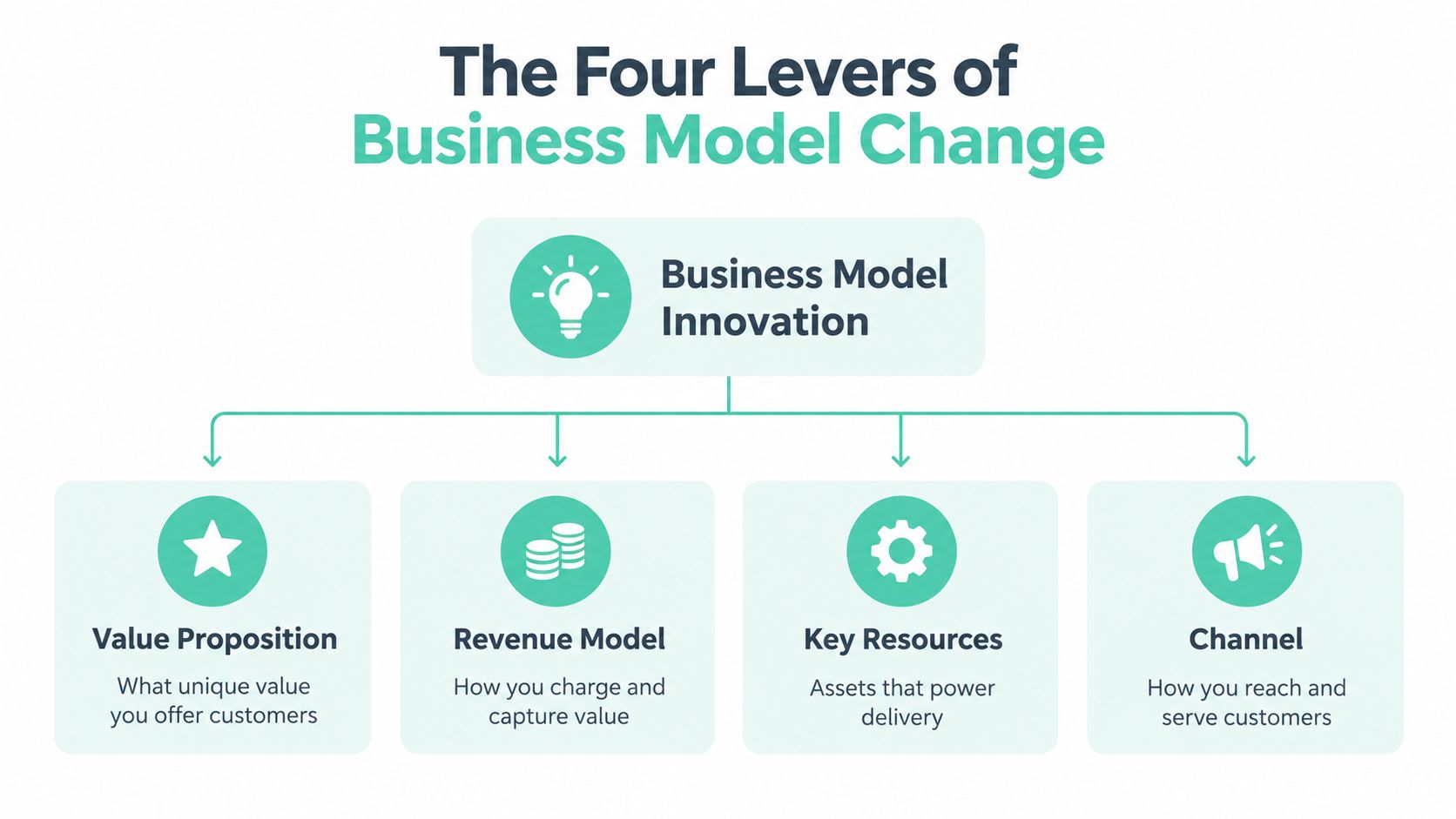
Start with the customer's job, not the feature list. A New Zealand farm management platform might sell “software for compliance”, while a stronger proposition could centre on reducing administration before an audit or helping a contractor prove completed work. The product may barely change. The buyer's reason to pay changes substantially.
Test the proposition by asking whether buyers can explain the benefit without repeating your category. “It's another dashboard” describes a product. “It helps me win work because clients can see the job trail” describes a commercial outcome. That distinction matters when an experimental idea needs to become a repeatable offer.
Revenue logic determines when and why money enters the business. Options include subscriptions, usage charges, transaction fees, licensing, commissions, services, and bundled offers. Each choice changes customer behaviour, cash flow, forecasting, and the work required after a sale.
Per-seat pricing suits products where each user receives similar value. It fits poorly when value depends on transactions, data volume, or organisational outcomes. Usage pricing can reduce the adoption barrier, but revenue becomes less predictable. Services can improve cash flow and customer success, while also pulling a software company towards labour-heavy delivery.
Model NZ and Australian economics before changing the price. Currency, tax treatment, procurement habits, support load, and partner margins can change the result. A model that looks clean in a spreadsheet may become difficult once an Australian reseller takes a cut and enterprise buyers require implementation work.
Sector-specific examples show why commercial logic often combines several elements. The Founder Connects cleantech guide illustrates how technology can sit alongside services, partnerships, and local delivery.
Resources include more than software, equipment, and cash. They can include trusted data, implementation expertise, regulatory knowledge, community access, and relationships with distributors.
A fintech may have excellent code but limited lending expertise. An edtech company may have strong content but no route into schools. A healthtech platform may need clinical governance before a hospital will take the first meeting. Business model change may therefore require acquiring a missing capability rather than rebuilding the product.
Hiring a large team before proving demand creates fixed cost. Avoiding every hire can make delivery unreliable. Choose the resource that removes the largest commercial constraint now, then test whether it should be hired, contracted, or supplied by a partner.
Channel covers how customers discover, assess, buy, and receive value. Direct sales provide control and buyer insight, but consume time. Partners provide reach and trust, while reducing margin and control over the customer experience.
A local accounting platform might distribute through firms that already advise small businesses. An Australian software company entering NZ might work with a local directory, industry association, or implementation partner instead of beginning with cold outbound. Distribution is part of the product experience, particularly when buyers need reassurance before switching.
The same channel rarely fits every segment. Enterprise buyers, sole traders, schools, and developers follow different purchasing paths. Map the route from discovery to delivered value, identify the narrowest constraint, and change that point first. This approach turns innovation activity into a commercial system that can be tested in NZ and carried into other markets without multiplying operational complexity.
Product innovation attracts attention. Commercialisation depends on a business model that can repeatedly turn customer value into cash. That distinction matters in New Zealand, where companies can generate strong innovation activity yet struggle to convert experiments into scalable revenue. Before changing the model, document how it works today.
Start with a short workshop involving sales, product, finance, and customer support. Ask each person to trace the path from customer problem to cash received. Compare the answers. Gaps often expose the underlying constraint: one account may drive the forecast, implementation may consume the margin, or a founder may still be carrying the sales process.
Customer concentration risk comes first. List the largest accounts and the relationships behind them. If one buyer, sector, or channel controls a large share of sales, test a second segment before the first becomes a dependency. Concentration can make revenue appear healthy while leaving the company exposed to one procurement decision or budget change.
Revenue sustainability requires more than a recurring invoice. Ask why customers renew. Is the product embedded in daily work, or has nobody reviewed the contract? Examine discounting, expansion paths, service effort, and payment timing. A subscription that depends on heavy manual support may be less durable than a smaller licence delivered consistently.
Channel efficiency concerns the full path from discovery to delivery. Track how prospects arrive, who influences the decision, and where deals stall. A partner channel may produce sales but little customer feedback. Direct sales can reveal objections quickly while consuming too much founder time. In a small export market, choose the channel that creates repeatable learning, not just the one that produces the quickest lead.
Unit economics clarity means knowing the full cost of serving a customer. Include onboarding, support, account management, payment fees, partner commissions, and delivery work, not only hosting costs. If finance cannot explain contribution margin by segment, avoid adding a complicated pricing model. The business needs reliable cost visibility before it can judge whether growth is profitable.
Competitive differentiation depth asks what remains valuable after a rival copies the feature. A workflow, data set, trusted brand, community, or distribution relationship can outlast a feature advantage. If the answer is only “we're easier to use”, test that claim with customers. In NZ, a defensible route to overseas revenue often comes from a repeatable operating advantage rather than a larger feature list.
| Diagnostic Area | High Risk Signals | Healthy Benchmarks |
|---|---|---|
| Customer concentration | One account, sector, or partner shapes the forecast | Several credible customer paths and a clear plan to broaden demand |
| Revenue model | Heavy discounting, weak renewal logic, or services hiding product weakness | Customers understand the charging trigger and the business earns acceptable margin |
| Distribution channel | Founder-led selling, unclear attribution, or stalled hand-offs | A repeatable path from discovery to purchase and delivery |
| Unit economics | Support and onboarding costs are missing from the model | Contribution margin is visible by customer segment |
| Differentiation | Buyers compare features and price only | Customers value a distinct outcome, workflow, relationship, or asset |
Give each area a low, medium, or high-risk rating. It is not a scientific score. Its job is to force a decision about where to investigate first and which assumption deserves a commercial test.
A useful diagnosis should change what you do next. If it only creates a colourful workshop board, it is decoration.
Select the constraint closest to cash flow or retention. Change one area first, define the evidence that would support the change, and set a short review point. A focused experiment produces cleaner learning. It also shows whether an idea can become repeatable revenue in NZ before the team adds operational complexity for export markets.
The most useful NZ SaaS pivot stories are not tidy tales of guaranteed growth. They are patterns for closing the gap between strong innovation activity and weaker commercialisation. A Wellington HR platform, an Auckland fintech, and a Christchurch edtech company illustrate three possible moves, but they are not verified case studies with published results. Claims that one doubled expansion revenue, another built a higher-margin service stream, or a third gained school access require reliable public evidence.
Use the examples as model patterns, not proof. Founders make costly decisions when a neat anecdote substitutes for customer evidence, delivery economics, and a clear path to repeatable revenue in a small, export-oriented market.

A per-seat HR platform can hit a ceiling when customers want broad access but only a small group uses the system each day. Usage-based pricing may fit better when value follows payroll runs, employee records, documents processed, or completed workflows.
The trade-off is predictability. Finance teams prefer a clear recurring base, while customers often prefer paying for measurable use. A practical test could retain a platform fee, add a usage band, and show how the bill changes before commitment.
Track activation, usage depth, support load, renewal intent, and gross margin. Rising sign-ups are not enough. A lower entry price can attract customers who never become profitable, especially when support and onboarding costs rise with adoption.
An Auckland fintech could combine its platform with cash-flow reviews, reporting support, or compliance guidance. The service may help customers reach value sooner and create another revenue stream without requiring a second product.
The risk is turning software into a consultancy. Delivery quality depends on people, and people do not scale like code. Keep the service narrow, document the work, and identify which parts can become templates, workflows, or product features.
This model fits buyers who need confidence as well as access. It can help where regulation, financial decisions, or operational risk make self-service adoption difficult. The commercial test is whether the service improves retention and margin, rather than only increasing activity.
A Christchurch edtech company may find direct school sales slow because procurement and relationships carry significant weight. Education providers, curriculum specialists, or school networks could shorten the trust gap and create a route into more accounts.
Partners do not provide free distribution. They need training, sales materials, lead protection, reporting, and a reason to keep selling. The company may also lose direct customer insight. Set ownership, feedback, and performance rules before signing a long agreement.
Founders comparing these patterns can use this explanation of the SaaS business model as a grounding reference, then build their own model from customer and cost data.
The shared lesson is practical: each pivot should address a defined constraint. Pricing can reduce adoption friction, services can improve confidence and time-to-value, and partners can extend reach. Choose the lever supported by evidence, then test whether the model delivers repeatable revenue in NZ before adding export-market complexity.
Innovation without disciplined testing is expensive guessing. A useful experiment begins with one risky assumption, not a broad ambition such as “grow in Australia” or “improve monetisation”.
Write the assumption in plain language: Australian accounting firms will introduce our workflow tool to their clients if we provide training and a revenue share. Then define the smallest test that could prove the assumption wrong.
Different experiments produce different kinds of evidence. Don't use a survey to answer a willingness-to-pay question when a real offer would give you better information.
| Experiment approach | Best question | Strength | Main risk |
|---|---|---|---|
| Customer interviews | Do buyers recognise the problem? | Fast learning about language and urgency | Polite interest can look like demand |
| Paid pilot | Will a customer commit money and effort? | Stronger evidence than verbal approval | Delivery work can distort the result |
| Pricing page test | Which offer gets serious attention? | Useful for message and package comparison | Clicks don't equal payment |
| Partner trial | Can another organisation create qualified demand? | Tests trust and distribution together | A weak partner can create a false negative |
| Concierge service | Can the outcome be delivered before automation? | Reveals the real workflow and customer value | Labour cost may hide the future margin |
Set a timebox, owner, customer group, offer, and success condition. Keep the variables tight. If you change the price, onboarding flow, target segment, and sales script together, you'll learn that something changed, but not what caused it.
A pricing experiment can use two packages with a clear difference in value. Present them to similar prospects, record objections, and track proposals, paid conversions, delivery effort, and expected retention. Don't negotiate every deal informally. That turns a test into a collection of anecdotes.
For a partner test, recruit one relevant partner, provide a short enablement pack, and define what counts as a qualified opportunity. A handful of serious conversations can teach more than a large list of uncommitted leads.
Teams new to testing often confuse a minimum viable product with a complete product. This guide to minimum viable products is useful because the smallest test should expose a risk, not merely look unfinished.
A positive result doesn't prove the entire model. It shows that one assumption survived one test. A negative result may mean the offer failed, the audience was wrong, or the channel lacked trust.
Use a decision note after every experiment:
Never let enthusiasm set the success metric after the test starts. Decide what counts before customers respond.
The aim isn't to avoid failure. It's to make failure cheap, specific, and useful.
A useful roadmap turns commercial constraints into controlled action. Start with the scorecard, then rank ideas by customer value, evidence, cash impact, delivery effort, and reversibility. A pricing change tested with existing customers may deserve priority over a platform rebuild that occupies the product team for months.
Choose one primary bet and one supporting bet. For example, test a new package with an existing segment while preparing a partner channel for a nearby export market. Keep other ideas in a parking lot. Too many initiatives create activity without producing clear learning.
The product lead may own the offer, while finance owns the margin model and sales owns evidence of buying intent. Assign one person to the result rather than a committee. Record the baseline, test window, decision date, and conditions for continuing.
Useful measures include:
New Zealand's policy direction reflects the need to convert innovation activity into commercial outcomes. The MBIE innovation and technology report describes a 15% R&D tax credit for eligible R&D spending. That support can create room for technical experiments, but it does not replace pricing discipline, customer discovery, or a route to market.
The wider ambition is substantial. MBIE's UpStart Nation framework targets 5,000 active high-growth startups, 250,000 high-value knowledge-intensive new jobs, 75 startups spun out of public research organisations each year, and five new startups reaching $100 million in revenue every year by 2030. The targets highlight a familiar gap for NZ founders: innovation activity has value only when it becomes repeatable revenue, including in small export-oriented markets.
Review each bet at its decision points. Continue when customers pay, use, renew, and produce acceptable margin. Revise when interest is strong but delivery costs too much. Stop when evidence shows that the problem, segment, or channel is not worth pursuing.
The NZ Apps go-to-market strategy resource can structure market-entry planning, but no framework can decide whether your model earns enough from its customers. That judgment requires observed buying behaviour and delivery economics.
Business model innovation is a sequence of deliberate changes. Start with the constraint closest to cash, test one assumption, and let customer behaviour overrule founder optimism. This approach gives experimental ideas a practical path toward repeatable revenue in NZ and Australia.
NZ Apps covers the NZ and Australian app and tech scene, giving founders a place to assess local companies, categories, and market opportunities while shaping regional growth plans. Visit NZ Apps to explore the directory and practical coverage for your next business model experiment.
Add your NZ or Australian app or tech company to the NZ Apps directory and get discovered by founders and operators across the region.
Get ListedReach tech decision-makers across New Zealand and Australia. Sponsored and dofollow editorial links, permanent featured listings, and sponsored articles on a DA30+ .co.nz domain.
See Options