
A founder announces a new workflow on Monday. A few keen people try it. By Friday most of the company is back on the old path. A busy pilot can still be a stuck company. Change management software is the record of that gap, the space between a tool that works and a team that uses it. This is written for NZ and Australian founders who have shipped something and now have to get people onto it, without a giant programme office and without pretending a task list is a change.
You have seen the scene. Someone posts the new way of working in the team chat. Two people try it the same afternoon. A week later the old spreadsheet is open again, and nobody wants to say the rollout failed. It did not fail as a demo. It failed as a habit.
Datacom's 2026 State of AI Index puts a hard frame on that feeling. 91% of NZ organisations use AI, yet only 15% are scaling it across the organisation. Only 4% use AI to change core operations, down from 8%. High usage is not the same as a working change. A lot of that use is shallow, informal, or unsafe.
The same research names the blockers in plain terms. Lack of internal capability or skills is the leading barrier at 20%. Employee concern, resistance, or fear of job loss sits at 18%. Those are people problems. A licence does not fix them.
So who owns the change when a pilot moves faster than the rules around it? If the answer is "the person who built the tool", you already have a risk. Builders ship features. They rarely sit with every team and watch the first messy week. That watching is the job.
A useful system has to show three things at once.
That is a different job from keeping a project board green. If your team collaboration software already holds the chat, do not assume it holds the adoption story. Chat shows noise. It does not show whether the new path stuck.
A pilot can look lively and still leave the core work untouched. Busy is not the same as adopted.
The rest of the decision is practical. What must the software record, what must it measure, and what must you be able to prove later when someone asks who changed, who was heard, and whether the new way is in use?
A milestone can say the system went live. It cannot say anyone changed how they work. Treat change management software as the operational layer for a change, not a prettier project board.
KPMG New Zealand's 2022 CEO Outlook makes the split obvious. 80% of surveyed CEOs called their digital-investment strategy aggressive. 73% said getting employees to adopt and keep new ways of working was a significant challenge. Spend and stubborn habits can sit in the same quarter. KPMG's point is sharp. This work belongs in programme design from the start, not as a tidy-up after go-live.
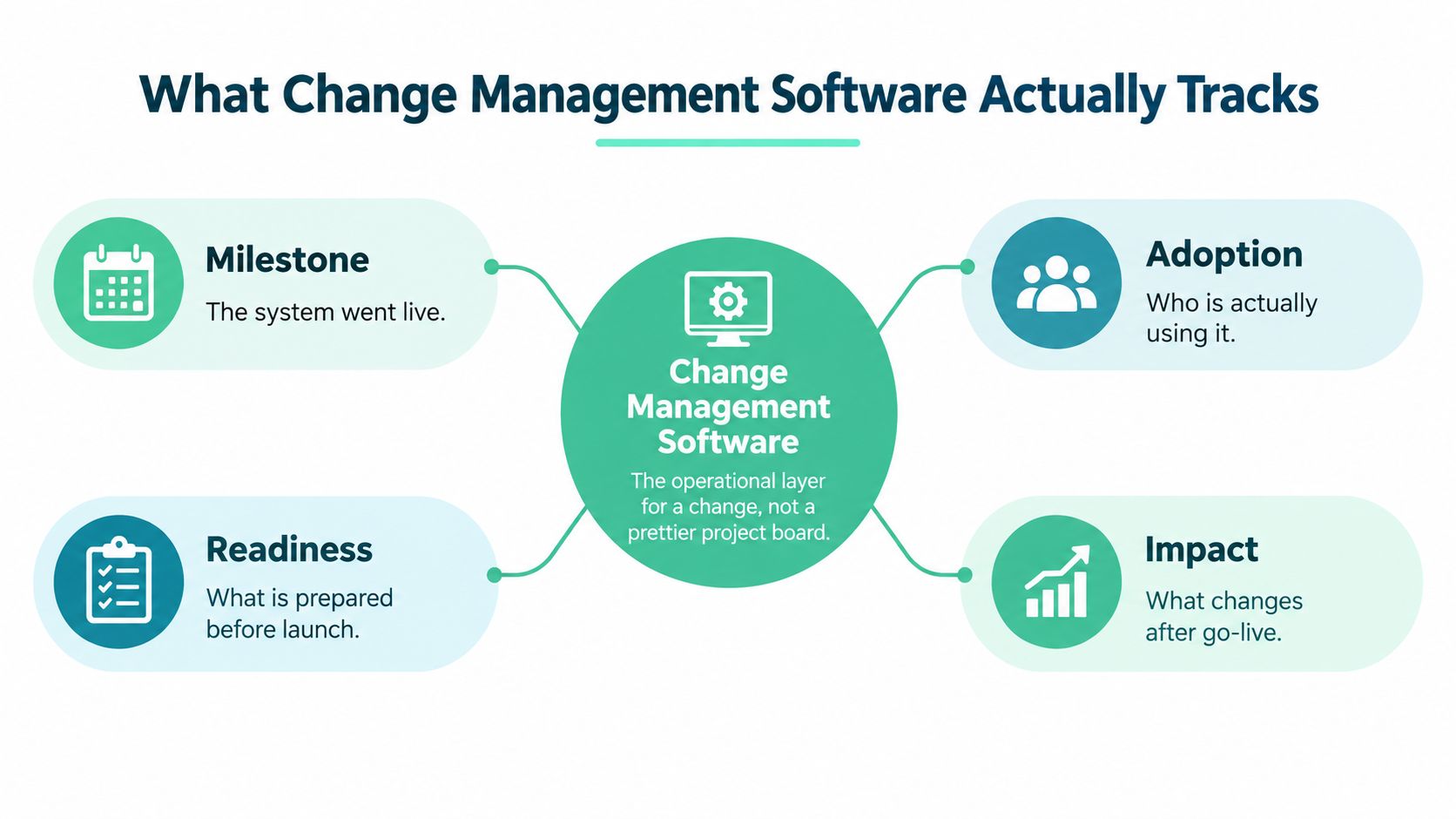
Watch the early signals before you trust a results slide. Training attendance, feature activation, workflow completion, and sentiment tell you whether people are even in the game. Later signals, such as productivity, error rates, and support-ticket volume, tell you whether the game paid off. If you only store the later set, you will notice the miss after the damage.
A useful record is boring on purpose. It holds role-based messages, stakeholder groups, pulse surveys, and a resistance-risk register. The dashboard should split exposure (who was told) from adoption (who repeated the new workflow). Those are not the same number. A read receipt is not a new habit.
Tie each initiative to a small set of measures you would defend in a board pack. Teams that align OKRs and KPIs for SaaS already know the trap. A goal with no behaviour behind it is a slogan. Your change record should name the owner, the affected role, the message they got, and the signal that counts as repeated use.
Keep the process notes next to the change, not in a forgotten wiki. Solid process documentation is what a new starter reads on day three, when the launch hype has gone. If the steps live only in someone's head, the software is a diary, not a system.
Practical rule: if a record cannot show who was asked to change and whether they did it twice, it is a status update.
Features have to earn their keep against real limits, not against a vendor slideshow. A Spark-commissioned survey of 397 NZ business leaders is a useful reality check. Only 46% had fully or partly integrated cloud infrastructure. 29% were experimenting with AI tools. The barriers were ordinary and stubborn. Lack of knowledge or expertise at 42%, technology cost at 40%, limited capital at 38%, and resistance to change at 36%.
Same survey, different cut. 36% named staff training and development as their most important investment for improving efficiency. Training is not a side note. It is where a lot of NZ firms already expect the return to come from.
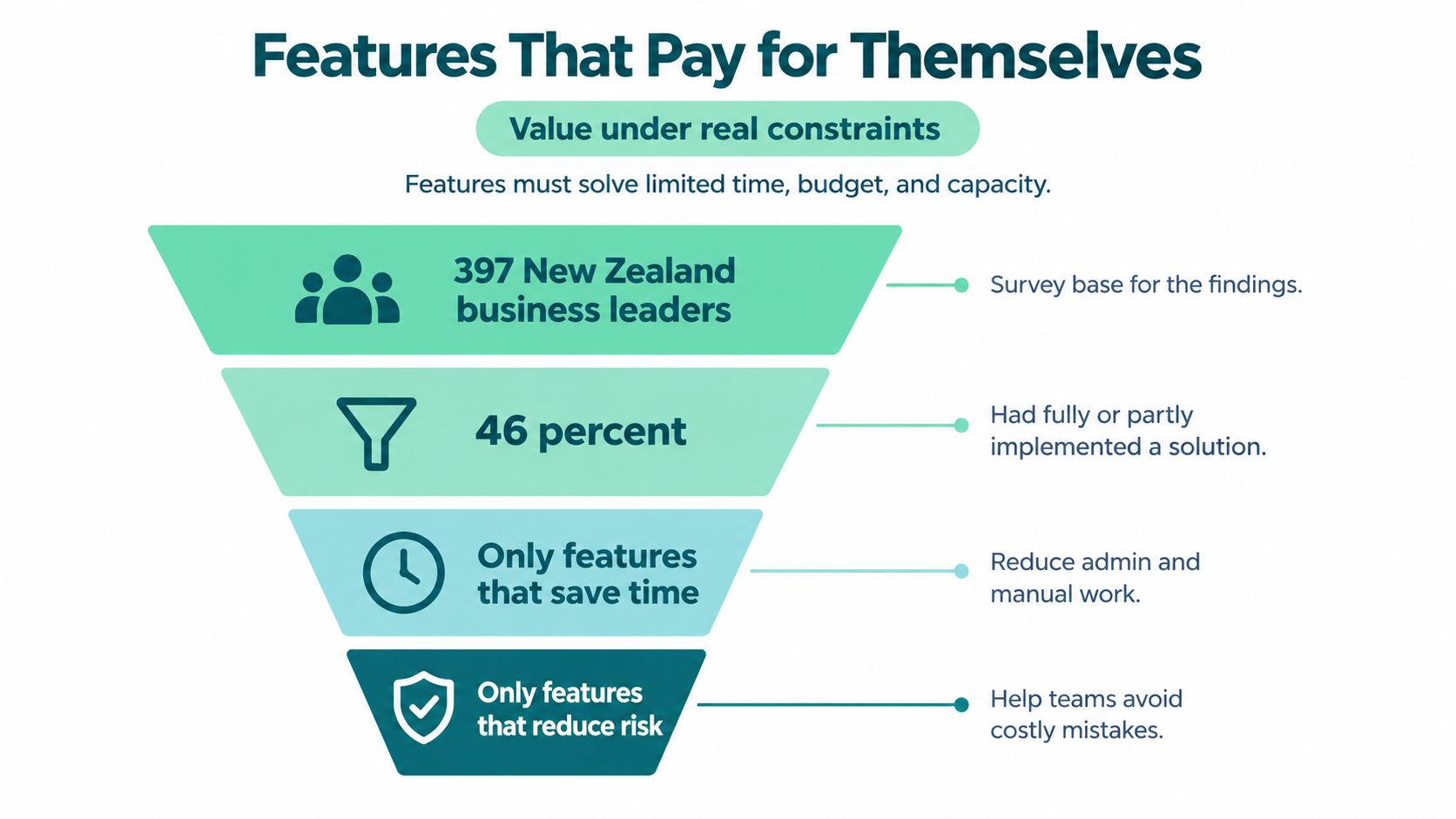
Do not buy a module because it looks complete. Buy the piece that hits a named constraint.
Here is a defence a founder can give without a finance team. Count fewer repeat support requests, faster process compliance, and fewer security mistakes. Weigh that against licence cost and the hours an admin spends chasing updates. If the tool adds more chasing than it removes, it fails, even if the feature list is long.
Cyber behaviour belongs in that sum. A missed acknowledgement or a shared login is a change failure, not only an IT ticket. Keep the emotional story light. People resist when the new path is unclear or when they think the job is at risk. The software should surface that early, through a short pulse, not after a resignation.
Sometimes you should not buy. A shared sheet, an intranet page, or the project tool you already pay for can carry a tiny, low-risk change. Extra software fails when staff must update yet another system and then stop. That is not a philosophy. It is Tuesday.
The bar rises the moment a change can touch someone's job. Employment New Zealand's workplace change process expects a proposal to state the changes, the reasons, how and when implementation will occur, the consultation and feedback process, and any assessment or selection criteria. During implementation, consultation may also cover selection for new or different roles and alternatives to redundancy. Miss one of those and a well-meant rollout can become a process dispute.
Turn that list into gates, not a vibe.
Run the commercial checks in the same pass. You want an audit trail, sign-in that matches your identity system, a link to the tools people already live in, a clear story on employee privacy, and admin effort a small team can carry. Pricing should stay fair as headcount grows. A quote that only makes sense at 500 seats is a no.
If you are also picking a content system for the staff-facing pages, a separate enterprise CMS buyer's guide for 2026 is a useful cross-check on publishing, permissions, and who can edit the message. Do not mash that decision into the change record and hope.
| Need | Sheet or intranet | Existing project tool | Dedicated software |
|---|---|---|---|
| Tiny, low-risk tweak | Enough if one owner updates it | Fine, often heavier than you need | Usually extra noise |
| Who was consulted, and when | Easy to lose versions | Tasks, weak on feedback history | Strong if fields are fixed |
| Job impact or role selection | Risky, too easy to edit over | Weak gates | Worth it for the audit trail |
| Repeated use, not a login | You will build this by hand | Possible with custom fields | Built for the funnel |
| Two suppliers plus a founder | Breaks once holidays hit | Works if you already live there | Helps when owners scatter |
Your agile project management board can still run the build. It should not pretend to be the consultation file. Pick the lightest stack that still leaves a record you could show a staff member, a lawyer, or your future self.
Public-sector programmes make a poor costume for a startup, but they are a good teacher on time. The New Zealand Government's 2026 Digital Reset Plan describes Inland Revenue's transformation at a scale a founder can feel. The plan reports 99% of transactions now running digitally, administrative savings of about NZ$500 million, and a wider revenue-system overhaul it values at about NZ$1.5 billion. Even taken as the plan's own account, the lesson is the staging.

Read past the dollar figures. Releases were sequenced over years. Delivery stayed tied to customers, and the change effort was measured against how people used the system, not whether a build shipped. A go-live date was a waypoint in the plan, never the finish.
The same plan carries a longer sting. Payments, data exchange, and digital identity appear as foundations dating to 2013, and the reset itself notes they were still unfinished when it was written. Call it a gap of roughly 13 years on the plan's own telling. Credit the honesty. Large change slips when ownership, sequencing, and day-to-day use get treated as extras.
Your 10-to-50-person SaaS will never run a billion-dollar programme, so steal the staging rather than the scale. Ship a change the way you would shift stock between two shops: a labelled load at a time, old shelf standing until the new one holds. Let the people affected respond before the date is locked, and keep the record somewhere it survives a supplier switch and a founder on leave.
Long change runs on owners, stages, and proof. A bigger launch email runs on hope.
Even a one-flag release needs the same muscle. The next change lands before the last one has bedded in, and teams that only celebrate go-live keep paying for the same confusion twice.
Comparison guides are written for transformation offices. Yours does not exist, and that's normal. QBE's 2025 Click, Breach, Repeat report found that 51% of New Zealand respondents name a lack of capabilities and resources as the greatest barrier to adapting at the required speed, while only 2% say their organisation is leading in redesigning how people and AI work together. That is the market you're buying in. Short on spare people, stretched on time. Buy for that team, not the one on the vendor's slide.
For a 10 to 50 person company, five things earn their keep. Everything else is demo fodder.
Judge setup in hours. If an admin needs a week of configuration before a 12-person team can log a change, walk away. Ask where employee comments sit, who can export them, and how long you keep them. Privacy is part of the product, especially when feedback touches job worry.
Communication should fit the room. A note that reads like a US enterprise memo will get ignored in a Christchurch or Melbourne standup. Plain language, local examples, and a channel for people who will never raise a hand in the all-hands. That's how risk reaches you early, while it's still cheap to fix.
Price by headcount. A tool that's cheap at 15 people and painful at 40 is a trap. Skip the catalogue Freshservice, Jira Service Management, or a heavy ITSM suite sells to an IT desk. The five items above and an audit trail you trust are the buy.
Before you book three demos, check who sells into this region. NZ Apps is an independent directory covering New Zealand and Australia vendors and the categories they work in. Use it to see who serves this market, then talk to two of them. A global brand with no local admin story will burn the hours you don't have.
Pick one live change. Not the whole roadmap. Name the affected team. Write five lines and stop.
If that record already lives in a sheet and the change is small, keep it there. Moving it for the sake of a logo is how tools become shelfware. If owners, approvals, or adoption signals are getting lost, shortlist two tools. Ask each vendor how a small NZ team would run those exact five lines. If they pivot to a feature tour, you have your answer.
Check regional vendors and category context before the calls, then book one demo against the five lines. Bring a real change, even a messy one. A polished sample workflow will flatter any product.
A fair process and a used workflow both have to be visible later, when someone asks what changed and who was heard. If you cannot show both, you do not have a change. You have an announcement.
NZ Apps keeps an independent directory of app and tech companies across New Zealand and Australia, including the tools founders use to run adoption, training, and team process. If you are shortlisting change management software for a small team, start with the regional vendors and category notes before you sit through a generic demo. Visit NZ Apps and see who serves this market.
Add your NZ or Australian app or tech company to the NZ Apps directory and get discovered by founders and operators across the region.
Get ListedReach tech decision-makers across New Zealand and Australia. Sponsored and dofollow editorial links, permanent featured listings, and sponsored articles on a DA30+ .co.nz domain.
See Options