
Ask around and the advice lands fast. Use a SAFE. One document, no interest, no maturity date, and half the startup world has already signed one. Simple.
Simple to sign, though, isn't the same as simple to live with. A SAFE is a United States contract form, drafted around US corporate law and US tax rules. Put it in front of a New Zealand company with a local constitution, local investors and Inland Revenue looking over your shoulder, and some of that simplicity leaks out of the seams. The convertible note, the dull debt instrument everyone keeps trying to retire, carries one feature the SAFE can't match: a deadline. Deadlines change how founders behave.
So this isn't another piece crowning the SAFE. It's a walk through what each instrument does to your balance sheet, your cap table and your tax position in New Zealand, starting with the question most comparisons glide past. What happens if the next round never happens?
A convertible note is a loan that promises to turn into shares later. A SAFE is a promise of shares that was never meant to be a loan. That's the whole argument in two sentences, and nearly every practical difference falls out of it.
| Feature | Convertible note | SAFE | What it means in NZ |
|---|---|---|---|
| Legal nature | Debt that converts into shares | Contractual right to future shares | A note sits on the balance sheet as a liability |
| Interest | Usually accrues, for example 5% a year | None | Interest must be modelled and tax-checked |
| Maturity date | Commonly 18 to 24 months in NZ practice | None | A note creates a repayment deadline if no round closes |
| Ranking in insolvency | Generally ahead of shareholders | Less settled, with limited local precedent | Investor protection differs in a failure |
| Local familiarity | Historically more common in NZ rounds | Less common outside accelerator deals | Check what your lead investor expects |
Read the interest and maturity rows first, because that's where the money sits. A note nearly always accrues interest on top of the principal, and New Zealand practice has commonly set repayment at 18 to 24 months after issue, according to startup law firm Kindrik. A SAFE normally carries neither an interest rate nor a fixed repayment date.
Familiarity is where the local picture gets interesting. Kindrik reported that convertible notes made up about 30% of the New Zealand funding rounds it helped complete in 2018, a trend the firm said continued into 2019, and that SAFEs were less common outside accelerator programmes than convertible instruments with interest and a repayment date. That reflects a real structural preference, not just habit.
The mood has moved since. In Q3 2025, 42.3% of New Zealand angel investment came through convertible instruments, including convertible notes and SAFE agreements, against 7.8% in 2024, according to figures published by Catalist and the Angel Association New Zealand.
One quarter is a snapshot, not a trend line. Ask which instrument your lead investor has actually used before, and let that answer drive the choice more than any global default.
The table simplifies, deliberately. The signed terms decide.
Here's the question founders skip. What if the priced round doesn't close? Not in a disaster scenario, just in the ordinary way that fundraising drifts six months, then twelve.
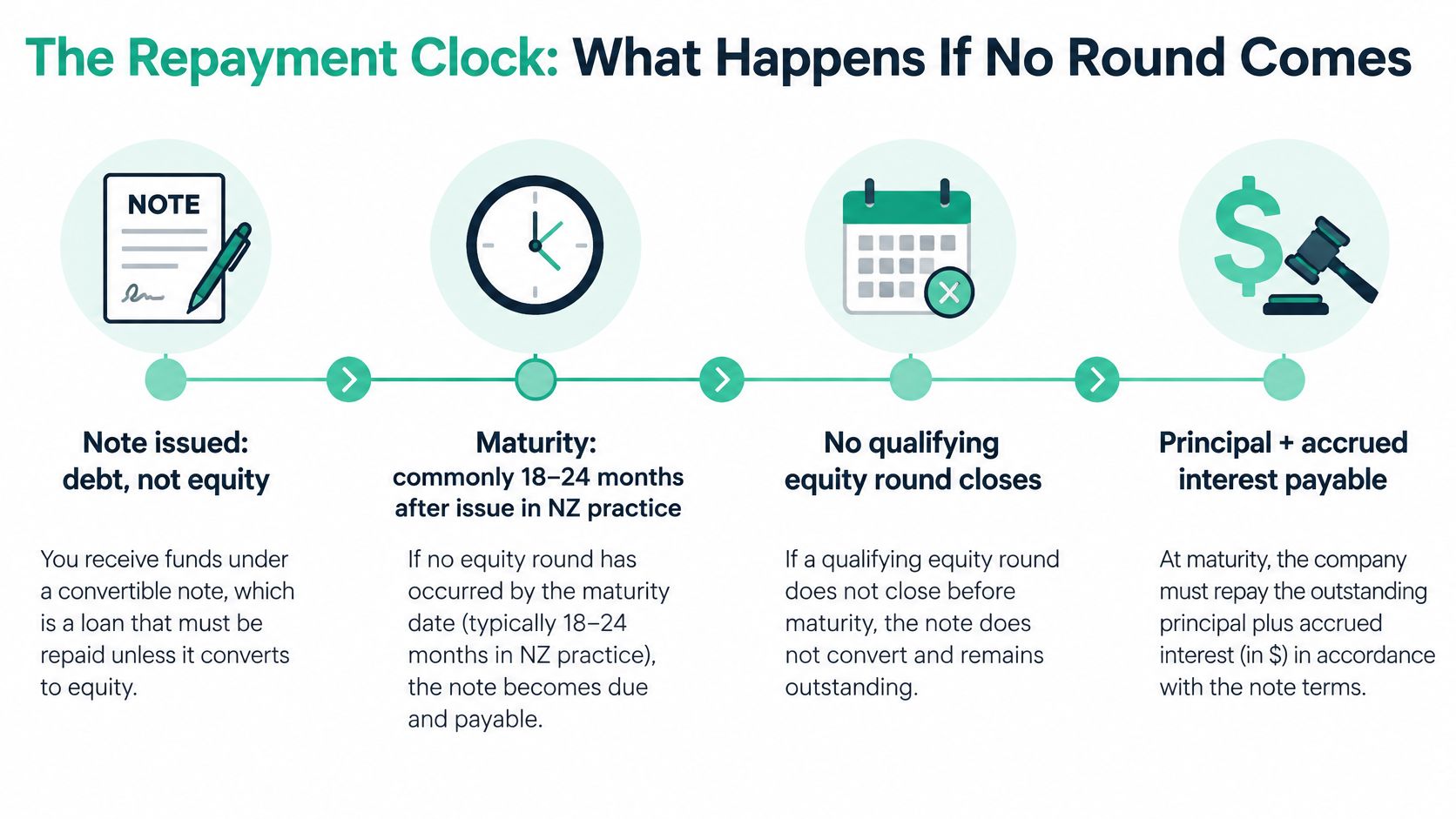
That timeline is the answer. A convertible note is debt. It generally accrues interest, it has a maturity date, and it can become repayable if no qualifying equity round happens, with New Zealand market practice commonly using an 18 to 24 month repayment period, as What Founders Want's startup legal guide sets out. A SAFE is a contractual right to future shares, with no interest, no maturity date and no ordinary repayment obligation.
Run the arithmetic on a small round and the clock gets loud.
| Time since issue | Accrued interest | What to note |
|---|---|---|
| 6 months | NZ$2,500 | Interest still accruing |
| 12 months | NZ$5,000 | Year-one cash check |
| 18 months | NZ$7,500 | Typical NZ maturity point |
| 24 months | NZ$10,000 | Upper end of the NZ range |
A founder who signed a NZ$100,000 note at 5% simple interest now owes NZ$107,500 at the 18-month mark, payable in cash if the round hasn't landed. That's a number worth putting in a calendar with a reminder three months earlier.
Notes normally give investors creditor status, so they rank ahead of shareholders if the company fails. SAFE treatment is far less settled here, with limited local legal precedent and genuine uncertainty about where a SAFE holder stands in a failure, per the same startup legal guide on first capital raises.
Practical rule: if you take the note, stress-test the cash repayment at the maturity date, then start negotiating an extension before the deadline, not after it.
One caution against over-reading the 18 to 24 month figure. Not every note behaves like short-term bridge finance. A published Inland Revenue determination describes an arrangement where the issuer could choose whether to pay interest each quarter at 250 basis points over the bank-bill rate, unpaid interest didn't accumulate, and principal fell due on a final repayment date set 9 years and 360 days after issue. Read the maturity clause on the document in front of you, not the one in the blog post.
Two pricing mechanisms do the work. A valuation cap sets a ceiling on the price your investor pays. A discount gives them a percentage off whatever the next round's share price turns out to be. When both appear in the same document, the lower effective price wins.
Work one example to the end so the mechanics stop being abstract. Say you raise NZ$100,000 and the next round prices at a NZ$10 million pre-money valuation.
| Terms | Price that applies | Effective valuation | Investor ownership |
|---|---|---|---|
| NZ$5m cap, 20% discount | Cap (lower price wins) | NZ$5m | 2.00% |
| NZ$5m cap, no discount | Cap | NZ$5m | 2.00% |
| No cap, 20% discount | Discount | NZ$8m | 1.25% |
| No cap, no discount | Full round price | NZ$10m | 1.00% |
A NZ$5 million cap against a NZ$10 million round means the investor buys at half the new price, so NZ$100,000 converts into 2.00% of the company. A 20% discount alone would buy at 80% of the price, an effective NZ$8 million valuation, and 1.25%. The cap wins because it's the better deal for them. It always wins when the cap sits below the discounted price.
Notes convert principal and interest, which is the detail founders forget between term sheet and closing. Eighteen months at 5% turns NZ$100,000 into NZ$107,500, and at the same NZ$5 million cap that's about 2.15% rather than 2.00%.
Small? Sure. Now multiply it across a round with several notes, all converting at once, all pulling shares from the same pool.
These figures ignore the option pool, other converting instruments and any pro rata participation, and those three factors often move the answer more than the cap does. Before signing, get a dilution table from your counsel or accountant covering three plausible next-round prices: a down round, a flat round and a strong one. If you're still deciding where your pre-money sits, the company valuation methods breakdown is the right place to start that argument.
Which version of the SAFE did you sign? That single question decides more than the cap does, and it rarely gets asked.
A post-money SAFE fixes the investor's slice of the company's capitalisation immediately before the priced round, and that capitalisation counts the other SAFEs. Their percentage is locked from the day they sign. Later SAFEs dilute the founders, not the first investor.
A pre-money SAFE is calculated before the other SAFEs and before the employee share pool. Each new SAFE shrinks the earlier investor's percentage, which sounds founder-friendly until you're managing a queue of annoyed angels who did the maths themselves.
Practical rule: if you expect to close several SAFEs over a year, model the whole stack before the first signature. A cap table built after the fact is an apology, not a plan.
Two clauses sit outside the headline cap and discount, and both cost real ownership.
Read the side letter as closely as the SAFE itself. Neither clause appears in the cap.
Here's where a SAFE is kinder. It doesn't come due. No lender calls, no repayment date, no refinancing cliff. If the next round never happens, it sits on your cap table as an outstanding promise, waiting for a priced round or an exit.
That's relief for a pre-revenue SaaS company whose timing is unpredictable. It's also open-ended dilution nobody ever resolved. Both things are true at once.
A US SAFE was never written against the Income Tax Act, so the template will not tell you when New Zealand stops treating the money as debt.

New Zealand can tax a convertible note as equity. Under the Income Tax Act text, the amount raised on certain convertible notes issued on or after 11 June 1971 is deemed to be share capital, the holder is treated as a shareholder, and the company cannot deduct interest or related borrowing costs. That issue-date rule is one condition. A separate condition sits in the terms: the note must require conversion into shares, or redemption or repayment by an issue of shares, on the timetable set by the instrument. Satisfying the 1971 date does not, by itself, satisfy the conversion condition.
The timetable is where long builds get caught. Hardware that needs seven years, or a round that keeps slipping, can run past a conversion date written for a faster raise. If that date arrives and no priced round has closed, the tax character of money already in the company follows those terms, not the word "note" on the cover.
Enterprise Angels' investor tax guidance explains that smaller investors who are cash basis persons are generally taxed on convertible note interest when it is physically received, while larger investors may be taxed on an accrual basis.
A SAFE pays no interest, so those receipt and accrual rules never start. What happens on a later share issue is a separate question, and it turns on the drafting, the investor's status and how the arrangement is characterised. If the next round never comes, a US SAFE has still not paid interest and has still not issued shares, so the promise sits outside both the note rules and a completed share issue.
The Companies Act 1993 framework explained by Sprintlaw governs share issues, director approvals and the company's authority to issue shares when a convertible instrument converts. Fundraising may also fall within the Financial Markets Conduct Act 2013, depending on the investors, the offer structure and any available exclusion.
Before conversion, a note can give the investor a repayment claim at maturity and priority over shareholders in an insolvency. A SAFE is generally not debt, so it does not ordinarily create that claim or that ranking. The simpler document still leaves work undone: dilution that never crystallises, and an obligation the Companies Act has not yet turned into shares.
No single winner. The right answer tracks your investor, your timeline and how much paperwork friction your round can absorb.
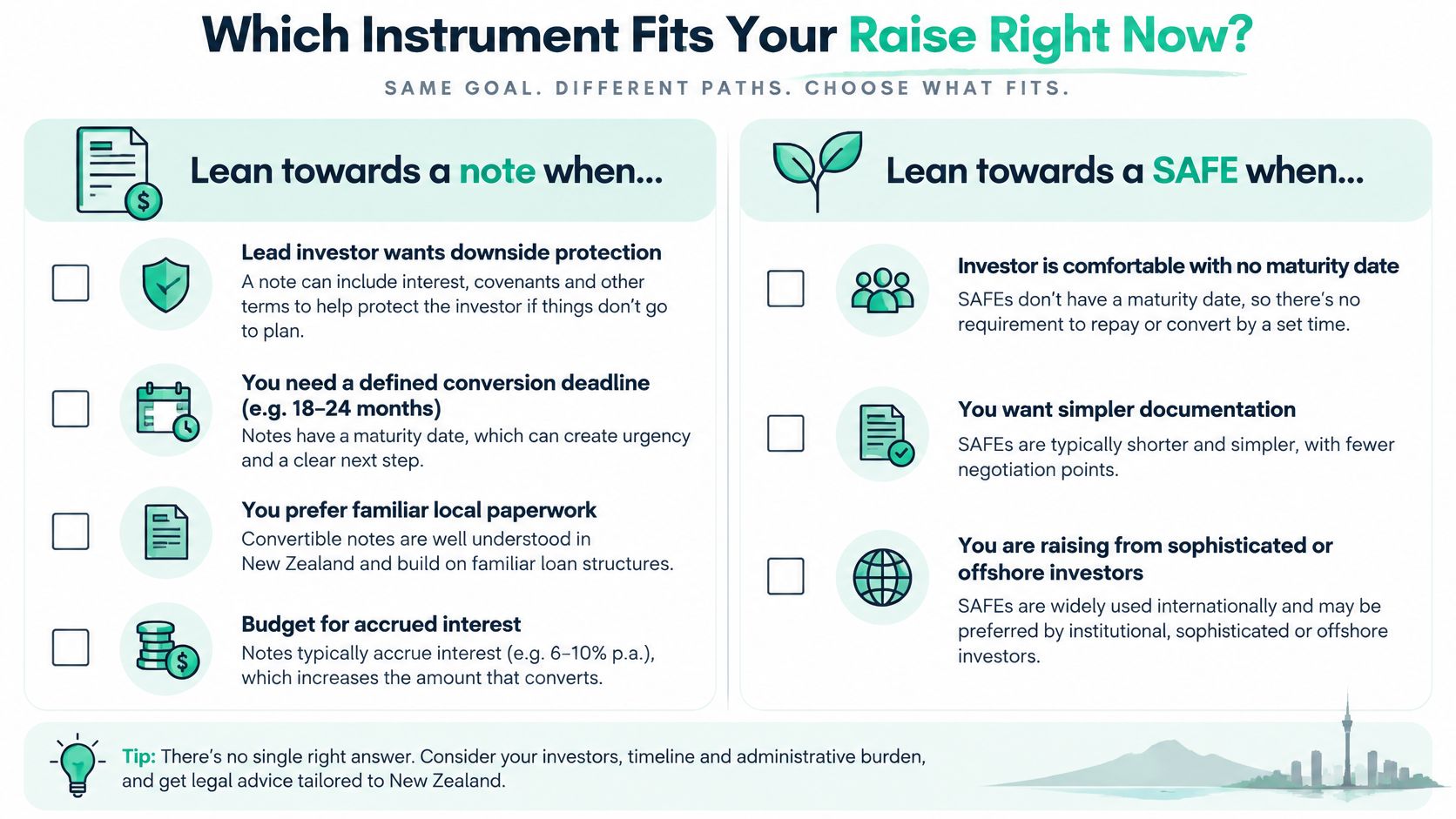
The local market is small enough that relationships decide deals. The FY25 NZ Angel Market Report recorded NZD 15.06 million invested across 125 deals and 74 businesses, and its dataset explicitly includes debt securities such as notes and other convertible products. That's a market where the lead investor's comfort level is a genuine technical factor, not a soft one.
| Situation | Lean towards | Why |
|---|---|---|
| Lead investor wants downside protection | Convertible note | Creditor-style ranking and a defined conversion deadline |
| Pre-revenue, uncertain raise timing | SAFE | No maturity date, so no repayment cliff |
| Accelerator-backed round using standard template | SAFE | Investors already know the document |
| Local investors expect familiar debt paperwork | Convertible note | Avoids friction with local expectations |
| Overseas SAFE template for an NZ company | Neither until reviewed | Needs NZ legal and tax drafting first |
Now the contrarian bit. A simpler SAFE can add uncertainty rather than remove it, because local investors, the company constitution, a shareholder agreement or a future institutional investor may all expect familiar debt or equity documentation. The document that felt easy in week one becomes the negotiation stall in week nine.
Cross-border raises sharpen the point. A US-designed SAFE used by an NZ company needs local review of investor rights, dissolution and repayment scenarios, conversion triggers, foreign-investor participation, and whether the words on the page match the deal you shook hands on. Security law compliance doesn't evaporate because the form came from a well-known accelerator either. If you're still mapping the raise itself, start with this guide to seed funding in New Zealand before you start choosing documents.
Practical rule: when an offshore template and a local investor's expectations disagree, the investor wins. Draft for the person writing the cheque.
Five steps, each tied to the ground already covered.
A useful extra pair of eyes sits in LegesGPT's AI contract review, which is handy for flagging clauses you skimmed at 11pm before a signature. It won't replace NZ counsel on tax characterisation, and it shouldn't. Run the startup due diligence checklist alongside it so the cap table, the instrument terms and the conversion maths all get reviewed together.
The cheapest mistake is the one caught before signing. One more conversation with counsel costs a fraction of a repayment deadline nobody planned for.
The convertible note vs SAFE decision comes down to documents, timing and tax, and NZ Apps publishes startup funding guides and due diligence resources that cover those exact questions, alongside a directory of app and tech companies across New Zealand and Australia. If you're raising now and want your instrument, cap table and disclosures reviewed in the right order, work through the resources at NZ Apps before the term sheet goes out.
Add your NZ or Australian app or tech company to the NZ Apps directory and get discovered by founders and operators across the region.
Get ListedReach tech decision-makers across New Zealand and Australia. Sponsored and dofollow editorial links, permanent featured listings, and sponsored articles on a DA30+ .co.nz domain.
See Options