
Let's be real, "digital marketing" is one of those phrases that gets tossed around like a rugby ball. But what does it actually mean for a business right here in Aotearoa? It’s time to cut through the noise. Honestly, digital marketing in NZ is just every single way you connect with your customers online—from your website and what pops up in Google, to your social media feed and the emails you send.
Think of it like this: your business, whether it's a funky café in Wellington or a farm deep in the Waikato, needs an engine. An engine to find new customers and keep your regulars coming back for more. Well, that's what digital marketing is. It’s about showing up and being helpful in the exact moments people are looking for what you offer, right there on their phones or laptops.
It's so much more than having a website that just sits there gathering digital dust bunnies. A great strategy is alive; it listens to what your audience is talking about and answers in a way that feels like it's coming from a real person, not a robot.
It’s easy to just assume everyone's online, but the numbers? They're pretty eye-opening. With pretty much everyone having internet access, the game has totally changed. DataReportal showed that in early 2024, internet use in New Zealand hit 95.7%. That means about 4.9 million Kiwis are online. You know what that is? A massive, reachable audience for any business, big or small. You can learn more about the digital economy in New Zealand from the International Trade Administration.
This isn't just some passing trend; it's the new normal. Your customers expect to find you with a quick search, check out your reviews on Google Maps, and maybe even see what you're up to on Instagram. If you're not there, are you even an option? It sounds a bit harsh, doesn't it? But it's the reality of how people shop and make choices now.

Here’s the thing—you can't just snatch a marketing strategy that works in the US or the UK and expect it to fly here. The New Zealand market is its own beast. We have our own unique sense of humour, our own way of talking, and a very sharp radar for anyone who isn't being straight up with us.
A successful digital marketing NZ strategy feels like it was made for Kiwis, by Kiwis. It gets the culture, respects the local vibe, and speaks a language that connects on a personal level, not a corporate one.
Effective marketing in Aotearoa needs a few key ingredients:
This guide is designed to give you a clear, no-fluff picture of all the moving parts. We’ll break down exactly what works here, so you can build an online presence that actually helps your business grow.
So, you get what digital marketing is, but what about the 'how'? It’s easy to feel a bit overwhelmed. The best way to think about it isn't as one giant, scary thing, but as a toolbox filled with different, specialised tools. Each one does a specific job, and knowing which one to pick for the task at hand is half the battle.
Let's pop the lid on this toolbox and take a peek at the essentials every Kiwi business should get familiar with.
Let's begin with the big one everyone talks about—Search Engine Optimisation, or SEO for short.
Honestly, SEO is just a fancy way of saying "making your website easy for Google to find and like."
When someone in Dunedin types "emergency plumber" into their phone, you want to be the business that pops up first, right? That’s what good SEO does. It’s not about trying to trick the system; it’s about making your website genuinely helpful and trustworthy.
This means using the right words your customers are searching for, making sure your site is fast and easy to use on a mobile phone, and creating useful content that actually answers their questions. It’s definitely a long game, but the reward is huge because you’re attracting people who are actively looking for what you offer. A huge part of that is figuring out what people are actually typing into that search bar. Our keyword research NZ guide can give you a head start on that.
If SEO is the slow-and-steady marathon, then Pay-Per-Click (PPC) advertising is the sprint. You know those sponsored results you see at the very top of a Google search page? That’s PPC in action.
You're pretty much paying to jump the queue. The beauty of it is that you only pay when someone actually clicks on your ad, making it a fantastic way to get immediate traffic and leads. This is especially handy for a new business, a special promotion, or anytime you need results, like, yesterday. The trick is to be smart about your targeting and budget, otherwise it can get pricey, fast.
Of course, marketing isn't just about search engines. It's about building a community and talking directly with your customers. That’s where social media and email really come into their own.
To do this well, you'll want to check out the different email marketing tools for small business available to help automate and manage your campaigns.
But what holds all of this together? Content Marketing. It’s the glue. The blog posts you write for SEO, the videos you share on social media, the newsletters you send via email—that’s all content.
Good content positions you as an expert in your field, builds trust with your audience, and gives people a compelling reason to choose you over the competition. It’s the difference between a website that just lists services and one that actually helps people solve their problems.
That, right there, is how you win customers for life.
To make things a bit clearer, here's a quick breakdown of how these channels fit into the picture for a local business.
| Channel | What It Is (In Plain English) | Why It Matters for a Kiwi Business |
|---|---|---|
| SEO | Making your website show up higher on Google when people search for what you do. | Attracts customers who are actively looking for your services or products right now. |
| PPC | Paying to have your ad appear at the top of search results or on other websites. | Gets you instant visibility and traffic, perfect for promotions or new launches. |
| Social Media | Using platforms like Facebook, Instagram, or LinkedIn to connect with your community. | Builds brand personality, trust, and a loyal following by showing the human side of your business. |
| Email Marketing | Sending newsletters, offers, and updates directly to people who've signed up. | A direct, personal line to your most engaged customers to encourage repeat business. |
| Content Marketing | Creating and sharing helpful articles, videos, or guides related to your business. | Positions you as a trusted expert and gives people a reason to visit your site. |
Each of these tools has its place, and the most successful marketing strategies often use a combination of them to get the job done right.
Here’s the thing: a marketing campaign that works wonders in London might fall completely flat in Lyttelton. New Zealand has its own distinct culture, its own rhythm, and your digital marketing needs to reflect that. You can’t just copy and paste a strategy from overseas; you need to understand the unique flavour of how we connect, communicate, and make decisions right here in Aotearoa.
This is where the idea of digital marketing in NZ gets really interesting. It’s less about chasing global trends and more about mastering local nuances. It’s knowing that a bit of self-deprecating humour often lands better than a polished, corporate humblebrag.
Let's get practical for a second and talk about Local SEO. This isn't just jargon; it's the art of showing up when a potential customer is physically near you and searching for what you offer. Think about it. When someone in Napier searches for "best flat white near me," they aren't looking for a café in Auckland. They want a great coffee, right now.
Showing up prominently on Google Maps with great reviews, accurate opening hours, and a local phone number is an absolute game-changer. It’s vital for businesses like:
This is your digital storefront, and for many Kiwi businesses, it’s even more important than their website's homepage. It’s the first impression that turns a search into a walk-in customer. Getting this right is a fundamental first step for many small businesses in New Zealand looking to grow.
Beyond the technical side, there’s the cultural side of things. Honestly, Kiwis have a finely tuned radar for inauthentic, corporate-speak. We can spot it a mile away. Your marketing voice has to feel real, approachable, and trustworthy.
It's all about genuine connection. Sounding less like a faceless corporation and more like a local business that truly 'gets it' is the secret sauce. This means embracing a tone that’s confident but not arrogant, and friendly without being fake.
This authenticity extends to how we engage online. The latest data shows that 79.1% of Kiwis are active on social media, spending an average of 2 hours and 3 minutes there every single day. That's a massive opportunity to connect, but only if you do it right.
Of course, being a good local business also means playing by the rules. It’s important to have a basic grasp of the legal stuff that governs commerce and communication here. You don’t need to be a lawyer, but you should be aware of a couple of key things.
The Commerce Act is in place to ensure fair competition, while the Privacy Act dictates how you can collect, use, and store your customers' personal information. This is especially important for things like email marketing—you absolutely need consent. Being transparent and respectful with customer data isn’t just a legal requirement; it’s a massive trust signal. Breaking that trust is a quick way to damage your reputation, something that’s very hard to rebuild in our tight-knit communities.
Alright, let's get to the question on every business owner's mind: cash. How much should you actually be spending on digital marketing in NZ, and what kind of return can you realistically expect?
It's a conversation that can quickly get bogged down in vague advice, so let's cut straight to it. There's no single magic number that fits every business, but there are definitely smart ways to figure out a budget that works for you. Think of it less as a cost and more as an investment in your business’s future growth.
The amount you put in naturally depends on what you want to get out. Are you a new Christchurch startup trying to make a name for yourself, or an established Auckland company defending your turf from competitors? Each goal needs a different amount of fuel in the tank.
Let’s be real for a moment. The price tags on different digital marketing channels can vary wildly. Firing up a Google Ads campaign is a completely different financial ball game to hiring a social media manager or playing the long game with search engine optimisation.
Here’s a rough feel for what you might be looking at:
The most important thing is just to start somewhere. You don't need a massive budget to make a difference, but you absolutely need a clear plan for every single dollar.
So, you’ve spent some cash. What now? How can you tell if it’s actually moving the needle? This is the exact point where many businesses get lost. They pour money into marketing but have no real clue if it’s leading to anything tangible.
This is where we talk about ROI, or Return on Investment. It’s a simple idea: for every dollar you put into marketing, are you getting more than a dollar back? If you spend $1,000 on ads and that brings in $5,000 of new business, your ROI is looking very healthy indeed.
The most dangerous thing in marketing is spending money without knowing what success looks like. You might as well just be guessing. Measuring your efforts is what separates professional marketing from a hobby.
A massive part of your strategy has to be understanding how to measure marketing effectiveness to make sure your budget isn't just disappearing into a black hole. It’s not about feeling busy; it’s about seeing real, measurable results.
You don't need a PhD in data science to figure out if your marketing is working. Just start with the basics. Tools like Google Analytics 4 (GA4) are completely free and incredibly powerful for seeing what people are doing on your website.
Here are a few simple numbers to keep an eye on:
By tracking these simple metrics, you start to draw a clear line between your marketing spend and actual business results. It takes the guesswork out of the equation and turns your marketing from a hopeful expense into a predictable engine for growing your Kiwi business.
So, you’re on board with the 'what' and the 'why' of digital marketing in New Zealand. Now comes the big one, the question that probably keeps you up at night: who is actually going to do all this? It’s a classic crossroads for Kiwi business owners.
Do you roll up your sleeves and go the DIY route? Maybe hire someone to join your team full-time? Or perhaps you bring in the experts and partner with a digital marketing agency?
Honestly, there's no single right answer here. What works for a café in Queenstown might be a terrible fit for a software company in Auckland. It all comes down to a tricky balance of three things: your time, your money, and your ambition.
Let's break down the real pros and cons of each path.
Going it alone is tempting, isn’t it? The biggest draw is obvious: it’s the cheapest option, at least on paper. You’re not paying salaries or agency retainers.
With brilliant tools like Canva for design or Mailchimp for emails, you can actually get a surprising amount done yourself.
But here’s the thing—while it saves you money, the DIY route will cost you something equally precious: time. A lot of it. One minute you’re trying to run your business, the next you’re three hours deep in a YouTube tutorial trying to figure out Google Analytics. It’s a steep learning curve.
The DIY approach is fantastic for getting started and understanding the basics. But it’s a bit like deciding to build your own house extension—sure, you can learn how, but at some point, calling in a professional builder is just faster and gets a better result.
This path is best for brand-new businesses with more time than money, or for those who genuinely enjoy the marketing side of things and are ready to learn.
This decision tree gives a simple view of how budget often guides the choice between a DIY approach and hiring an agency.
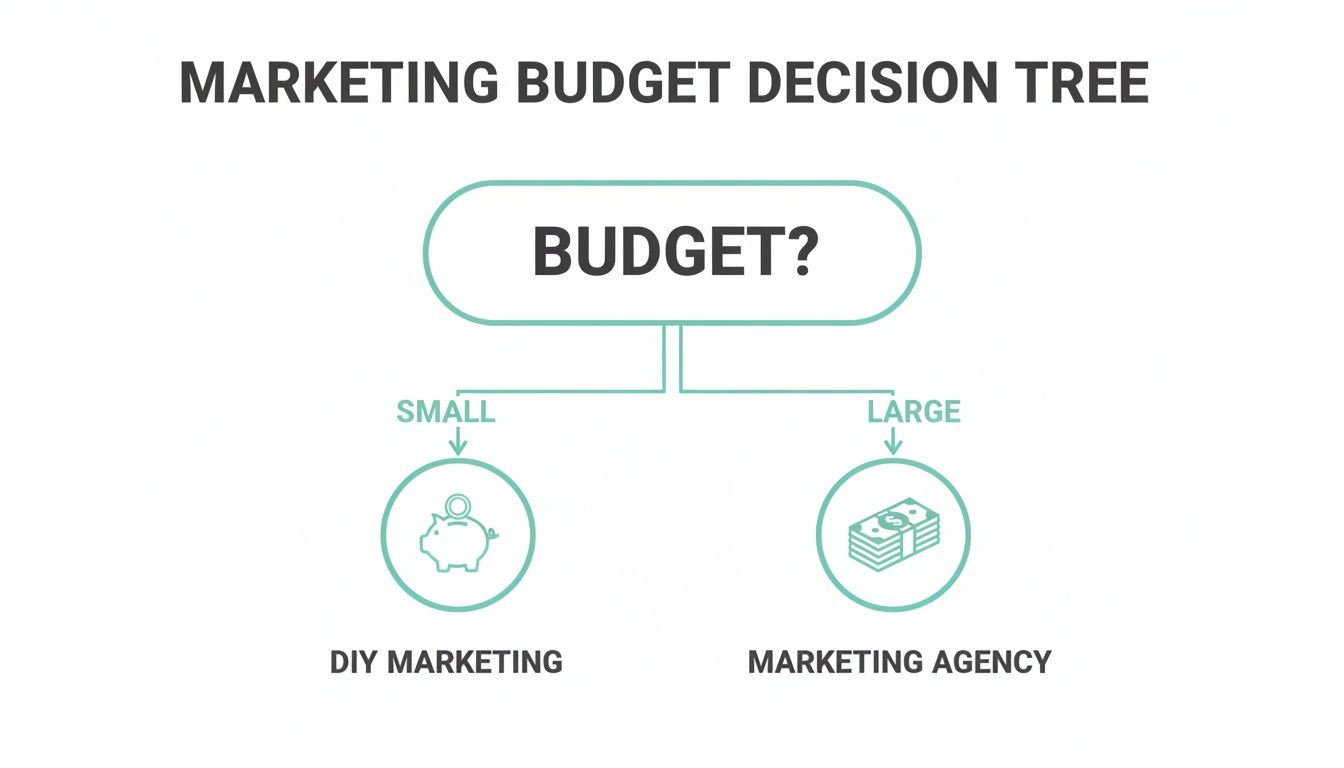
As the infographic shows, smaller budgets often lead business owners to the DIY path, while larger budgets open up the possibility of an agency partnership.
The next logical step for many growing businesses is to hire someone. Bringing a digital marketer onto your team means you have a dedicated resource who lives and breathes your brand every single day. They get to know your business inside and out.
This is a great move when you have a consistent need for marketing support but aren't quite ready for a full-blown agency. An in-house person can become a true champion for your brand.
The flip side? It’s a significant commitment. You're not just paying a salary; you’re also covering Kiwisaver, ACC levies, and providing equipment. Plus, you need to manage them and ensure they have the resources and training to stay current—because the digital world changes fast.
Then there's the agency option. This is where you bring in a whole team of specialists—an SEO expert, a content writer, a PPC manager—for what's often less than the cost of one senior in-house employee.
You’re tapping into a deep well of experience from people who do this all day, every day. A good agency partner will act as an extension of your team. The right agency will ask you about your business goals, like increasing profit margins or breaking into the Christchurch market, not just vanity metrics like clicks and impressions.
But how do you spot a good one? Here are a few pointers:
Watch out for red flags like "guaranteed #1 rankings on Google" (no one can promise that!) or a one-size-fits-all approach. Your business is unique, and your digital marketing NZ strategy should be too.
Making this choice is a big step, but getting it right can be the fuel that drives serious growth. To help you weigh it all up, here’s a quick comparison of the three main paths.
| Approach | Best For | Potential Pros | Potential Cons |
|---|---|---|---|
| DIY | Startups, sole traders, or businesses with very small budgets and a willingness to learn. | Lowest direct cost. Deep learning of your own business. Complete control. |
Extremely time-consuming. Steep learning curve. Easy to make costly mistakes. |
| In-House | Growing businesses that need consistent marketing but aren’t ready for an agency. | Deep brand and industry knowledge. Dedicated focus on your business. Quick turnaround times. |
High cost (salary + overheads). Risk of skills becoming outdated. Limited breadth of expertise in one person. |
| Agency | Businesses ready to scale, seeking expert strategy and a diverse skill set without hiring a full team. | Access to a team of specialists. Broad industry experience. Can be more cost-effective than a senior hire. |
Less day-to-day immersion in your business. Communication can be a challenge. Finding the right agency takes effort. |
Ultimately, the right choice hinges on your specific circumstances. What you need today might not be what you need in a year, so be prepared to reassess as your business evolves.
Right, let's get you moving. It's easy to feel a bit swamped by all the digital marketing talk. That's totally normal. This last part isn't about more theory; it's a practical, step-by-step list to help you build some real momentum for your business.
The goal here isn't perfection. It's just about taking that first important step. The biggest mistake you can make is doing nothing because you feel you have to do everything at once. So, let’s focus on a few simple, high-impact actions you can tick off this week.
Think of these as the absolute essentials. Getting these foundational pieces sorted will set you up for success later on, and they honestly don't take long. They're the digital equivalent of putting a sign on your shop door.
Here's the thing: If you try to talk to everyone, you end up connecting with no one. Knowing your customer is the foundation of all good marketing. It's the difference between shouting into the wind and having a meaningful conversation.
Once you’ve got those two things sorted, you’ve already made huge progress. Now, we can add a little more focus to your plan.
It’s incredibly tempting to sign up for Facebook, Instagram, TikTok, and LinkedIn all at once and start a blog on day one. Please don’t. You'll just burn yourself out. For a small business, effective digital marketing in NZ is all about focus.
This isn't about mastering the entire world of digital marketing overnight. It’s about building a solid base, one simple action at a time. You've got this.
Got a few questions still rattling around? You're not alone. Honestly, getting into digital marketing in NZ for the first time brings up a lot of "what ifs" and "how on earth does that actually work?" moments.
Let's tackle a few of the most common things we hear from Kiwi business owners.
This one really comes down to which tool you’re picking up. If you fire up a Google Ads campaign, you can see traffic and leads coming through almost instantly. It’s like turning on a tap.
But SEO is a long game, more like planting a Kauri tree than flicking a switch. It often takes a good 3 to 6 months to see any real, meaningful movement in search rankings, especially if you're up against some stiff competition. The goal isn't a quick win; it’s about consistent, steady effort that builds a valuable digital asset for your business over time.
The simplest answer is always the best one: go where your customers are. Don’t just jump on TikTok because it’s the new shiny thing; stop and ask if your ideal customer actually spends their time there.
For most Kiwi businesses with a fairly broad audience, Facebook and Instagram are still the heavy hitters. But if you’re a B2B company in Auckland or Christchurch trying to connect with other professionals, LinkedIn is almost certainly your best bet. The trick is to pick one or two platforms and do them really well, rather than spreading yourself thin and doing a half-hearted job everywhere.
While it’s not strictly mandatory, a blog is one of the most powerful tools you can have for your SEO. It’s the perfect spot to answer your customers' questions, show you know your stuff, and target a much wider range of keywords.
Think of it like this: a roofer in Christchurch could write articles on "common roof repair costs in Canterbury" or "the best roofing materials for NZ's weather." This kind of helpful content doesn't just attract people searching for answers—it builds trust and shows Google you're a local authority worth recommending.
Ready to build a digital presence that gets real results for your Kiwi business? At NZ Apps, we create bespoke websites and digital strategies that help you connect with your customers. Book a free consultation today to start the conversation.