
So, you want to get more productive. The secret isn't about working longer hours. It's about getting smarter by looking at three key areas: your people, processes, and technology. It's about setting clear goals, figuring out where your workflows get stuck, and using the right tools to handle all the repetitive stuff.
Let's be honest, 'improving productivity' is a phrase that gets tossed around a lot. But what does it actually mean for a Kiwi SME? Is it just some corporate jargon for squeezing more out of every minute?

Let's get one thing straight: real productivity is not about grinding your team into the dust. That's a surefire way to cause burnout, see good people leave, and create a place nobody wants to be on a Monday morning. Nobody wants that, right?
True business productivity is all about creating more value with less effort. It's the engine that drives sustainable growth. Picture it this way: you could paddle a leaky boat as hard as you can, or you could patch the holes and glide smoothly through the water. Which one gets you further?
This means finding smarter, more efficient ways to get work done so your team can focus on what actually makes a difference—the high-impact work that moves the business forward.
At its heart, productivity is about effectiveness, not just being busy. It's a measure of how well your resources—time, money, and people—are being used to hit your business goals.
For the many small businesses in New Zealand, getting this right is the key to not just surviving, but actually thriving. It’s how you build a resilient operation that can handle whatever comes its way.
If it’s so important, why isn't every business a productivity machine? Well, it's easier said than done. We all get stuck.
Here are a few common roadblocks we see all the time:
This guide is here to help you cut through all that noise. Before we even think about specific tools or fancy techniques, the very first step is to figure out what productivity actually looks like for you. It's about laying a solid foundation—creating a clear destination on your map—before you even start the engine.
Before you even start thinking about shiny new software or fancy tools, we need to roll up our sleeves. You can't fix what you can't see, and right now, your daily operations might feel like a bit of a black box. You know what I mean? What really happens between a customer placing an order and the money hitting your account?
Let's pull back the curtain. This part isn’t about dramatic overhauls; it's about honest, clear-eyed observation. It’s the groundwork that makes everything else we discuss actually stick.

Ever feel like you're tracking numbers that don’t really move the needle? Website visits are great, but do they lead to sales? Social media likes are nice, but they don't pay the bills. It's far too easy to get caught up in these "vanity metrics."
To genuinely improve your business's productivity, your goals have to be tied directly to the health of your company. These are your Key Performance Indicators (KPIs), and they need to be crystal clear.
Instead of chasing vague ideas like "more sales," let’s get specific. Think about things like:
These are goals you can actually measure and build a plan around. They give you a real target to aim for and tell you, in no uncertain terms, whether your changes are actually working.
Now for the part that might sound a bit tedious but, trust me, is an absolute game-changer. We're going to map your processes. Literally. Grab a whiteboard, some sticky notes, or even just a big sheet of paper.
Pick a core business function—let's use "fulfilling a customer order" as an example. Now, map out every single step from the moment the order comes in to the moment it's complete. Who does what? What information do they need? Where does it go next? Be brutally honest and incredibly detailed.
This simple exercise is where the magic happens. I guarantee you'll immediately start to see things you've never noticed before.
This isn't just an admin task; it's a discovery session. It’s where you’ll find the hidden friction, the unnecessary steps, and the tasks that are begging for a better way. This map is your treasure map to finding lost time and money.
Once you have your map, you can start asking the tough questions. Why does this file need to be approved by three different people? Why are we manually entering this data twice? Suddenly, the bottlenecks and repetitive tasks aren't just vague feelings—they're glaring problems on a chart.
To help you with this, here's a quick guide to spotting some common productivity killers as you map things out.
| Symptom | Potential Cause | What to Look For |
|---|---|---|
| Work Grinds to a Halt | Bottlenecks, over-reliance on one person | A single person or step in the process where tasks pile up. |
| Mistakes Keep Happening | Manual data entry, lack of validation | The same information being typed into multiple systems. |
| Simple Tasks Take Ages | Unnecessary steps, too many approvals | A process with endless sign-offs for low-risk decisions. |
| Staff Seem Frustrated | Repetitive, low-value work | Tasks that involve copying and pasting all day long. |
| Information is Hard to Find | Poor communication, siloed systems | Team members constantly asking where to find a file or a status update. |
Looking for these patterns will turn your process map from a simple diagram into a powerful diagnostic tool, pointing you directly to your biggest opportunities for improvement.
Here’s the thing: just buying technology isn’t the silver bullet. There’s a fascinating paradox in New Zealand business culture. A recent study found that while two-thirds of Kiwi business leaders admit the country has a productivity issue, a whopping three-quarters believe their own company is doing better than the competition. A bit of the old "she'll be right" attitude, perhaps?
Despite 77% planning tech investments, only a fraction are actually experimenting with things like AI. This disconnect highlights that the real challenge is often leadership and a willingness to truly redesign how work gets done—a perfect example of why process mapping is so crucial before you spend a cent. You can explore more insights on New Zealand's productivity challenges on auckland.ac.nz.
This foundational work—setting real goals and mapping what you do—gives you a clear starting point. It takes you from guessing to knowing, setting the stage for smart, effective changes. Without this step, you're just paddling in the dark.
Right, you’ve done the hard yards. You've mapped your processes, stared into the abyss of your daily workflows, and pinpointed exactly where things get messy. Now, we get to talk about the fun stuff—technology.
But hold on. This is not about chasing every shiny new app that pops up in your social media feed. That’s a fast track to a confusing tech stack and an empty bank account. This part is about being a savvy operator, choosing digital tools that are surgical solutions to the problems you've just uncovered.
For Kiwi businesses, this is a massive opportunity. It’s about more than just having a website; it’s about genuinely embedding digital tools into the fabric of your operations. The potential here is huge, and honestly, it’s what separates businesses that just chug along from those that really take off.
Before you rush out and buy a brand-new system, take a look at the tools you're already paying for. Are you really using them to their full potential? Your accounting software, your email platform, even your Microsoft 365 or Google Workspace subscription—these things have powerful features that most people never even touch.
You might find that a simple integration between two tools you already use can solve a major headache. For instance, connecting your email marketing platform to your customer database can automate follow-ups and save someone hours of manual work each week. It's about working smarter, not just buying more.
Okay, so sometimes you do need something new. Whether it's a project management tool like Asana or a customer relationship manager (CRM) to keep track of your sales pipeline, the options can feel endless. How do you choose?
Don’t just look at features. Instead, ask these simple questions:
The best tool isn't the one with the most features; it's the one that gets adopted by your team and quietly solves a persistent, annoying problem without creating three new ones.
This focused approach stops you from getting distracted by bells and whistles you'll never use. It keeps the mission clear: improve business productivity where it matters most.
Making smart tech investments isn’t just a gut feeling; there’s solid evidence backing it up, especially for New Zealand SMEs. Research shows that accelerating the adoption of digital tools could boost our national GDP by a staggering NZD 8.6 billion.
The return on investment is incredibly compelling—for every dollar an SME puts into digital tools, they typically see a return of between NZD 2.40 and NZD 3.10. That's a powerful business case for moving beyond basic emails and websites. You can read more about the findings on slow digitalisation in NZ on Xero's website.
This data proves that investing in the right technology isn't just an expense; it’s one of the most effective levers you can pull for growth.
For most everyday problems, an existing "off-the-shelf" software solution is perfect. Tools like Xero for accounting or Monday.com for project management are popular for a reason—they work well for a wide range of businesses and are cost-effective.
But what happens when your problem is unique to your industry or your specific way of working? What if you're trying to glue together five different apps and it’s all getting a bit messy?
This is where you might start thinking about a custom solution. It sounds expensive, and it can be, but sometimes the return is well worth it. A custom-built app or piece of software is designed to fit your processes like a glove, automating exactly what you need and nothing you don't.
While it's a bigger upfront investment, it can deliver huge efficiency gains that off-the-shelf products just can't match. If you are weighing your options, it's worth exploring the difference between custom software vs off-the-shelf solutions to see which path is right for your business.
The key is to make a strategic choice based on your unique needs, not just what everyone else is doing. That’s how you build a tech stack that truly works for you.
Alright, let's talk about the elephant in the room: AI. For many Kiwi business owners, the term itself can sound… big. Complicated. Maybe even a bit scary. It’s easy to assume it’s just for massive corporations with data scientists on speed dial.
But that’s simply not the case anymore. Honestly, AI today is less like a futuristic robot overlord and more like a super-capable co-pilot for your team.

Its real job is to handle the tedious, repetitive stuff so your people can get back to the work that actually needs a human brain—the creative thinking, the strategy, the high-value tasks that drive your business forward. And here in New Zealand, businesses are already jumping on board in a big way.
The good news? You don’t need a degree in computer science to get going. The key is to start small and be practical. Just think about the little tasks that eat up time every single day.
These are exactly the kinds of jobs that modern AI tools are brilliant at. We're not talking about building complex, custom systems from scratch. We're talking about using simple, often free, tools to get a massive head start.
The best way to think about AI right now is as a clever assistant. It’s not here to take over; it's here to take on the grunt work. It’s a tool for augmenting your team’s abilities, not replacing them.
You've probably heard of tools like ChatGPT. They fall under the umbrella of Generative AI, which is just a fancy way of saying they can create new content—text, images, you name it—from a simple instruction, or 'prompt'.
The power here is in the simplicity. You can just type a request in plain English.
You could ask it to "write a friendly but firm email to a customer about their overdue invoice" or "give me 10 ideas for a winter promotion for my cafe," and it’ll spit out a solid first draft in seconds. The trick is to see it as a starting point—something you then refine with your own expertise and brand voice.
This isn't just theory; it's happening right now, all across New Zealand. Recent data shows a massive surge in AI adoption, with 82% of Kiwi organisations now using some form of AI in their operations.
What’s really telling is that 93% of these businesses report that AI has made their workers more efficient. It’s hitting the bottom line, too, with 71% achieving real cost savings. And interestingly, very few companies are actually replacing workers. Instead, they’re using AI to supercharge their existing teams. This trend actually puts New Zealand ahead of many other countries when it comes to boosting productivity with technology.
The message is crystal clear: using AI to improve business productivity is no longer a 'nice-to-have'. It's quickly becoming standard practice for smart, competitive businesses. Exploring how AI in business automation in NZ can work for you is a practical next step to staying ahead of the curve. It's much more accessible than you think.
Here’s the thing about productivity: you can have the slickest processes and the most advanced tech, but if your team isn't genuinely on board, it’s all just window dressing. The best software in the world can’t fix a disengaged team. When it comes to improving your business, your people are, without a doubt, the most important piece of the puzzle.
So, how do you introduce new ways of working without sparking a full-blown mutiny? It’s less about top-down commands and more about bringing everyone along for the journey. It all comes down to great communication, proper training, and making sure everyone understands the 'why' behind the change.
Introducing change can feel like trying to turn a massive ship. If you wrench the wheel too hard, you’ll just make everyone seasick. The key is a gradual, steady hand.
Let’s say you’re rolling out a new project management tool. Instead of just dropping it on everyone on a Monday morning, you need a plan.
This isn’t just about implementing software; it’s a masterclass in change management. Get this right, and your team will feel respected and included, not just managed.
Now, let's talk about what a truly productive culture actually looks like. It’s a common mistake to think productivity comes from watching the clock or tracking every single click. Does that sound like a place you’d want to work? Exactly.
A genuinely productive environment is built on a foundation of trust and clear expectations. It's where micromanagement goes to die.
When you empower your team with trust, you give them the psychological safety to take ownership. They stop being afraid of making small mistakes and start focusing on delivering great results. It’s a subtle shift, but it changes everything.
This means defining what success looks like for each role and then stepping back to let your people figure out the best way to get there. It’s about focusing on the output, not the minute-by-minute process. When people feel you trust them to do their jobs, they are far more likely to go the extra mile.
How do you know what’s really going on in your business? You have to ask. Fostering a culture where feedback flows freely—in all directions—is non-negotiable. And yes, that includes hearing things you might not want to hear.
Encourage your team to speak up when a process is clunky or a new tool isn't working as promised. A quick, honest chat can save you weeks of lost productivity down the line. More importantly, it shows you value their on-the-ground experience.
Ultimately, a productive business is one where people feel motivated because they feel valued. They see a clear link between their efforts and the company’s success, and they feel supported by their leaders. To dive deeper into the specifics, you can find some fantastic resources on building culture at work that offer more insights. It’s an investment that pays dividends in both morale and momentum.
We've covered a lot of ground, from mapping out your internal workflows to choosing the right tech and, most importantly, getting your team on board with the changes. So, what’s next?
The biggest trap I see businesses fall into is treating this whole exercise as a one-off project. It’s not.
Real, lasting improvement isn't about a massive, disruptive overhaul that happens once every few years. It's about building a rhythm. It’s a simple, continuous loop you can start tomorrow: measure, implement, review, and repeat.
Think of it like getting a heavy flywheel spinning. Those first few pushes are always the hardest. Spending a week mapping your processes might feel painstakingly slow. Getting everyone trained up and comfortable with a new tool can feel a bit clunky at first.
But every single one of those small, consistent efforts adds momentum.
Before you know it, that flywheel starts spinning on its own. Your team begins to spot inefficiencies and suggest improvements without you even having to ask. Your new, streamlined processes become second nature. You’re no longer just putting out fires; you're proactively building a more resilient, efficient, and frankly, a more enjoyable business to work in.
This isn't about chasing some mythical, 'perfect' end state. It’s about committing to the simple process of getting a little bit better, every single week. That's how you build a business that doesn't just survive—it thrives.
This infographic shows a simple flow for building a culture that supports this kind of ongoing improvement.
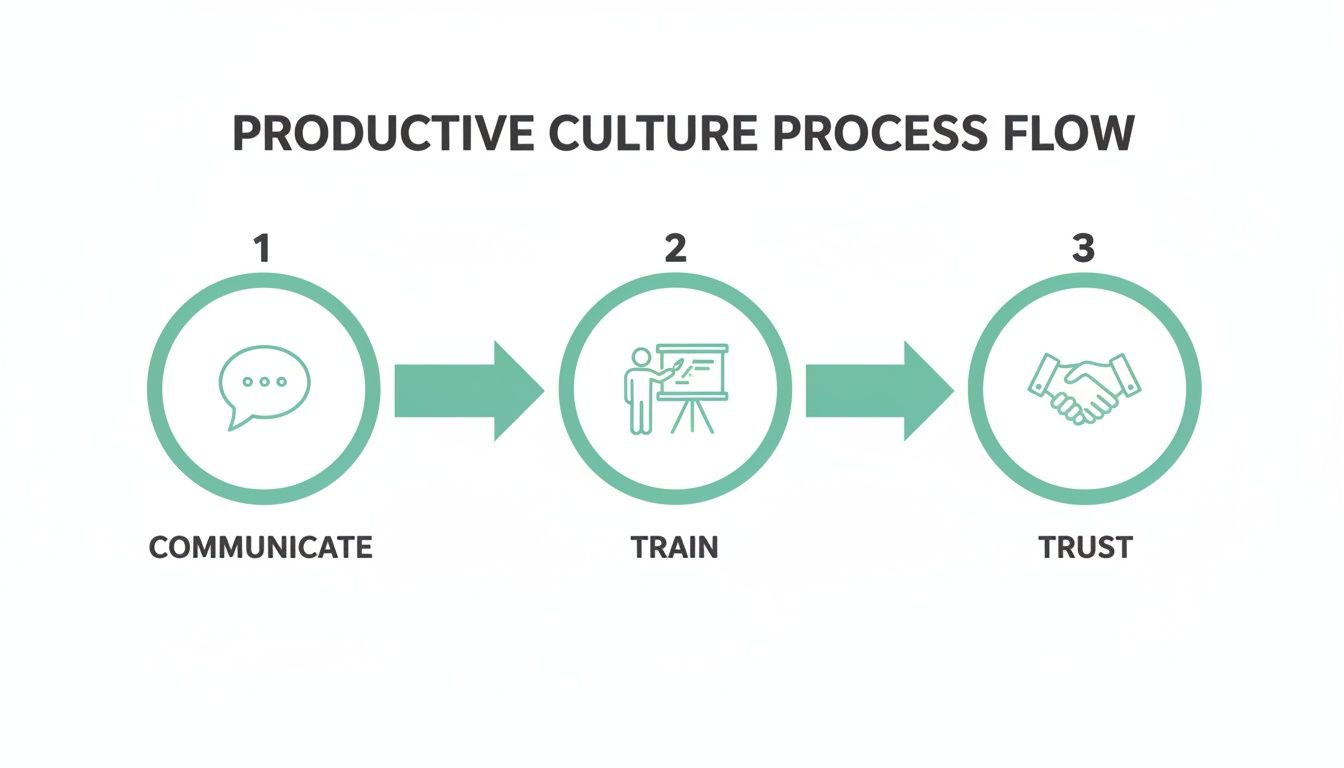
It really boils down to a simple truth: clear communication, proper training, and genuine trust are the fuel for any truly productive team.
As you build out your go-forward plan, you can dig deeper with these 7 proven tactics to improve employee productivity for more specific ideas. Just remember, small, consistent steps are what lead to major progress.
What’s the first small push you can make tomorrow?
You've made it this far, which means you're serious about this stuff. That's fantastic. But it's natural to still have a few questions buzzing around. Let's tackle some of the most common ones we hear from Kiwi business owners just like you.
Honestly, start with something that costs nothing but your time: process mapping. Just getting your workflows down on paper is often the most eye-opening exercise you can do. It’s free and it will immediately show you the biggest time-wasters in your business.
You'd be surprised how often the biggest productivity gains don't come from buying new software, but from simply changing a clunky workflow. After that, look at free or 'freemium' tools. Trello for basic project management or Slack for team chat can bring a huge amount of organisation without costing you a cent upfront.
This is a big one, and it's all about empathy. No one likes change for the sake of change. The key is to focus on the "what's in it for them."
Frame any new technology as a way to eliminate their most annoying tasks. Is there a report that takes them hours to compile every Friday? Show them how a new tool can do it in minutes. That's a win they can feel directly.
Involve them in the decision-making process. Ask for their input on what frustrates them most. When people feel heard and see how a change will genuinely make their workday better, they're far more likely to embrace it. Patient training is non-negotiable, too.
It's tempting to look for that one magical 'all-in-one' platform that promises to do everything. But for most small and medium businesses, this can be overkill—expensive, complex, and full of features you'll never use.
A more flexible and cost-effective approach is usually to pick a few best-in-class, specialised tools that are excellent at one thing. Think Xero for accounting, Mailchimp for emails, and a simple CRM. The absolute key is making sure they can "talk" to each other, often with a simple integration tool like Zapier. This gives you a powerful, customised system without the massive price tag.
Don't think of this as a one-and-done project. Your business is always evolving, and your processes should too. A good rhythm is to do a major review of your core processes once a year.
However, the real magic happens when you build a culture where suggesting improvements is just a normal part of the day. If you bring on a new team member, launch a new service, or just notice something feels a bit clunky—that’s your cue. Treat your processes as living documents, not dusty manuals on a shelf.
Ready to stop patching holes and start building a more efficient, automated business? At NZ Apps, we specialise in creating custom software and web solutions that fit your unique workflows perfectly. Let’s have a chat about your biggest productivity challenges. Book a free consultation with us today.