
Your app is live. The demo works. But search for your category in New Zealand and the same familiar names keep appearing, while your company barely gets a look-in. You could buy another overseas guest post. Or you could earn a mention where Kiwi buyers, partners and investors already look.
Local SEO link building means earning links from websites that connect your business to a place and a relevant audience. For NZ and AU software companies, it's also a market-entry tool. The useful question isn't just whether a website has a strong authority score. It's whether the people who matter to your business have a reason to find you there.
A startup can end up listed under three names, two addresses and a phone number with the wrong country code. The product name sits on LinkedIn, the legal entity appears in a directory, and an old domain still gets sent to journalists. None of this looks dramatic until someone tries to check who you are.
Clean the record before you promote it. Otherwise, each new placement spreads another version of the same muddle.
Pull your official record. Find your company in the NZ Companies Office register and note its legal name, incorporation date and registered office. Keep legal records separate from public contact details, since a registered office isn't always a customer-facing location.
Write one canonical business block. Include your trading name, public address format, phone in +64 or +61 form, primary HTTPS domain, category and founder names. Copy this block into submissions rather than rewriting it from memory.
Audit the profiles you already control. Check Google Business Profile, LinkedIn, app store developer profiles, Crunchbase and NZ or AU directories you've joined. Record the published details and who has access, because a correction is hard to make when the login belongs to a former contractor.
Fix the most visible mismatches first. Search your brand name and work through the profiles buyers see first. Use this Google Business Profile guide for NZ businesses when reviewing that listing, and check eligibility before creating a profile for an online-only software business.
Set a quarterly recheck. Assign an owner and keep a change log for renames, new domains and retired products. Make profile updates part of the launch checklist, not an afterthought.
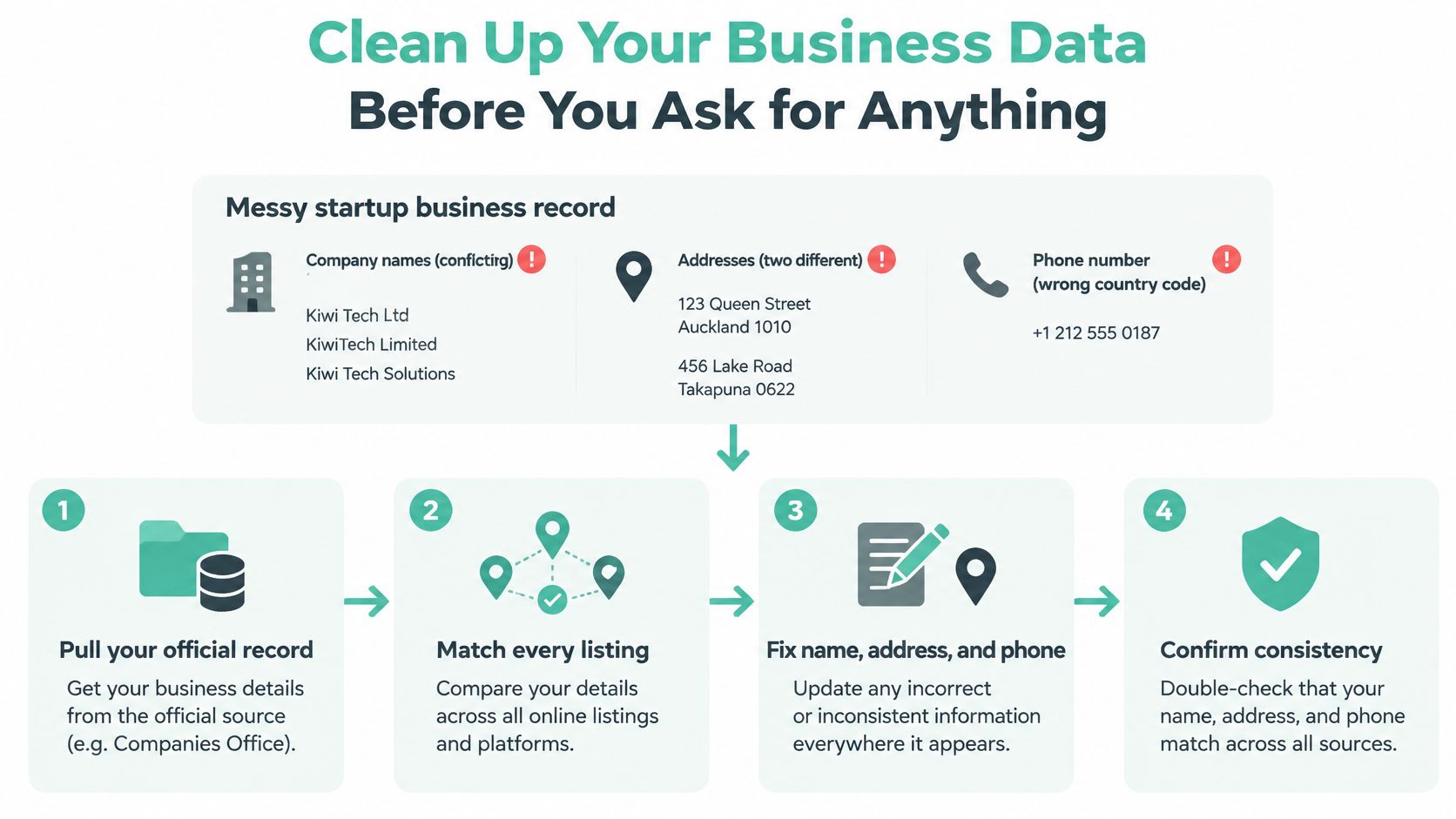
Common slips include Auckland on one profile and Auckland, New Zealand on another, Pty Ltd appearing only in some company names, and an old domain lingering in a 2023 directory. Those differences aren't equally serious. A shortened city label is less urgent than a broken website address or the wrong legal entity.
Don't invent a New Zealand office to look local. An Australian SaaS company can state that it serves New Zealand customers without claiming premises it doesn't have.
Practical rule: Keep the underlying facts consistent, even when a platform forces a different display format.
That consistency helps users and search systems connect the brand with the right business and market before outreach starts.
Local link source types ranked by signal
| Source type | Example in NZ or AU | Local signal | Typical effort | Main risk |
|---|---|---|---|---|
| Industry association member page | NZTech member listing | High when the category matches | Low to medium | Membership fees or criteria |
| University or accelerator ecosystem page | Alumni or portfolio page at an NZ or AU accelerator | High | Medium | Competitive entry |
| NZ or AU tech news site | Founder interview or funding story | High | Medium to high | Needs genuine news value |
| .co.nz directory profile | NZ business or app directory listing | Medium | Low | Stale or thin listings |
| Customer case study on a client's .co.nz site | NZ customer success page | High | Medium | Client approval |
| Council or regional development resource | Regional business support listing | Medium to high | Medium | Slow approval cycles |
Treat this as an order of investigation, not a fixed league table. A customer story can be your strongest prospect if the customer already wants to publish it. An association listing is less useful if its members don't buy, recommend or invest in your category.
Commercial role comes before domain authority. For an Australian company entering NZ, a local industry profile can establish regional credibility. An accelerator page can introduce a founder to partners. A technology article can explain a product to buyers who haven't heard of it.
In MBIE's business digital-capability survey of 2,508 business owners and senior managers, 51% believed they'd benefit from being more online, while 27% identified SEO or search terms as additional external digital tools they wanted. That's a capability problem, not a contest to collect impressive domain scores.
Export your backlinks from Ahrefs, Semrush or Search Console. Tag each referring domain by source type, country and commercial role, then count the NZ and AU sources separately. Check the actual publisher, since a global domain can still serve a local audience.
Look for gaps rather than chasing copies of every existing link. A company with plenty of directory profiles but no customer evidence needs a different campaign from one with press coverage and no reliable company listing.
For directories, I'd start with five to eight relevant candidates across NZ and AU app, SaaS and industry categories. Check that each profile has a public page, useful category information and a working website link. Don't pay to join an abandoned catalogue.
StatCounter figures compiled in AppLabx's New Zealand SEO statistics review put Google's NZ search-engine market share at 92.66% for January–December 2024. A .co.nz domain, NZ spelling, local customer examples and named cities provide context, but none guarantees a ranking.
A modest NZ category site can offer better trust and referral value than a high-authority general blog with no relevant readers. Fit matters. This local SEO guide for NZ small businesses provides useful context for the broader search work around those placements.
Use a five-minute test: strip out the city names and ask what remains. If nothing else connects the page to local buyers, the placement may be generic content wearing a local label.
A good prospect list isn't a pile of email addresses. It's a record of people who publish material your company can help them produce.
Start with entity checks. Use the NZ Companies Office register for local businesses, and ABN Lookup or the ASIC company register for Australian partners. Confirm the legal name and trading brand before contacting someone about a portfolio company or customer story.
Try searches such as site:.co.nz SaaS founder interview, NZ startups funding, or site:.com.au software customer story. Look for domains that keep covering companies like yours, rather than websites that publish anything with a payment attached.
Open the masthead, author biography or contact page. Find the person responsible for technology, small business, investment or your specific sector. A healthtech founder needs a different angle for a health-sector editor than for a startup reporter.
Keep the core sheet simple:
| Domain | Editor name | Beat | Date of last relevant article |
|---|---|---|---|
| Publisher under review | Named contact | SaaS, funding or sector coverage | Date checked against the article |
I'd aim for around 30 prospects, split roughly evenly between news sites, associations and ecosystem pages. That's a manageable working list, not a forecast of replies. Remove targets that haven't covered your topic in six months unless a named contact confirms they still handle it.
Editors commission stories. Association staff maintain member resources. Programme managers approve portfolio pages. Sending all of them the same press pitch is like sending a sales proposal to accounts payable.
Don't guess a private email address when a publisher offers a clear submission route. Use a named contact through the stated channel, and respect requests not to pitch.
A smaller, current list beats a sprawling spreadsheet of people who never covered your subject.
Keep separate notes on the next action and any response. The core sheet should stay easy to scan, not become a tiny CRM nobody wants to maintain.
A useful pitch gives the recipient a local publishing angle, a credible asset and a clear next step. A product launch alone is not a reason for an editor to link to your site.
MBIE's December 2021 business digital-landscape report found that 63% of businesses had a website, while 24% used digital marketing or social-media-management tools. The figures do not measure outreach, but they show why having a website and actively promoting it are different tasks.
For a resource or data pitch, put the finding in the subject line. Explain why it matters locally, link to the asset and its methodology, then make one clear request.
Subject: NZ software onboarding survey finds a recurring setup barrier
Hi [editor], your recent article on software adoption covered the cost of switching tools. Our founder survey examines where NZ teams get stuck during setup. The published report includes the questions and sample details. Would the findings suit your small-business coverage?
Use this format only when the published report supports the claims in your email. A specific local angle helps an editor judge whether the asset fits their audience, while the methodology gives them something concrete to assess.
A partnership request should reflect a real relationship. Write to an accelerator, university innovation office or association with a contribution that fits its work, not a demand for a link in return. Offer a founder case study or speaker session, explain its relevance to the programme, and ask whether an accurate company profile would suit its ecosystem page. Let the organisation decide whether and how to publish a link.
A profile-correction request can be brief. Identify the existing listing, describe the error, provide the correct details and point to the official company page that confirms them. Keep maintenance separate from promotion.
Address the editor by name and refer to a recent article you have read. CleanMyList's email writing guidance for outbound teams offers practical advice on structure, tone and making a clear ask.
Skip a heavy press pack on first contact. Send a working asset page, provide a clear contact and make it easy for the recipient to ask questions.
Use this test before sending: could the editor forward your email to a colleague without rewriting it? If the angle or request needs extra explanation, tighten the message.
Useful assets can earn mentions without paid placement. The catch is that someone has to do the less glamorous work: define the category, check the records and maintain the page.
The Companies Office data services recorded 752,292 registered companies as at 30 September 2026, with 5,068 incorporations during that month. That's a starting point for investigation, not a ready-made list of software startups. Incorporation alone doesn't establish a company's product, funding or active trading status.
A regional startup map could help an accelerator explain its local network. A funding-by-sector overview could support a business editor's investment story, provided every funding claim has a traceable source. A quarterly list of new NZ tech companies could serve an ecosystem newsletter after each company's category and status are checked.
Other useful formats include:
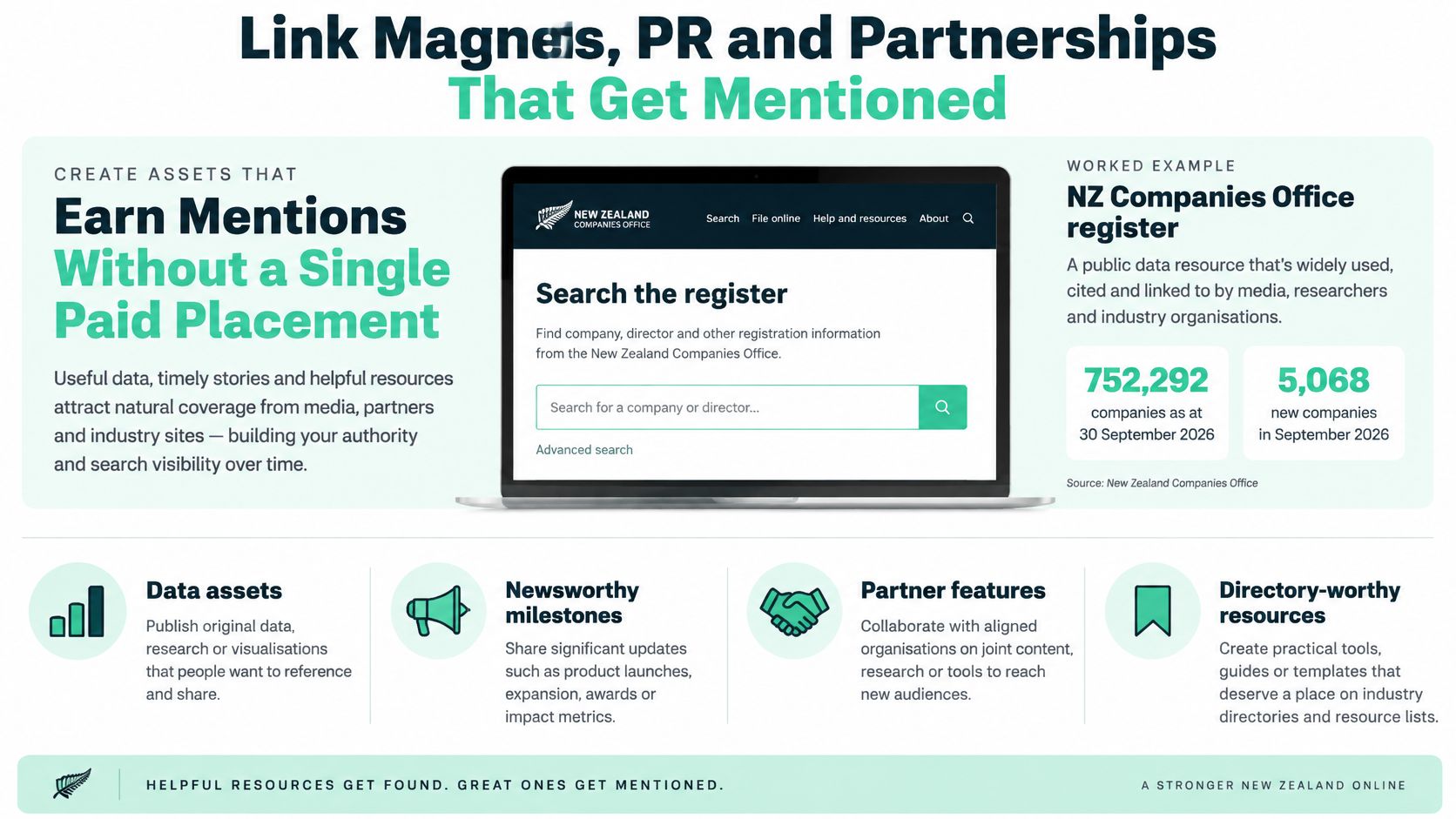
PR works the same way. A funding announcement needs confirmed terms that can be shared. A new NZ partnership needs a named partner and a practical outcome. A customer result needs permission, a clear measurement period and numbers the customer will stand behind.
Each relationship offers a different route to a useful mention:
These aren't guaranteed exchanges. The contribution should remain worthwhile even if the organisation doesn't publish a link.
Before sending an asset campaign, test your message with the MailGenius email deliverability tool. Use it as a pre-send check, not proof that an editor will receive or answer your email.
Date every resource and assign an update owner. A static best-companies page becomes careless when it features renamed startups or discontinued products. Maintenance is part of the asset, not an optional extra.
Buying a placement is not the same as earning editorial coverage. Nor can anyone promise that a paid link will improve rankings without risk.
Placement types and their disclosure expectations
| Placement type | Disclosure expectation | Long-term value |
|---|---|---|
| Editorial coverage | None for genuinely independent coverage earned on news value | High when the story is genuine |
| Sponsored content | Paid and clearly labelled | Medium when the audience fits |
| Directory listing | Accurate profile; paid tier marked | Medium |
| Partner link | Reciprocal relationship justified by the content | Medium to high |
| Community contribution | Logo or profile marked as sponsorship | Low to medium |
Independent editorial coverage involves no placement fee, though preparing the story still costs staff time. Sponsored content is advertising and should be recognisable as such. A paid directory tier should explain what the fee buys, while a community sponsorship should identify the sponsor's role.
The Institute of Digital Marketing New Zealand reported NZ$2.967 billion in digital advertising revenue in 2025, including NZ$1.44 billion from search advertising, or 48.5%. That spending is market context, not evidence that buying backlinks works.
Judge sponsored content as a media buy. Ask who reads the publication, where the article will appear, how long it will remain available and what reporting you'll receive. Agree on the label before approving the copy.
Ask the publisher to qualify paid links with an appropriate rel="sponsored" or nofollow attribute. Don't pay extra for a promise to disguise an advertisement as an independent recommendation.
Buying check: Would you still purchase the placement if it passed no ranking value?
Partner links should help readers understand a real relationship. Don't turn them into a paid link swap or insist on keyword-heavy anchor text that doesn't fit the page.
Walk away from guaranteed rankings, bundles spanning unrelated niches, hidden links and undisclosed advertorials. If a vendor can't tell you what the sponsorship label will say, you don't have a sound placement agreement.
Link metrics to track monthly
| Metric | What it tells you | How to check |
|---|---|---|
| .co.nz and NZ referring domains | Growth of your local footprint | Search Console links report or backlink tool, tagged by country |
| Referral sessions from NZ and AU | Real visits from local sources | Analytics referral report filtered by country |
| Branded search growth | Whether people search for you by name | Search Console branded queries, month on month |
| Demo requests or sign-ups from linked pages | Commercial value of each link | Analytics from landing page through to conversion |
| Link quality audit pass rate | Share of reviewed links that are relevant, indexed and visible | Manually review a sample of ten links |
| Lost-link rate | Links removed or broken | Monthly comparison of backlink exports |
Raw link totals are easy to report and easy to misread. A directory link that produces a qualified demo can be more useful than an article that sends visits from countries you don't serve. Judge the campaign against its commercial job, including partner introductions and assisted leads, not rank alone.
Keep attribution honest. Analytics won't capture every path, and branded search can rise after events, advertising or sales outreach. Ask new leads how they heard about you and record that answer alongside tracked source information.
Pull the referring-domain export and tag new sources by country and type. Review local-domain growth quarterly so a quiet month doesn't trigger a rush to buy filler links. Don't treat every .co.nz domain as a relevant NZ publisher without opening it.
Next, load the referring pages. Check that they still contain your link, display the right business details and send readers to a suitable destination. Record broken pages, removals and redirects separately, since each calls for a different fix.
Calculate the audit pass rate from the reviewed sample, and state the sample size. For lost-link rate, use the same tracked set each month so changes in your backlink tool's coverage don't masquerade as publisher removals.
Use this guide to measuring website performance to connect referral activity with useful site outcomes. Check the destination page too: a good local mention won't rescue a confusing sign-up form or a product page that never explains NZ availability.
For the next month, pick three placements: one relevant directory profile, one editorial pitch built on a defensible data hook, and one partner or asset campaign. Set an owner, destination page and success measure for each.
Three is enough to test different routes, yet few enough to inspect properly. Keep the approach that attracts the right people. Change the one that creates admin but no useful conversations.
NZ Apps offers a curated NZ and AU tech company directory, editorial coverage and clearly labelled sponsored content. Visit to explore relevant company profiles and coverage, then assess whether a directory listing or sponsored placement fits your local audience and campaign goals.
Add your NZ or Australian app or tech company to the NZ Apps directory and get discovered by founders and operators across the region.
Get ListedReach tech decision-makers across New Zealand and Australia. Sponsored and dofollow editorial links, permanent featured listings, and sponsored articles on a DA30+ .co.nz domain.
See Options