
When it comes to NZ online marketing, the core idea is pretty simple: making sure local Kiwi customers can actually find your business. You know what? Think of it as putting up the biggest, brightest sign on your digital storefront so you don't get lost in the online crowd. It's that straightforward.
Let's cut through the jargon. For a small business here in New Zealand, 'online marketing' isn't about chasing complicated global trends. It's about what genuinely works right here in Aotearoa.
Imagine the internet is a massive, bustling market, like the Otago Farmers Market on a Saturday. Your website is your stall, but how do people find you among hundreds of others? That’s the million-dollar question, isn't it?
This is exactly where online marketing comes in. It’s the art and science of directing the right foot traffic straight to your stall.
It all boils down to a few key channels that work together. We’re talking about things like:
The goal is to paint a clear, no-fluff picture of how these pieces fit together. This diagram breaks down the main components of a solid NZ online marketing strategy.
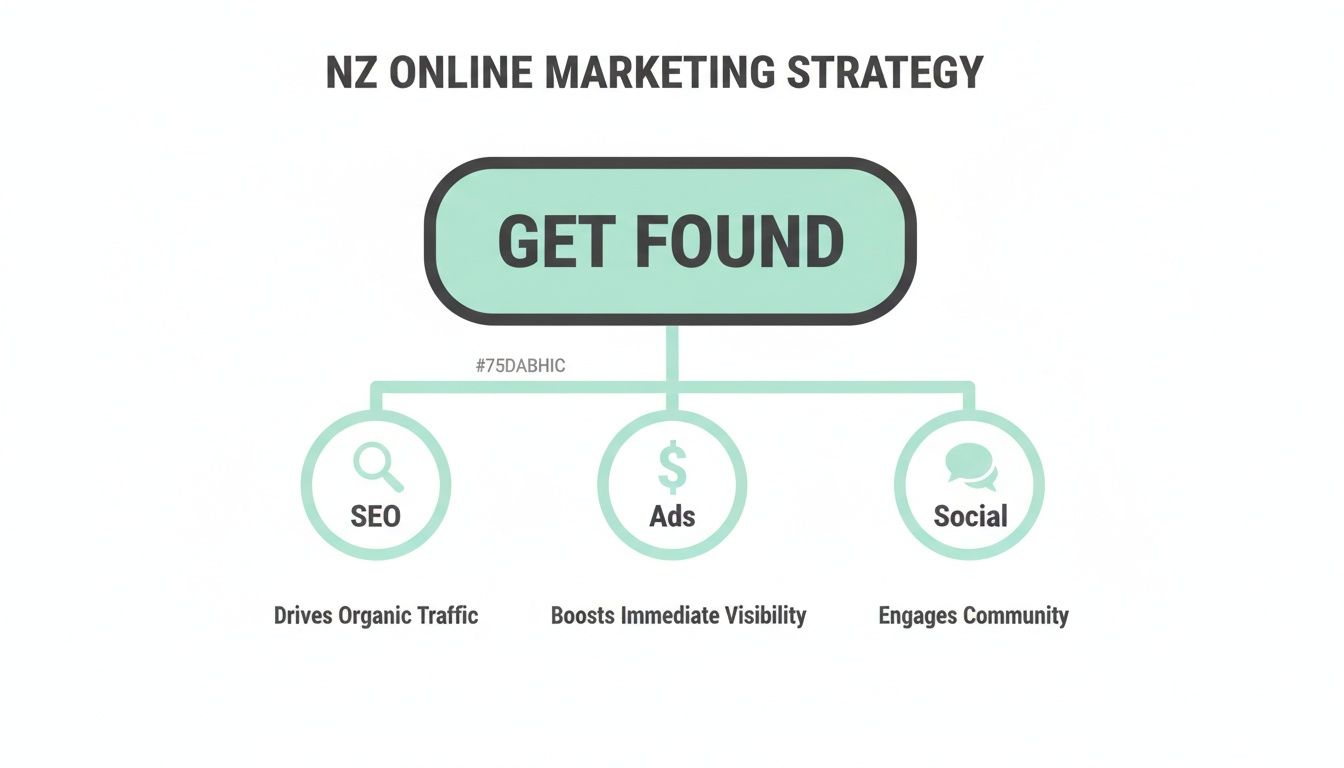
As you can see, everything branches out from one central goal: getting found online. It’s about connecting a cafe in Christchurch with its neighbours or helping a startup in Auckland find its first clients—a challenge many small businesses in New Zealand face every single day.
So, forget the buzzwords for a second. At its heart, this is simply about getting your business in front of the right people, right here at home.
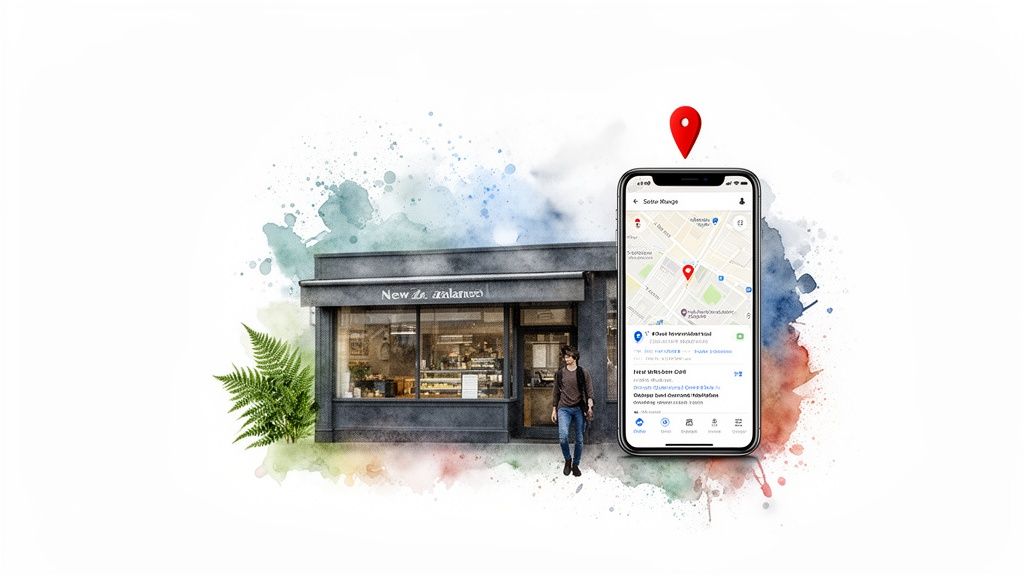
Ever wondered why your competitor’s cafe pops up on Google Maps when you search for "coffee near me," but yours is nowhere to be seen? That’s not luck; it's local SEO at work.
Think of it as putting the biggest, brightest, most helpful sign on your digital storefront. It’s all about making your business impossible for customers in your neighbourhood to miss, whether that's Ponsonby, Riccarton, or anywhere in between.
This isn’t about trying to trick Google. It’s about proving you’re a legitimate, trusted local business that deserves to be seen by Kiwis actively looking for what you offer. And honestly, getting this right is becoming more critical every single day.
Let’s not overcomplicate things. Your first port of call, and probably the most crucial one, is your Google Business Profile. This is that handy info box that shows up on the side of Google Search and on Google Maps.
Getting this right is completely non-negotiable. You’d be amazed how many businesses drop the ball on the absolute basics here.
Your hours, address, and phone number (often called your NAP—Name, Address, Phone) must be 100% correct and consistent everywhere online. An old phone number or a wrong closing time is a fast way to lose a potential customer.
This foundation builds trust not only with customers but with Google itself. It’s a simple signal that you’re a real, operational business that people can rely on.
Now that we’ve got that sorted, let’s look at a simple checklist to cover the foundational tasks.
This table breaks down the essential first steps to improve your local search visibility right here in New Zealand. Ticking these off will put you ahead of many of your competitors.
| Action Item | Why It Matters for NZ Businesses | Quick Tip |
|---|---|---|
| Claim & Verify Google Business Profile | This is your digital shop front on Google. It's the first thing Kiwis see when they search for you or services like yours. | Make sure to complete 100% of your profile—add photos, services, and accurate opening hours. |
| Ensure Consistent NAP | Inconsistent details (Name, Address, Phone) across different websites confuse customers and search engines. | Do a quick search for your business name and check listings on sites like Finda or Yellow. Correct any old info. |
| Get Your Website Mobile-Friendly | Most local searches happen on a phone. If your site is hard to use on mobile, potential customers will just leave. | Use Google's Mobile-Friendly Test tool. It's free and tells you instantly if you have a problem. |
| Encourage Customer Reviews | Positive reviews build trust and are a major local ranking factor. They show Google you're a popular, quality business. | Simply ask happy customers! A small sign at your counter or a link in your email signature works wonders. |
Getting these basics sorted is a huge step forward. It shows Google you’re a serious, active business worth recommending to local searchers.
Okay, so you've sorted your Google profile. What's next? Your website absolutely must work brilliantly on a mobile phone.
Honestly, this is a massive deal. Just think about it: a tourist in Wellington looking for a souvenir shop or a local in Auckland searching for an emergency plumber—they’re almost certainly on their phone. If your site is a pinch-and-zoom nightmare, they're gone in a flash.
It's a huge part of effective local SEO for small businesses in NZ, as a clunky mobile experience can turn away customers in seconds. The whole point is to make it easy for people to find you and take the next step.
The advertising market in New Zealand is projected to hit US$2.75 billion in spending by 2025, and Search Advertising is the biggest piece of that pie. This just goes to show how much Kiwi businesses rely on being visible in search results, making a strong online presence a pillar for growth. You can see more on these market trends over at Statista.com.
And finally, let's talk reviews. Genuine customer feedback is like gold. Encouraging happy customers to leave a quick review on Google can seriously boost your local ranking and give new customers the confidence to give you a go.
So, you’ve built your website, you’re doing all the right things with SEO, but you want results now. This is where paid advertising comes in. It often feels like a bit of a gamble, doesn't it? Chucking money at Google or Facebook and just hoping for the best.
But it doesn't have to be a game of chance. When you know what you’re doing, paid advertising is one of the fastest ways to get your business directly in front of the Kiwis who are ready to buy. Think of it as paying for a premium spot at the weekend market, right by the entrance, instead of hoping people wander down to your stall in the back corner.
The real magic of paid ads, a core part of nz online marketing, is their incredible precision. You can literally jump to the front of the queue.
Let’s get practical. Imagine you're a plumber in Hamilton. How do your potential customers search? They aren't just typing "plumber" into Google. They're much more specific: "plumber in Hamilton" or "emergency plumber Christchurch".
With Google Ads, you can bid to show up for those exact phrases. This means you stop wasting money showing ads to people halfway across the country. You're only paying to be seen by potential customers who are actively looking for what you offer, right in your backyard. That’s a massive game-changer for small businesses.
Then there's the world of social media advertising on platforms like Facebook and Instagram. This is a completely different approach. Instead of targeting what people are searching for, you target who they are.
You can get incredibly specific, showing your ads to people based on their:
This level of targeting changes everything. It’s the difference between shouting into a massive, uninterested crowd and having a quiet, persuasive conversation with someone who's already leaning in, ready to listen.
Is it for every single business? Not necessarily. You need a realistic budget to get started, though even $100 a month can be enough to dip your toes in and reach thousands of locals. The trick is to understand what you're paying for (clicks vs. impressions) and have a way to measure if your ads are actually bringing in customers or just burning cash. It’s all about smart spending, not just big spending.

Let’s be honest, social media can feel like one big popularity contest. It’s easy to get sidetracked chasing likes and follower counts, but that’s not where the real business value lies. The magic really starts to happen when you stop broadcasting and start building genuine connections.
For Kiwi businesses, social media isn’t some optional extra; it’s one of the main ways we all interact with brands now. It’s your chance to build a real community, one authentic conversation at a time, and turn followers into loyal customers who actually trust you.
And the numbers don't lie. An incredible 95% of Kiwis over 15 are on social media, spending, on average, 2 hours and 3 minutes scrolling every single day. That's a massive, highly engaged audience waiting to hear from businesses just like yours.
Here’s the thing: you absolutely do not need to be everywhere. Trying to juggle Facebook, Instagram, TikTok, LinkedIn, and Pinterest all at once is a classic recipe for burnout. It’s far more effective to pick one or two platforms where your customers hang out and completely own that space.
Just think about it. A builder based in Christchurch is talking to a very different crowd than a high-end fashion boutique in Ponsonby.
Choosing the right channel is your first big strategic move. It's all about finding where your customers are already spending their time and simply joining them there.
Alright, so what do you actually post? Bombarding people with constant sales pitches is the quickest way to get unfollowed. Instead, think of your social media feed as a behind-the-scenes pass to your business.
People connect with people, not logos. Your goal is to build trust by showing the human side of your brand. When customers feel like they know you, they're far more likely to choose you over a faceless competitor.
Instead of another "Buy our stuff!" post, try sharing content that Kiwis will find genuinely useful, entertaining, or inspiring. Some simple but powerful strategies for social media marketing in Auckland and across the country involve sharing customer success stories, offering handy tips related to your industry, or even posting a quick video of your team at work.
It all comes down to giving before you ask. When you consistently provide real value, the sales will follow.
You know what’s really powerful? When customers start looking for you because they genuinely trust your expertise. That’s the magic of great content and smart email marketing; it completely flips the old sales script on its head.
Forget the hard sell. Content is all about being generous with your knowledge. And it’s not just about writing blog posts, either. It could be a simple, helpful guide, a quick how-to video, or even a useful calculator on your website that saves your customers a bit of time.
It’s about answering their questions before they even have to ask. Think of it like this: your content is the friendly expert at Mitre 10 who helps someone find the right tool, not the salesperson just trying to push the most expensive drill. This is how you build a reputation as the go-to expert in your field.
Brainstorming ideas that will actually resonate with a Kiwi audience is easier than you think. Just start by listening. What are the most common questions you get from customers day in and day out?
Every single one of those questions is a potential piece of content that positions you as a helpful authority. It’s a core part of any successful nz online marketing strategy because it builds trust, which is something you just can’t buy with ads.
Now, let’s talk about email. I know what you’re thinking—spam. But we’re not talking about that annoying, unsolicited junk that clogs up your inbox. We’re talking about building a direct line to your most interested customers, the ones who have willingly given you their email address.
This is permission-based marketing, and it’s incredibly effective. Think of it as a friendly, monthly newsletter that offers genuine value. You could share a heads-up on new products, offer exclusive deals, or simply link to your latest helpful blog post.
It's about staying top-of-mind without being a nuisance. A well-crafted email reminds your customers that you’re still here and ready to help when they need you. It nurtures the relationship long after the first sale.
If you're just getting started with email, especially on a platform like Shopify, this guide on how to start email marketing for Shopify stores has some great pointers. Honestly, it’s one of the most cost-effective tools in your entire marketing toolkit.

Let's be honest. There is absolutely no point in pouring your time and money into social media, content, or ads if you have no idea whether it’s actually bringing in business. Marketing without measurement is just guessing, and nobody has the budget for that.
This is where you stop throwing spaghetti at the wall and start making smart, informed decisions. And the good news? You don’t need a degree in data science to get your head around it. It really just comes down to keeping an eye on a few key numbers.
Before you get lost in complicated dashboards, let’s talk about a free tool that’s probably already on your website: Google Analytics. Think of it as the odometer for your website—it gives you the basic, must-know stats about what’s going on.
At the start, you’re just trying to answer a few simple but powerful questions:
This gives you a starting picture of whether your efforts are even getting people to your digital front door. Similarly, to make sure your social media posts are resonating with Kiwis, you need to understand key social media performance metrics. It’s a slightly different set of numbers, but the principle is the same—know what's working so you can do more of it.
The most crucial question of all is this: are people taking the action you want them to? A thousand website visitors mean nothing if none of them pick up the phone, fill out your contact form, or buy your product.
This is where it all comes together. A conversion is simply the industry term for when a visitor does something you want them to do. Tracking these conversions is the only real way to understand your return on investment (ROI).
Here’s the thing: you can set up specific goals in Google Analytics to track these actions automatically. It can tell you, for example, that the Facebook ad campaign you ran last month brought in 15 new enquiries through your contact form.
Suddenly, you’re not just spending money on NZ online marketing; you're investing it. You know precisely what is driving real, tangible results for your business. That clarity allows you to confidently double down on what works and cut what doesn't.
It's completely normal to have a heap of questions when you're just starting out. Honestly, everyone does. Let's run through a few of the most common queries we hear from Kiwi business owners dipping their toes into the world of NZ online marketing.
This is the big one, isn't it? The most honest answer is that there’s no magic number that fits everyone. It really comes down to your industry, what you’re trying to achieve, and how fast you want to get there.
A small Kiwi business could reasonably start with a budget anywhere from a few hundred to a couple of thousand dollars a month. A local tradie might kick things off with a modest $100 monthly Google Ads spend just to test the waters, while a new e-commerce store might invest more heavily into social media ads and content from day one.
The most important mindset shift is to treat your marketing spend as an investment, not just another business cost. Think about the lifetime value of a new customer—if a $500 ad campaign brings in a client worth $5,000 over their lifetime, it’s a fantastic return. Start small, measure everything, and double down on what works.
Not necessarily, but you absolutely need a good one. Think of your website as the central hub for all your marketing efforts—it's the destination you send people to from your ads, your social media, and your Google profile.
If your current site is painfully slow, a nightmare to use on a mobile, or doesn't spell out what you do within five seconds, then all the marketing spend in the world won't save it. That's like sending out fancy invitations to a party at a house that’s still under construction.
Before you pour money into ads, it's worth doing a quick audit of your site. Sometimes, a few strategic tweaks from a professional web design team, especially one that gets the Auckland or Christchurch market, can make a massive difference without the cost and hassle of a complete rebuild.
You can definitely get started on your own. Most business owners are perfectly capable of handling the basics, like setting up a Google Business Profile and staying active on one social media channel. It’s a brilliant way to learn the ropes.
But as you grow, things like SEO and managing paid ad campaigns get much more complex and time-consuming. That's usually the point where it makes sense to partner with a freelancer or an agency. They live and breathe this stuff, and they have the specialised tools and expertise to get you better results, faster.
Often, the best approach is a hybrid one: you handle the parts you enjoy and have time for, and you outsource the more technical bits to the experts.
Ready to stop guessing and start getting real results from your online marketing? The team at NZ Apps specialises in building high-performing websites and SEO strategies that connect Kiwi businesses with local customers. Book a free consultation today to discuss your goals.