
Which process mining tool fits your workflow when the useful data sits across an ERP, CRM, service desk and automation platform? A colourful process map is easy to show in a demo. The harder job is proving that the map reflects real work, that your team can maintain it, and that the findings lead to better decisions.
That's why this roundup compares ten process mining tools through real buying questions. We'll look at core mining features, deployment options, integrations, automation links, pricing signals, implementation effort, governance and suitability for organisations in New Zealand and Australia. Pricing, licences and local partner arrangements can change, so confirm current terms with each vendor before signing anything.
Process mining reconstructs how work moves through business systems using event logs. Task mining captures actions on a user's desktop when those actions don't appear in system records. RPA then automates repeatable tasks, but it doesn't replace mining. One shows what happens, one captures how people work, and one performs selected actions.
NZ readiness matters here. A 2025 Spark report on lifting productivity in Aotearoa found that 66% of surveyed business leaders agreed productivity was a problem, while 75% believed new technology could deliver significant gains. Yet only 46% said their organisation had fully or partly integrated cloud infrastructure, and 29% were experimenting with AI. The shortlist below keeps that gap in view. It also ends with a practical buyer checklist and scenario-based recommendations, because the right platform depends less on its feature count than on your systems, data and operating capacity.
Microsoft Power Automate Process Mining makes the strongest first impression when your organisation already lives in Microsoft 365, Dynamics 365 or Azure. The platform can ingest event logs, map process paths, highlight bottlenecks and connect findings to Power Automate flows. That short route from observation to action matters. A process insight that stays in a dashboard may inform a meeting, while one linked to a flow can change the work itself.
The service supports cloud and desktop-based process mining, guided analytics and dashboards. Native Microsoft connectors reduce friction for teams with familiar data sources, while dataflows and additional connectors extend the reach. Task mining adds a desktop view, which helps when system logs explain the official process but not the workarounds people use to get through the day.
Practical rule: Microsoft fit lowers the first hurdle, but it doesn't remove the need for clean case IDs, activity names and timestamps.
Power Automate also brings Copilot and the Power Platform governance model into the discussion. Administrators can manage access, environments and oversight through the wider platform, including a Centre of Excellence approach. Teams with existing Power Automate licences may find a pilot easier to fund and staff than a separate enterprise platform.
The trade-off appears at scale. Advanced mining can require add-ons, capacity planning and a careful review of current entitlements. Microsoft's licensing terms evolve, so the old assumption that an existing Power Platform agreement covers every useful mining capability can lead to an awkward procurement surprise.
Choose it for a Microsoft-heavy SMB or mid-market team that wants discovery close to workflow automation. It's less compelling when your data is spread across non-Microsoft systems and you need deep, vendor-neutral process intelligence without building extra data connections. Review the current Power Automate product details, then test one live process rather than accepting a polished demonstration.
SAP Signavio Process Intelligence suits organisations where SAP ERP or S/4HANA sits at the centre of finance, procurement, supply chain or order management. It combines process discovery, conformance analysis and performance analysis with the broader Signavio suite. That broader setting is important. Teams can connect mined reality with process documentation, collaboration and change work, rather than leaving the findings in a specialist analytics corner.
The platform supports SAP and non-SAP data sources, with connectors designed for enterprise estates. Action triggers and workflows can connect a finding to follow-up work, although the exact path depends on the processes, data and Signavio products in scope. For a company already investing in SAP transformation, shared governance and process language can be more valuable than a narrow feature comparison.
Signavio's advantage is not that it can draw a process. It gives SAP teams a place to compare how work runs with how the organisation says it should run, then bring the issue into a wider improvement programme. That makes it useful for conformance, process ownership and change conversations, especially where many teams touch the same enterprise process.
The downside is commercial and organisational. Pricing is quote-based and enterprise-skewed. The strongest value usually appears when Signavio is part of a wider SAP programme, not when a small team wants a quick standalone analysis.
For context, NZ buyers also need to consider the surrounding ERP systems used in New Zealand. Ask whether your non-SAP applications, local workflows and reporting needs fit the proposed data model.
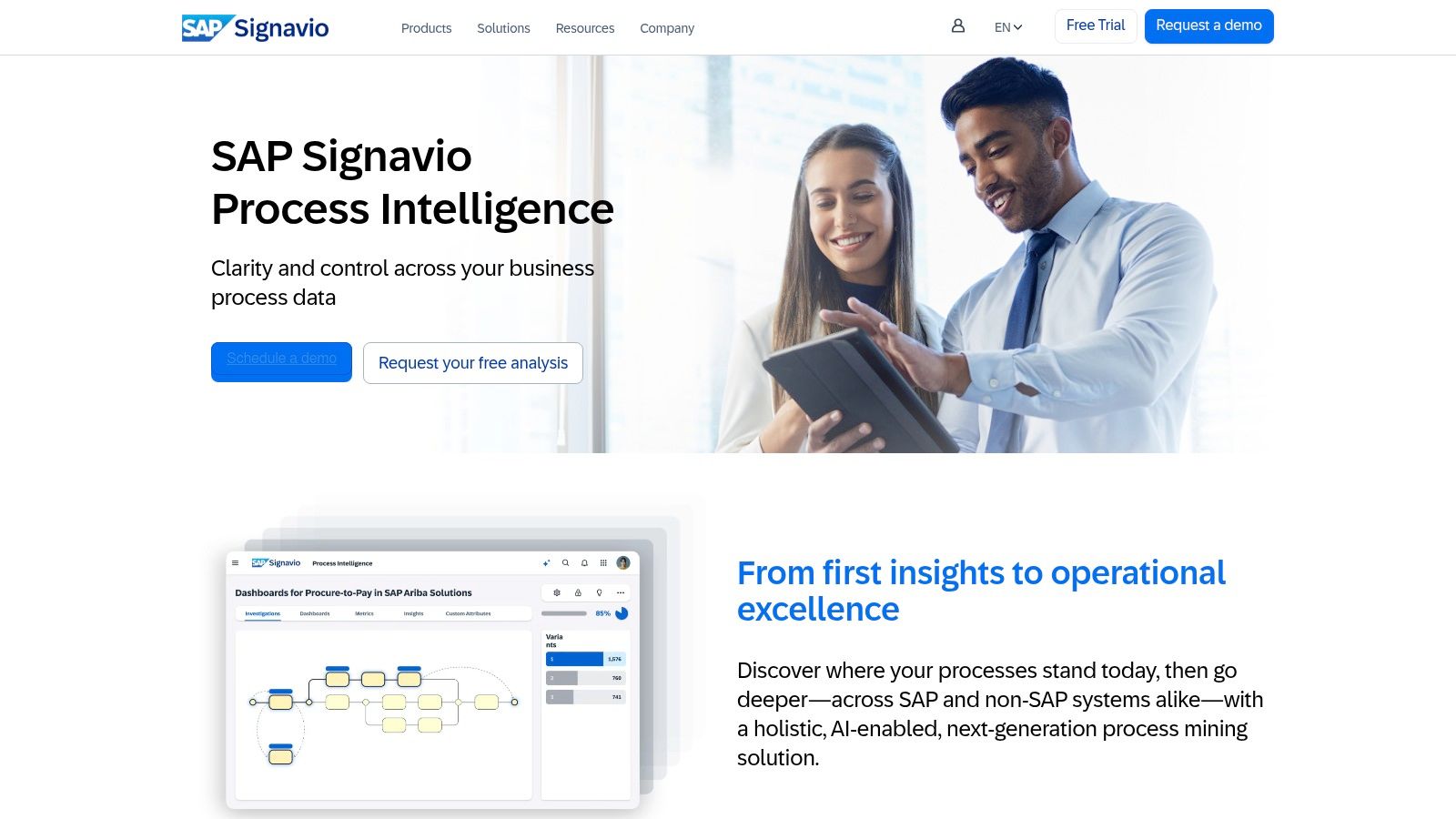
Request a clear split between software, implementation, data preparation, training and ongoing support. Test a representative event log from one process, including exceptions and repeated activities. If the platform is being bought as part of a large SAP programme, make sure the mining use case has its own success measures. Otherwise, it can disappear beneath the weight of the wider transformation agenda.
See the SAP Signavio Process Intelligence offering for current scope, then confirm regional support and licensing with SAP or its NZ and Australian partners.
Celonis is built for organisations treating process mining as a strategic process intelligence layer across a complex enterprise. It goes beyond discovery and conformance with action flows, process apps, industry content and a broad analyst toolkit. Finance, supply chain and order-to-cash teams can start with established process patterns, then adapt analytics through PQL when standard views don't answer the business question.
Its scale is the attraction, but scale also changes the buying decision. Celonis usually makes most sense when several systems, processes and stakeholders need a shared view. A small team investigating one uncomplicated workflow may spend more time setting up the platform and operating model than the first use case justifies.
Celonis combines advanced process discovery with task mining and action management. That helps teams move from “this queue is slow” to “which cases create the delay, who owns the next action, and what should happen now?” The platform's library of process applications can shorten the path to a useful analysis when your systems and process definitions match its content.
The harder part is capability. An enterprise Centre of Excellence, data engineering support and process ownership often make the difference between a useful intelligence programme and a dashboard that nobody updates. Licensing is enterprise-oriented, and the commercial conversation commonly extends beyond the software itself.
Celonis belongs on the shortlist for large enterprise analytics programmes with multiple source systems and a clear appetite for ongoing process management. It's also worth considering when analysts need deep custom queries rather than only guided charts.
Ask for a pilot using your own event data. Test refresh work, permissions, case-level analysis and the hand-off from finding to action. The Celonis Process Intelligence Platform is powerful, but the key question is whether your team can run it after the partner leaves. That's where many enterprise purchases either settle into value or gather dust.
UiPath Process Mining is a natural choice when RPA already has a seat at the table. It joins process mining, task mining, automation, testing and orchestration, so a team can identify a process variant, assess the opportunity, build an automation and monitor the result within a connected platform.
That sequence is practical. Process mining shows the system path, task mining captures desktop behaviour, and UiPath automation handles selected repeatable work. The platform also offers templates and connectors for processes such as CPQ and lead-to-order on Salesforce, which can help teams start with a familiar business pattern.
UiPath's strongest story is discover, build, run and measure. For a company with an established automation programme, that continuity can reduce hand-offs between analysts, developers and operations leaders. Cloud and on-premises deployment options add flexibility for organisations with specific infrastructure or data requirements.
Still, mining isn't automatically valuable just because RPA is available. A platform can identify a repetitive task that shouldn't be automated, perhaps because the policy is changing or the underlying data is poor. Human review remains essential. So does process ownership.
Licensing can be difficult to model because AI, robot and business-user units may all matter. The sales process is often detailed and commercial terms are best confirmed for the exact mix of users and automation capacity.
Give UiPath one process question and one event log. Ask the team to show what happens when a mining finding becomes an automation candidate, then check whether monitoring captures the post-change result. If you need mining alone, compare that workflow with a specialist platform rather than assuming the wider UiPath stack is automatically the cheaper route.
Review the current UiPath Process Mining product before requesting a proposal. For RPA-led teams, it may be the most coherent choice in this list. For everyone else, the wider platform can become a commitment rather than a benefit.
IBM Process Mining takes a governance-friendly route, with discovery, conformance, rework and performance analysis alongside simulation and what-if work. Its object-centric data model and decision mining are useful for processes where one case does not tell the whole story. A customer, order, invoice and shipment may each have a different relationship to the work, and flattening those objects into one simple case can hide the picture.
Deployment flexibility is a key buying factor. IBM offers SaaS and on-premises options through OpenShift, and its product can be purchased through AWS Marketplace. That may suit organisations with strict infrastructure, procurement or data-control requirements.
IBM's prescriptive recommendations and rule analysis make it a candidate for compliance-heavy settings. Teams can investigate not only how work moved, but also where it departed from rules or where decisions shaped the path. watsonx-assisted analysis adds an AI layer, though buyers should still ask what data it uses, how findings are reviewed and what permissions apply.
IBM publishes entry pricing for starter SaaS and on-premises packages, which gives buyers more visibility than a completely quote-only model. That doesn't mean the total cost is obvious. Data preparation, configuration, support and advanced features can still change the commercial picture.
A public price signal is useful, but it isn't a total cost estimate. Separate the licence from the work required to make the event log usable.
The interface and content ecosystem may feel less extensive than those of the category pioneers. Advanced features can also demand careful data engineering. If your team has the skills and cares about deployment control, that trade-off may be acceptable.
Test discovery, conformance, simulation and decision analysis on a process with real exceptions. Then review the IBM Process Mining product and ask how the proposed architecture fits your security model.
ARIS Process Mining is a strong candidate when process mining must sit beside process modelling, governance, risk and compliance. The ARIS suite connects mined reality with the process repository, BPMN and EPC modelling, simulation and controls. That suits organisations that need to document the intended process as carefully as they analyse the actual one.
Many teams have two problems, not one. They lack a trustworthy view of what happens, and their process documentation drifts away from daily work. ARIS addresses both within the same suite. A process owner can compare the current flow with the designed flow, investigate deviations and take the findings into governance work.
The platform supports SaaS and on-premises deployment, with extractors for major ERP systems. Its modelling depth is useful where business analysts, risk teams and operations leaders all need to work from a shared process structure. Simulation adds a way to explore a proposed design before changing production work.
That breadth comes with a learning curve. ARIS is not the lightest route for a founder who wants a quick chart from one export. Advanced flexibility can take time to learn, and pricing is sales-led and typically quote-based.
NZ operators considering the wider process stack may also want a reference point for process documentation in New Zealand. The practical question is whether you need a governed repository or only an investigative mining tool.
Choose ARIS when controls, ownership, modelling and mining belong in one operating model. Ask for a pilot that includes a designed process, its event log, a conformance view and a small simulation exercise. If the team only needs to find bottlenecks quickly, a simpler platform may reach the first useful answer with less effort.
The ARIS suite is therefore less about a single mining screen and more about governing how an organisation describes, runs and improves its processes.
Appian Process Mining belongs in a different part of the shortlist. It is not a standalone mining purchase, but process intelligence within the Appian Platform, alongside low-code application development, case management, RPA and Data Fabric. That makes it relevant when the goal is to find a process problem and then build or orchestrate the improved process in the same environment.
The Data Fabric can unify sources, while higher platform tiers include AI and agent features. Cloud and self-managed Kubernetes deployment options help organisations with different infrastructure preferences. For a team already committed to Appian, the shared platform model can be tidy and persuasive.
Appian is strongest when mining is one step in a broader build programme. A process owner might identify a hand-off problem, create a case application, route work through rules and measure the revised flow. That chain is useful for service operations, regulated workflows and case-heavy work.
The compromise is obvious. You can't buy Appian Process Mining as a small standalone experiment. The platform-level pricing framework is more transparent, with tiers commonly shaped around users and applications, but per-user or per-app costs may not suit a pure mining proof of concept.
A buyer who only wants to inspect an event log should compare the total platform commitment, not just the cost of access. A buyer who wants to redesign and run the process may find the shared model more efficient.
Choose one process where a case application or workflow change is likely to follow the analysis. Test data access, case views, automation hand-offs and the permissions needed by business users. The Appian pricing framework can help clarify the platform model, while a regional guide to business process automation provides useful context for the wider category.
Appian works best when you want to build as well as measure. It's less suitable when the only job is independent process analysis.
QPR ProcessAnalyzer stands out for organisations that already standardise on Snowflake. It runs as a Snowflake-native application, which keeps process data inside the customer's AI Data Cloud rather than sending it elsewhere. For data teams, that can simplify governance conversations and reduce the architecture needed to bring process context to analytics and AI work.
The platform also offers natural-language questions and an MCP interface for exposing process context to AI tools. That's a useful direction, but the quality of the answer still depends on the event data, process model and permissions behind it. A clever question can't repair missing timestamps or inconsistent activity names.
QPR can be available through AWS Marketplace, with starter packages and trial options. Marketplace procurement may help teams move faster when the cloud account, security review and purchasing route are already established. It also gives buyers a clearer way to test the product before negotiating a larger commitment.
The main limitation is fit. QPR's Snowflake-first posture is attractive if Snowflake is already central, but it's less compelling if your data estate runs elsewhere. The ecosystem is smaller than that of the largest enterprise vendors, so check connector coverage, partner support and the availability of process content for your industry.
QPR is worth a close look for a Snowflake-first analytics group that wants process context beside existing data products. Ask how the platform handles refreshes, repeated activities, sensitive fields and access by business role. Also test its natural-language interface against questions your process owners ask, not only questions prepared for a demo.
See the QPR ProcessAnalyzer platform for current deployment and commercial details. The best case is a clean extension of your existing data architecture. Without Snowflake, the same architecture may feel like a constraint.
ABBYY Timeline is a strong match for document-heavy operations, particularly where ABBYY intelligent document processing already plays a role. It combines process mining and task mining with monitoring, prediction, simulation and digital-twin visualisations. That gives teams a route from the document entering the organisation to the work moving through the process afterwards.
This matters in public-sector, financial-services and other workflows where documents create the first event and manual handling creates much of the delay. Mining can show where a document waits, returns for correction or moves through an unexpected route. ABBYY's document capabilities can then sit close to the process view.
Real-time monitoring and predictive analytics add more than a historical map. A team can watch for conditions that suggest a case may miss its target, then investigate the pattern before the queue becomes painful. Simulation can help compare possible changes, although buyers should test how much configuration and data preparation that requires.
ABBYY offers a 30-day trial, as described in its product material, which can support a focused evaluation. Use that period to test a real document-led workflow, not a clean sample with all the awkward exceptions removed.
The commercial picture is less open. Pricing isn't publicly listed and follows an enterprise-oriented sales cycle. Its third-party accelerator library is also smaller than those of some larger peers, so local partner capability may matter more.
Check how Timeline connects document events with ERP, CRM and workflow records. Ask who owns the model, how monitoring alerts reach operational teams and which ABBYY products are required. The ABBYY Timeline platform is most convincing when document capture and process performance need one view. If your work is mostly system transactions with few documents, another tool may give you a cleaner fit.
Apromore brings a useful ANZ perspective to a market dominated by global enterprise software. Headquartered in Melbourne, it offers process discovery, conformance, dashboards, simulation and predictive monitoring, with connectors for systems such as SAP, ServiceNow and Salesforce. Its regional presence and partner network can make conversations easier for NZ and Australian teams that want support closer to home.
The platform aims for a balanced experience. It has enough depth for enterprise work, but its interface can remain approachable for mid-market teams that don't want to build a large process intelligence function before seeing a result. Integration Center supports extractors, ETL and schedulers, which helps turn a one-off analysis into a maintained data flow.
Apromore offers enterprise SaaS, training and consulting services, plus a 30-day trial. That combination suits a buyer who wants to test discovery and simulation on a meaningful process before committing to a larger rollout. Start with a process that repeats often and has a clear owner. Otherwise, the team may spend the trial discussing data access instead of learning from the process.
The trade-offs are commercial rather than conceptual. Pricing is quote-based, and the community or open-source edition has been deprecated. Buyers should now treat Apromore as a commercial platform, not a free route into production mining. It also has fewer prebuilt accelerators than the largest vendors, so ask how much configuration your industry use case needs.
Apromore is a good candidate for organisations that value local ANZ presence, balanced analytics and practical deployment support. Test SAP, ServiceNow or Salesforce data with your own case definitions, then check simulation, monitoring and report distribution. Review the Apromore platform and ask about NZ support coverage, partner responsibilities and data handling before purchase.
| Solution | Core strengths ✨ | Quality ★ | Pricing/value 💰 | Best for 👥 | Standout 🏆 |
|---|---|---|---|---|---|
| Microsoft Power Automate Process Mining | Native Power Platform connectors; task + process mining; Copilot tie-ins | ★★★★ | 💰 Included/add‑on (check evolving licensing) | 👥 M365 / Dynamics / Azure organisations | 🏆 Best Microsoft ecosystem fit |
| SAP Signavio Process Intelligence | End‑to‑end discovery, conformance, collaboration; SAP data model | ★★★★ | 💰 Quote‑based; enterprise skew | 👥 SAP ERP / S/4HANA transformation teams | 🏆 Deep SAP integration & change management |
| Celonis Process Intelligence Platform | PQL, large library of process apps, execution management | ★★★★★ | 💰 Enterprise pricing; strategic investment | 👥 Large enterprises scaling process intelligence | 🏆 Category pioneer with rich industry content |
| UiPath Process Mining | Discovery → automation → monitoring; prebuilt templates | ★★★★ | 💰 Complex/licensing; best with UiPath stack | 👥 RPA‑centric teams standardised on UiPath | 🏆 Strong end‑to‑end RPA + mining story |
| IBM Process Mining | Discovery, conformance, simulation; watsonx analysis | ★★★★ | 💰 Transparent starter SaaS & on‑prem packages | 👥 Governance/compliance‑focused organisations | 🏆 Flexible deployments & prescriptive recommendations |
| Software AG ARIS Process Mining | Integrated modelling, risk & compliance, simulation + mining | ★★★★ | 💰 Quote‑based; suite licensing | 👥 Organisations needing process governance + docs | 🏆 Single platform for modelling → mining → controls |
| Appian Process Mining | Mining inside low‑code platform with case mgmt & RPA | ★★★★ | 💰 Tiered per‑user/app platform pricing | 👥 Low‑code teams building apps + automation | 🏆 Unified low‑code + mining for rapid delivery |
| QPR ProcessAnalyzer | Snowflake‑native; NL Q&A; keeps data inside customer tenancy | ★★★ | 💰 Marketplace starter packages; flexible procurement | 👥 Snowflake‑first teams prioritising data governance | 🏆 Snowflake‑native (no data egress) |
| ABBYY Timeline (Process Intelligence) | Process + task mining, real‑time monitoring, predictive analytics; IDP integration | ★★★★ | 💰 Enterprise sales; 30‑day trial available | 👥 Document‑heavy sectors (finance, public) | 🏆 Best with ABBYY IDP for document→process visibility |
| Apromore | Discovery, conformance, simulation, predictive monitoring; ANZ presence | ★★★★ | 💰 Quote‑based annual SaaS; trial option | 👥 ANZ customers; mid‑market → enterprise | 🏆 Local ANZ roots and partner network |
A process mining purchase should begin with the event log, not the logo. Ask each vendor to show how it handles a real process with a stable case ID, clear activity names and trustworthy timestamps. Check whether the platform preserves event order, handles repeated activities and separates waiting time from active work. If the source data is fragmented across spreadsheets, desktop tools and disconnected applications, the mining project may become a data-consolidation project first.
NZ adoption evidence points to that readiness issue. Deloitte New Zealand's intelligent-automation survey found that 82% of respondents believed process mining produced better outcomes than not using it, while only 23% said their organisations already used it. 43% planned to implement process mining or process monitoring within three years, and 63% believed process intelligence accelerated discovery and helped identify automation opportunities. These figures come from Deloitte New Zealand's automation survey. They describe a market where perceived value is ahead of operational maturity.
Use this buyer checklist before you compare final proposals:
The AI question deserves its own pause. Datacom's 2024 research, reported by IT Brief New Zealand, surveyed senior managers in NZ organisations with at least 100 employees. It found that two-thirds were using some form of AI, up from 48% in 2023. Automation of repetitive tasks led the listed AI use cases at 24%, followed by big-data analysis and insight synthesis at 17%, and workflow automation and optimisation at 15%. Yet only 13% had audit-assurance and governance frameworks. That combination makes process visibility valuable, but it also makes permissioning, human review and communication with employees essential.
The other four have clear roles. IBM suits buyers who value deployment choice and governed analysis. ARIS fits process repositories and control-heavy environments. Appian is compelling when the team wants to build and run a process application after mining it. ABBYY Timeline makes sense when documents and intelligent document processing shape the workflow.
Before signing a broad contract, test one meaningful process. Use the same event log, the same question and the same definition of a useful result with every shortlisted vendor. Measure data preparation effort, time to a trusted process view, clarity of findings and the work needed to keep the analysis current.
A narrow pilot can also be the wiser choice for a smaller NZ business. MBIE's research on AI adoption by New Zealand SMEs found that 94% of SMEs surveyed in 2025 were aware of at least one AI tool, while confidence, capability, privacy, security and trust still held adoption back. The same research states that 68% of surveyed SMEs in 2024 had no plans to evaluate or invest in AI, and 43% of non-users named a lack of expertise as their main barrier. Process mining won't fix those conditions by itself.
For founders and operators comparing technology providers across New Zealand and Australia, NZ Apps can serve as a regional reference point. Use the directory and editorial coverage to understand the local software environment, then ask vendors to prove their fit with your data rather than selling a distant vision.
NZ Apps covers the New Zealand and Australian app and technology sectors, including SaaS, AI, automation and practical software guides for founders and operators. Visit NZ Apps to compare regional technology providers and find useful context before you shortlist a process mining platform.
Add your NZ or Australian app or tech company to the NZ Apps directory and get discovered by founders and operators across the region.
Get ListedReach tech decision-makers across New Zealand and Australia. Sponsored and dofollow editorial links, permanent featured listings, and sponsored articles on a DA30+ .co.nz domain.
See Options