
The most popular roadmap advice is backwards. A roadmap rarely fails because the boxes are the wrong colour or the quarters are too ambitious. It fails because somebody treats a planning view as a promise, then asks a small team to defend dates that were never supported by evidence.
An NZ SaaS founder usually has three audiences pulling at the plan. Customers want their requests next. Investors want a credible growth story. Engineers know the team can't build everything without leaving security, reliability, and customer learning to gather dust. That tension won't disappear because you add another column to Jira.
The better approach is to treat the roadmap as an evidence-gated investment portfolio. Each initiative earns more commitment as it earns stronger evidence. That gives you a practical way to rank work, handle AI features without chasing demo appeal, and discuss priorities with customers and investors without painting the team into a corner.
A date-led roadmap makes uncertainty look settled. “Q3, reporting module” sounds useful, but it hides the questions that matter: which users need it, what problem does it solve, how strong is the evidence, and what result would justify the engineering effort?
The problem gets sharper in New Zealand, where software companies often operate with a small domestic market and a lean product crew. MBIE says New Zealand's digital technologies sector contributed approximately NZ$7 billion to GDP in 2021 and grew at 10.4% annually from 2016, compared with 5.1% for the wider economy, while reliable SaaS-sector data remains limited. That combination creates opportunity, but it also makes every large bet feel personal. You can read more in MBIE's digital technologies industry transformation plan.
A founder hears the same request from two respected customers and adds it to the “committed” column. Sales repeats the promise. The engineering team discovers that the work touches billing, permissions, reporting data, and support documentation. Suddenly a useful signal has become a delivery obligation.
Practical rule: Customer enthusiasm is input to discovery, not approval for a major build.
Good product roadmap best practices start by separating direction from commitment. Near-term delivery can carry a clearer horizon when the work is understood. Further out, the roadmap should show themes, outcomes, assumptions, and learning milestones rather than pretend certainty.
That may create a harder conversation. A customer might ask, “When will you ship this?” A credible answer can be, “We're testing whether this solves the workflow you described. If the evidence holds, it will move into committed delivery.” That sounds less exciting than a date, but it protects trust when the evidence changes.
The roadmap isn't there to make every stakeholder happy. It's there to help a small team spend scarce capacity on problems worth solving.
Think of a roadmap as a share portfolio. Some work protects the base, such as reliability, security, and migration. Some bets aim for growth, such as improving activation or supporting a new market. A small amount can fund a speculative idea, provided the team knows what evidence would make it worth continuing.
That portfolio view forces three disciplines:
The difference is visible in the wording. “Q3, reporting module” is a delivery label. “Help operations managers spot failed customer tasks, test with the target segment, and improve task completion” gives the team a problem, a user, a hypothesis, and an outcome measure.
New Zealand's R&D figures make the portfolio lens hard to ignore. Statistics New Zealand reported NZ$4.0 billion in business-sector R&D expenditure in 2024, up 9% from 2023. Large businesses with 100 or more employees accounted for 56% of that spend while representing 14% of businesses undertaking R&D, according to Statistics New Zealand's Research and Development Survey. Investment can grow while participation remains concentrated. For a small SaaS team, that makes resource allocation a management job, not a formatting exercise.
A few high-cost initiatives can consume the team without anyone noticing. They may look strategically important, yet leave no room for instrumentation, customer research, or technical risk reduction. The roadmap should show those trade-offs rather than bury them in a delivery board.
Use a simple record for every meaningful initiative:
For a broader explanation of roadmap structure and founder-facing communication, this SubmitMySaas guide for founders is a useful companion. Keep the public version simple, but keep the internal evidence visible.
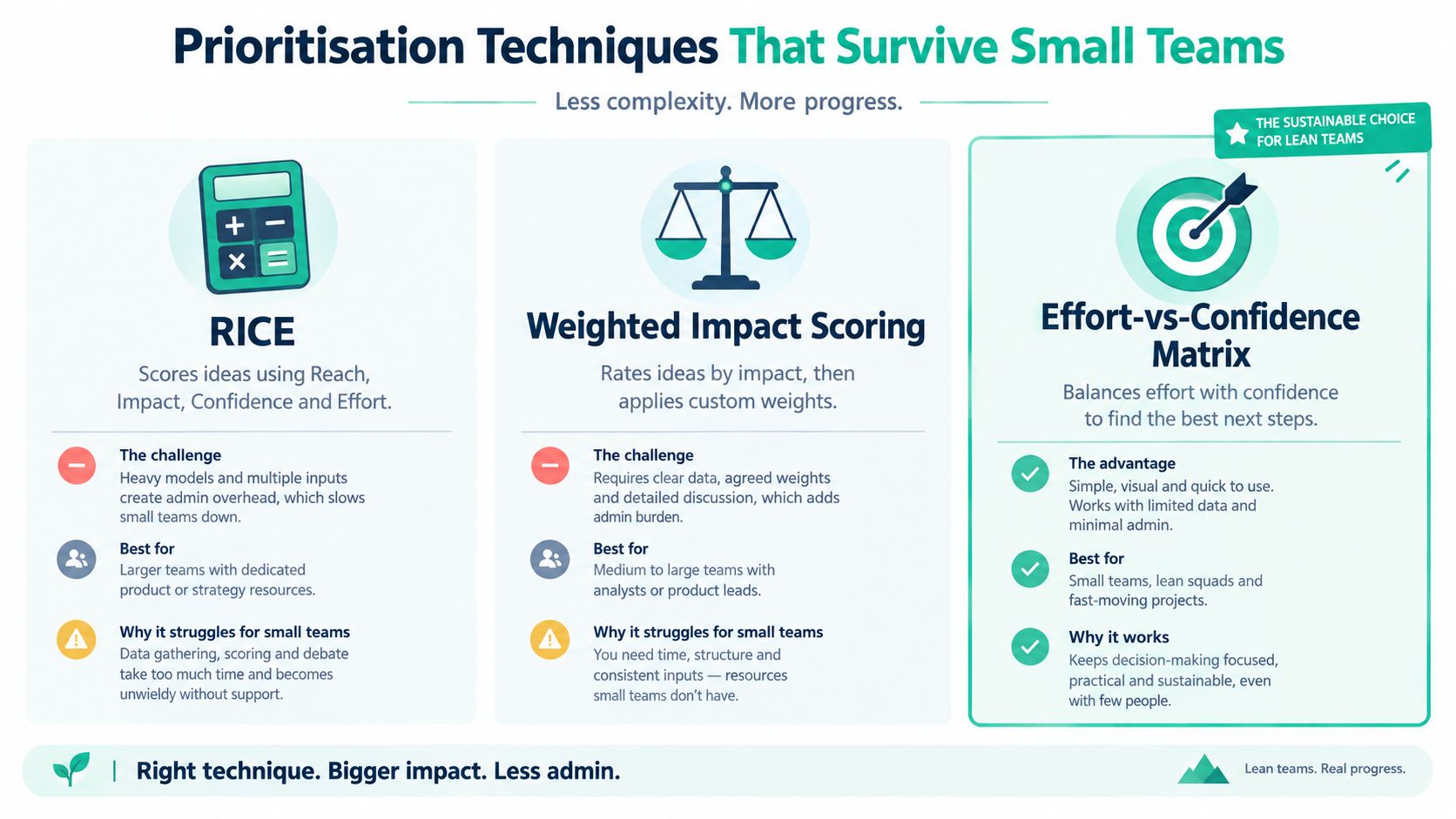
A large product organisation can maintain a detailed scoring model, run regular calibration sessions, and keep its data tidy. A four-person team often can't. The model becomes a second product, complete with its own backlog.
RICE can help compare reach, impact, confidence, and effort, but it depends on estimates that may be fragile early on. Weighted impact scoring is easier to explain, especially when a team wants to give customer value, strategic fit, risk, and learning value different weights. An effort-versus-confidence matrix is lighter still. It won't create false precision, which is often its strength.
| Method | Best for | Weakness for small teams |
|---|---|---|
| RICE | Comparing a broad set of initiatives with reasonable input data | Estimates can create admin work and pretend uncertain numbers are firm |
| Weighted impact scoring | Making strategic trade-offs explicit | Weights can become political if the team doesn't define them clearly |
| Effort-versus-confidence matrix | Fast decisions during planning and discovery | It offers less detail when several initiatives look similar |
The practical score I favour is:
Expected impact × confidence ÷ engineering effort and delivery risk
You don't need to turn that into a decimal-heavy ranking. Use a small scale, write down why each rating exists, and discuss the outliers. A request with strong customer evidence, meaningful impact, modest effort, and manageable risk should rise. A flashy idea with weak evidence and hidden data work should wait.
New Zealand's software sector has a strong reason to protect this kind of learning capacity. MBIE reported that computer-services firms represented 27% of all business R&D investment in New Zealand, while roughly one-third of those firms conducted R&D, compared with 10% across the rest of the economy. The MBIE ICT industry analysis supports a practical conclusion: discovery and technical investigation aren't side projects. They are part of how software teams create value.
An NZ-specific compliance requirement isn't the same bet as a capability that helps an Australian expansion. Put both on the roadmap, but label the difference.
For each item, record:
Reserve explicit capacity for infrastructure, security, data quality, and discovery. Visible features are easier to celebrate, but invisible work often determines whether the visible work survives. Teams looking for a practical delivery framework can also use this resource on agile project management for product teams.
At each planning cycle, retire items whose evidence has weakened. A roadmap should be able to say “not now” without treating that decision as failure.
A feature request is an assumption wearing a nice shirt. Treat it as demand only after the evidence supports it.
A customer may describe a genuine frustration while proposing a solution that is too costly, poorly suited to the wider segment, or specific to an unusual workflow. Start by testing four things: the problem, the target customer, the urgency, and the behaviour that would show value.
Research on New Zealand startup validation found that, across more than 4,000 ideas, only 18.3% received a “go” verdict. 67% of founders said they validate before building, yet only 23% used structured methods with real target customers. Unstructured validation can inflate perceived demand by 25–30%, according to this NZ startup validation research.
Use an evidence gate before a major item enters delivery. The gate should answer:
The interview script protects the team from polite agreement. Ask about the last occurrence, the workaround, and what the customer paid or changed. Record answers consistently, then score the evidence against the same criteria. That gives a small NZ SaaS team a firmer basis for comparing local demand with a stronger or weaker Australian signal.
A feature can pass one market's gate and fail the other. Record the market, evidence strength, portability, and expected learning before assigning capacity. This turns the roadmap into an evidence-gated investment portfolio, where uncertain bets receive small tests and stronger bets earn larger commitments.
Ask what the customer did the last time the problem occurred, then look for behaviour that would change the investment decision.
Discovery should reduce uncertainty before engineering carries the cost. Teams defining a focused first release can use this minimum viable product guide alongside a step-by-step guide to build an MVP. The first release should produce learning, not a miniature version of the full vision.

Two credible customers repeatedly request an analytics add-on from an NZ SaaS team. The demand sounds strong, but it does not justify spending the next build cycle. The team first tests whether the problem exists beyond those conversations, and whether interest is similar in Australia.
It adds an “Analytics preview” entry inside the relevant workflow, with a Join the waitlist action. The feature does not exist. After someone selects the action, the team explains the test, records the user's market and role, and asks what job they expected the feature to solve.
“Reporting would be handy” is useful context, not commitment. An observed action in the product is stronger evidence of intent, though it still needs qualification. Compare NZ and Australian responses rather than combining them into one demand signal. A feature may earn a prototype in one market while remaining an untested bet in the other.
Record the experiment on an assumption card:
The card ties evidence to an investment decision. Before assigning substantial capacity, write down what the team believes, how it will test that belief, and which result would change the roadmap. Small tests protect cash and engineering time; stronger evidence earns a larger commitment.
Startup Dunedin cites research suggesting that about 35% of startups fail because they lack market need, and recommends customer interviews, fake-door tests, and test cards in its discussion of how teams can avoid building products nobody needs. A small team can still spend months polishing a capability customers praise but rarely use.
AI needs its own delivery discipline. An AI feature brings questions about data quality, evaluation, human review, privacy, and trust that an ordinary backlog item can conceal.
Awareness is widespread, yet it does not prove product-market fit. MBIE research conducted from April to June 2025 found that 94% of NZ SMEs were aware of at least one AI tool. Datacom's 2025 research found 87% of larger organisations used AI, while only 12% had deployed it across the whole business, according to MBIE's report on AI adoption by New Zealand SMEs.
A polished demo can still fail in production. Source data may be incomplete, staff may struggle to assess the output, or ownership of errors may be unclear. For a small trans-Tasman SaaS team, those risks also vary by market. An AI workflow that earns strong customer evidence in Australia may remain an untested bet in New Zealand, so keep the investment decision tied to the segment and evidence behind it.
Define the user problem and target metric first. “Help support staff resolve common cases faster while preserving answer quality” gives the team something observable to test. “Add an AI assistant” does not.
Use the following gates, in order:
Model access is rarely the bottleneck. Clean, well-instrumented product data and team time to judge whether the output helps usually determine the pace. Move quickly when the evidence supports it, but keep the gates intact. Regional guidance on AI in business automation in New Zealand can help frame that decision.
A roadmap earns trust by showing how decisions are made, not by pretending uncertainty has disappeared. Dates that sound firm become promises in a customer's mind, even when dependencies, new evidence, or market conditions later change.
Show one company-level outcome, then expose the bets underneath it. For a small trans-Tasman SaaS team, that may mean pursuing stronger regional retention while testing different routes in New Zealand and Australia. Keep discovery findings attached to the relevant market, customer segment, and constraint. Evidence from Australian buyers should not automatically fund a New Zealand release.
AI adoption makes the distinction practical. MBIE reports that 68% of NZ SMEs had no plans to evaluate or invest in AI in a 2024 NZIER/Spark survey, compared with 38% of Australian SMEs reporting the same position in 2025, as described in New Zealand's state of play on AI. A regional feature list can conceal that uneven signal and steer capacity toward the loudest segment.
A customer-facing roadmap should answer five questions:
Use a broad horizon instead of a brittle date. Investors may focus on expansion and commercial impact. A large customer may need confidence around a workflow dependency, while engineers need clarity on data readiness and technical risk. Keep one evidence record, then explain its trade-offs in language each audience can use.
A useful update might read: “We're validating reporting workflows with operations teams. We'll decide on the build after the test.” It gives customers a clear decision point without turning an unproven bet into a commitment. When evidence changes, update the rationale openly and revise the horizon. That looks more reliable than quietly preserving a date the team can no longer defend.
A roadmap that can't be measured is a wish list with nicer typography. Review both delivery and learning, because a team can ship on time while solving the wrong problem.
Track a small set of signals each quarter:
A lightweight team performance dashboard guide can help structure the review without turning it into a reporting ritual. Keep the dashboard close to decisions. If a metric won't change what the team does, it probably doesn't belong.
Standards New Zealand role guidance links product planning with lifecycle review, portfolio rationalisation, stakeholder feedback, and future investment. That means the quarterly meeting should ask not only what to build, but which existing feature should be simplified, retired, or supported differently.
Adoption barriers make this especially important. A New Zealand technology-productivity report identified lack of knowledge or expertise at 42%, price of new technology at 40%, limited access to capital at 38%, and resistance to change at 36% as major barriers, according to the Lifting Productivity report. A feature can be technically strong and still fail if customers can't understand it, afford it, or fit it into existing habits.
Reserve roadmap capacity for onboarding, migration, integrations, training, and change support. The path to use matters as much as the path to launch.
For your next quarterly review, export the roadmap and ask:
Then update the roadmap in plain language. Keep the outcome, record the evidence, change the investment, and explain the decision.
NZ Apps gives founders and operators regional coverage of the NZ and Australian app and tech ecosystem, along with practical guides for building and growing software businesses. Visit NZ Apps to explore local market resources, company listings, and insight that can strengthen your product planning and regional growth decisions.
Add your NZ or Australian app or tech company to the NZ Apps directory and get discovered by founders and operators across the region.
Get ListedReach tech decision-makers across New Zealand and Australia. Sponsored and dofollow editorial links, permanent featured listings, and sponsored articles on a DA30+ .co.nz domain.
See Options