
Right then, let's get into it. Managing a project here in New Zealand isn't just about ticking boxes on a Gantt chart; it’s more like navigating a tramping track. You need the right gear, a solid plan, and a real feel for the local conditions. This is our friendly chat about what makes project management in NZ a bit different.
Honestly, what does it really take to get a project over the line here? Is it all about process and paperwork? Not quite. In New Zealand, there's a certain way of doing things that blends professional grit with a healthy dose of pragmatism.
Think about the classic Kiwi 'number eight wire' mentality. It’s not just a cliché; it’s a real approach to problem-solving. It means being resourceful, practical, and not getting bogged down by theory when a straightforward solution is staring you in the face. This applies directly to how projects are run, especially within small businesses where you often have to wear multiple hats. You can learn more about the unique challenges and opportunities for small businesses in New Zealand in our guide.
Here’s the thing: you can have the most beautiful project plan in the world, but if you haven’t built genuine relationships, you’ll struggle. A firm handshake and a bit of a yarn before a meeting can often achieve more than the meeting itself.
This relationship-first approach is vital because it builds trust. When things get tricky—and they always do—that trust is what gets you through. It’s the difference between a contractor who goes the extra mile and one who sticks strictly to the contract, letter for letter.
A project’s success often hinges on the quality of its human connections. In New Zealand, this isn't just a nice-to-have; it's a core requirement for getting things done efficiently and respectfully.
It's no surprise that with all this activity, the need for skilled project managers has been on the rise. In fact, the number of businesses offering project management services grew by 12% between 2020 and 2025, with the profession now employing around 45,000 people. This growth is heavily linked to significant infrastructure investment, with most jobs centred in Auckland, Wellington, and Christchurch. You can see the full breakdown of these trends and learn more about New Zealand business demography statistics on stats.govt.nz.
This guide is your orientation, your starting point. We’re setting the scene for everything that follows, from choosing the right workflow to handling contracts without the usual headaches. It's all about giving you a practical foundation, whether you're launching an app or breaking ground on a new office. Let's make sure you're properly equipped for the journey.
Ever feel like picking a project management framework is like ordering a coffee? You’ve got your classic long black (Waterfall), your trendy flat white (Agile), and a whole menu of options in between. So, what’s the right call for your Kiwi business?
Honestly, there isn’t a single “best” way. It really boils down to what you’re trying to build.
Think of it this way: you wouldn't use a pavlova recipe to build a garden shed, would you? The tools and steps are completely different. The same logic applies here. Let’s break down the main options without the confusing jargon.
The Waterfall method is the traditional, step-by-step approach. You finish one phase completely before moving on to the next, like a series of cascading, well, waterfalls.
You plan everything upfront—every single detail—and then you execute that plan. It’s perfect for projects where the final outcome is crystal clear and isn't likely to change, like constructing a building or planning a major event. Its predictability is its greatest strength.
But here’s the catch: it’s not very flexible. If you discover halfway through that a core assumption was wrong, making a significant change can be a real headache.
Then you have Agile, which is less of a rigid process and more of a mindset. Instead of one big launch at the very end, Agile breaks the project into small, manageable chunks called “sprints.”
Your team works in short cycles, building and testing a small piece of the project, getting feedback, and then adapting. This is a godsend for software development, creative work, and any project where you expect things to change along the way. It keeps you nimble.
If you're exploring different approaches for your projects, such as Agile, you might find a complete guide to the Scrum framework a helpful resource.
This flowchart can help you think through which path might be right for your next project.
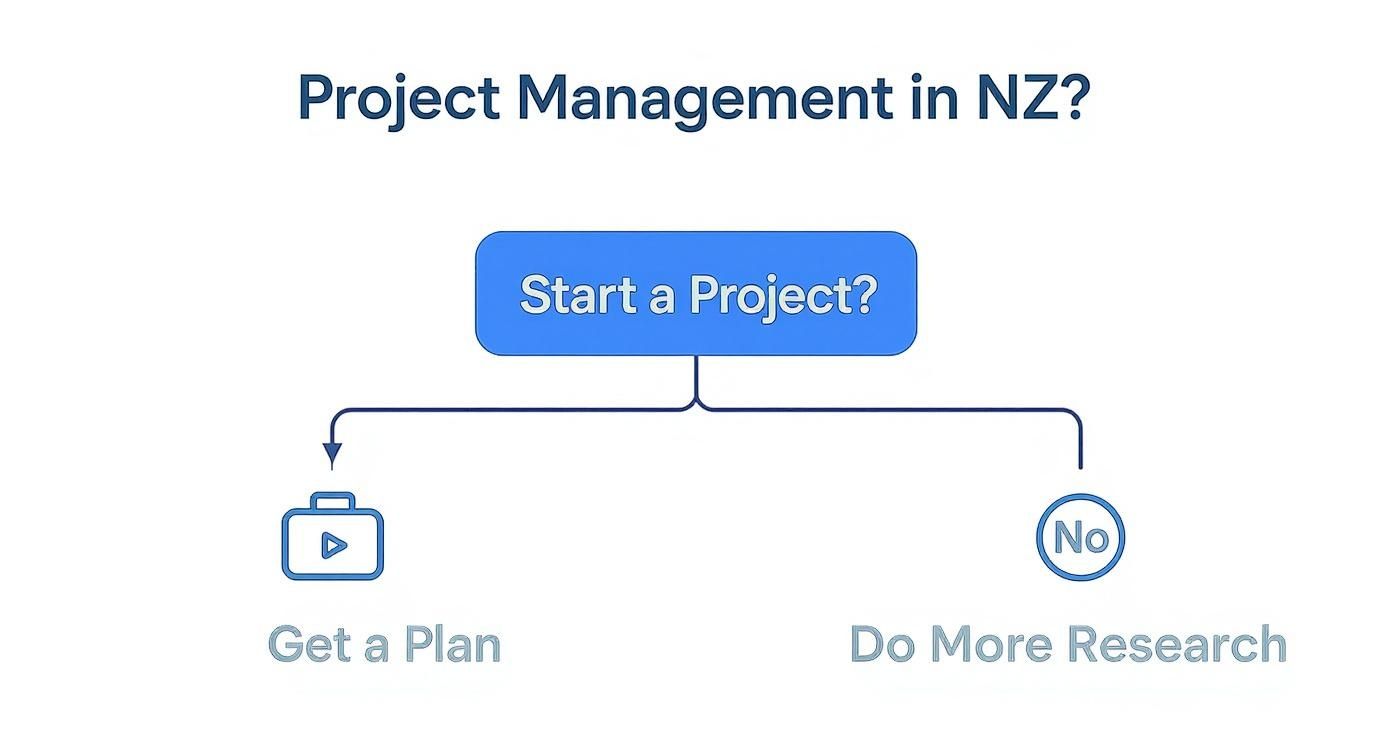
The key takeaway here is that planning is essential, but so is knowing when you need more information before you commit to a single path.
What if your project needs a bit of both? That’s where a Hybrid approach comes in. You might use Waterfall for the initial planning and hardware setup but switch to Agile for the software development part. It’s about mixing and matching to suit your specific needs.
This practical, blended approach is becoming extremely popular here in New Zealand. A recent survey found that 65% of organisations in NZ now use Agile or Hybrid frameworks. It’s a smart way to get the structure you need without sacrificing the ability to adapt.
To make it even clearer, here’s a simple comparison to help you decide which methodology best fits your project's needs.
| Methodology | Best For... | Key Trait | Kiwi Analogy |
|---|---|---|---|
| Waterfall | Projects with fixed requirements and a clear endpoint (e.g., building construction). | Sequential & Linear | Building a classic state house from a set blueprint. |
| Agile | Complex projects where requirements are expected to evolve (e.g., app development). | Iterative & Flexible | Exploring a new tramping track; you adapt your route based on the terrain. |
| Hybrid | Projects with both stable and evolving components (e.g., a new retail store with an e-commerce site). | Blended & Practical | Renovating a villa: the foundation plan is fixed, but the interior design is flexible. |
Ultimately, choosing the right methodology isn't about chasing the latest trend. It’s about honestly assessing your project's goals, your team's strengths, and how much uncertainty you're facing.
The goal is to pick a method that helps you deliver value, not one that just adds unnecessary admin. Don't be afraid to take elements from different frameworks to create a system that works for you. That’s the real number-eight-wire solution.
Here’s the thing about getting projects off the ground in New Zealand – it has its own unique rhythm. It’s not just about what you do, but how you do it. This part of the guide covers both the unwritten rules and the official laws you need to get your head around for any project to succeed here.

Think of it like this: your project plan is the map, but understanding the local culture and laws is your compass. Without the compass, you’re just guessing which way is north.
In New Zealand, business often feels less transactional and more personal. Building genuine relationships isn't just a "soft skill"; it's a core part of getting things done.
A quick coffee before a meeting can often achieve more than the meeting itself. It’s in these informal moments that the real trust is built and progress is made. Kiwis want to know who they’re working with, not just what’s on the agenda. It’s a culture built on mutual respect, where your word still means something.
In many ways, the strength of your project is directly tied to the strength of your relationships. A project stakeholder isn't just a name on an email chain; they're someone you might bump into at the supermarket on Saturday. That simple fact changes everything.
This relational approach means you need to be a good listener, show genuine interest, and just be upfront. Kiwis have a pretty low tolerance for corporate jargon and fluff; they appreciate straight talk.
Another vital piece of the puzzle is understanding the principles of Te Tiriti o Waitangi (the Treaty of Waitangi). This isn't just a historical document; its principles are woven into the very fabric of modern New Zealand business and governance. For any project, especially those impacting land, resources, or communities, a genuine partnership with Māori is absolutely essential.
So, what does this actually mean for your project? It means early and meaningful engagement with local iwi (tribes) and hapū (sub-tribes). This goes far beyond simple consultation; it’s about co-design and partnership, making sure Māori perspectives are respected and properly integrated from the start.
Bringing Te Ao Māori (the Māori worldview) into your planning can also bring incredible value. Concepts like kaitiakitanga (guardianship and protection of the environment) can guide sustainable practices, leading to much better long-term outcomes for everyone. Ignoring this dimension isn't just a cultural misstep—it can create significant project risks and roadblocks down the line.
Right, onto the official rules. While there’s a mountain of legislation out there, a few key acts directly impact most projects, particularly in the digital and construction spaces. Let's break down the big ones.
Navigating this landscape successfully is all about balance. It’s about blending that classic Kiwi 'get it done' attitude with a deep respect for people, culture, and the law. Get that right, and your projects won't just be completed; they'll be truly successful.
So, you’ve decided to partner with a local digital agency for your web or app project. Great choice! But how do you make sure it's a success story and not one of those cautionary tales we've all heard?
Let’s be honest, managing that partnership is a project in itself. It's all about clear communication, setting realistic expectations, and working as a genuine team—even if they’re not on your payroll. Think of it like co-piloting a plane; you both need to agree on the destination and trust each other to handle the controls.
You know what? The single biggest point of failure in agency projects is a vague or incomplete brief. If you don't clearly define what you want, how can you possibly expect them to build it?
A good brief isn’t just a wish list. It’s the foundational document for the entire project. It should clearly outline:
Getting this document right forces you to think through your own requirements. A well-written brief saves everyone a ton of time, money, and headaches down the track.
When the proposals start rolling in, it’s so tempting to just skip to the bottom line. But trust me, the cheapest quote is rarely the best value.
What you should be looking for is an agency that asks smart questions. If they just accept your brief without any pushback or suggestions, that’s a bit of a red flag. A great partner will challenge your assumptions and bring ideas to the table you hadn't even considered. They should feel like a strategic advisor, not just a pair of hands to write code.
A proposal is more than a price; it's the beginning of a conversation. A good one demonstrates that the agency truly understands your business problem and has a credible plan to solve it.
Now, let's talk contracts. You’ll usually run into two main types here in New Zealand:
There’s no single right answer here. A fixed-price contract is often safer for a simple, well-defined website. T&M, on the other hand, is usually better for complex software development where you'll be learning and adapting as you go.
Many Kiwi agencies are getting smarter about this, too. Recent data shows that by the end of 2024, 78% of project managers in NZ had adopted digital tools, which helped 62% of projects finish within 10% of their original budget. For a deeper dive, you can discover more insights in the full AECOM report.
Once the project kicks off, your role changes. You need to stay engaged without becoming a bottleneck.
Your main job is to provide clear, timely feedback. If your agency works in sprints (which is common in Agile), make sure you attend the sprint reviews. This is your opportunity to see the progress, test what’s been built, and give constructive input. For managing these kinds of workflows and client relationships, many businesses are exploring new systems. You can read more about some of the options for CRM and automation development in our guide.
Remember, the agency are the experts in their field. Trust their process. Give them the space to do their best work, but be available to answer questions and make the important calls. That balance of trust and oversight is the real secret to a brilliant partnership and a successful project.
Right, let's get into the sharp end of things: the money and the paperwork. It’s not the most exciting part of managing a project here in NZ, but trust me, getting this stuff wrong can bring a world of pain later on.
This is all about the nuts and bolts of actually getting your project off the ground. Sorting out the commercial side isn't just about dotting i's and crossing t's; it’s about pouring a solid foundation so the whole thing doesn’t fall over halfway through.
First up is procurement—which is just the business-speak for finding and choosing the right suppliers or contractors for your project. I know it’s incredibly tempting to just grab the cheapest quote and run with it. Who wouldn’t want to save a bit of cash? But in my experience, that’s often a recipe for disaster.
What you're really looking for is a partner, not just a vendor. You need someone who actually gets your vision. When you’re vetting potential suppliers, you should be asking some pointed questions about their process and their past work. Can they give you references from other Kiwi businesses? How do they handle it when things inevitably go sideways?
The best suppliers are the ones who ask you smart questions back. It shows they're genuinely thinking about your project's success, not just the invoice they'll be sending at the end of it.
Once you've found your partner, it’s time to get everything down in writing. A solid contract is there to protect everyone involved and make sure there are no nasty surprises down the track.
Here in New Zealand, contracts for digital or service projects tend to follow a few common formats, but it's the clauses inside that really matter. Don't just give it a quick skim. You absolutely must pay close attention to a few key areas:
Getting the contract right is especially crucial when you're deciding on a big purchase. For instance, you need to clearly understand the long-term implications and costs when considering custom software vs off-the-shelf options.
Finally, let's talk budget. Putting together a realistic budget is a bit of an art form. It's so easy to fall into the trap of being overly optimistic and underestimating costs, but that will always come back to bite you.
Start by breaking down every single expense you can think of. And I mean everything—from the major contractor fees right down to the smaller monthly software subscriptions. And please, don't forget to add 15% for GST to all your NZ-based costs; it's a simple mistake that can instantly blow your numbers out of the water.
But here’s the most important tip of all: always, always have a contingency fund. You know what? Things go wrong. Unexpected problems crop up. A good rule of thumb is to set aside an extra 10-20% of your total project budget for these "just in case" moments. It might feel like unnecessary padding at the start, but you’ll be incredibly grateful for it when you need it. A budget without a contingency isn't really a budget—it's just a wish list.
So, you’re ready to pull the trigger and engage a digital agency. Fantastic. But just before you pick up the phone or start typing that email, let’s run through a quick pre-flight check. This isn’t about creating more work for yourself; it’s about making sure you’re set up for a win right from the very first conversation.
Think of it like packing your bags before a big trip. A bit of prep work makes the whole journey smoother, and you're far less likely to forget something critical. Getting these few things sorted internally will make your initial chats with potential partners incredibly productive.
First things first: what problem are you actually trying to solve? It’s a simple question, but the answer is everything. "We need a new website" isn't a business goal; it's one possible solution.
You need to dig deeper. "We need to increase online sales by 20% within six months" – now that’s a goal. Or, "We need to cut our customer service call volume by 30% by letting customers self-serve online" – that’s a goal, too. When an agency understands the commercial outcome you’re chasing, they can bring their A-game and suggest far smarter, more effective solutions.
Next up, who is this all for? And just a heads-up, "everyone" is never the right answer. Try to paint a simple picture of your ideal customer. What keeps them up at night? What are their biggest frustrations with your current setup (or lack thereof)? What do they really need this new digital tool to do for them?
The more you understand your audience, the better the end product will be. This clarity helps an agency make those crucial design and functionality decisions that serve your customers' real-world needs, not just your own internal assumptions.
Let's talk brass tacks. You have to have a rough budget and an ideal timeline in your head. No one expects a detailed financial model, but you need to know if you're working with a $15,000 budget or a $150,000 one. It's a world of difference that completely reframes the scope of what's achievable.
Being upfront about your budget from day one allows an agency to propose a realistic solution that fits. The same goes for your timeline. Do you absolutely need this launched before Christmas for the holiday rush? Let them know. This kind of honesty prevents a world of pain and disappointment down the track.
It's also vital to figure out your internal capacity. Who on your team is going to be the main point of contact? Who has the authority to make the final call on decisions? Answering these questions now will prevent delays and confusion once the project is underway.
So, before you reach out, can you confidently tick these boxes?
When you have solid answers to these questions, it shows you’ve done your homework. It helps agencies give you a much more accurate and thoughtful proposal. And honestly? It makes them really want to work with you. You're not just another vague enquiry; you're a serious business, ready to build something great.
Still have a few questions rattling around? You're definitely not alone. Once Kiwi businesses start getting serious about project management in NZ, the same queries tend to pop up time and time again.
It’s one thing to talk about methodologies and contracts, but it's another to handle the day-to-day realities. So, let’s tackle some of the most common questions we hear with some straight-up answers to help clear the air.
Honestly, you don’t need a super-complex system to get started. Many small and medium businesses in New Zealand do just fine with flexible, affordable tools like Trello, Asana, or Monday.com. They’re like a digital whiteboard—easy to get the hang of and great for visualising workflows.
For more complicated projects, especially in the construction or IT sectors, you’ll often see teams using something more robust like Jira. The real key isn’t the brand name; it’s choosing a tool that actually fits how your team works. A complicated tool that nobody uses is just a waste of money, right?
Ah, the dreaded scope creep—when small, seemingly harmless requests slowly pile up and derail your entire project. The best defence here is a really clear, detailed scope of work outlined in your initial contract. It has to be your single source of truth.
When a new request pops up (and it will), you need to address it immediately. Don’t just say yes to be nice. Acknowledge the idea, then have an open chat about how it will impact the project's timeline and budget.
Your best friend in this situation is a formal 'change request' process. This simply means any new work is documented, costed, and approved in writing before any work begins. It might feel a bit formal, but it keeps everyone on the same page and protects you from those nasty budget blowouts.
This is a big one. While formal certifications like PMP or PRINCE2 are certainly valuable and well-respected, they're not always essential for managing projects within a Kiwi SMB.
Let me explain. In a smaller business, practical experience, great communication skills, and a deep understanding of your industry often carry far more weight. Your ability to build relationships and solve problems on the fly is what really matters at the end of the day.
However, if you’re tackling large, complex projects or looking to make project management your long-term career path, getting certified can give you a significant edge. It provides a structured framework and a credential that many larger organisations look for. Think of it as a nice-to-have for most SMBs, but a must-have for certain career tracks.
Ready to turn your next project idea into a reality? The team at NZ Apps specialises in building custom web and mobile solutions that help Kiwi businesses grow. Book a free consultation with us today!