
You're at the kitchen table at 11pm, comparing two pricing pages for the product you've spent years building. One says “simple flat fee”. The other says “per seat, per month”. Both look tidy in a pitch deck. In the spreadsheet, both have started a small fire.
That discomfort is sensible. SaaS pricing models decide more than what appears on an invoice. They shape your sales motion, product packaging, support load, gross margin, expansion path, and the way NZ and Australian buyers react when GST, AI costs, or price rises enter the conversation. A pricing model is product architecture with a price tag attached.
The founder in this situation usually isn't afraid of choosing the wrong number. They're afraid of choosing the wrong unit of charge. If the product charges by seat, a customer can avoid adding users. If it charges by usage, the customer may worry about an unpredictable bill. If it charges one flat fee, your heaviest accounts can quietly consume the margin that lighter accounts create.
That choice can cap growth for months, then force an awkward migration when customers have already built their budgets around the old structure. Nobody wants to tell a loyal Christchurch customer that their “simple” plan now needs a calculator. Nobody wants to explain to an Auckland finance lead why an AI feature has doubled infrastructure costs while the subscription stays fixed.

Practical rule: Choose the charge unit your customer already uses to describe value.
A useful explainer on how the SaaS business model works can help with the wider commercial picture, but the pricing call still belongs in your product room. Ask what grows when the customer gets more value. Is it the number of people collaborating, the number of records processed, access to advanced modules, or the volume of AI work completed?
The seven models ahead give you a practical menu: flat-rate, per-user, tiered, usage-based, freemium, per-feature, and hybrid. You don't need a perfect answer. You need a defensible default that fits your buyer, your costs, and the way the product will mature.
The easiest way to understand SaaS pricing models is to picture the bill before you write the pricing page. What event causes the charge? A login, a transaction, a feature, a usage threshold, or just the passing of a month?
One plan, one recurring fee, and the same core access for every customer. It's the café menu board: easy to read, quick to order, and not interested in measuring every sip. Charge for access to the whole product, rather than seats, calls, or storage.
The customer pays for each named or active seat. Think of a gym membership. The more people who need access, the larger the bill, whether those people use the product heavily or only wander in occasionally. This suits collaboration products where every additional user receives clear value.
Customers choose from packages that increase in capability, limits, or support. It's the airline cabin model: economy, business, and something more comfortable for buyers with bigger needs. The charge is usually a recurring fee per account, with features or usage allowances defining each tier.
The bill follows consumption, such as API calls, transactions, gigabytes, documents, or AI generations. It works like a taxi meter. The customer pays for the distance travelled, so the value metric must be easy to count and easy to understand.
A useful version of the product stays free, while advanced features, larger limits, or team controls require payment. It's the supermarket sample. People can taste the product without a purchase, but the free experience must lead naturally to a moment where paying makes sense.
The customer pays for access to particular modules, such as reporting, automation, security, or advanced integrations. Picture a cable TV add-on. The base service works, and customers add the channels that matter to their role or organisation.
Hybrid combines two charging methods, often a base subscription with usage overages, or a platform fee with paid modules. It resembles a loyalty card with points and tiers. The customer gets a predictable foundation, while your revenue can grow when usage or product breadth grows.
The analogy matters, but the charge unit matters more. “Per user” and “per active user” aren't the same. “Per plan” and “per module” aren't the same. Write the billable event in one plain sentence. If a customer can't repeat that sentence to a colleague, the model is already too foggy.
A model can look attractive in a product meeting and still behave badly in the market. The right question isn't “Which one sounds modern?” It's “What must be true about our customers for this model to work?”
| Model | Key Upside | Key Downside | Best-Fit Stage |
|---|---|---|---|
| Flat-rate | Fast to explain and easy to forecast | Heavy accounts can consume more than they pay for | Pre-PMF, while one buyer type and usage pattern dominate |
| Per-user | Revenue grows as teams add seats | A small account can limit spend by keeping access narrow | Early growth, when an admin buyer controls team access |
| Tiered | Gives buyers a clear upgrade path | Poor boundaries create confusion and stalled upgrades | Several customer groups, with repeatable differences in needs |
| Usage-based | Price follows consumption and customer value | Forecasting and bill anxiety become harder | Products with clean, visible usage such as transactions or API calls |
| Freemium | Removes the first purchase barrier | Free accounts still create hosting and support costs | Product-led products with a strong self-serve activation path |
| Per-feature | Lets larger buyers pay for advanced capability | Too many gates make the product feel chopped up | Sales-led products with distinct admin, security, or reporting needs |
| Hybrid | Balances predictable revenue with expansion | Billing and metering become more demanding | Growth stage, when costs and customer behaviour no longer look uniform |
Flat-rate is a great demo, rough business when founders haven't found their buyer. It keeps the sales conversation clean, but it hides whether a large account is genuinely profitable. Keep it when the product is narrow and usage barely varies. Replace it when the spreadsheet shows two very different customer shapes.
Per-seat pricing is the model that bleeds margin when an NZ SME buyer says, “We only need three logins.” If the product delivers value through data volume, automation, or AI work rather than human access, seats create the wrong ceiling. A tiered or hybrid structure usually gives that buyer a fair entry point without giving a high-consumption account unlimited headroom.
The uncomfortable test: If your customer gets more value without adding users, don't make headcount your only growth lever.
Freemium deserves particular discipline. It isn't a pricing model that fixes weak activation. It's an acquisition route that works when users reach a clear product moment, then need collaboration, capacity, or control. If that moment never arrives, you're funding a free service rather than building a paid funnel.
A founder in Hamilton can copy a polished US pricing page and still lose margin on the first large account. NZ and AU buyers bring different expectations around recurring spend, tax, procurement, and AI value. Price the local buying situation, not the competitor's layout.
New Zealand buyers have long understood recurring software bills. A 2014 comparison of SaaS cloud pricing in NZ SMEs found 57% of observed models were subscription-based, compared with 29% one-off payment models and 20% pay-per-use models. 24% of NZ SMEs used open-source pricing arrangements. The figures overlap because the study tracked multiple arrangements, but the historical NZ SaaS pricing baseline still shows that subscription software was familiar to local buyers.
NZTE describes flat-rate, per-user, usage-based, feature-based, and bundled approaches in its guidance on pricing and packaging SaaS products. The practical test is simple: buyers should understand what makes the bill rise. That usually means a clear usage unit, a visible feature boundary, or a package tied to a recognisable business outcome.
| Signal | NZ impact | AU impact |
|---|---|---|
| Recurring software spend | Subscription billing is familiar, but buyers question expansion costs | Recurring billing is expected, while procurement teams want clearer packaging |
| Price-rise pressure | Enterprise SaaS vendors raised prices by an average of 12%, and 73% raised prices in the reported period, according to NZ SaaS price-rise reporting | Buyers scrutinise increases and ask what new value supports them |
| GST | Non-resident software suppliers must register and charge GST after NZ customer supplies exceed NZ$60,000 in the relevant 12-month test. GST is 15%, according to NZ GST guidance for remote digital services | Australian tax treatment requires separate accounting and local advice |
| AI packaging | AI features need visible value and sensible usage controls | Larger buying committees scrutinise AI surcharges |
| Local comparison | Founders compete with bundled platforms and direct rivals | Buyers compare modules, service levels, and contract flexibility |
AI-linked price rises make vague packaging especially dangerous. Charge for measurable processing, automation, or output where possible. A blanket AI surcharge gives procurement teams a reason to delay approval.
The local shift away from pure per-seat pricing is practical, not fashionable. A Hamilton HR SaaS may need usage tiers when customers buy an all-in-one platform. A Melbourne CRM may need feature packages when buyers resist a broad per-seat increase. Hybrid pricing can preserve an accessible base fee while charging for consumption that drives cost.
Use lost-deal notes, usage logs, and margin data to choose the model. Review SaaS companies operating in Australia for competitor questions and packaging patterns, then test those patterns against your own customers. Competitor research should shape the questions, never dictate the answer.
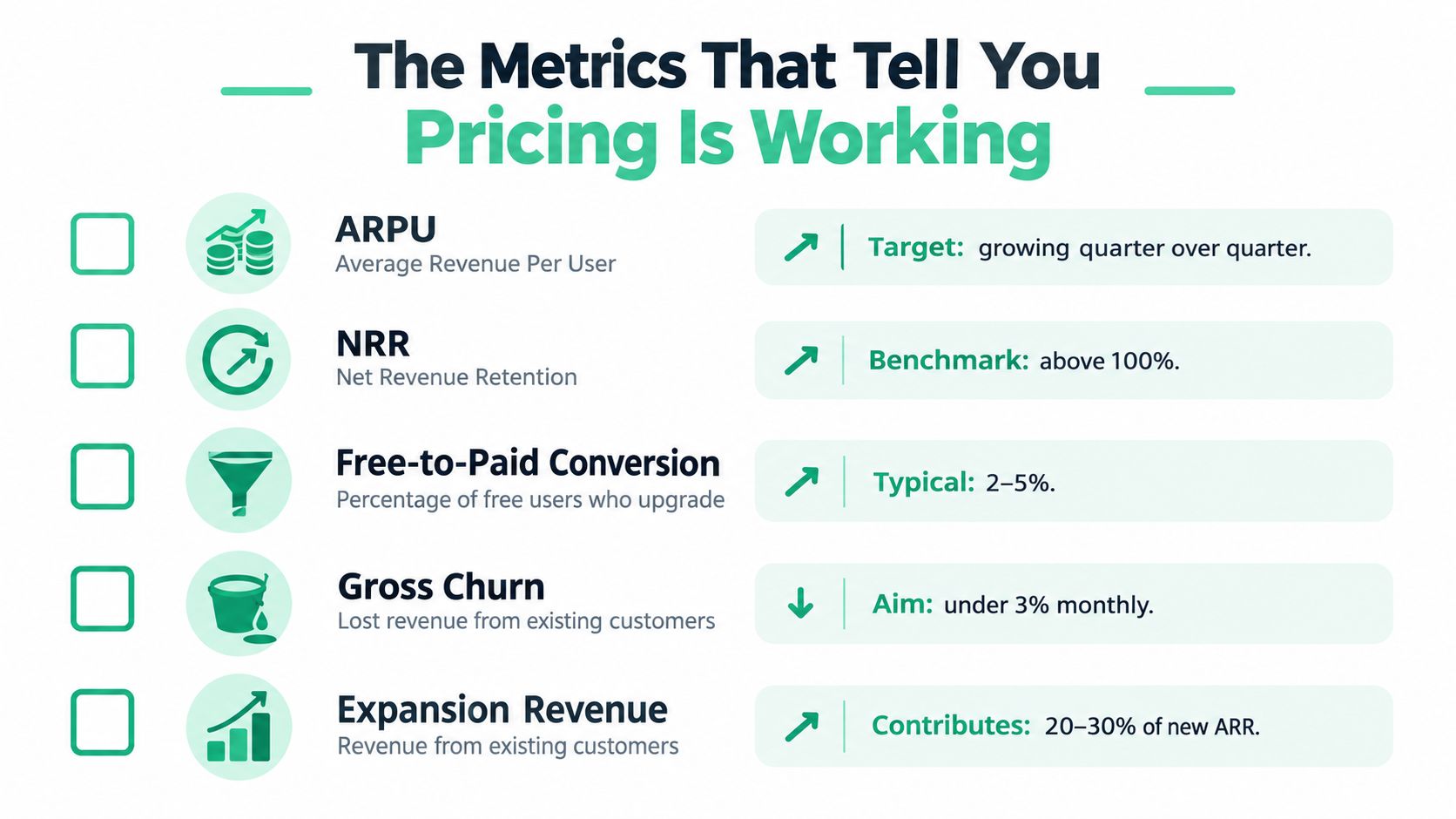
Pricing changes fail when founders watch the wrong dashboard. Sign-ups can rise while paid conversion falls. Revenue can rise while gross churn steadily worsens. A useful pricing review connects the first customer action to the later account economics.
Free-to-paid conversion tells you whether the new wall or package makes sense to active users. Watch it before celebrating sign-ups. If more people arrive but fewer recognise the reason to pay, the pricing page may be doing its job too well at attracting the wrong audience.
Gross churn is the first hard warning after a price change. Separate cancellations caused by price from cancellations caused by product gaps, poor onboarding, or a failed use case. A single blended churn figure hides the reason you need to act.
ARPU, or average revenue per user or account, shows whether the new structure captures more value from paying customers. Growing ARPU is useful only if customers still renew and expand. A higher starting bill can mask a weaker customer base.
NRR shows whether existing customers, including upgrades, downgrades, and cancellations, are worth more over time. Expansion revenue reveals whether the model gives healthy accounts a natural way to spend more, rather than forcing your sales team to renegotiate every account.
Review the metrics in this order:
For a deeper measurement framework, Prometheus Agency's guide to SaaS revenue analytics is a useful companion. Keep the dashboard small. Five decision inputs beat a wall of numbers nobody uses.
Your SaaS customer lifetime value guide can sit beside this review, but don't let lifetime value become a decorative finance number. Use it to decide whether the customer you acquire under the new model can support the cost of selling, serving, and retaining them.
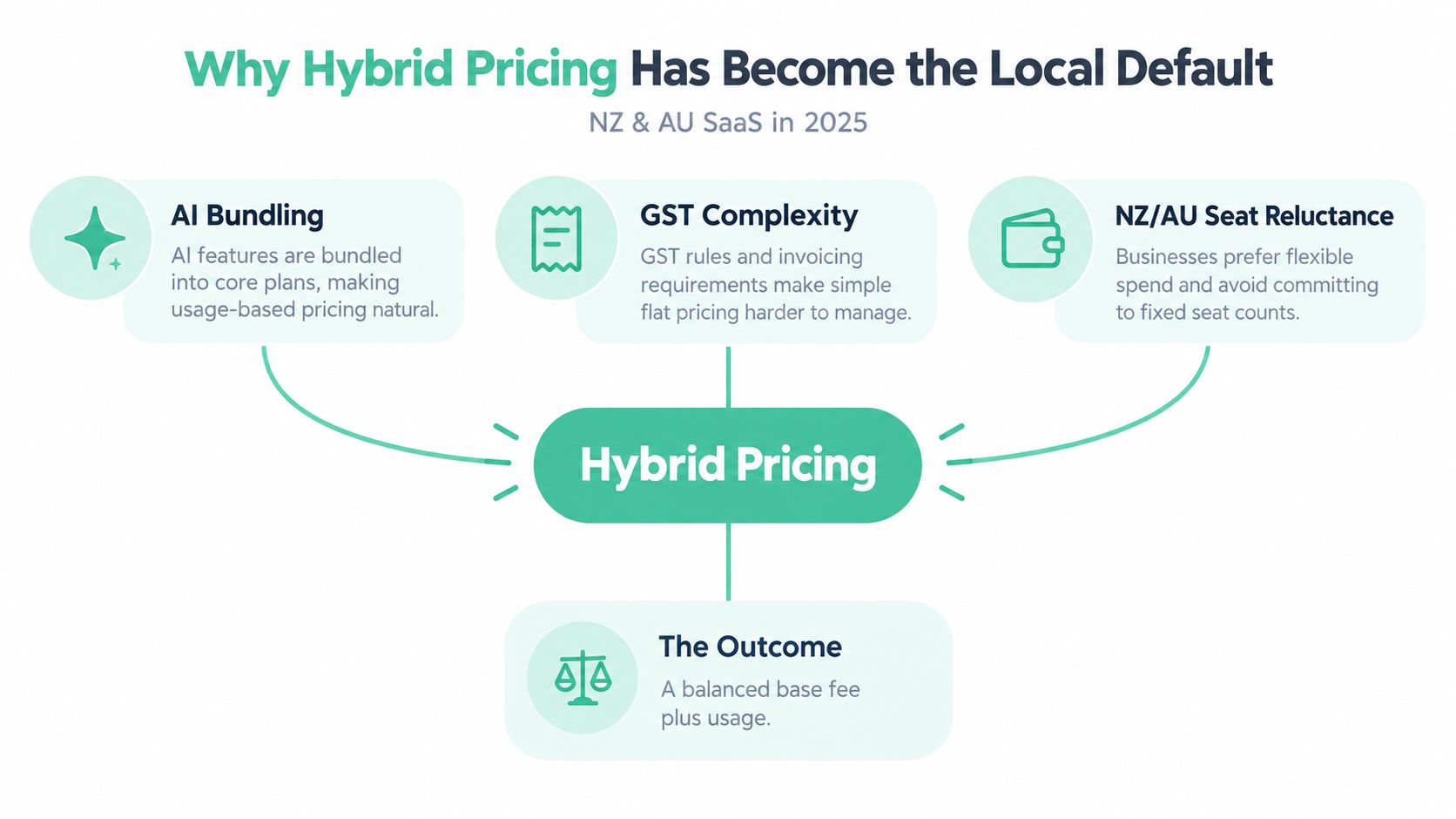
Hybrid pricing is the sensible default for many NZ and Australian SaaS products because customers want a predictable starting bill while founders need protection from variable costs. A single flat fee struggles when AI usage varies. A pure usage bill can frighten procurement. A pure per-seat model misses value that grows without headcount.
The most practical regional pattern is a per-seat base plus usage overage. Seats cover access to the workspace, while AI generations, document processing, or other costly actions use a visible allowance and then trigger a charge. The second pattern is a tiered platform fee plus per-module add-ons, which lets a small customer buy the core product without paying for enterprise reporting, automation, or compliance tools they don't need.
A 2025 report said Microsoft tested AI-linked price increases of 29% to 45% across several Asia-Pacific markets, including New Zealand, as described in coverage of AI-linked price testing. That doesn't tell you what your price should be. It does tell you that buyers will ask whether an AI bundle earns its place on the invoice.
A Wellington data startup that adds AI processing to a fixed subscription can discover the problem quickly: revenue stays flat while every active workflow consumes more compute. Adding a metered allowance after launch sounds like a billing task. It isn't. You need event definitions, customer-facing usage visibility, invoice rules, alerts, entitlement logic, and finance reconciliation.
Build the meter before you need the meter. Retrofitting usage charges onto a flat-rate platform is a billing project, a product project, and a customer-trust project at once.
Hybrid doesn't mean adding every possible charge. Use two clear dimensions at most for the common purchase. A base fee plus usage can work. A platform tier plus modules can work. Three overlapping limits, credits, seats, and overages usually needs a calculator, which is a polite way of saying the pricing page has stopped selling.
A pricing migration should start with an account map, not an announcement email. List every customer on the current model, then segment accounts by annual recurring revenue, tenure, usage, contract terms, and renewal date. You need a clear decision for each group: grandfather, move at renewal, or discuss an earlier change because the current plan no longer reflects the account's needs.
Speak to champions before the wider notice. Give them the reason for the change in product terms, such as a new usage allowance or a module that better matches their workflow. Then send written details that show the old price, the new structure, the effective date, and the path back to a lower plan.
A sensible transition often freezes the old price for 12 months for existing customers, with the exact treatment recorded in the contract and billing system. Give customers a one-click downgrade path. A downgrade is information. If you make it feel like a trap, it becomes a cancellation.
Stripe and Chargebee can handle grandfathered line items, but the operational work doesn't end there. Map every new product, tax treatment, discount, and legacy price to Xero before month-end reconciliation. If finance can't explain why an invoice changed, support will inherit the argument.
Give each red flag a response within 48 hours. Don't wait for the next monthly report. Pricing trust is easier to protect while the confusion is fresh.
Take this checklist into the next pricing review. Follow the order, and keep the discussion anchored in evidence before debating the headline price.
Choose one model to test against the current structure for the next quarter. Use one tiebreaker metric, such as paid conversion for new customers or gross churn during an existing-customer migration. An unclear result usually means the test includes too many changes.
NZ Apps provides a regional directory and editorial view of app and SaaS companies across New Zealand and Australia. Use NZ Apps to research local companies and compare pricing approaches in your category before the next review.
Add your NZ or Australian app or tech company to the NZ Apps directory and get discovered by founders and operators across the region.
Get ListedReach tech decision-makers across New Zealand and Australia. Sponsored and dofollow editorial links, permanent featured listings, and sponsored articles on a DA30+ .co.nz domain.
See Options