
Search engine marketing (SEM) is a fancy term for a simple idea: putting your business right in front of customers the very moment they’re looking for what you sell. At its core, it's about running paid advertisements on search engines like Google.

Picture this. A potential customer in Wellington is on their phone, typing in a search for the exact service you provide. Will they find you, or will they find your competitor first? Honestly, that’s the million-dollar question SEM is built to answer.
This isn’t about just running flashy ads. It's about being present and helpful at the precise moment a potential customer needs you. It’s a powerful way Kiwi businesses are connecting with new customers every single day.
You’ve likely heard of SEO (Search Engine Optimisation), and it's easy to get the two mixed up. It's a classic case of mistaken identity. Think of them as cousins, not twins. Let me break it down with a simple analogy.
Imagine the Google search results page is the busiest digital highway in the country. SEM is like renting a massive, eye-catching billboard right at the main exit—you pay to be seen immediately. SEO, on the other hand, is like building such a fantastic shop with amazing word-of-mouth that the city gives you a permanent, prime spot right on the main street for free.
Both are incredibly valuable, but they get the job done in different ways:
Many of the most successful small businesses in New Zealand use a smart combination of both.
Throughout this guide, we'll give you a clear roadmap, covering everything from the foundational ideas to smart, actionable steps you can use today. You’ll learn how to make every dollar count and turn clicks into loyal customers. No fluff, just practical advice. Ready? Let's get into it.
Before you put a single dollar on the table, it’s crucial to get the basics down. We’ll walk through the essentials of search engine marketing, but don't worry—we’re skipping the dense, confusing jargon. Honestly, it's a lot simpler than it sounds.
Think of the Google search results page as a bustling digital marketplace. The paid ads you see right at the top? Those are the premium stalls at the main entrance, catching everyone's eye immediately. The organic results further down are the established, trusted shops that people have come to know and love over time. Both are super valuable, but they attract customers in completely different ways.
Here’s the thing, the real magic is understanding how people search. The journey a customer takes isn’t a straight line; it's more of a winding path. It often starts with a vague idea, then gets more and more specific as they get closer to making a decision.
Let’s imagine someone in Christchurch needs a new heat pump. Their search journey might look a little something like this:
These super-specific phrases are what we call long-tail keywords. They might not get a huge volume of searches, but the people using them? They usually know exactly what they want. They are your secret weapon for finding customers who are ready to buy, not just browse.
Of course, the way we search is always changing. Trends like voice search ("Hey Google, find a cafe near me") and visual search are shaping how Kiwis find what they need. To truly get ahead, it's essential to first grasp the fundamental concepts, including a deeper understanding of What Is Search Engine Marketing and How Does It Drive Growth.
The goal of great search engine marketing is to meet your customers exactly where they are on their journey—with the right message at the right time. It’s less about shouting at them and more about being the helpful answer they were looking for all along.
So, with all the options out there, where should you focus your energy and budget? In New Zealand, the answer is crystal clear. It's Google.
When we look at the numbers, Google isn't just a leader; it's practically the entire game. This dominance is why a well-executed Google Ads strategy is non-negotiable for any Kiwi business looking to grow.
| Search Engine | Market Share |
|---|---|
| 90.52% | |
| Bing | 5.86% |
| DuckDuckGo | 1.35% |
| Yahoo! | 1.05% |
| Ecosia | 0.6% |
| Other | 0.62% |
Data from StatCounter, May 2024
As you can see, while other search engines exist, Google’s hold on the New Zealand market is massive. For businesses, this means that nearly every potential customer you want to reach is already using Google to find products and services just like yours.
Here’s a simple visual that shows how all the different pieces of SEM fit together.
This diagram shows how things like keyword research, ad creation, and landing page design all feed into the same goal: attracting the right kind of traffic. It highlights that SEM isn't just one thing, but a collection of interconnected tactics. Think of it as a system where each part supports the others, helping you build a campaign that doesn't just get clicks, but actually grows your business.
So, you're ready to see how a search engine marketing campaign actually comes together? Let's pull back the curtain and unpack the four essential pillars of any campaign that gets real-world results. This isn't about some secret technical wizardry; it's about a solid, repeatable process.
Think of it like building a house. You wouldn't just throw up the walls and hope for the best, would you? You need a solid foundation first. SEM is exactly the same.
Everything starts here. Honestly, great keyword research is less about guesswork and more about digital empathy. What words are your potential customers in Auckland, Christchurch, or anywhere in between actually typing into Google?
Your job is to get inside their heads. Are they searching for an "emergency plumber near me" or "how to fix a leaky tap"? The first one is a customer ready to hire; the second is someone looking for a DIY solution. That's a massive difference, isn't it? You're hunting for those high-intent phrases that signal someone is ready to make a move. For a much deeper look, check out our complete guide to keyword research for NZ businesses.
Once you've got your keywords, it's time to bid on them. I know this sounds intimidating, but let me explain. Imagine a silent auction happening millions of times a day on Google. The smartest bid often wins, not just the highest one.
Google’s system is a bit more sophisticated than a simple highest-bidder-wins scenario. It also looks at the quality and relevance of your ad and the page you send people to. This means a well-crafted, highly relevant campaign can sometimes outrank a competitor with a much bigger budget. You're not just buying clicks; you're earning them by being the best answer.
Now for the fun part: writing the actual ad. This is your chance to start a conversation, not just shout a sales pitch from a digital rooftop. Your ad copy—the headline and description people see on Google—needs to be compelling, clear, and human.
The best ads don’t feel like ads at all. They feel like a direct answer to a question the searcher just asked. It's a moment of connection.
Here are a few pointers to keep in mind:
The goal is simple: stand out on a crowded results page and give someone a genuine reason to choose your ad over all the others.
Finally, let's talk about the landing page. This is the crucial handshake that happens after the click. You can have the best ad in the world, but if it leads to a slow, confusing, or irrelevant webpage, you've just wasted your money.
A great ad leading to a poor landing page is a broken promise. The page must continue the conversation your ad started, making the next step obvious and easy for the visitor.
The journey from a user's search to a final purchase is a critical path to understand. This visual shows the simple, yet powerful, journey a customer takes in a search marketing campaign.
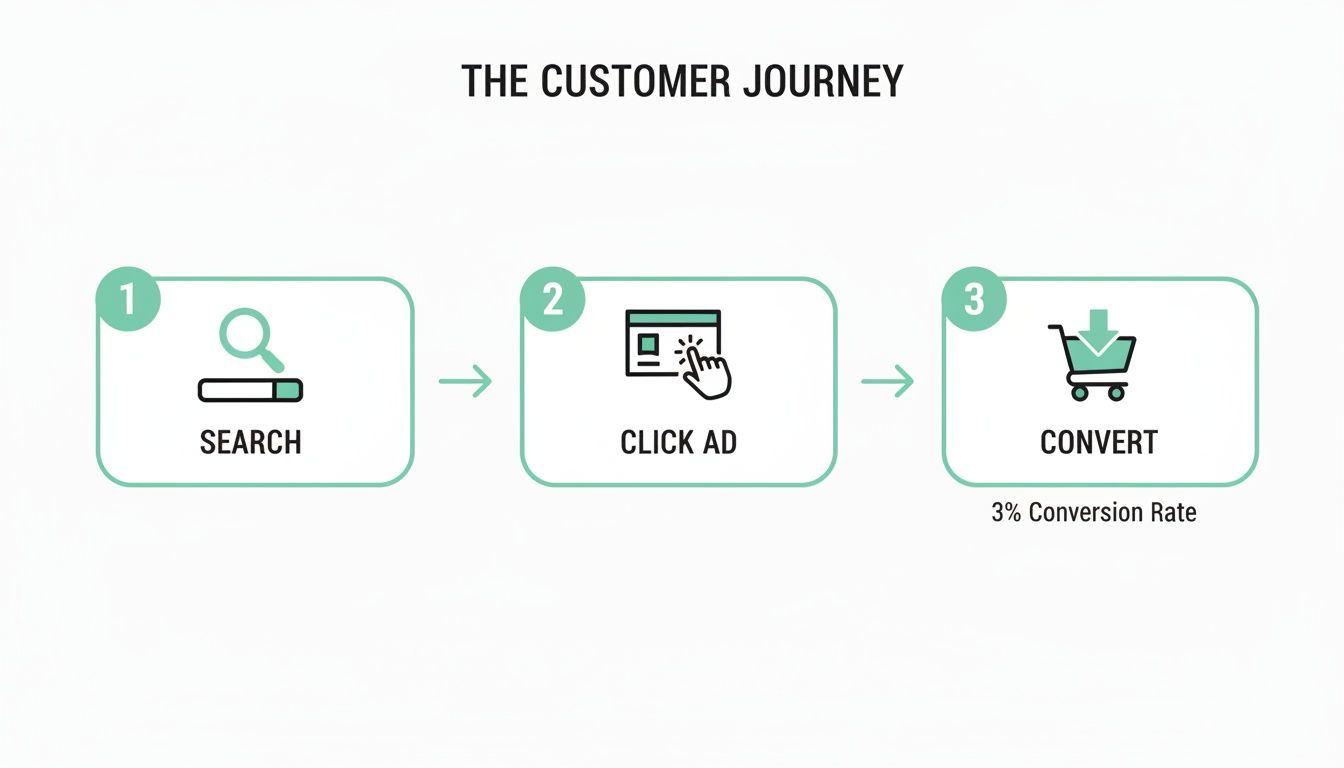
This flow highlights that every step is connected. A weakness in one area, like a confusing landing page, can break the entire chain. These four pillars—keywords, bidding, ad copy, and landing pages—are the foundational elements you'll build your success on. Get these right, and you're well on your way.
Alright, let's get local. This is where a good search engine marketing campaign becomes a great one, especially here in New Zealand. Casting a wide net across the entire country might seem like a solid plan, but honestly? It’s often a fast way to burn through your budget without much to show for it.
A campaign that’s hyper-focused on specific suburbs in Auckland or Dunedin will almost always outperform a generic, nationwide one. Why? Because you’re not just shouting into the void; you’re talking directly to the people most likely to become your customers. It's about being a big fish in a small, profitable pond.
Think of it this way. If you're a florist in Ponsonby, does it really make sense to pay for your ad to be shown to someone searching in Invercargill? Probably not. That's where geo-targeting comes in. It lets you draw a virtual fence around the areas you actually serve—down to specific postcodes or even a radius around your shop.
But we can get even smarter. Let's talk about timing.
Ad scheduling is your secret weapon against wasted spend. If you run a B2B accounting firm in Riccarton, does it make sense to run your ads at 3 AM on a Sunday? Unlikely. You can schedule your ads to appear only during business hours when your ideal clients are actually looking for your services. This simple tweak makes every dollar work harder.
It's not about having the biggest budget; it's about making every single dollar work smarter. Precision beats power every time in the world of search engine marketing.
Beyond just where and when, you need to think about who. You can tailor your messaging to different audience segments. For example, you might show a different ad to someone who has visited your website before compared to someone who is discovering you for the first time. It's like having a slightly different conversation with a new acquaintance versus an old friend.
Now, let's talk numbers, because I know that's the big question. What does all this cost?
The truth is, there's no one-size-fits-all budget. A startup cafe in Wellington will have a vastly different budget from an established e-commerce store shipping nationwide.
Here’s a practical way to think about it:
Remember, these are just starting points. The key is to set a budget that aligns with your business goals and what you can realistically afford to test and learn with.
With New Zealand's internet penetration hitting a massive 96.2%, your potential audience is definitely online. But where exactly are they spending their time? This is crucial for figuring out where your ad spend will have the most impact.
| Platform | Reach % |
|---|---|
| 96.2% | |
| YouTube | 80.6% |
| 73.1% | |
| 61.2% | |
| TikTok | 40.5% |
As you can see, Google is king, but platforms like YouTube offer massive reach too. This data helps you understand the opportunity waiting for you. You can discover more insights about NZ's digital habits on datareportal.com. Your job is to find the most valuable slice of that audience and focus your budget there.
Launching your search engine marketing campaign is genuinely just the start. Think of it like putting a boat in the water; the real skill comes in steering it, reading the currents, and making sure you’re actually heading toward your destination. The real magic happens when you start listening to the data.
So, how do you know if your campaign is a roaring success or just… well, roaring? You don’t need a data science degree, just a handle on a few key numbers. These are your campaign’s vital signs, telling you what’s healthy and what needs attention.
Forget drowning in spreadsheets filled with dozens of confusing acronyms. For now, let’s focus on the big three that tell most of the story. These are the Key Performance Indicators (KPIs) that reveal what’s truly happening.
A crucial metric for gauging your campaign's success is understanding your Return on Ad Spend (ROAS). This tells you how much revenue you’re generating for every dollar you put into your advertising. It’s the ultimate measure of whether your SEM efforts are paying off.
Okay, so you know what to look at. But how do you actually track it all without getting overwhelmed? Honestly, tools like Google Analytics are your best friends here.
Setting up conversion tracking is non-negotiable. This is what connects the dots between someone clicking your ad and taking that valuable action on your website. Without it, you’re flying blind, spending money without knowing if it’s generating any real business.
You wouldn’t run a shop without a cash register, right? Think of conversion tracking as the cash register for your digital marketing. It’s the only way to know if you're making a profit.
Once that's set up, your workflow becomes a simple, continuous loop: launch, measure, learn, and adjust. Spend a little time each week checking in on your campaigns. Look for keywords that are getting lots of clicks but no conversions—those are just eating your budget. Pause them. Find ads with a low CTR? It’s time to test a new headline.
Speaking of testing, let's talk about A/B testing. This sounds technical, but it’s just a fancy term for a simple idea: testing one version of something against another to see which one performs better.
You can A/B test almost anything:
The key is to change only one thing at a time. If you change the headline and the button colour, you won’t know which change made the difference. This process of continuous improvement is what turns a decent campaign into a fantastic one. You stop guessing what your audience wants and start knowing what resonates with them, one small tweak at a time.
So, we've covered a lot of ground on ads, keywords, and data. But here’s the crucial bit—a powerful search engine marketing campaign is only as good as the technical foundation it’s built on. Honestly, it's a bit like having a world-class race car driver but giving them a clunky, unreliable car to drive.
That’s where your website or app enters the picture. All the ad clicks in the world mean very little if they send people to a frustrating experience.
Have you ever clicked an ad on your phone, only to land on a page that’s impossible to read without pinching and zooming? It’s an instant turn-off, isn’t it? That user experience is something Google pays very close attention to.
A responsive, mobile-first website or app isn't just a "nice-to-have" these days; it directly affects how well your SEM performs. Google actually rewards advertisers who provide a fantastic post-click experience with a higher Quality Score.
A higher Quality Score is essentially Google's nod of approval, saying, "Hey, your ad and your landing page are genuinely helpful." The reward? Better ad positions and, often, a lower cost per click. It’s proof that putting your customers first is also fantastic for your bottom line.
This means a well-designed site from a team like NZ Apps can genuinely make your ad budget stretch further. It’s all about creating a seamless journey from the moment someone sees your ad to the second they become a customer.
Okay, let's get practical. You’re spending money to get people to your website. But what happens once they arrive? A click is just a visit; a conversion is what actually grows your business. This is where your marketing and your digital assets have to connect perfectly.
Proper tracking is the first, non-negotiable step. Without it, you’re just guessing. We help our clients install and set up the right analytics tools, so you know precisely which ads are bringing in phone calls, form submissions, or sales.
From there, we move into Conversion Rate Optimisation (CRO). This is the process of fine-tuning your website to make it as easy as possible for visitors to take that next step. This could involve things like:
These small, data-driven tweaks can have a massive impact on your return on investment. It's the difference between a website that just looks nice and one that actively works to grow your business.
Let's look at a real-world example. We worked with a Kiwi e-commerce client who was getting plenty of ad clicks but was frustrated with their sales figures. Their ads were spot-on, but their mobile checkout process was clunky and confusing.
By simply redesigning their checkout flow to be more intuitive, we saw their mobile conversion rate jump by over 30% in the first month. Their ad spend didn't change, but their revenue certainly did. For companies building from the ground up, understanding the nuances of mobile app development in New Zealand can make all the difference.
This is exactly what a cohesive strategy looks like. It’s about ensuring your search engine marketing and your digital platforms are working together in perfect harmony. Your ads make a promise, and your website or app delivers on it flawlessly. When that happens, you create a customer experience that not only converts but also builds trust and loyalty for the long haul.
Let's quickly run through some of the most common questions we get from Kiwi businesses. This is your chance to clear up any final thoughts before you jump in.
This is a great question, and the answer isn't "all the time." You don't need to be changing your ads every single day, but you definitely can't set them and forget them for months on end.
A good rhythm is to check in on performance weekly, and aim to test a new ad variation every 2-4 weeks. If you notice an ad’s click-through rate starting to dip, that’s your signal it's time to bring in something fresh.
Honestly, yes, it’s becoming more and more relevant. While people aren't making complex purchases through their smart speakers just yet, they are asking plenty of questions.
Think about queries like "find a cafe near me" or "best mechanics in Christchurch." Targeting these conversational, question-based keywords is a clever way to catch customers right when they need you. It’s all about being the answer, wherever they happen to be asking the question.
When you're just kicking things off, keep it simple. Don't get lost in all the complex bidding models from day one.
Starting with a "Maximise Clicks" strategy is usually the best approach. Why? Because your first goal is simply to gather data. Once you've got enough click and conversion data flowing through, you can switch to a more advanced strategy like "Maximise Conversions." It's a natural progression—you learn first, then you earn.
Feeling ready to put all this into action? The team at NZ Apps can help you build a high-performing website or app that turns your SEM clicks into loyal customers. Get in touch for a free consultation today.