
Search engines optimisation is the art and science of getting search engines like Google to find, understand, and ultimately, favour your website. Simple as that.
It’s all about making your digital storefront visible to Kiwis who are actively searching for what you offer, whether they're in Auckland, Christchurch, or Invercargill. The end game? To climb higher in the search results and drive more of the right kind of traffic to your site. You want people who are actually looking for you, right?
Let's be honest, the term 'search engines optimisation' sounds a bit like technical jargon, doesn't it? But really, it’s not as intimidating as it sounds.
Think of it like this: your website is a brand-new shop on a busy high street. Just opening the doors and hoping for the best won't cut it; you need people to actually find you. SEO is everything you do to put up a big, bright sign, hand out flyers, and make sure your shop is listed correctly on the local map so customers can walk right in. It’s about being seen by the right people, at the exact moment they need you. A simple, powerful idea.
You know, a few years back, some businesses could get away with treating SEO as an afterthought. Those days are long gone. It’s now a non-negotiable part of having a presence online. It’s the difference between putting up a billboard in the middle of the desert and securing a prime storefront on Queen Street. One gets seen; the other... not so much.
This isn’t just a gut feeling; the numbers tell the same story. The global market for search engine optimisation services is forecast to shoot up from $108.28 billion in 2026 to a massive $203.83 billion by 2030. That’s a huge leap, and it signals that businesses everywhere, including right here in New Zealand, get just how critical SEO is for survival and growth.
Here's a simple breakdown of the core pillars of search engines optimisation.
| SEO Pillar | What It Means in Simple Terms | Why It Matters for Your NZ Business |
|---|---|---|
| Technical SEO | Making sure your website's foundation is solid so search engines can easily read and understand it. Think of it as ensuring your shop has clear signs, wide aisles, and no broken steps. | A technically sound site gets indexed faster and more accurately by Google, which is the first step to ranking for anything. |
| On-Page SEO | This is all about the content on your website itself—the words, images, and structure. It's about using the right language to show both customers and Google what you're about. | This helps you rank for specific Kiwi search terms, like "plumber in Wellington" or "best flat white Christchurch," connecting you directly with local customers. |
| Off-Page SEO | This is your website's reputation across the internet. It includes things like getting links from other reputable NZ sites, reviews, and mentions on social media. It’s your word-of-mouth, but online. | Strong off-page signals build trust and authority with Google, proving your business is a legitimate and respected player in your industry. |
Getting these three pillars working together is where the magic really happens for your business's online visibility. They all need to be in sync.
At its heart, search engines optimisation is really about one thing: proving your website offers genuine value. Google’s primary goal is to give its users the best, most relevant answers to their questions. Your job is to convince Google that your website is that best answer. That's the whole game.
You do this by:
It's less about trying to 'trick' Google and more about playing by its rules. And the biggest rule is this: be helpful, be clear, and be trustworthy. When you focus on that, you’re already well on your way.
For anyone wanting to get the full picture, there are some fantastic resources out there. To get a better handle on how a business can succeed with SEO, this guide explains how to tie together the technical, on-page, and local aspects in a comprehensive Mastering SEO Of A Company Guide. It's a great place to start wrapping your head around the bigger picture.
Ever wondered how Google seems to read your mind? It’s not actually magic, but it’s pretty close. Think of search engines as the world's most organised and efficient digital librarians, working tirelessly behind the scenes to make sense of the internet. A mammoth task, really.
They do this by sending out little automated programs, often called 'spiders' or 'crawlers,' to explore the web. These crawlers are constantly at work, following links from one page to the next, reading the content, and figuring out what each page is all about.
Once a crawler visits a page, it sends that information back to be stored in a gigantic, organised library called an index. This isn't the live internet; it's a saved copy, like a colossal catalogue of every webpage the search engine has found.
When you type a search—say, "best flat white in Christchurch"—the engine doesn't start searching the entire internet from scratch. Can you imagine how long that would take? Instead, it blitzes through its own neatly organised index to find every relevant page in a matter of milliseconds.
This is where the real art of search engines optimisation comes into play. After finding all the relevant pages, the search engine has to decide which ones deserve the top spots. This is the ranking stage, and it's all handled by a complex set of rules, or algorithms.
So what are these algorithms looking for? They analyse hundreds of different signals to figure out a page's authority, relevance, and overall quality. They’re essentially asking a series of questions:
The end goal is always the same: to give you, the searcher, the most helpful and reliable answer to your query. Your job, with SEO, is to prove to the search engine that your page is that answer.
Here’s the thing: Google’s algorithms are constantly evolving. They're always getting smarter about spotting genuinely useful content versus pages just trying to game the system. Staying informed about important changes like recent Google updates helps you adapt your strategy to remain visible.
For any Kiwi business, getting your head around this is critical. Why? Because one player completely dominates our local scene. Google's grip on New Zealand's search market is almost absolute, holding a staggering 91.05% market share as of early 2026. This means that focusing on Google isn’t just a good idea—it's the only game in town if you want to be found online.
This infographic breaks down the core pillars of search engines optimisation, showing how Technical, On-Page, and Off-Page SEO all work together.
As you can see, everything starts with a solid technical foundation. From there, it's about creating quality content and then building authority and trust across the web.
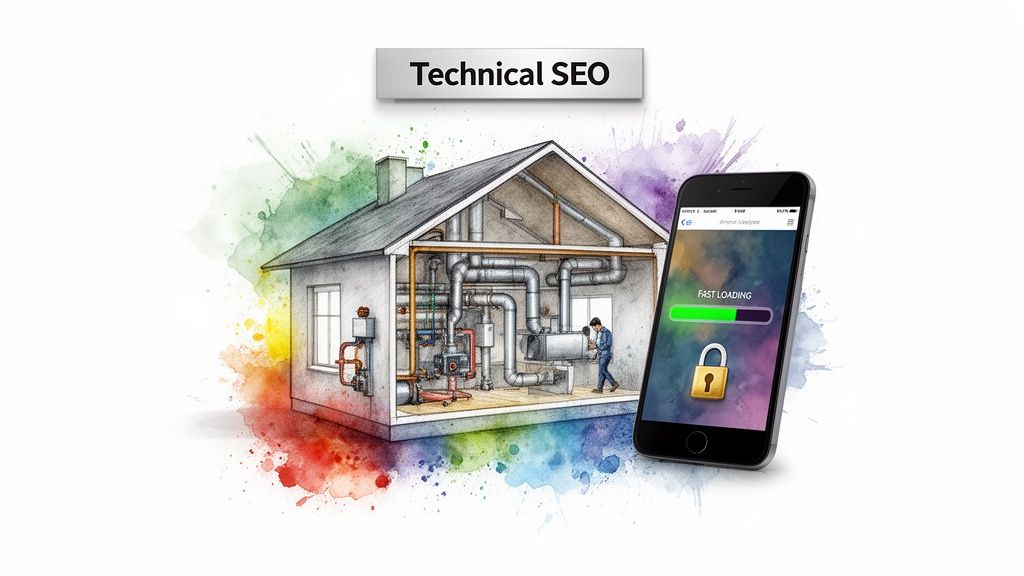
Alright, let’s talk foundations. Technical SEO is a bit like checking the plumbing, wiring, and structural integrity of your house before you start decorating. If the foundation is shaky, it doesn't matter how amazing the interior design is. This side of SEO is all about making sure your website is easy for search engine crawlers to find, understand, and index.
Is your site fast? Is it secure? Does it work well on a mobile phone? These aren't just minor tech details; they're massive signals that tell Google whether your site offers a good experience for visitors. For any Kiwi business serious about competing online, a solid technical base is non-negotiable.
Think about it from a user's perspective. You’ve probably clicked on a website and just… waited. And waited. We all have. Most people will hit the back button within seconds if a page doesn’t load. Google knows this, which is why site speed has become a huge ranking factor.
Site speed isn’t just about keeping impatient visitors happy; it’s a direct message to search engines about the quality of your website. A slow site feels clunky and untrustworthy—not exactly the kind of experience Google wants to send its users to.
In the same way, security is essential. A site with an SSL certificate (that's the little padlock you see in the address bar) encrypts data between the user and your site. It’s a basic sign of professionalism and safety, and Google gives a clear preference to secure sites. Without it, you’re not just risking your customers’ trust, you’re actively hurting your chances to rank well.
Another crucial piece of the puzzle is your site's structure, often guided by a sitemap. Imagine you're a first-time visitor in a massive museum without a map or any signs. Pretty confusing, right? That’s exactly what it feels like for a search engine crawler landing on a messy, disorganised website.
A clean, logical structure helps Google understand which pages are most important and how they all relate to one another. This includes things like:
yourshop.co.nz/mens/running-shoes is far clearer to everyone than yourshop.co.nz/prod_id=123.Here's a thought: Technical SEO is fundamentally about removing roadblocks. Every technical issue—a broken link, a slow-loading image, a confusing URL—is a barrier that stops Google from seeing the great content you've created. Fixing them is like clearing the path.
Let me explain something critical about how Google sees your site today. It uses what's called mobile-first indexing. In simple terms, this means it primarily looks at the mobile version of your website for ranking and indexing purposes.
What does that mean for you? It means your website must work beautifully on a phone. If it's clunky, hard to read, or difficult to navigate on a mobile device, your rankings will suffer, no matter how great it looks on a desktop. This isn't just a trend; it's the new standard.
Many businesses also find that their choice of website hosting in New Zealand can have a surprising impact on both site speed and reliability—two cornerstones of technical SEO.
So, while "technical SEO" might sound like something you'd want to leave to the IT department, the basics are incredibly important for any business owner to grasp. It’s the invisible framework that holds up all your other marketing efforts. Without it, even the best content can fail to get the attention it truly deserves.
If technical SEO is the solid foundation of your house, then on-page SEO is everything that makes it a home—the paint on the walls, the furniture, the smart layout. This is the part of search engines optimisation that your customers actually see and interact with. It’s all about using the right words, headlines, and images to tell both Google and your visitors exactly what a page is all about.
You wouldn’t just dump all your products onto shelves in a random jumble, would you? Of course not. You’d create clear aisles and put up helpful signs. On-page SEO does the exact same thing for your website, making sure every page is clearly labelled so people can find what they need, fast.
The real heart of great on-page SEO is getting inside your customers' heads to understand what they're looking for. It's so much more than just stuffing a keyword into a page a dozen times; it's about genuinely answering a question or solving a problem.
For example, someone searching for "emergency plumber Auckland" isn't after a long-winded history of plumbing. They have an urgent, specific problem that needs solving right now. Your page has to meet that need head-on with clear, direct, and helpful information. This is where keyword research is so vital. You need to know the exact phrases and questions Kiwis are typing into Google. If you're keen to nail this, our detailed guide on keyword research for NZ businesses is the perfect place to start.
This principle is even more important now, thanks to new search habits. Voice search, for instance, has completely changed the game. Recent statistics show that a whopping 50% of all searches in New Zealand are now voice-based. This is a massive shift because people talk to their phones very differently than they type. They ask full, conversational questions, and your content has to be ready with the answers. You can discover more insights about these evolving digital marketing trends in New Zealand on applabx.com.
So, how do you create content that both people and search engines will love? Simple: focus on creating something genuinely useful, then structure it in a clear, logical way.
Here’s what that looks like in practice:
Page Titles and Meta Descriptions: Your page title (that blue link in the search results) is your first impression. Make it compelling and include your main keyword. The meta description, that little snippet of text underneath, is your sales pitch to convince someone to click.
Headings and Subheadings: Break up your text with clear headings (just like the ones on this page!). They create a logical flow that makes your content easy to scan for busy readers and helps Google understand the structure of your information.
High-Quality Content: This is the big one. Your content has to be well-written, accurate, and truly helpful. Your goal should be to answer the user's query better than anyone else on the internet.
Honestly, the best on-page SEO feels invisible. It’s not about trickery; it’s about clarity. When you write clear, helpful content that directly addresses what your audience is searching for, you’re already doing most of the work.
On-page optimisation isn't just about the text on the page. Other elements play a massive role in how your content is perceived by both your audience and search engines.
Take images, for example. A page with relevant, high-quality images is far more engaging than a boring wall of text. But search engines can't 'see' images the way we can. That’s why you need to use descriptive alt text—a short, written description of what the image shows. This simple step helps search engines understand the image's context and makes your site more accessible for everyone.
Likewise, the URL of the page itself is an important on-page signal. A clean, descriptive URL like yourbakery.co.nz/sourdough-bread-making-class is much better than a messy one like yourbakery.co.nz/page-id=789. It tells everyone, including Google, exactly what to expect before they even click. It’s all part of creating a seamless, easy-to-understand experience from start to finish.
So, your website's technical foundations are solid and your on-page content is genuinely helpful. What’s next? It’s time to start building your reputation across the web, not just on your own site. This is where off-page and local SEO come into play, two absolutely critical pieces of the search engine optimisation puzzle.
Think of it this way: everything we've talked about so far is what you say about yourself. Off-page SEO, on the other hand, is all about what everyone else says about you. It’s the digital version of word-of-mouth, and it’s incredibly powerful.

The most common form of off-page SEO is earning backlinks. Put simply, a backlink is just a link from someone else's website pointing back to yours. But here's the catch—not all links are created equal.
Imagine you're a chef in Wellington. A glowing review from a well-known food critic at The Post carries a lot more weight than a casual compliment from a stranger, right? It’s exactly the same with backlinks. A single link from a highly respected site like the NZ Herald or a major industry blog acts as a powerful vote of confidence. It tells Google that your website is trustworthy and authoritative.
Google sees these quality links as strong signals that your content is valuable. The more of these reputable "votes" you can collect, the more authority your own site gains, which can give your rankings a serious boost. It's always about quality over quantity.
Now, let's talk about something that is absolutely vital for any Kiwi business with a physical address or a local service area. Local SEO is a specialised part of search engine optimisation that focuses on making you visible in geographically-related searches.
You know when you search for "cafe near me" or "plumber in Auckland"? That little map with three business listings that pops up at the very top of the results—that's called the 'map pack' or 'local pack.' Getting your business featured there can be a complete game-changer.
Why is this so important? Because people making these kinds of searches are ready to act. They’re not just browsing; they’re looking to buy, book, or visit right now. For many small businesses, dominating that local pack is far more valuable than ranking number one nationally.
The absolute cornerstone of local SEO is your Google Business Profile (GBP). This is the free business listing that appears in Google Maps and the local pack. Honestly, if you do nothing else for your local SEO, make this your number one priority.
A well-managed GBP includes:
Here's the thing about local search: consistency is king. Google needs to see the exact same NAP information for your business everywhere it looks online—on your website, on your GBP, and on other online directories. Any little inconsistencies can create confusion and erode Google's trust, which can hurt your local rankings.
Beyond your GBP, two other elements are crucial for a strong local presence. The first is customer reviews. Positive reviews on Google and other relevant sites are a massive trust signal, not just for potential customers but for search engines, too. Encouraging your happy customers to leave feedback is one of the most effective local SEO strategies you can possibly employ.
The second is citations. A citation is any online mention of your business's NAP (name, address, phone number). These can appear in local business directories like Finda, industry-specific websites, or community portals. Having consistent citations across the web reinforces to Google that you are a legitimate, established local business. If you're looking for more actionable advice, exploring a comprehensive guide to local SEO for small businesses in NZ can provide a clear roadmap.
Ultimately, both off-page and local SEO are about building trust and proving your relevance. By earning quality backlinks and cementing your local presence, you’re showing Google that you’re not just another website—you’re a reputable authority and a trusted part of the local community.
Right, feeling a bit swamped by all this SEO talk? That's perfectly okay. It's a massive field, and no one expects you to master it overnight.
The trick is to just start somewhere simple. You don't need a grand, all-encompassing strategy from day one. For most small businesses here in New Zealand, the best first step is a quick check-up to see where you're currently at.
This initial audit doesn't need to be some intimidating, multi-page report. It’s really just about getting a quick snapshot of your website’s health by asking a few basic questions.
Are your page titles clear? Does your website load at a decent speed on a mobile phone? Do you have a Google Business Profile set up and verified? Answering these gives you a clear and immediate starting point.
From there, it's all about tackling the low-hanging fruit—those quick wins that can deliver real results without a mountain of effort.
Not sure where to begin? Let's break it down into a few practical steps. Think of this as your beginner's roadmap to getting found online.
Claim and Polish Your Google Business Profile: This is an absolute must-do for any Kiwi business with a physical location or local service area. Fill out every single section you can—add good photos, list your services, and make sure your hours are dead-on accurate. For many, this is the fastest way to see a jump in local search results.
Review Your Most Important Page Titles: Take a look at the titles for your homepage and your top three service pages. Do they clearly state what you do and where you do it? Something like "Bespoke Kitchen Design Christchurch" is far more effective than just "Services". A simple title tweak can have a surprisingly big impact.
Check Your Mobile Experience: Pull out your phone and actually try to use your own website. Is it easy to navigate? Can you find your contact number in a few seconds? If it frustrates you, you can bet it's frustrating your potential customers, too.
The most important thing is to just start. Don’t get stuck in 'analysis paralysis.' Pick one thing from that list and do it this week. Small, consistent actions are what build momentum in search engines optimisation.
Now, the big question: should you try to do this all yourself?
Getting your hands dirty with the basics is a fantastic way to learn. But when you’re ready to build powerful SEO into your projects from the ground up—or if you simply don't have the time—then bringing in the professionals makes a lot of sense. An agency like NZ Apps can weave these principles into the very fabric of your website, ensuring your digital presence is built on a strong foundation from day one.
We get it. The world of search engine optimisation can feel like it has its own language, full of jargon and moving parts. It’s only natural to have a few questions.
So, let’s clear the air on some of the most common ones we hear from Kiwi business owners just like you.
Honestly, SEO isn’t an overnight fix. It’s more like planting a garden than flipping a switch; it needs a bit of patience to see it flourish.
You can often spot small, encouraging improvements within the first 3 months, especially with quick fixes to your local SEO. However, for those more competitive keywords and significant, lasting results, you should expect to see meaningful progress in about 6 to 12 months.
It's a long-term strategy that builds on itself over time, delivering compounding returns.
You absolutely can! You know what? There are many foundational SEO tasks you can learn and put into action yourself.
Getting started is often the hardest part, but things like setting up a Google Business Profile, writing descriptive page titles, and creating genuinely helpful blog content are great first steps. It’s a fantastic way to understand the fundamentals.
However, as you get into the more technical side of search engine optimisation—things like site speed, schema markup, or complex backlink strategies—partnering with an agency can save you a huge amount of time and help you get better results, faster.
This is a big one. SEO is definitely an ongoing process, not a set-it-and-forget-it task.
Think of it like maintaining your car; you don't just service it once and expect it to run perfectly forever. Search engines are always updating their algorithms, your competitors are constantly trying to outrank you, and what your customers search for changes over time.
Consistent effort is the key to maintaining and, more importantly, improving your rankings for the long haul. It's about staying relevant in a constantly shifting digital space.
Ready to build a powerful digital presence from the ground up? The team at NZ Apps weaves expert search engine optimisation into the very fabric of our custom web and app development projects, ensuring your business is built to be found. Let's chat about your goals. Get in touch with us today.