
Trying to find the right SEO agency in New Zealand can feel like a mission, can't it? You're staring at a huge list of options, all promising the world, but it’s so hard to figure out who can actually deliver real, measurable growth for a Kiwi business like yours.

Let’s be honest. Have you ever found yourself scrolling through countless websites, from big-name firms in Auckland to specialists in Wellington, and noticed they all start to sound the same? They all promise the moon. But what does that actually mean for your business?
Where do you even begin? It's so easy to get lost in the noise.
This guide is designed to cut right through that. We’re going to get real about what actually matters when you're trying to grow your business online here in Aotearoa. Forget the buzzwords for a second; let's talk about tangible results—more qualified people finding your website, more genuine leads landing in your inbox, and a healthier bottom line.
The truth is, many agencies throw around jargon like "keyword density" and "domain authority" without ever tying it back to what you really care about. It’s a bit like a mechanic talking about the torque converter when all you want to know is if your car is safe to drive to work. Right?
You need a partner who speaks your language. One who gets that a top ranking is completely useless if it doesn't bring in a paying customer.
For instance, a plumber in Christchurch doesn't just want to rank for "plumbing services." They need to be the first result for "emergency plumber Christchurch" when someone has a burst pipe at 2 AM. That kind of specific focus is everything.
So, why is this so important? Because when SEO is done right, it really works. It's still a powerhouse for New Zealand businesses, driving an incredible 53% of all website traffic organically, compared to just 15% from paid search.
On top of that, a whopping 49% of marketers see organic search as the channel with the highest return on investment. For a local business, say a dental clinic in Auckland, hitting one of the top-3 spots for a search like 'dentist near me' can capture almost all the potential clicks. It just shows how crucial great SEO is. You can learn more about how powerful SEO still is from this recent report.
Think of it this way: your website could be the quietest corner of the internet or your most powerful sales tool. A great SEO partnership is what makes the difference. It turns your online presence from a passive brochure into an active, lead-generating machine.
This guide isn’t just another list of agencies. It’s your roadmap. It’s here to help you understand the landscape before you sign on the dotted line, so you can find a true partner who will deliver genuine, sustainable growth.
Let’s get into it.
Okay, let's hit pause before you even think about Googling "SEO agency." The single biggest mistake I see Kiwi businesses make is jumping into the search without a clear map of where they actually want to go. It’s a bit like hopping in the car for a roadie with no destination—you’ll burn a lot of fuel, that’s for sure, but you'll probably end up somewhere you never intended to be.
Honestly, what does a "win" with SEO look like for your business? The answer is always different.
Are you an e-commerce store in Wellington trying to shift more product online? Or maybe you're a plumber in Christchurch who just needs the phone to ring more consistently? Perhaps you're an Auckland accounting firm aiming to be seen as the undisputed expert across the country. Each of these scenarios demands a completely different game plan.
Before you have a single conversation with an SEO agency in New Zealand, you absolutely must define what success means in tangible terms. Vague goals like "I want more traffic" are the enemy of good SEO. Why? Because website visitors don't pay the bills. Customers do.
We need to get specific. Your goals have to be measurable and tied directly to real business outcomes.
Figuring this out first is non-negotiable. It’s the difference between telling an agency "get me to number one on Google" and "help me land 20 more plumbing jobs in Christchurch each month." One is a vanity metric; the other is pure business growth. For a deeper look at this, you might find our guide on local SEO for small businesses in NZ really useful.
Now for the slightly awkward but totally necessary conversation: your budget. How much you're prepared to invest directly shapes the scope and pace of any SEO campaign. There's no magic number, but walking into a conversation without a realistic range in mind is a recipe for wasted time.
Think of it like building a house. You wouldn't tell a builder "just build me something nice" without giving them a budget, would you? The exact same logic applies here. An agency needs to understand what resources they have to work with to build your digital presence effectively.
Your budget isn’t just a line item cost; it’s an investment in your growth. And like any good investment, it should be structured to deliver a return. Being upfront about what you can afford allows an agency to build a practical strategy that gets you the best possible results for your spend.
Finally, take a quick look inward at your own resources. Who do you have on your team? Is there someone who can write a decent blog post when needed? Do you have a person who can quickly approve technical changes to the website?
An SEO agency is a partner, not a magician working in a vacuum. The more support you can offer from your end—whether that's industry knowledge, content creation, or just speedy approvals—the faster and better the results will be. Knowing your own capacity helps set realistic expectations for everyone involved.
Doing this groundwork isn't just a "nice-to-have." It’s what separates a focused, successful search for a partner from a random shot in the dark. Nail this part, and you're already halfway to a great result.
So, you’ve figured out what you want to achieve. Brilliant. Now for the interesting part—choosing your partner. And let’s be crystal clear, this isn't about picking the agency with the flashiest website or the smoothest sales pitch. It’s about finding a team that can genuinely deliver.
How do you tell the real experts from the ones just selling snake oil? You need to dig a little deeper.
The first and most important test is proof. Anyone can talk a good game, but can they show you the results they've achieved for businesses like yours? When you ask for case studies, don't just accept a glossy PDF. You're looking for specifics, especially from other Kiwi businesses.
You should be asking:
An agency that’s truly proud of its work will be eager to share the story behind the numbers. If they're hesitant or vague, that’s a pretty big red flag.
Here’s a simple but surprisingly effective trick: Google them. Seriously. If you’re looking to hire an SEO agency in New Zealand, how well does their own website rank for relevant terms? If they can't get their own site to show up in search results, how can you trust them to do it for you?
Now, this isn't the be-all and end-all—they might focus on referrals—but a strong online presence is a good sign they know their stuff. It shows they believe in their own process enough to use it on themselves.
This handy decision tree shows how your goals—whether they're about sales, leads, or authority—should shape the kind of results you look for.
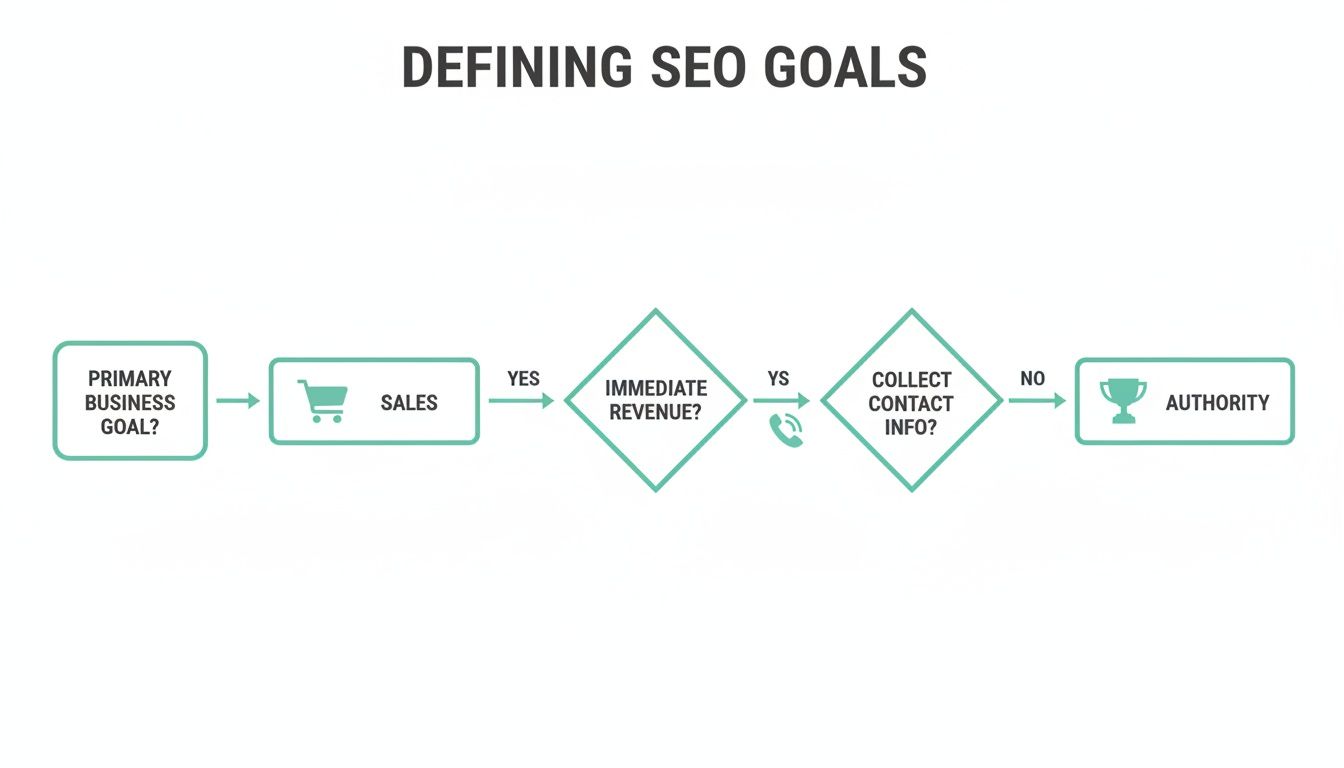
Whether you’re chasing sales or leads, the proof of an agency's ability lies in their demonstrated results for businesses with similar goals.
SEO has its fair share of jargon—SERPs, DA, CTR, you name it. A great agency knows all these terms, but a truly excellent one knows when not to use them. Their job is to make the complex simple, not to confuse you into signing a contract.
If you find yourself in a meeting nodding along but secretly have no idea what they're talking about, be cautious. A good partner will take the time to explain their strategy in a way that makes sense to you. They should be able to connect every proposed action back to your business goals.
A key sign of a trustworthy agency is their ability to translate technical actions into business outcomes. They should be able to answer the question, "Why are we doing this?" with an answer that relates to your bottom line, not just search engine algorithms.
This is especially critical when vetting potential partners. To effectively evaluate their proposals, it helps if you and your team have a foundational understanding of the key concepts. Taking a look at practical digital marketing classes that cover SEO can give you the confidence to ask the right questions and properly assess an agency's competence.
When you’re talking to an agency, find out who will actually be working on your account. Will it be the experienced director you're speaking with, or will your account be handed off to a junior team member once the contract is signed?
It’s perfectly fine for junior staff to be involved—everyone has to learn somewhere. But you need to know who is leading the strategy and who your main point of contact will be. A good agency will be transparent about their team structure.
In the competitive landscape of digital marketing in New Zealand, some agencies deliver remarkable results for local businesses. One standout example is NiKa Consulting Group in Auckland, which helped clients achieve a staggering 368% increase in revenue and a 469% surge in customer acquisition through their SEO strategies. For one startup in Auckland, this meant jumping from total obscurity to dominating local search results. You can read more about their success with Kiwi businesses on their site.
Vetting an agency isn't just a box-ticking exercise; it's about finding a team you can build a genuine, collaborative relationship with. Take your time, ask the tough questions, and trust your gut.
Right, let’s get into the big question—the money. How much should you actually budget for an SEO agency in New Zealand? The honest answer is always, "it depends," but that’s not very helpful, is it? It’s a bit like asking how long a piece of string is.
So, let's break it down properly. When you start getting quotes from different agencies, you'll come across a few common ways they structure their pricing. Getting your head around these is crucial, because you’re not just buying a product off the shelf. You’re investing in a service, and the pricing model tells you a lot about the kind of partnership you're about to step into.
You need to be crystal clear on what you’re paying for. Is it just access to some fancy keyword tracking software, or does it include the real heavy lifting—like creating high-quality content, performing deep technical audits, and building genuinely valuable links?
When you partner with an agency, your money is going towards a blend of time, expertise, and tools. I like to compare it to hiring a master builder; you're paying for their hard-won skill, their team's hours on the job, and the specialised materials they use. In SEO, the "materials" are sophisticated software for audits and tracking, and the "skill" is the years of experience it takes to look at that data and make smart, effective decisions.
Here are the main pricing models you'll run into.
For most Kiwi businesses aiming for sustained, long-term growth, the monthly retainer is the way to go. It fosters a true partnership where the agency effectively becomes an extension of your marketing team, constantly working to refine and improve your online presence.
Okay, let's talk numbers. SEO costs in New Zealand can vary quite a bit, depending on the size of your business and how ambitious your goals are.
As a general guide, you can expect to see ongoing campaigns average between $1,850 and $6,000 per month. For bigger, one-off projects, the price tag can be anywhere from $5,000 to $25,000, which depends on factors like how fierce your keyword competition is and the sheer depth of work required. For example, a local Auckland cafe just wanting to show up for 'best coffee Auckland' might find a solid entry-level package starting around that $1,850 mark.
Here’s the single most important thing to remember: with SEO, cheaper is almost never better. A suspiciously low price often means an agency is cutting corners. They might be using outdated tactics, outsourcing to low-quality content farms, or simply not giving your account the time it needs to succeed. This can do more harm than good in the long run.
It’s so important to shift your thinking from seeing SEO as just another monthly cost to viewing it as a long-term investment. It’s an investment in what is arguably your business’s most valuable digital asset: your website.
When it's done right, the return you get from a solid SEO strategy—in the form of qualified leads, increased sales, and stronger brand visibility—should far outweigh the monthly fee. It's about building a sustainable, reliable channel for growth that pays dividends for years to come.
For a more in-depth look at what goes into these costs and what you can expect, you might be interested in our guide on how much SEO costs in NZ. The ultimate goal is to find a plan that fits your budget without skimping on the critical services that will actually move the needle for your business. That way, you’re not just spending money; you’re building future revenue.

Here's something I’ve learned over the years: not all SEO is good SEO. Some of it can be downright harmful to your business.
You'll inevitably come across agencies that promise you the world, dangling irresistible offers like "guaranteed #1 rankings on Google." If you see that, run. Seriously. That’s a massive red flag. SEO is a long-term strategy that needs patience and genuine skill; it’s not a magic wand you can wave for instant results.
This section is your field guide for telling the good from the bad. Think of it as your shield, helping you sidestep costly mistakes and find a partner you can actually trust.
Let's start with the warning signs. These are the tell-tale signals that an agency might not have your best interests at heart. If you spot even one or two of these, it’s probably a good idea to walk away.
A big one is a total lack of transparency. If you ask an agency how they plan to get you results and they get cagey or hit you with a smokescreen of jargon, be wary. A good partner should be able to explain their process in plain English.
Another major red flag is an obsession with getting you tonnes of links from anywhere and everywhere. In the world of SEO, quality always trumps quantity. A handful of links from reputable New Zealand websites is worth far more than hundreds from spammy international directories.
Then there are the sketchy "black-hat" tactics. These are the shady shortcuts that go directly against Google's rules. They might work for a hot minute, but they almost always end with your website getting a penalty, which can be devastating and incredibly difficult to recover from.
A common black-hat tactic is "keyword stuffing," where an agency crams your pages with so many keywords that the text becomes unreadable. If a proposal feels more focused on tricking algorithms than helping your customers, it’s a bad sign.
These dodgy practices just aren't worth the risk. A short-term gain can lead to very long-term pain.
Now for the good stuff. What are the signs that you’ve stumbled upon a genuinely great SEO agency in New Zealand? These are the green lights that signal you’re on the right track.
First and foremost, they focus on a customised strategy. They don't pull a one-size-fits-all plan off the shelf. Instead, they take the time to really understand your business, your customers, and your specific goals. They ask smart questions.
They talk about your business, not just about SEO.
Ultimately, a trustworthy agency acts like a true partner. They’re invested in your success because they know that when you grow, they grow too. They have an open, honest conversation with you about what success looks like and how they plan to measure it.
Finding the right agency is about finding a team that shares your vision and has the skills to help you get there. Don’t settle for anything less.
You’ve done the research, you’ve picked your agency, and the contract is signed. Time to pop the champagne? Maybe just a well-deserved flat white. It feels like the end of a long process, but really, it’s just the beginning. The signature on the dotted line isn't the finish line; it’s the starting block.
Building a genuine partnership with your agency is the real secret sauce for getting long-term SEO results. This isn't a "set and forget" service. It's about building a team.
The first few weeks are all about getting you onboarded. A decent agency won't just take your money and vanish into a cloud of technical jargon. They’ll kick things off with a proper discovery phase to get right under the hood of your business. It’s a two-way street—the more you put in, the more you'll get out.
Think of this early stage as pouring the concrete foundation for a house. You can't start framing the walls until that foundation is solid. A healthy onboarding process means your new agency will be asking for a fair bit of information to get started.
Here’s what they’ll almost certainly need:
This initial info dump is absolutely vital. It’s what allows them to conduct a deep technical audit of your website and start mapping out a strategy that’s genuinely built for your business, not just pulled from a tired old template.
Once they have what they need, the next step is establishing a communication rhythm. How often should you expect an update? A good SEO agency in New Zealand will be proactive and set clear expectations from day one.
You should get a detailed report every month, at a minimum. But the best agencies will also schedule a regular call—often monthly or fortnightly—to actually walk you through it. This is your time to ask questions and their time to explain what all those numbers really mean for your bottom line.
Here’s a pro tip: Try not to get obsessed with tiny, day-to-day keyword ranking movements. SEO is a marathon, not a sprint, and watching daily fluctuations will drive you mad. Focus on the big-picture trends in your monthly meetings. Are things moving in the right direction over the long term? That’s what counts.
This regular contact keeps everyone in sync and holds the strategy accountable. You’re investing your hard-earned money, and you have every right to know what work is being done.
Speaking of reports, let's cut through the noise. A flashy report full of colourful graphs is completely useless if it doesn't track what matters. Your agency should be laser-focused on Key Performance Indicators (KPIs) that connect directly to your business goals.
We’re talking about real-world results:
That last point is everything. If traffic is up but your sales are flat, something’s not right. A great agency will help you figure out why. Maybe you’re ranking for the wrong keywords, or perhaps the website’s landing page isn’t doing a good job of converting visitors. They should be just as focused on conversions as they are on rankings. Getting this right all starts with solid groundwork, and you can learn more about finding the right search terms in our comprehensive guide to keyword research in NZ.
To make sure your investment is paying off, it’s crucial to monitor the right metrics. Here’s a quick-glance table of the KPIs that connect SEO activity to tangible business outcomes.
| Metric (KPI) | What It Measures | Why It's Important for NZ Businesses |
|---|---|---|
| Organic Traffic | The number of visitors who land on your site from unpaid search engine results. | A direct measure of your online visibility. Steady growth shows your SEO is making you easier to find for potential customers. |
| Keyword Rankings | Your website's position in search results for specific, targeted keywords. | Tracks progress towards capturing high-intent search traffic. Ranking for local terms (e.g., "plumber Auckland") is crucial. |
| Conversion Rate | The percentage of organic visitors who complete a desired action (e.g., sale, enquiry). | The ultimate test of SEO effectiveness. It shows whether your traffic is high-quality and turning into actual business. |
| Click-Through Rate | The percentage of people who see your site in search results and click on it. | A high CTR indicates your titles and descriptions are compelling and relevant to what Kiwis are searching for. |
| Bounce Rate | The percentage of visitors who leave your site after viewing only one page. | A high bounce rate can signal a mismatch between what users expect and what your page delivers, pointing to user experience issues. |
| Leads/Sales | The total number of enquiries or sales generated directly from organic search. | This is the bottom line. It directly connects SEO efforts to revenue, proving the ROI of your investment. |
Tracking these KPIs will give you a clear, honest picture of how your SEO strategy is performing. It moves the conversation beyond just rankings and into the realm of real business growth.
Ultimately, a successful agency relationship is a collaborative one. Be a great client by providing fast feedback, sharing your industry knowledge, and staying engaged. When you and your agency work as a single, unified team, you’re not just buying a service—you’re building a powerful engine for growth.
It’s smart to have questions. It means you’re doing your homework. Here are a few of the most common ones we hear from Kiwi business owners when they're looking to hire an SEO agency in New Zealand.
Honestly, the best way to think about SEO is like planting a kōwhai tree, not a radish. You’re not going to see it sprout overnight.
For most businesses, you should expect to see some meaningful movement within 4 to 6 months. If you’re in a really competitive industry or gunning for a nationwide audience, it might be closer to a year before you gain serious, undeniable traction. The first few months are always about laying the groundwork—sorting out the technical stuff, building the strategy, and planning the content.
Be very, very wary of anyone promising you instant number-one rankings. That’s a massive red flag and it’s just not how good SEO works.
You bet it is. Even if your company serves the whole of New Zealand, your customers are still local people, sitting in their homes or offices.
Think about how people search. They’ll often use location-specific terms like ‘buy wool blankets Auckland’ or ‘business accountant Christchurch’. Sound familiar?
Optimising for major hubs like Wellington, Auckland, and Christchurch lets you capture that very specific, high-intent traffic. It builds local trust, strengthens your overall national presence, and shows Google you’re a real, relevant business for Kiwis on the ground. A good agency will know exactly how to balance your national and local efforts.
Great question, and one we get all the time. Let me break it down with a simple analogy.
While ads are fantastic for a quick boost, SEO is an investment in your own digital asset. It delivers sustainable, long-term value and almost always provides a much higher return over time.
Ready to build a powerful online presence that drives real growth for your business? At NZ Apps, we create bespoke SEO strategies and stunning websites designed specifically for the New Zealand market. Let's have a chat about your goals. Book a free, no-obligation consultation with our team today.