
New Zealand startups raised NZ$754 million in 2025, a record, and 61% more capital than the year before, according to the New Zealand Growth Capital Partners 2025 investment report. Now the other line from the same pages. Only 47 companies got a first cheque in 2025, against 46 in 2024 and 51 in 2023.
Two facts, side by side, telling different stories. One says the market is booming. The other says the queue at the door hasn't moved.
Both are true, and the tension between them is the most useful thing a founder can understand about startup funding trends right now. Aggregate dollars tell you what happened to the ecosystem. First-cheque counts tell you what's likely to happen to you.
Think of the ecosystem as a bathtub with a mixer tap. The water level is higher than it has ever been. Most of the new flow comes from two or three big spouts near the middle, and the thin trickle at the far end is where first-time founders stand with a bucket.
That pattern shows up cleanly in the numbers. In 2023, only 25% of investment went to new startups, while 75% was follow-on funding for companies investors had already backed, per the OECD's equity finance policy note on New Zealand. The same note puts deal volume at roughly 120 to 140 angel and venture deals a year, and shows a clear sector tilt: deep tech took 49% of deals in the first half of 2023, SaaS 16%. Inside deep tech, health technology drew 46% of the funding, clean tech 22%, agri-tech 17%.
The founder's version of the chart: a record total tells you how much money is moving. It doesn't tell you how much of it is looking for someone like you.
One measurement warning before we go further. Different reports count different things. One tracks disclosed venture and early-stage capital, another counts ecosystem deals including follow-on rounds. Read a trend inside a single series, and don't splice two together to build a growth rate that neither source claims.
Two housekeeping notes. The newest full-year figures here are for 2025, so any question about what 2026 does gets answered by what 2025 implies, not by 2026 totals. And the hard numbers are New Zealand's; Australia comes up only where a source says something specific about it.
Where the money lands by stage. What the cliff before a first cheque looks like. Which routes exist beyond equity, including one that puts cash in your account without taking a slice of your company.
Before you read on, put your own company on that map. What stage is your product at? What repeatable revenue can you point to? How many months of runway are left at your current burn? The rest of this is built to help you answer those three.
New Zealand's reported startup capital rose sharply between 2023 and 2025, while the number of new companies funded stayed nearly flat. The totals describe different measures, so the distinction matters.
New Zealand startup funding by year, 2023 to 2025
| Year | New companies funded | Capital reported | Deals or transactions reported |
|---|---|---|---|
| 2023 | 51 | NZ$384.4 million (disclosed venture and early-stage) | 299 transactions |
| 2024 | 46 | NZ$587.6 million (disclosed venture and early-stage) | 307 transactions |
| 2025 | 47 | NZ$754 million (ecosystem total) | 166 funded deals |
The 2025 capital figure is an ecosystem total, unlike the disclosed venture and early-stage figures for 2023 and 2024. Compare 2025 with 2024 only on the ecosystem basis, where capital increased 61%.
The EY New Zealand Private Capital Monitor reports that disclosed venture and early-stage capital rose from NZ$384.4 million in 2023 to NZ$587.6 million in 2024, an increase of about 52.9%. Private-capital transactions moved from 299 to 307. Deal count barely changed as capital rose.
For 2025, the NZGCP ecosystem report records 166 funded deals and NZ$754 million. On the ecosystem basis, that is 14% more deals and 61% more capital than in 2024. The larger total did not translate into a comparable rise in the number of new companies funded.
The distinction is the point: a record capital figure can coexist with limited access for new entrants when large rounds account for much of the increase.
Ask this before you admire any total: how many companies got the money, and how many were new?
When capital rises faster than deal counts, the average amount per deal rises too. That can reflect larger rounds for companies already raising, rather than more first-time companies getting funded. For a founder starting cold, a bigger market total does not necessarily mean more openings.
New-company counts were 51 in 2023, 46 in 2024 and 47 in 2025. The figures show little change in the number of new companies funded, even as reported capital climbed.
According to the NZGCP ecosystem report, proof-of-concept transactions made up 19% of all deals in 2025. Early-expansion and expansion-stage rounds together accounted for 49% of rounds and 83% of the capital invested. The deal count and the capital share describe different parts of the same distribution.
The pattern points to capital concentrating in later-stage rounds. A high total can therefore signal substantial funding activity without showing that early companies have gained easier access.
When you read a funding record, check both the amount invested and the number of new companies funded. The headline total measures capital moving; the new-company count gives a clearer view of how widely access is spreading.
The chart below is the shape of the 2025 market in one glance: a long tail of small early cheques, and one dominant block where the later money sits.
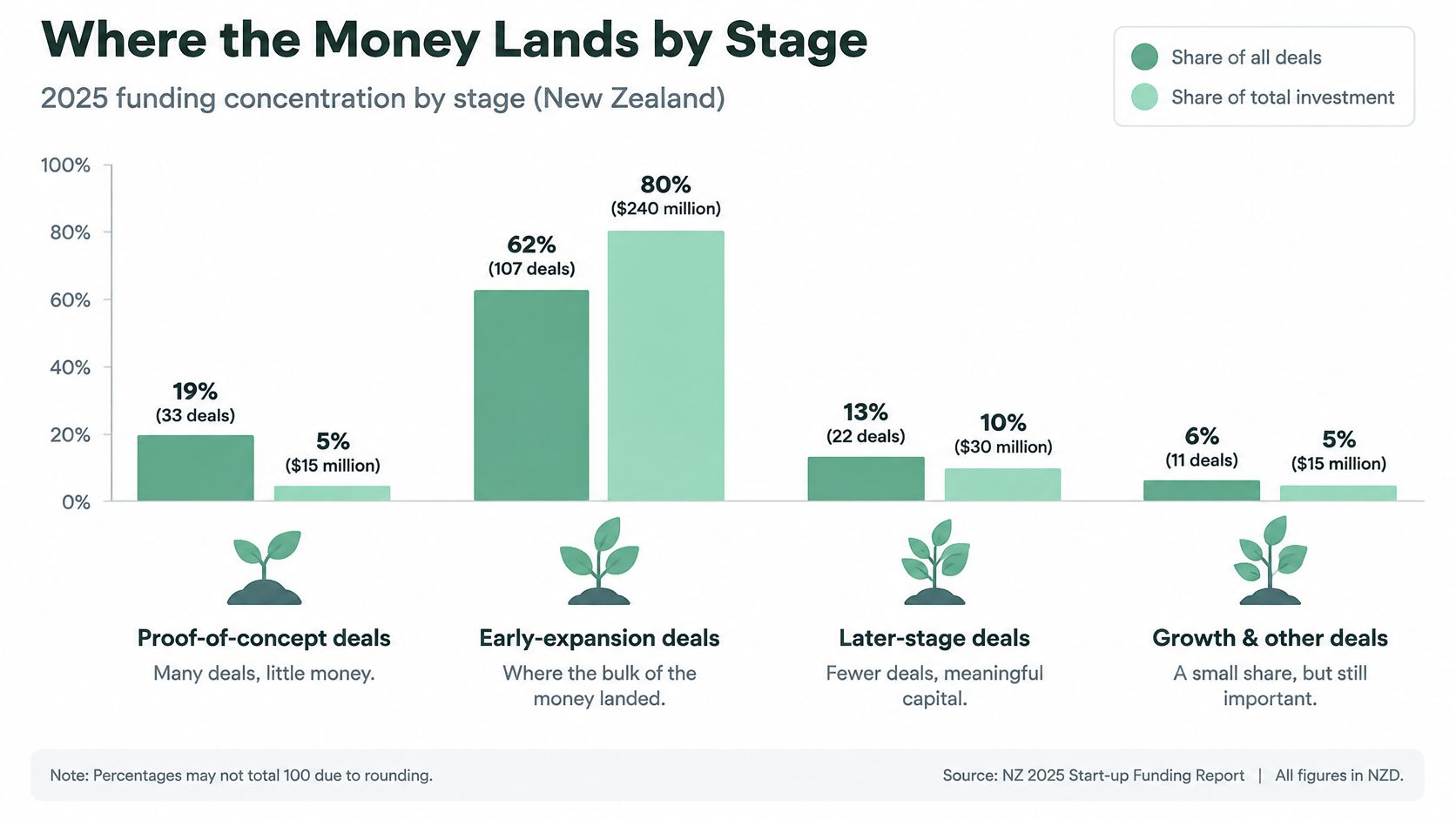
Short version: money is abundant for companies with commercial evidence and thin for companies with a promising prototype. That isn't a moral judgement. It's a description of where professional capital believes the next decade of returns will come from, and what it wants to see before it writes.
The lane that matters most: rounds of NZ$2 million to NZ$20 million, where a company stops being a bet and starts being a business.
The Government's programme has supported more than 120 local tech startups through its underlying funds, which have invested about NZ$440 million in aggregate since inception, per the NZGCP annual report. During the 2024 financial year, those funds made around 20 Series A and Series B investments, defined as rounds of NZ$2 million to NZ$20 million, supplying roughly NZ$80 million of capital.
That range is useful because it names a specific gap. Above angel cheques. Below the very large growth rounds that need international capital and a board full of institutions.
What does an investor check before a Series A or B in that lane? Three things, roughly in order.
If you're still assembling the angel part of your cap table, the NZ angel investors directory is a practical place to start mapping names before you need them.
Institutional programmes don't remove the need to prove traction. They fill the follow-on gap that opens after a seed round and before a company is ready for major international capital. That gap is where more companies die than at any other point.
Here's the test to run on your own business. Which stage does your evidence match, not which stage your deck claims? If your revenue is a pilot with one logo and your team is three people, you're pre-Series A no matter what the slide says. Aim at the lane your evidence can reach in two quarters, then build the next quarter's evidence on purpose.
A two-person SaaS team, a working product, three paying pilot customers and twelve months of savings. That profile is common, and it's the one that stalls most often before a first round.

The cliff isn't a shortage of ideas or even a shortage of investors. It's the stretch between a proof of concept and a seed or Series A cheque, where a company runs out of money before it runs out of product. Twelve months sounds like plenty until you count the six you'll spend in meetings.
Now the contrarian read. A maturing ecosystem concentrates capital in companies that already show traction. That's rational behaviour from fund managers, and it means a record year can coexist with worse access for newcomers. More money entering the market doesn't automatically mean more doors opening.
Representation tells a parallel story. In FY2026, women accounted for 27% of founding teams in New Zealand, unchanged from the prior year, as BusinessDesk reported on the record year. So who gets the first cheque is also a question about who gets counted, and a flat line there is worth noticing while the dollar line climbs.
If the raise itself is your weak spot, how to pitch seed investors is worth an hour before you book the meetings.
Notice what the warning signs have in common. None of them are about the market. They're all about the evidence you can put in front of someone who has forty other decks on the same afternoon.
The funding route matters as much as the headline amount. Equity exchanges ownership for capital; a tax credit can reduce the cost of qualifying research and development without diluting a founder's stake.

Funding routes compared for NZ founders
| Route | What you give up | Best fit | Watch for |
|---|---|---|---|
| Angel or venture capital round | Equity and some control | Proven traction with a scale plan | Investors look for repeatable revenue and a credible growth path |
| R&D Tax Incentive | Nothing in equity; 15% credit on qualifying R&D | Technical uncertainty and product development | NZ$50,000 standard annual minimum and record-keeping rules |
| Government-backed funds (Elevate) | Equity in fund-backed deals | Series A and B rounds of NZ$2m to NZ$20m | Investors still expect product-market fit and commercial traction |
New Zealand's Research and Development Tax Incentive offers eligible businesses a 15% tax credit on qualifying R&D spending, with a standard annual minimum of NZ$50,000 and a cap of NZ$120 million in eligible expenditure, according to the Ministry of Business, Innovation and Employment. The minimum works differently when the R&D is contracted to an approved research provider.
The credit does not dilute ownership, but eligibility and record-keeping rules apply. Teams need to document their experiments as they go, rather than trying to reconstruct a year of work later.
R&D credits can help fund product development involving technical uncertainty. Equity can fund the next stage, such as go-to-market work, hiring and growth. The distinction is practical: the credit applies to qualifying R&D, while an equity round gives a company capital in exchange for ownership.
Before choosing a process, it may help to compare tax service providers. For a wider overview of contestable funds and regional programmes, see the NZ startup funding grants guide.
Start with the bottleneck. If the need is to fund qualifying R&D, check whether the tax credit applies. If the need is capital for scaling, consider whether the growth opportunity justifies the ownership given up in an equity round.
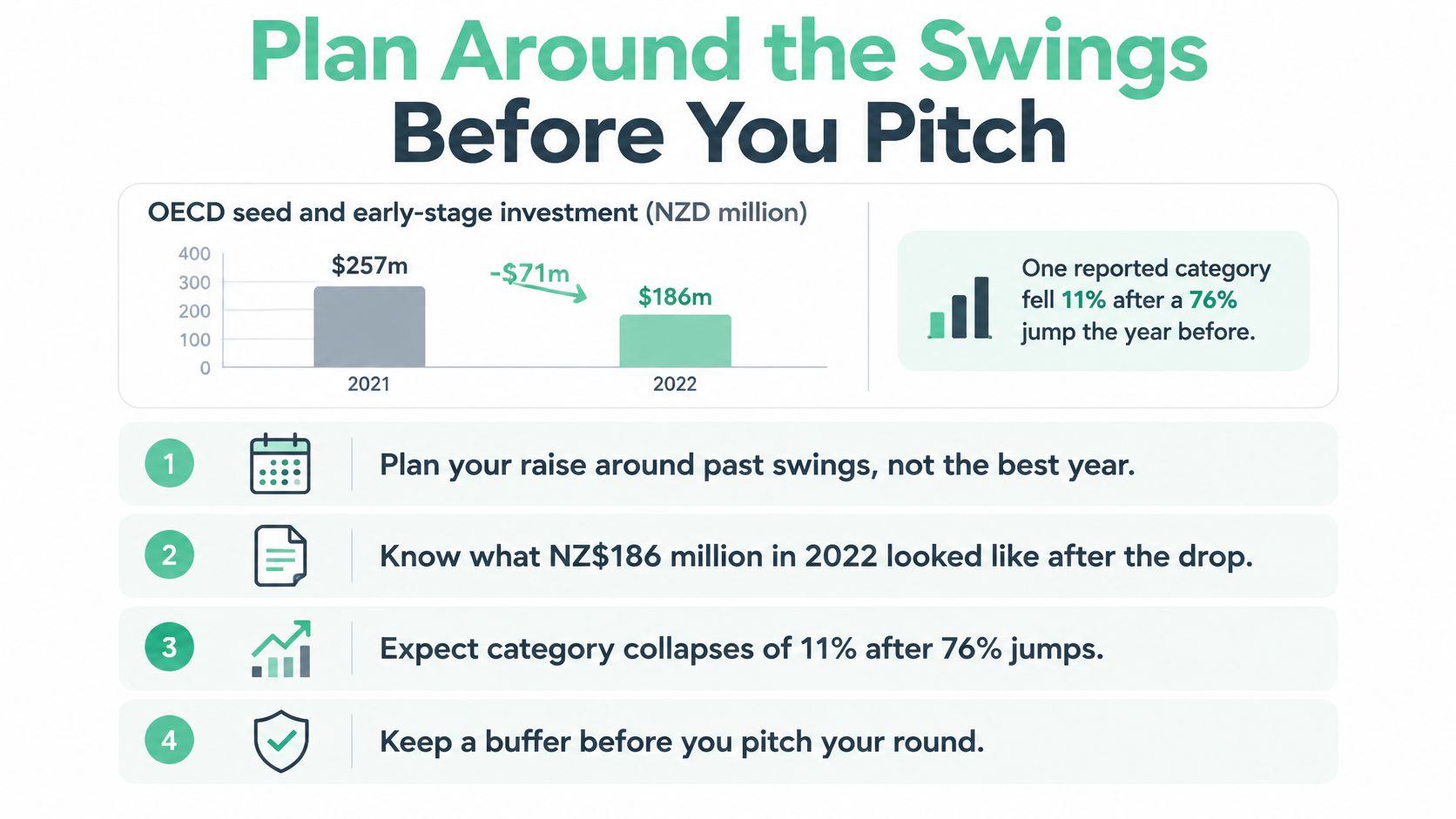
NZ$186 million went into New Zealand seed and early-stage startups in 2022, a fall of NZ$71 million from 2021, per the OECD's financing SMEs report. Funding does not travel in a straight line. That one-year drop is large enough to change who gets a meeting.
Read it as a pattern, not a forecast. Markets tighten. Investors reappraise risk. The large deals that flattered last year's headline total often do not repeat, so a strong year can still leave first-time companies with fewer cheques available. A founder pitching into that swing needs a plan that still works if the round slips a quarter.
What stage is the company at, and does the evidence match the cheque size you are asking for? How many months of runway remain at current burn? Is there repeatable revenue, or a clearly dated path to it?
Three questions. Ninety seconds. They tell you whether you are raising or hoping. If you cannot answer the third, fix that before you fix the deck.
Pre-cliff companies should put weight on R&D credits and customer evidence, because both make the next conversation cheaper. Series A and B candidates need a diligence file on traction and path to scale, ready before anyone asks. If runway is under six months, start the raise with a bridge plan already costed. The negotiation changes completely when you need the money this month.
One more piece of the revenue picture is worth tightening before you pitch. NZ Apps has published a practical guide titled "SaaS Pricing Models: A Practical Guide for NZ & AU Founders", and pricing is the fastest lever most early teams leave untouched while they chase a bigger round.
Write the one-page plan this week. Runway in months on one line, the next three milestones under it, the cheque each milestone brings beside them, and the fallback if none of it lands. Honest numbers on one page, and you walk into the first meeting knowing more about your own business than most of the room.
NZ Apps covers funding and growth in its editorial content, and its directory lists app and tech companies across New Zealand and Australia. Start with the NZ Apps directory to see who is building in both markets, and add your own company so the next investor or partner searching the local market can find you.
Add your NZ or Australian app or tech company to the NZ Apps directory and get discovered by founders and operators across the region.
Get ListedReach tech decision-makers across New Zealand and Australia. Sponsored and dofollow editorial links, permanent featured listings, and sponsored articles on a DA30+ .co.nz domain.
See Options