
You've got a healthy pipeline, customers are signing, and the product roadmap looks full. Then a large invoice slips past its due date, a new hire starts earlier than planned, and the bank balance suddenly feels much smaller than the profit report suggested. That's the moment many founders discover that accounting tells them what happened, while strategic financial planning should have shown what was about to happen.
For NZ and AU SaaS operators, the difference matters. A yearly budget can look tidy and still miss payment delays, payroll changes, tax timing, churn, or a cautious funding market. Good planning is less about producing a polished spreadsheet and more about building a set of decisions you can use when conditions turn.
A founder often begins with a simple question: “Can we afford this?” A strategic plan asks better questions. What happens to cash if the sales cycle stretches? Which hire creates capacity, and which hire merely adds fixed cost? How much runway remains if two large customers pay late?
That forward view separates planning from bookkeeping. Accounting records revenue, expenses, assets, and liabilities. Strategic financial planning connects those numbers to product choices, hiring, pricing, fundraising, and personal risk. A product-led company can grow users while losing cash, especially when implementation costs arrive before subscription receipts or annual contracts create deferred revenue.
New Zealand's household data offers a useful warning about planning quality. The 2021 Financial Capability Survey found that planning use of income scored 70 out of 100, with 47% of respondents achieving a high score. While 69% said they plan their spending, only 37% plan in detail, and 26% reported doing so very often or always. For a founder, the business equivalent is the move from a rough budget to exact, repeatable cash-flow planning and adherence tracking.

Ask yourself:
If the answers feel vague, you don't need a more elaborate model first. You need clearer assumptions and a rhythm that people will maintain.
The local funding environment makes this discipline even more important. NZ and AU founders may have access to customers across the Tasman, but they still deal with currency movement, different tax settings, payroll obligations, and the practical friction of collecting cash. A profitable quarter won't rescue a business that cannot meet payroll or suppliers during a timing gap.
A useful strategic financial planning guide can help frame the wider discipline, but the operating test is simple: does the plan change what you do this week? If it only produces a report for an investor meeting, it isn't doing enough.
Start with the business you want to run in twelve months, then translate that picture into financial targets. Avoid a single heroic revenue number. Set separate objectives for growth, profitability, and resilience, because these goals can pull against one another.
Growth might mean reaching a defined level of recurring revenue or entering Australia with a clear customer profile. Profitability might mean improving gross margin or reducing dependence on founder-led delivery. Resilience might mean preserving a cash buffer, reducing customer concentration, or keeping hiring reversible.
Write each objective as a decision statement:
A useful objective changes behaviour before the result appears.
“Grow faster” won't tell a sales lead what to do. “Increase recurring revenue while keeping gross margin within an agreed range” gives the team a boundary. “Hire only when the forecast supports the role under the downside case” gives a founder a rule.
SaaS companies can drown in dashboards. Keep the main set tight:
Choose one North Star KPI that best reflects the health of your specific model. For a subscription product, that could be retained recurring revenue. For an app with mixed subscriptions and usage revenue, cash contribution by customer cohort may be more useful.
The test is blunt. If a KPI moves, what decision changes? If the answer is “we mention it in the board pack”, remove it from the core dashboard. Supporting metrics still matter, but they shouldn't compete with the handful that govern action. Resources such as UAE business tracking with KPIs can broaden your thinking about measurement across markets, but local assumptions still need to sit underneath the numbers.
Your one-page objective and KPI canvas should include:
Don't call a target a plan until you've named the sacrifice it requires. More sales may require implementation capacity. Better retention may need product work before another marketing hire. Financial planning earns its keep by making those tensions visible.
A forecast fails when it becomes a monument. Founders build a complicated workbook during a funding push, then stop updating it because every change breaks three formulas. A maintainable model should be plain enough to refresh after the monthly close, with assumptions you can defend in a conversation.
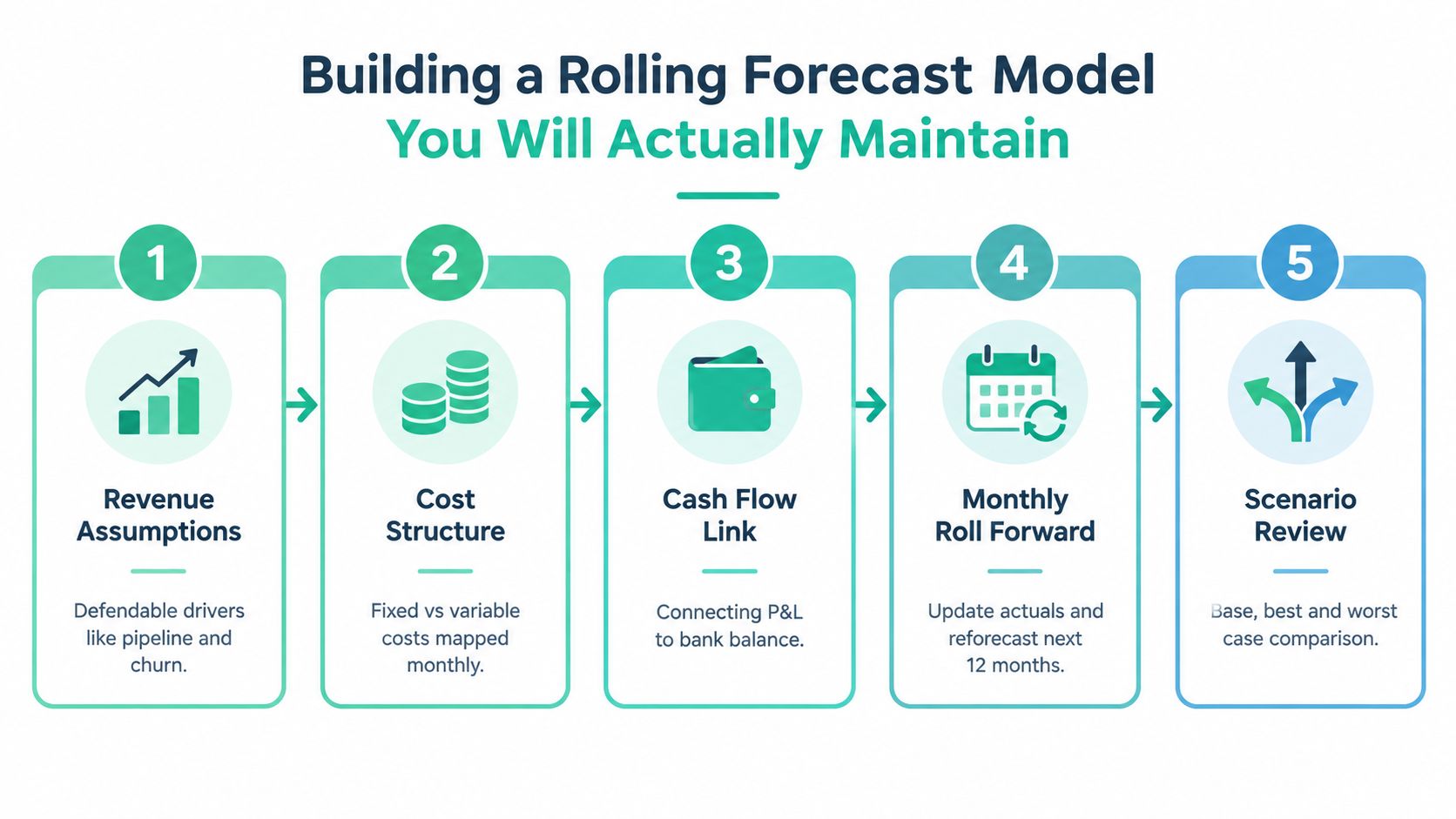
Use a monthly model with three linked views:
For a SaaS company, revenue recognition and cash collection aren't the same event. An annual prepayment may improve the bank balance immediately while accounting revenue is recognised over the service period. Keep the revenue view and cash view separate, then connect them deliberately.
Use separate assumption areas for headcount, pricing, churn, and sales pipeline. Each assumption should have an owner, a source, and a short note explaining why it changed. A model is easier to trust when someone can trace a number back to a contract, hiring plan, or observed operating pattern.
The NZ SME evidence makes this practical rather than theoretical. A major SME white paper reports that 34% of New Zealand SMEs face cash-flow and late-payment problems monthly, with average late-payment delays of 5.3 days, and over 58% of affected firms often unable to pay suppliers as a result. These figures are reported in the SME white paper. A founder should therefore stress-test receivables timing and supplier-payment buffers, not rely on profit alone.
A practical routine looks like this:
Tools such as Google Sheets, Excel, Xero, and reporting connectors can all work. The tool matters less than the handoff between accounting data and operating decisions. If you want a starting point, this financial forecasting template can give the workbook a practical shape without forcing you into a giant finance system.
Watch for familiar traps. Don't mix GST-inclusive and GST-exclusive figures. Don't forecast invoices as cash receipts without a collection assumption. Don't let headcount appear only as salary, because payroll-related costs and start dates affect the bank balance. Keep formulas visible, protect core assumptions, and write down the logic.
The best model is the one the team updates before the next decision, not the one with the most tabs.
A base forecast is a useful reference point, but it isn't a safety plan. Founders need to know which assumptions can hurt cash fastest and what they'll do before the downside case becomes the actual case.
Build three versions:
Then run sensitivity checks on two or three levers. For most SaaS companies, sales-cycle length, churn, pricing, headcount timing, and receivables collection deserve attention. Change one lever at a time first. That shows which variable moves runway most. Then combine the serious risks in a downside scenario.
The funding question deserves honest treatment. NZ SME commentary for 2026 identifies cash-flow timing, working-capital headroom, and funding structure as central priorities. One SME sentiment snapshot reports that 40% of SMEs were very unlikely to seek external funds in the next twelve months, up from 28% in October 2025, as reported in NZ SME sentiment tracking. If founders don't want debt or outside capital, the plan must show how growth will be funded through pricing, collections, staged hiring, or slower commitments.
| Runway Remaining | Signal | Founder Action |
|---|---|---|
| Comfortable runway | Base and downside cases both support committed costs | Keep hiring selective, preserve the buffer, and invest only against clear evidence. |
| Watch runway | A key assumption weakens, such as slower collections or rising churn | Freeze optional spend, review pricing, and refresh the downside case. |
| Tight runway | The downside case threatens payroll or supplier payments | Delay non-essential hires, accelerate collections, and speak with funders before urgency takes over. |
| Critical runway | Cash timing creates an immediate operating risk | Protect payroll and core service delivery, renegotiate commitments, and make a formal funding or cost decision. |
Don't wait for the bank balance to force the conversation. Set triggers around forecast runway, cash receipts, and committed liabilities. A decision matrix is more valuable than a confident forecast because it tells people what to do when confidence fades.
A practical cash-flow management guide for startups can support the mechanics, but work is behavioural. Decide who owns the trigger, how often it gets reviewed, and which actions need board approval. Otherwise, the threshold is decoration.
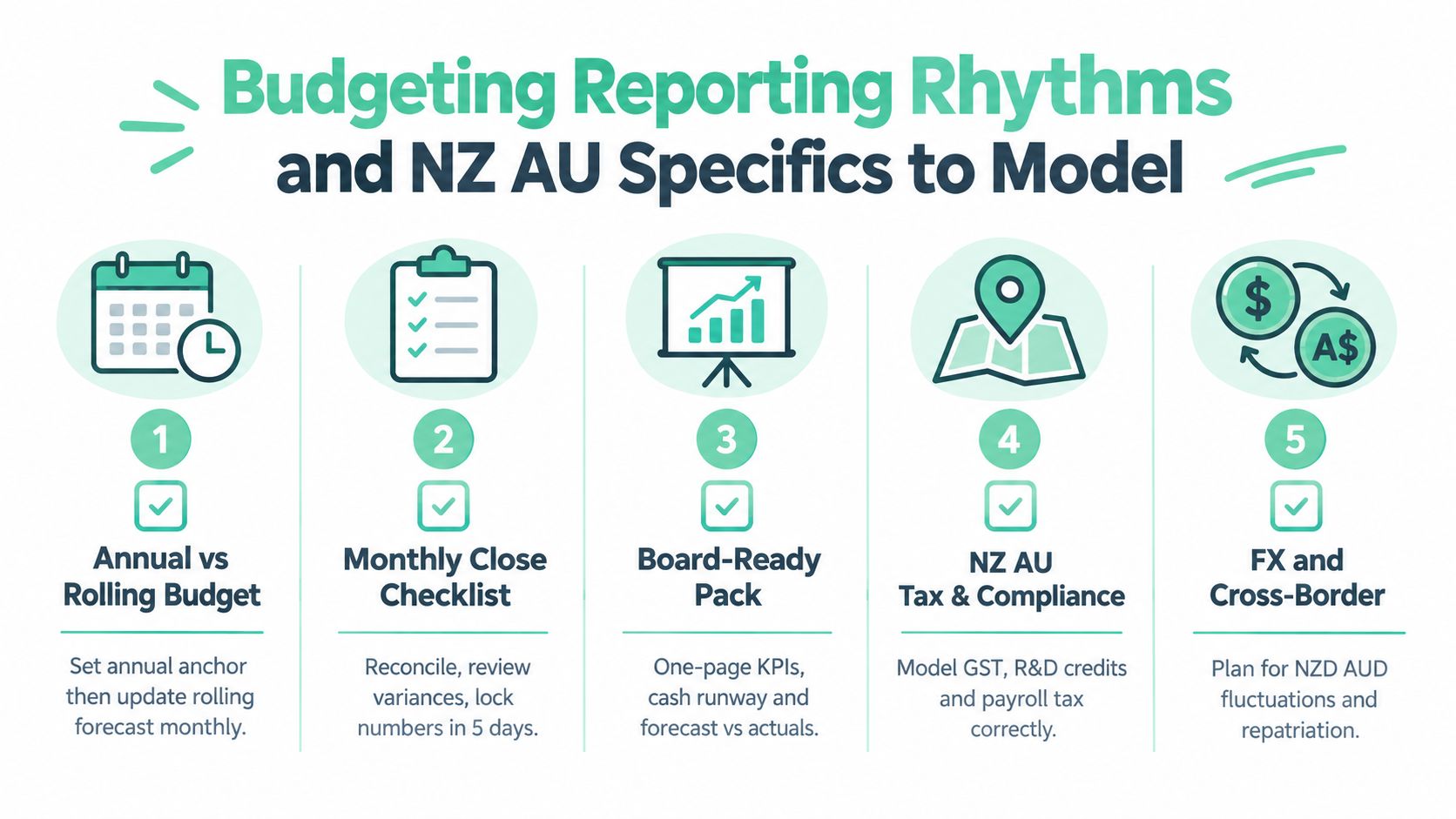
A budget gives the year an anchor. A rolling forecast keeps that anchor from becoming a blindfold. Use the annual budget for broad resource choices, then update the forward view as actual sales, costs, hiring dates, and collections change.
The operating rhythm should be light enough to survive a busy product cycle. Weekly, review expected receipts, large payments, payroll changes, and any customer that has slipped past terms. Monthly, close the books, reconcile the bank, compare forecast with actuals, and write the reason for each meaningful variance. Quarterly, revisit objectives, pricing, staffing, funding needs, and the assumptions behind the downside case.
KiwiSaver deserves a place in the hiring model, not a footnote in payroll. Employees can choose contribution rates of 3.5%, 4%, 6%, 8%, or 10% of gross pay, with 3.5% as the default rate from 1 April 2026. The rate rises again to 4% on 1 April 2028, so cash planning needs to reflect a two-step increase. These settings are outlined by Inland Revenue's KiwiSaver guidance.
For each planned hire, model the start date, gross pay, employer obligations, KiwiSaver impact, leave, recruitment cost, and equipment. A role that looks affordable in a salary-only view may look different once the full payroll cost and ramp period appear.
Self-employed founders need a separate personal cash view. Only 44% of self-employed people actively contribute to KiwiSaver, compared with 78% of employees, and 41% of self-employed KiwiSaver members receive no government contribution, often because income is irregular or too low during some periods, according to Retirement Commission analysis. Treat personal drawings, tax reserves, and retirement contributions as planned cash movements, not whatever remains at month end.
The government KiwiSaver contribution is 25 cents for every dollar personally contributed, capped at $260.72 per year. A member needs to contribute at least $1,042.86 between 1 July and 30 June to receive the full amount, while people earning more than $180,000 aren't eligible from the year starting 1 July 2025, according to the Retirement Commission's KiwiSaver update.
Your monthly pack shouldn't be a data dump. Include a one-page view of revenue movement, gross margin, cash balance, runway, forecast versus actuals, aged receivables, and the decisions required. For NZ accounting workflows, review the options in this guide to the best accounting software in NZ, then choose a setup that gives your team clean source data.
Australian operations add their own tax, payroll, and currency considerations. Keep NZD and AUD revenue visible, document conversion assumptions, and model the timing of transfers between entities. A resource on master budget planning for 2026 can help broaden the annual planning view, but don't let an annual template replace monthly cash judgement.
A useful plan runs as a loop. Set objectives, forecast the operating picture, test scenarios, then review actual results and adjust the assumptions. The loop matters more than the first version.
Use a simple implementation sequence:
Avoid three common failures. Don't confuse a budget with a forecast. Don't hide weak assumptions behind precise formatting. And don't delay difficult decisions because the base case still looks comfortable. Financial pressure changes behaviour, so your rules need to be clear before the pressure arrives.
The Financial Services Council's resilience data captures the personal side of this problem. Its 2025 index found that 55% of New Zealanders worry about money daily or weekly, while only 44% feel prepared for retirement, a gap detailed in the Financial Resilience Index. Founders aren't separate from that reality. A business plan that ignores personal cash buffers, debt tolerance, and retirement saving can push an operator into poor choices at exactly the wrong time.
Retirement contribution behaviour also tends to sit near the floor. Retirement policy analysis found that over 60% of contributing KiwiSaver members were on the 3% default rate in the year ended June 2022, and over 80% contributed either 3% or 4%. The same analysis reported a mean employee contribution of $2,500 in 2022/23, equal to a 3.7% gross-earnings contribution rate, as shown in the KiwiSaver contribution analysis.
The practical test: A strategic financial plan should help you make a calmer decision on a difficult Tuesday, not merely present a neat picture on a Friday.
Start with the next month. Build enough visibility to see cash timing, enough discipline to question assumptions, and enough flexibility to change course. Then keep going.
NZ Apps gives NZ and Australian founders practical coverage of the tech market, software choices, funding, growth, and operating decisions that shape app businesses. Visit NZ Apps to find regional tools, company insights, and resources that can support a sharper financial planning process.
Add your NZ or Australian app or tech company to the NZ Apps directory and get discovered by founders and operators across the region.
Get ListedReach tech decision-makers across New Zealand and Australia. Sponsored and dofollow editorial links, permanent featured listings, and sponsored articles on a DA30+ .co.nz domain.
See Options