
When you're running a business in Auckland, doesn't it feel like half your job is just wrangling the supply chain? From port congestion holding up your precious stock to the logistical puzzle of last-mile delivery, it’s a constant battle. The goal is to move past the daily firefighting and manual processes, embracing smarter tech to manage inventory and shipping without the non-stop headaches.
Let's be honest, trying to manage a supply chain in Auckland can feel like you're putting out one fire after another. You’re juggling stock levels, chasing up deliveries, and doing your best to keep customers from getting frustrated. But the moment you think you’ve got things under control? A new bottleneck pops up somewhere else.
This isn't just you—it's a frustration shared by so many Kiwi business owners. These aren't just little annoyances; they're genuine, day-to-day problems that are costing you real time and money.
The challenges we face here are unique, woven into the city's geography and economic pulse. How many times has something completely outside of your control thrown a spanner in the works?
Every shipping mistake, every unexpected stockout, and every delayed delivery chips away at your bottom line and, just as importantly, your reputation. You start asking yourself, how much is this actually costing me? How many customers have I lost because something went wrong somewhere along the line? If that sounds familiar, you’re definitely not alone.
Here's the hard truth: sticking with the same old spreadsheets and manual follow-up calls is a recipe for being left behind. The pressure you're feeling is a big, flashing sign that it's time to try a different way.
Modern, tailored software isn't just another tech expense to add to the pile. It’s a fundamental tool for survival and growth in Auckland's competitive market. It’s about finally getting back some control, visibility, and peace of mind.
This is where custom supply chain solutions for Auckland businesses come in. We're talking about a system built specifically for your challenges—one that gets the local landscape and helps you turn those logistical headaches into a real competitive edge. It’s about building a smooth, predictable flow from your supplier all the way to your customer, so you can spend less time firefighting and more time actually growing your business.
Let's be honest, "supply chain solutions" sounds like a bit of corporate jargon, doesn't it? It's easy to picture it on a PowerPoint slide in a stuffy boardroom. But when you get down to it, the concept is actually pretty straightforward.
Think of your business as an orchestra. Without a conductor, you’ve just got a room full of talented musicians making a lot of disconnected noise. But with a conductor, every instrument—or in your case, every supplier, warehouse worker, and courier—plays its part at the perfect time. The result? Something smooth, cohesive, and impressive.
That's what modern supply chain solutions do for Auckland businesses. It’s the technology that gets all the moving parts working in harmony. It keeps an eye on the entire journey of a product, from the moment an order pings your system to the second it lands on a customer's doorstep. It's about getting everyone to play from the same sheet music.
When we talk about these "solutions," we're really talking about a few key pieces of software working together. These aren't just glorified spreadsheets; they're the brains of the operation.
Effective inventory management is often the heart of an efficient supply chain. Understanding your options is the first step to finding the best inventory management software for your unique setup.
Here's the crucial part: these tools don't just help you move boxes faster. They give you data. Cold, hard facts about what’s working and, more importantly, what isn’t. This visibility is everything.
You can finally get clear answers to those nagging questions. Which delivery routes are costing you a fortune in fuel? What products have the highest return rate? Where are the real bottlenecks that are slowing everything down?
This diagram highlights some of the most common pain points we see with businesses across Auckland.
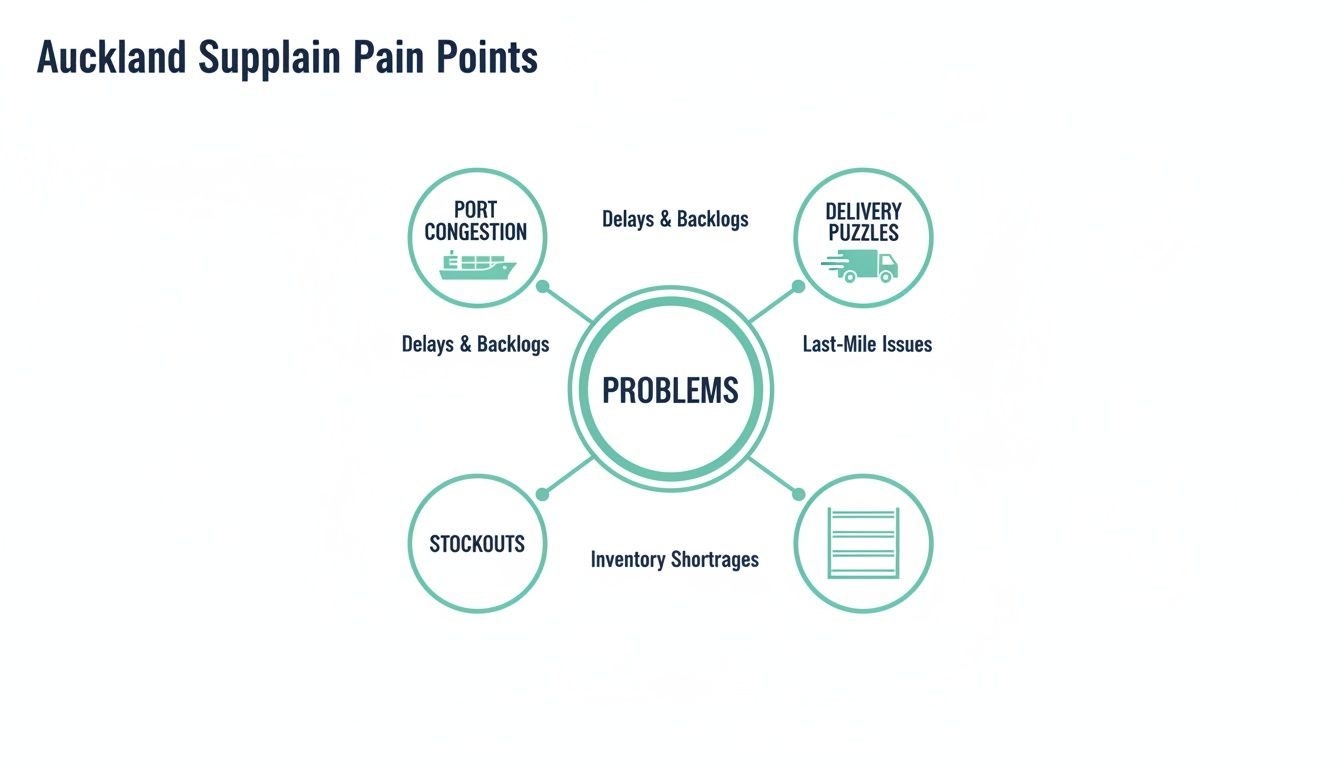
As you can see, things like port congestion and unexpected stockouts aren't just isolated headaches. They're interconnected problems that a unified system can help you get ahead of.
The Auckland-Hamilton-Tauranga "golden triangle" is the engine room for New Zealand's freight, and our city's port alone handles a massive 22% of the nation's container volumes. With the entire NZ logistics market projected to grow to over USD $19 billion by 2026, the pressure is only going to mount. For SMEs in retail and manufacturing, custom software from NZ Apps is a lifeline, offering a level of data-driven agility that off-the-shelf systems simply can't match.
Honestly, the goal is to demystify the tech. This isn’t about buying complicated software for its own sake. It’s about finding smart, practical ways to make your entire operation run smoother, become more predictable, and ultimately, more profitable.
Picking the right software for your business can feel like standing in a supermarket aisle, staring at a hundred different brands of the same thing. You've got flashy off-the-shelf products promising to solve all your problems with a single click, and then you have the idea of building something completely from scratch. It’s a lot to take in, right?
So, how do you actually figure out what’s right for your business? This is your practical, no-nonsense guide. Let's cut through the sales talk and figure out which path makes sense for your Auckland operation. A pre-packaged solution might seem like the easy answer, but will its limitations just create bigger headaches down the road?
Sometimes, what seems cheaper upfront ends up costing more in lost time, frustrating workarounds, and missed opportunities. It's a classic trap we see all too often.
At first glance, it seems simple. One is ready-made, like buying a suit off the rack. The other is tailored, measured, and stitched just for you. Both have their place, of course, but for something as central to your business as your supply chain, the fit is everything.
An off-the-shelf system is designed for the "average" business. The problem is, no business is truly average, especially not in Auckland's unique market. These systems often come loaded with features you'll never use, yet somehow, they're always missing that one specific function you desperately need. You end up trying to bend your processes to fit the software, instead of the other way around. Does that sound familiar?
A custom, or bespoke, solution starts with a blank piece of paper. The first question isn't "what does the software do?" but rather, "what do you need it to do?" It's built around your specific pain points, your team's actual workflow, and your unique business goals.
The core idea behind a bespoke solution is simple but powerful: technology should adapt to your business, not force your business to adapt to the technology. This is where you find a genuine competitive edge.
So, how do you decide? It's not about which option is "better" in general, but which is better for your specific situation.
To make it clearer, here's a quick breakdown of the main differences you’ll find when weighing up your options.
A straightforward look at the key differences between buying a ready-made solution and building a custom one for your supply chain needs.
| Feature | Off-the-Shelf Software | Custom Software (like from NZ Apps) |
|---|---|---|
| Fit & Functionality | General-purpose; you adapt to its workflow. May have unused or missing features. | Built specifically for your processes. You get exactly what you need, nothing you don't. |
| Initial Cost | Typically lower upfront cost (licensing fees). | Higher initial investment for development. |
| Long-Term Cost | Ongoing subscription fees, costs for add-ons, and potential expenses from inefficiencies. | One-time development cost, with smaller ongoing costs for maintenance and hosting. |
| Scalability | Limited. You might outgrow it or need to switch systems as you expand. | Designed to grow with your business. New features can be added as your needs change. |
| Integrations | Limited to standard, popular apps. Custom connections can be difficult or impossible. | Can be built to integrate seamlessly with any existing tools you use (e.g., Xero, Shopify). |
| Competitive Edge | Minimal. Your competitors are likely using the same tools. | High. It supports your unique business model, giving you a distinct operational advantage. |
This table gives you a starting point, but the real decision comes from looking inward at your own operations. You can find more details in our complete guide comparing custom software versus off-the-shelf options in NZ.
Before you even look at a demo or talk to a salesperson, grab a coffee and ask yourself a few honest questions. Getting clear on these answers will make your decision a whole lot easier.
What Are My Biggest Operational Headaches Right Now? Be specific. Is it the time spent manually entering courier information? Is it the constant back-and-forth trying to confirm stock levels? Pinpoint the one or two things that, if fixed, would make the biggest difference to your day.
What Does My Business Need That Generic Software Just Can't Handle? Maybe you have a unique returns process, or you deal with a specific type of freight that needs special tracking. These are the details where off-the-shelf systems often fall short. Your unique processes are part of your business's DNA; your software should support them, not fight them.
How Important Is It for This New System to Talk to My Existing Tools? This is a big one. If your business runs on tools like Xero for accounting or Shopify for e-commerce, your new supply chain system absolutely has to play nice with them. A clumsy integration—or no integration at all—creates more manual work, defeating the entire purpose. A custom build can ensure these connections are seamless.
Answering these questions gives you a clear checklist. It moves you from a vague feeling of "we need something better" to a concrete list of requirements. Suddenly, the path forward becomes much clearer.
The goal here isn't to make a quick decision; it's to make an informed one. Choosing the right supply chain solutions in Auckland means finding a genuine partner that understands your local challenges and can build a tool that feels like a natural extension of your team. It's about investing in a system that grows with you, not one you'll outgrow in a year.
Here's the part that most people miss entirely. Having a slick, automated supply chain is fantastic, but what good is it if potential customers can't find you in the first place? This is where the magic really happens—when smart development and even smarter marketing start working together.
It's a common blind spot. Business owners often see operations and marketing as two completely separate departments, each with its own budget and goals. But what if they were two sides of the same coin? A well-built custom web application does so much more than just manage logistics; it can directly boost your online presence and bring in new business.
Let me explain.
Think about one simple feature: showing real-time stock levels on your website. Operationally, this is great. Your team knows what's on the shelf, and you avoid selling products you don't actually have.
But from a customer's point of view? It's a game-changer. And from Google's point of view? It's pure gold.
When someone in Auckland searches for a specific product you sell, having your website clearly show "In Stock" with an accurate count can be the single deciding factor. It builds instant trust and answers the customer's most urgent question. That positive user experience is a massive tick in the box for search engines, which want to send users to helpful, reliable pages.
This isn't just a small perk; it’s a powerful signal that your website provides real value. This is how operational efficiency becomes a powerful tool for customer acquisition.
A custom system doesn't just manage your inventory behind the scenes; it can project that accuracy and reliability directly onto your website, turning a logistical strength into a visible marketing advantage.
This is a key concept that separates businesses that just operate in Auckland from those that truly dominate their local market online. The image below shows how we approach integrating SEO to capture that vital local search traffic.
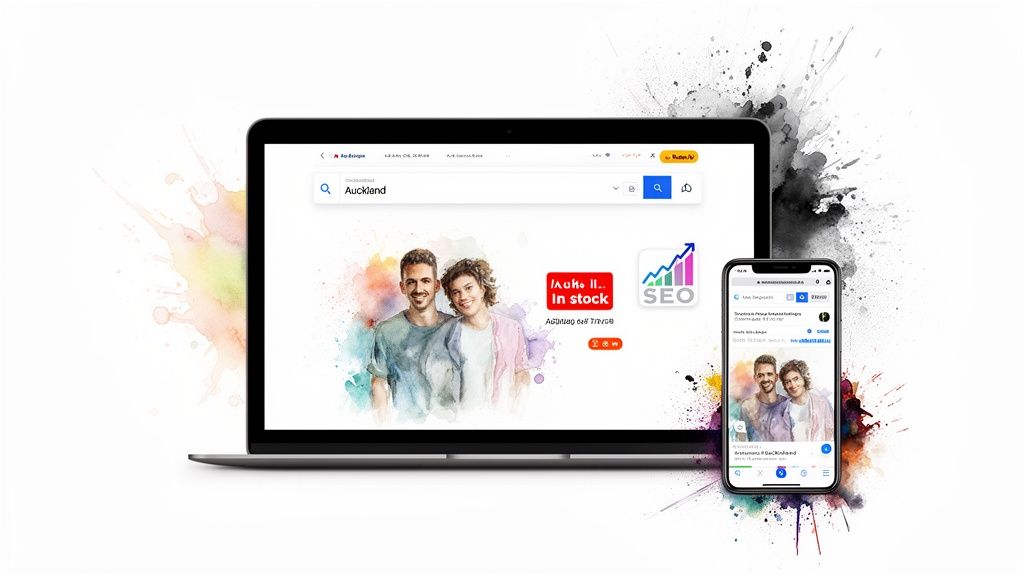
The focus here is on targeting specific, high-intent keywords for the Auckland area, ensuring your business appears the moment local customers are actively searching.
The connection goes even deeper than just displaying stock levels. A custom-built web application or e-commerce platform gives you complete control over the technical nuts and bolts that influence your search rankings.
Generic, off-the-shelf platforms often come with clunky code, slow loading times, and rigid structures that are far from ideal for SEO. They are built for the masses, not for performance. When you build custom, you can bake in the features that search engines love right from the start.
Here are a few ways custom software gives you an edge:
Essentially, you stop fighting against the limitations of a generic platform and start building on a foundation designed for visibility. Custom development and local SEO aren't separate strategies; they are deeply intertwined.
If you’re looking to improve your online visibility, you might find our guide on search engine optimisation services in Auckland particularly useful. It shows in more detail how a targeted local strategy can drive real growth. When that strategy is powered by a custom-built, SEO-friendly application, the results can be truly powerful. Your operation becomes more efficient, and your business becomes more visible. It’s a win-win.
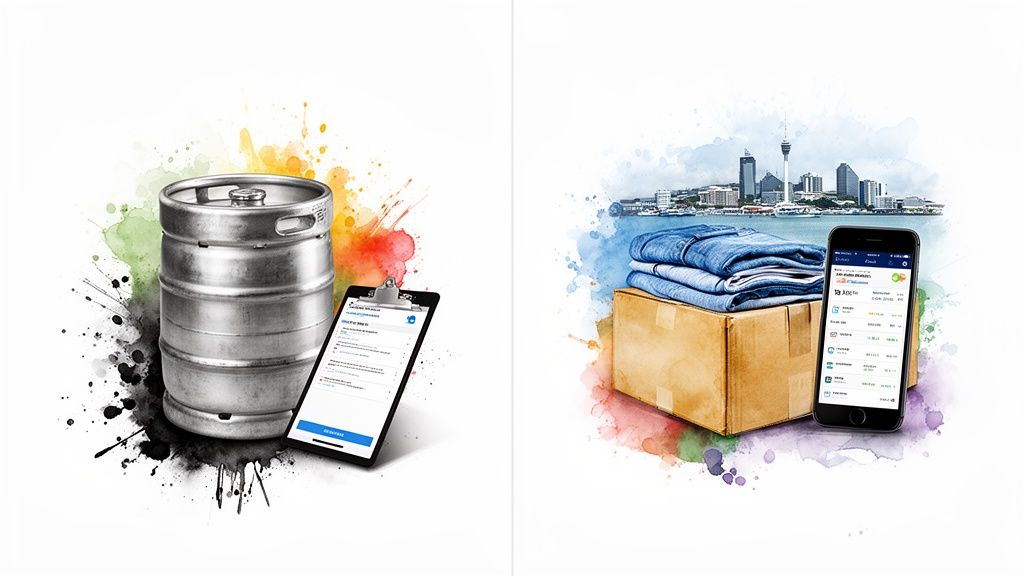
All this talk about systems and strategies is fine, but what does it actually look like out in the wild? It’s one thing to discuss theory; it’s another to see it working for businesses you probably drive past every day.
So, let's paint a picture with a couple of stories from right here in Auckland. These aren't just hypotheticals. They’re realistic snapshots of what happens when a local company decides to tackle its operational headaches with smart supply chain solutions in Auckland. This is where the rubber really meets the road.
Imagine a craft brewery tucked away in Henderson. They’re making fantastic beer, and the local pubs can't get enough of it. The problem? Their logistics were an absolute shambles.
The "before" picture was total chaos. Kegs would go missing, delivery routes were scribbled on the back of a napkin each morning, and pubs would call, desperate for a top-up, only to find the delivery van had already been and gone from their area. It was inefficient, expensive, and a source of constant frustration.
So, what turned it all around? A simple, custom-built mobile app.
The result? The brewery cut its fuel costs by a massive 20% and seriously improved its customer relationships. More importantly, the brewers could get back to perfecting their next hazy IPA instead of playing detective with missing stock. That’s a real win.
Now, let's head over to Ponsonby and look at a small but trendy online fashion brand. Their clothes were flying off the virtual shelves, but their success was causing a huge headache. Their inventory system didn't talk to their Shopify store.
The 'before' was painful. A customer would excitedly buy a dress online, only to get a sheepish "sorry, we're out of stock" email a day later because the last one had actually been sold in their small physical store. Honestly, is there a faster way to lose a customer for good?
The 'after' involved a seamless integration between their in-store point-of-sale system and their e-commerce platform. When an item sold in one place, it was instantly updated in the other. No more guesswork, no more awkward apologies.
This one change had an enormous impact. Customer complaints about stock issues dropped to zero. Their online reviews got better. And because they had a crystal-clear, real-time view of their inventory, they could make much smarter buying decisions and avoid tying up cash in slow-moving items.
These examples show that the right technology doesn't have to be overwhelmingly complex. It's about solving the specific, painful problems holding your business back. For companies looking for a clear path forward, connecting with experienced information technology companies in Auckland can make all the difference.
Space is getting tighter in Auckland's industrial hubs. Projections show that new industrial supply will slow to just 1.2% of total stock in 2025 and 2026, making every square metre more critical than ever. Agile software is the key to managing this squeeze, allowing businesses to navigate tighter capacity without seeing costs balloon. You can read more about these commercial real estate trends and what they mean for New Zealand's freight future on CBRE.com.
Right, feeling that spark of motivation? Let's channel that into action. This isn't about a massive, disruptive overhaul. It’s about making smart, targeted changes that add up to a much smoother operation.
The best place to start is surprisingly low-tech. Grab a coffee and a whiteboard, and just map out your current process from start to finish. Seriously. Where does an order kick off, and what are all the little handoffs before it gets to your customer?
Once you have that visual map, the frustrating parts usually stand out immediately. You're looking for the one or two bottlenecks that cause the most headaches. Is it the mind-numbing time spent manually booking couriers? Or maybe it’s the constant back-and-forth trying to confirm stock levels, which pulls everyone away from their actual jobs.
Don't try to solve everything at once. That's a sure-fire way to get overwhelmed and do nothing. The trick is to find the single biggest point of friction and aim all your energy there first. Nailing that one problem delivers instant relief and builds the momentum to tackle the next.
This isn't just about spotting problems; it's about prioritising them. Ask yourself: which issue, if we fixed it, would make the biggest difference to our team's sanity and our bottom line? That's your target. That’s where you start.
Once you’ve zeroed in on your main challenge, you're in a great position to talk to a technology partner like NZ Apps. A good developer won't just pitch you a product; they'll want to get under the hood and really understand your business. To get the most out of that conversation, it pays to come prepared.
Here’s a quick checklist to have on hand:
Improving your supply chain solutions in Auckland is a journey, not a destination. It’s a process of continuous refinement. But by taking that first small step, you’re already building a more resilient, efficient, and profitable business. You don't have to figure it all out at once, and you definitely don't have to do it alone.
We get it. Thinking about new technology for your business always brings up a lot of questions. Here are a few of the most common ones we hear from Auckland businesses looking to get their supply chain sorted.
Honestly, the cost really depends. Anyone who throws a number at you without understanding your business is just taking a guess. Sure, an 'off-the-shelf' subscription might look cheaper upfront, but those costs often creep up with extra features or user licences you never planned for.
A custom solution is a bigger investment to start with, no doubt. But here’s the key difference—it's built exactly for what you do, so you aren't paying for a load of features you'll never touch. At NZ Apps, we always start with a free, no-pressure chat to get to grips with your specific challenges and budget. That way, we can give you a clear, tailored proposal with no nasty surprises down the line.
That's a very real concern, and a fair one. The last thing anyone wants is a new tool that ends up creating more work than it saves.
The great thing about a custom-built application is that we design it around your existing workflows and your team's comfort level. The whole point is to make their jobs easier, not add another complicated tool to their plate.
It’s made to feel intuitive for the people who will actually be using it every single day. We also provide full training and ongoing support to make the transition as smooth as possible, making sure everyone feels confident from day one.
The timeline really hinges on how complex your needs are. A simpler app designed to solve one specific problem—like tracking local deliveries around Auckland—might take a few months to get up and running. A more comprehensive system that needs to connect with multiple platforms like your accounting software and e-commerce store will naturally take a bit longer.
During our initial consultation, we'll map out a realistic project plan and a clear timeline. We believe in being upfront, so you’ll always know what to expect at every stage of the development process for your supply chain solutions in Auckland.
Ready to stop firefighting and start building a more efficient, predictable business? The team at NZ Apps builds custom web and mobile applications that solve real-world logistical challenges for Kiwi businesses. Let's have a chat about your biggest bottlenecks and see how we can help. Book your free consultation with us today.