
Ever used an app and thought, "Wow, this just gets me"? That wasn't some happy accident. That’s the work of a user experience designer, the person who makes sure technology feels intuitive, genuinely helpful, and maybe even a little bit fun.
Let’s get one thing straight: a UX designer isn't just someone who picks pretty colours or trendy fonts. Honestly, that’s a tiny slice of their world. It’s better to think of them less as a graphic artist and more as an architect for digital spaces. They build feelings and solve problems for the people who will actually use the thing.
Their main job is to be the advocate for the person on the other side of the screen—you, me, all of us. They fight for clarity over confusion and make sure every single click, tap, and scroll has a purpose and feels completely natural. Doesn’t that sound like a job worth doing?
Imagine you’ve just been dropped into a massive, unfamiliar city. A user experience designer is like your expert local guide. They’ve already walked the streets, learned the local dialect, and figured out all the best routes. They anticipate your questions before you even think to ask them.

This guide knows which back alleys are frustrating dead ends and which ones are delightful shortcuts. They work to make your entire journey—from arriving at the airport to finding the best flat white—smooth and memorable, not just the final destination. That’s precisely what a UX designer does for a website or an app. It's a journey, not a transaction.
Their entire process is grounded in understanding people. It's about psychology, empathy, and careful observation. What motivates a user? What makes them give up in frustration? What are they really trying to achieve here? A great UX designer digs deep into these questions to bridge the gap between human behaviour and a digital interface.
Ah, the classic question. One of the most common points of confusion is the difference between a UX designer and a UI (User Interface) designer. While they're often thick as thieves, their focus is quite different. The UX designer maps out the journey, while the UI designer crafts the look and feel of the vehicle that gets you there.
Here’s a quick breakdown to clear it up:
| Aspect | User Experience (UX) Designer | User Interface (UI) Designer |
|---|---|---|
| Focus | The overall feel and flow of the experience. The "why" behind the design. | The look and feel of individual screens and interactive elements. The "how" it looks. |
| Primary Goal | To make the product useful, usable, and enjoyable. Problem-solving. | To make the product aesthetically pleasing and visually consistent. Visual design. |
| Core Skills | Research, user testing, information architecture, wireframing, prototyping. | Visual design, typography, colour theory, branding, interaction design. |
| Key Questions | How can we make this process easier for the user? What is their goal? | What is the best colour for this button? Is this font legible? |
| Deliverables | User personas, journey maps, wireframes, prototypes, usability reports. | Style guides, high-fidelity mockups, icon sets, design systems. |
Think of it this way: UX is the skeleton and organs that make a body function, while UI is the skin, hair, and clothes that give it a specific appearance. You need both for a complete, functional person—or in this case, a digital product.
The visual look of an app or website is important, of course. No one wants to use something that looks like it was designed in 1999. But those visuals are the final layer, the paint on the house after the foundation and framework are rock-solid.
This focus on evidence-based design is what separates UX from purely aesthetic graphic design. A user experience designer’s success is measured by hard data: Are people completing their tasks? Are support tickets going down? Are users sticking around longer? These are the metrics that matter.
For any NZ business owner or startup founder, grasping this is crucial. You aren’t hiring someone to simply make things look good. You’re bringing on a strategist who will make your digital product function beautifully, solve real problems for your customers, and ultimately grow your bottom line. They are researchers, testers, and communicators, ensuring the final product isn’t just launched, but loved.
Keeping up with modern web design trends in NZ is definitely part of their job, but it’s always through the lens of what actually serves the user best. And that’s a big deal.
So, what exactly is in the toolkit of a top-tier UX designer? It's a fascinating blend of human insight and technical know-how. Honestly, it’s not something you can just learn from a textbook; it’s a mix of skills that are part art, part science.
Let's talk about the skills you can't really put on a certificate—the "soft" skills. These are the qualities that separate a good designer from a truly great one. They're less about specific software and more about a way of thinking.
First up is empathy. And no, I don't mean the vague, feel-good kind. A UX designer needs the genuine ability to step into someone else’s shoes and understand their frustrations, motivations, and goals on a deep level. You know what? It’s their superpower, really.
Then there's communication. This one is huge. A designer can have the most brilliant idea in the world, but if they can't explain the "why" behind it to a developer, a product manager, or the CEO, that idea goes nowhere. They act as translators, turning complex user needs into clear, actionable instructions for the rest of the team.
Here's what these soft skills look like in action:
These aren't just nice-to-haves; they are the absolute foundation. Without them, even the most pixel-perfect design will likely fail to connect with its audience.
Now, let's get into the hard skills—the tangible, teachable abilities a UX designer uses every single day. This is where ideas start to take shape and become real.
User research is the starting point for absolutely everything. This is the detective work: conducting interviews, running surveys, and analysing data to figure out what users actually do, not just what they say they do. It’s all about gathering cold, hard evidence to inform every design decision. A key skill here is the ability to translate user needs into actionable product features, often by crafting impactful user stories.
Next comes wireframing and prototyping. Think of these as the digital blueprints for your website or app.
A wireframe is a simple, low-fidelity sketch—like a pencil drawing—that just outlines the structure and layout. A prototype is a more interactive, clickable model that feels like the real thing, allowing you to test the flow before a single line of code is written.
This process is where a UX designer brings their ideas to life, using tools like Figma or Sketch to build interactive mockups. The goal isn’t to create a pretty picture; it's to create a testable hypothesis about what will work for users.
And that brings us to the final, crucial step: usability testing. This is where the rubber meets the road. The designer puts their prototype in front of real people and simply watches. Do they get stuck? Do they look confused? Where do they click first? It can be a humbling experience, but it’s absolutely essential for ironing out the kinks and ensuring the final product is genuinely easy to use. A good UX designer lives for this feedback.
Here’s something many Kiwi businesses get wrong: a user experience designer isn't just another line item on a spreadsheet. They're a direct investment in your company's future success. It’s tempting to think of design as the final coat of paint, but in reality, good UX is the very foundation your digital house is built on.
Time and again, we see fantastic New Zealand businesses with brilliant products that just can't seem to get any traction. The culprit? Often, it's a website that’s a nightmare to navigate, a clunky app, or a checkout process that makes you want to give up entirely. Your product can be the best in the world, but if people can't figure out how to use it, it just doesn't matter. A user experience designer is the person who fixes that.
Let's cut to the chase: good UX makes you money, and bad UX costs you. It’s that simple. When people have a genuinely good time using your website or app, they stick around. They buy more. They come back for more, and even better, they tell their mates about it.
Think about the last time you abandoned a shopping cart online out of pure frustration. Maybe the payment form was confusing, or you couldn't find the shipping details. That's a lost sale, and it happens every second of every day. A good UX designer is obsessed with ironing out those little friction points, turning user frustration into a smooth, satisfying purchase.
The data backs this up. Studies have shown that businesses can see returns of up to 9,900% on what they spend on UX. For every dollar invested in making things easier for customers, you can expect to see around $100 in return. On the flip side, poor user experience is directly blamed for 35% of lost sales, and a massive 75% of people will judge your entire company’s credibility based on its design.
The benefits of a solid user experience don’t just stop at boosting your sales figures. A well-designed product that anticipates what a user needs and guides them clearly has another huge, often-overlooked advantage.
It drastically reduces your customer support load.
Every time a customer has to fire off an email or call your team because they’re stuck, it costs you time and money. A user experience designer’s work is to solve those problems before they even happen, freeing up your team to focus on growing the business instead of constantly putting out fires.
This is especially vital for small businesses in New Zealand, where every resource counts. Investing in UX from the start means you’re building a more efficient, self-reliant business for the long haul.
Look, hiring a skilled user experience designer is one of the smartest commercial moves a business can make. This isn't about chasing the latest design trends or just making things look pretty. It's about building a sustainable, profitable business by putting the very people you serve at the heart of everything you do. It’s about respecting your customer's time and intelligence. And really, what’s a smarter business decision than that?
Alright, let's bring the conversation home to Aotearoa. The local tech industry is absolutely buzzing right now, and guess who’s right in the middle of all the action? The user experience designer.
If you've ever wondered whether UX design is a solid career path in New Zealand, the short answer is a massive yes. It’s not just a good time to be in the field; it’s a fantastic one. What we're seeing is a classic case of demand dramatically outpacing supply. For years, the need for skilled digital professionals has been on a steady climb, and UX designers are at the very top of that wanted list.
Why the sudden rush? Kiwi businesses are finally waking up to the fact that a slick-looking website or app just isn't enough anymore. To win, they need digital products that Kiwis genuinely find easy and enjoyable to use.
Honestly, calling it a "skills shortage" almost doesn't do it justice. It feels more like a talent gold rush. Nearly two-thirds of IT employers in New Zealand are reporting significant gaps in their teams, and the need for a user experience designer is particularly sharp.
This pressure-cooker environment is especially intense in our main tech hubs—Auckland, Wellington, and Christchurch. Take a look at the web design companies in Auckland and you'll quickly see how central this role has become to their operations.
The numbers are pretty stark. ICT roles in Auckland alone are projected to rocket past 34,000 positions by 2025, with UX/UI skills being one of the most sought-after specialisations. For anyone with the right skills, the opportunities are simply huge.
Now, you might be thinking this demand is all driven by flashy startups in shared office spaces with ping pong tables. And while they’re definitely part of the picture, they are far from the whole story.
The hunt for top-tier user experience designers is happening everywhere. We're talking about the big players, the major institutions that shape our daily lives here in New Zealand.
What does this all mean? It means a user experience designer in New Zealand has choices. You’re not locked into one type of industry. You can work on projects that have a massive, tangible impact on how people live, work, and connect right here in Aotearoa.
This shift proves that understanding the user is no longer a "nice-to-have" — it’s now a core business strategy. Companies big and small have recognised that connecting with Kiwis on a human level through their digital platforms isn’t just good manners; it’s good business. And the user experience designer is the one who makes that connection happen.
Alright, let's talk numbers. This is the part everyone’s curious about, whether you're a business owner budgeting for a new hire or a budding user experience designer wondering what your skills are worth. Getting a handle on salaries is the difference between making a confident offer and just taking a wild guess.
The good news is that all the demand we've been talking about has a very real impact on paycheques across New Zealand. A skilled user experience designer is a huge asset, and the market absolutely reflects that.
It probably goes without saying, but what you earn depends heavily on where you are in your career. A fresh graduate isn’t going to pull in the same salary as a seasoned professional who has led massive projects. It just makes sense, right?
Here’s a rough guide to the salary landscape. In New Zealand, an entry-level designer can expect to earn between NZ$55,000 and NZ$70,000 annually. Once they get a few years under their belt and move into a mid-level role, that figure typically climbs into the NZ$70,000 to NZ$95,000 range.
For senior designers with a strong, proven track record, salaries often push past NZ$95,000 and can reach NZ$130,000 or even higher. If you're keen to dig into more detailed data, you can explore the full salary research on uiuxjobsboard.com.
Now, where you’re based in Aotearoa also plays a pretty big part in all this. Like many tech roles, salaries tend to be highest in the major city centres where the competition for top talent is most fierce.
Auckland, as the country's largest economic hub, often leads the pack with slightly higher salary bands. Wellington, with its strong government and tech sectors, isn't far behind. Christchurch's growing tech scene also offers competitive packages, making all three cities hotspots for any user experience designer.
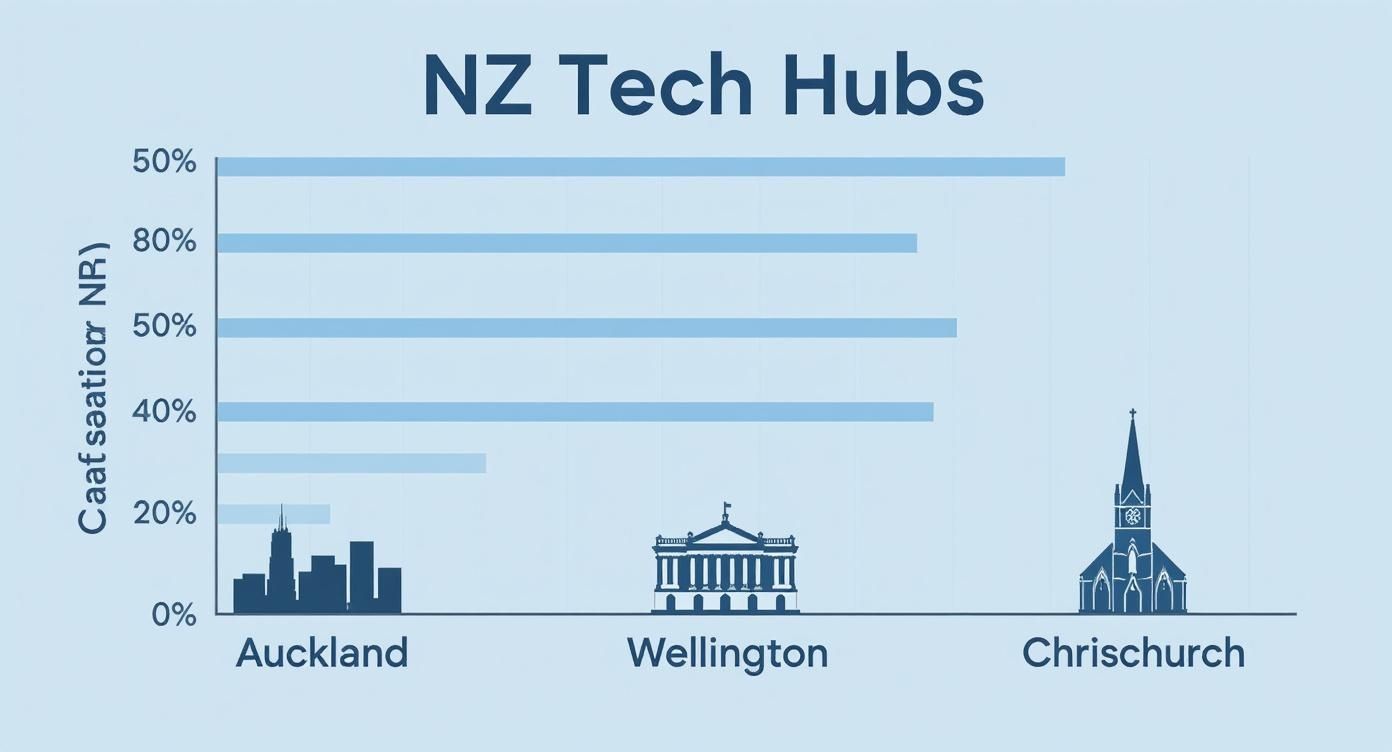
These three cities really are the core of New Zealand's tech industry, which drives both demand and salaries for designers.
Another huge factor is the type of employment. Are you looking for a permanent role with all the trimmings, or does the flexibility of contracting appeal more?
Permanent roles offer stability, sick leave, holiday pay, and often professional development budgets. The trade-off is usually a slightly lower base salary compared to what a contractor can earn.
Contractors, on the other hand, can command much higher hourly rates. The catch is that they're responsible for their own taxes (hello, GST returns!), have no paid leave, and need to manage the classic feast-or-famine nature of freelance work. It's a risk-versus-reward scenario. A senior contractor could easily bill well over $100 an hour, but they need the network and skills to keep the work flowing consistently.
Ultimately, understanding these figures helps everyone. For businesses, it means you can create a competitive offer that attracts the right person. For designers, it gives you the confidence to know your worth and negotiate effectively. It’s not about being greedy; it’s about acknowledging the incredible value a great user experience designer brings to the table.
So, you’re sold. You know you need a user experience designer, and you’re ready to bring one into the fold. What’s next? Honestly, finding the right person can feel like a huge challenge, but it doesn’t have to be a shot in the dark.
This isn’t about just filling a seat; it's about finding a strategic partner. You need someone who will champion your users and, in doing so, drive your business forward. Let’s break down how you can make a confident hire that pays dividends for years.
First things first, let’s talk about the job description. A generic ad is going to attract generic candidates. To find a real problem-solver, you need to be specific about the problems you’re trying to solve, not just list a bunch of software skills.
Instead of saying "Must be proficient in Figma," try something like, "We need someone who can take a complex user problem, explore solutions through low-fi wireframes, and build interactive prototypes in Figma for user testing." See the difference? One is a task; the other is about solving a real challenge. A great UX designer will be drawn to the latter.
To make sure you bring on the most capable people, it’s worth understanding the principles of skills-based hiring to help you assess true talent. It's all about focusing on what a candidate can do, not just the credentials on their CV.
When it's time to review portfolios, it's so easy to get dazzled by beautiful, polished final designs. Don't fall into that trap. A pretty picture tells you very little about a designer’s ability to solve real-world business problems.
What you're really looking for is the messy middle part. A great portfolio tells a story. It should show you:
You want to find someone who isn’t afraid to show their work—the scribbled notes, the dead ends, the "aha!" moments. That’s where the real thinking of a user experience designer happens. The beautiful final mockup is just the last chapter of a much longer story.
During the interview, your goal is to understand their thought process. Avoid generic questions like "What are your weaknesses?" Instead, dig into their problem-solving skills with practical, scenario-based questions.
Try asking things like: "Walk me through a project where the user data completely changed your initial assumptions." Or, "Imagine our checkout conversion rate dropped by 10%. What would be your first three steps to figure out why?"
The right candidate won't jump straight to a solution. They'll ask more questions. They’ll talk about talking to users, looking at the data, and forming a hypothesis before doing anything else. You're not hiring a pixel-pusher; you're hiring a strategic thinker. Find the person who loves the "why" as much as the "what," and you’ll have found your perfect match.
Let's clear the air on a few questions that always seem to come up when we talk about user experience designers. Think of this as the rapid-fire round – quick, straightforward answers to make sure everything clicks into place.
It’s easy to get fixated on the software, but honestly, the tools are just a way to get the job done. That said, most designers have a few go-to applications they use every day.
Figma is the undisputed champion at the moment for just about everything, from rough wireframes to polished, interactive prototypes. You’ll also see Sketch a lot, especially with designers who are long-time Mac users. For the research side of things, they might use a digital whiteboard like Miro for brainstorming or a tool like Dovetail to make sense of all their user interview notes.
The specific tool is far less important than the thinking behind it.
Short answer? Nope. While a degree in something like design or psychology can be a great foundation, it's definitely not a requirement to get into the field. Many of the best designers I know are self-taught or came from completely different backgrounds – marketing, copywriting, even hospitality.
What really matters is a solid portfolio that shows how you think and solve problems. Can you walk someone through how you uncovered a user's frustration, did the research, tested your ideas, and landed on a smart solution? That’s what gets you hired.
We've already covered this, but it’s the number one point of confusion, so it’s worth hammering home. Think of it like the difference between a building’s architectural plans and its interior decorating.
A user experience (UX) designer is the architect. They're focused on the big picture – the structure, the flow, making sure the building is logical and easy to move through. A user interface (UI) designer is the interior decorator. They're picking the colours, the furniture, and the finishes to make sure the space looks and feels great.
You really need both to create a place people love.
Ready to see how a focus on user experience can completely change the game for your next project? The team at NZ Apps specialises in building custom web and mobile solutions that are designed around your users from the very beginning. Book a free consultation with us today.