
Ever look at a website and think, "I could do that better"? You're not alone. The world of web design is buzzing, and here in New Zealand, the demand for people who can build beautiful, functional websites is stronger than ever. But figuring out where to even begin can feel a bit like trying to solve a puzzle in the dark.
Should you go for a full-on university degree? Is a shorter, punchy diploma the right move? Or maybe an online course you can chip away at after work? It's a lot to weigh up, isn't it? Honestly, the 'best' path is different for everyone. It depends on your goals, your budget, and how you like to learn. Let me explain.
We're going to walk through some of the standout web design courses NZ has on offer—from the big city campuses in Auckland and Christchurch to flexible online options you can tackle from anywhere. We'll break down what makes each one tick, who it's really for, and the nitty-gritty details like cost and duration. Think of this guide as your roadmap. Each option includes direct links and key facts to help you compare your choices without the usual headache of a dozen open browser tabs.
Of course, once you've gained the skills, the next step is showcasing them. Building a powerful CV is crucial. A specialized Frontend Developer Resume Template can give you a fantastic structure to work from, making sure your new qualifications get the attention they deserve. This isn't just a list; it's a starting point for your next big career move.
So you want to get serious about this web design thing? Good. For anyone ready to turn this interest into a full-blown career, the Diploma in Web and UX Design from Yoobee Colleges is a heavyweight contender. This isn't just a quick online tutorial; it's a comprehensive, NZQA-accredited Level 6 diploma designed to make you genuinely job-ready for the New Zealand tech industry. It's the deep, structured learning path you need to build a professional foundation from the ground up.
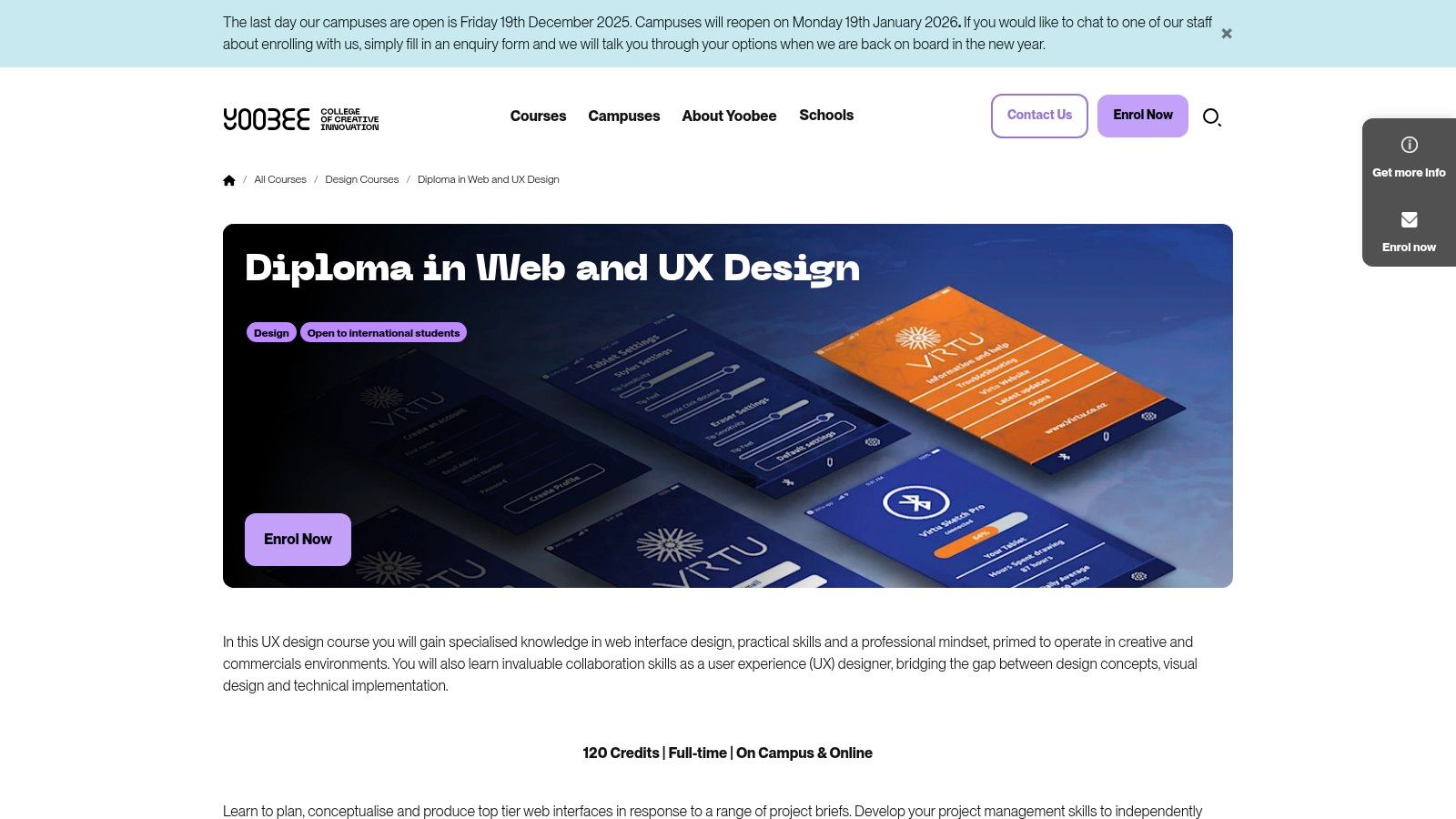
You know what makes Yoobee’s programme stand out? It cleverly blends the creative side of design with the crucial technical skills that employers are hunting for. You’ll be working with industry-standard tools like the Adobe Creative Cloud suite, getting your hands dirty with HTML and CSS, and focusing heavily on user experience (UX) and user interface (UI) design. The whole curriculum is specifically geared towards creating responsive, accessible, and beautiful websites that work flawlessly on any device.
Let's be clear, this is a full-time course. It runs for 40 weeks and demands a significant time investment, making it perfect for school leavers, career changers, or anyone ready to commit fully to their education. You can study on-campus in Auckland, Christchurch, or Wellington, or go for the online delivery if you need more flexibility. The course culminates in creating a professional portfolio—which is pretty much your golden ticket when you start applying for jobs.
Here’s a quick breakdown of what to expect:
Website: https://www.yoobee.ac.nz/courses/design/web-and-ux-design-diploma
Let’s keep rolling. If a diploma feels like just the start, perhaps a full degree is more your speed.
If you're aiming for the top tier of the creative tech world and see web design as part of a bigger picture, then the Bachelor of Media Design from Media Design School is a serious contender. This isn't a quick bootcamp; it’s a full three-year, NZQF Level 7 degree. Think of it as the university-level deep dive, preparing you not just for a job, but for a long-term career in user experience (UX), interaction design, and creating complex digital products.
Media Design School has a stellar reputation, particularly for its strong industry connections and prime location in Auckland's Wynyard Quarter innovation precinct. The Interactive/UX major is laser-focused on user-centred design for both web and mobile platforms. You’ll be learning the theory behind why great design works, and then immediately applying it. It’s less about just coding a webpage and more about understanding the entire user journey—from initial research and wireframing to prototyping and final execution.
This is a university degree, so it’s a significant three-year, full-time commitment. It's perfectly suited for those coming straight from high school or individuals ready to fully immerse themselves in a career change. The on-campus experience in Auckland is a huge part of the appeal, putting you right in the heart of New Zealand's tech hub. The programme is designed to build your skills progressively, culminating in a professional-grade portfolio that showcases your expertise to potential employers.
Here’s a quick breakdown of what to expect:
Now, what if you're not in Auckland but still want that hands-on, campus vibe? Let’s head south.
If you're in the South Island and looking for a qualification that perfectly balances the 'how it looks' with the 'how it works', the NZ Diploma in Web Development & Design from Ara is a fantastic choice. This is another NZQA-accredited option, but at Level 5, it serves as an excellent entry point into the tech world. It’s designed to give you a solid, practical foundation in both the creative design process and the technical coding skills needed to bring those designs to life.
Ara’s diploma is all about practical, hands-on learning. The curriculum covers the entire web creation lifecycle: planning, designing with UX principles in mind, building with front-end and back-end technologies, and finally, testing and deployment. You’ll get familiar with industry-standard frameworks and libraries, making sure the skills you learn are relevant to what Christchurch website developers are actually using in the field. This course is less about abstract theory and more about building real-world web solutions from scratch.
This is a one-year, full-time programme based primarily at their Christchurch campus. While it's a significant commitment, there are part-time study options available, which is great news if you need to juggle work or other responsibilities. One of the unique aspects of Ara's offering is its modular structure; you can take related individual courses like Web Fundamentals, allowing for more flexible, stackable learning pathways if a full diploma feels like too much at once.
Here’s a quick rundown of what to expect:
Feeling like a full diploma is a bit much to start with? No problem. There are shorter, sharper ways to get your foot in the door.
If you're thinking about a career in tech but aren't quite ready to commit to a full-blown diploma, this Unitec certificate could be the perfect starting line. It's a Level 4 NZQA-accredited course designed to give you the foundational IT knowledge every professional needs, with a specific and valuable taste of web design built right in. Think of it as a gateway course; it provides the essential skills to either enter an entry-level IT role or, more importantly, to confidently step up to higher-level study.
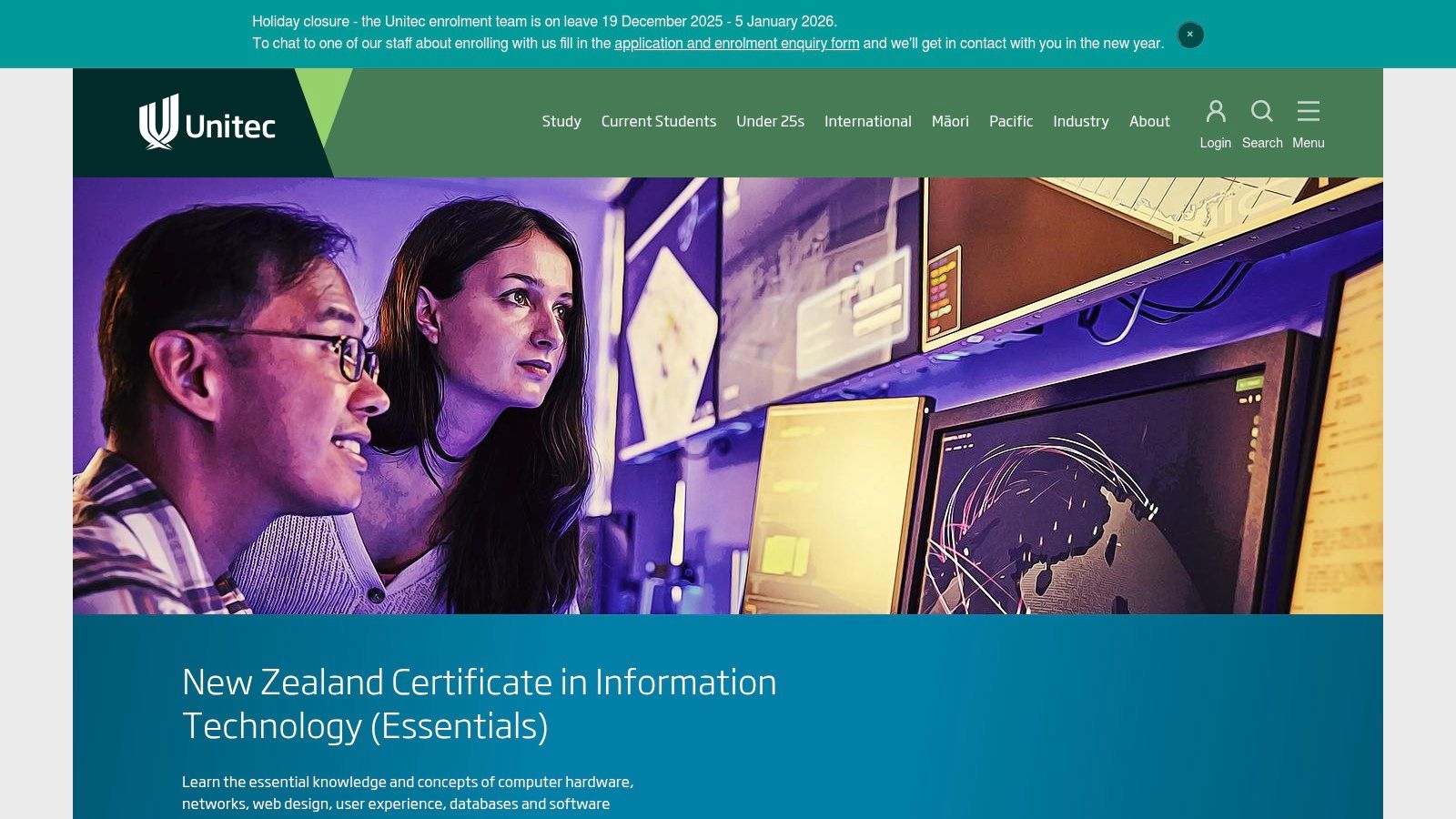
What makes this programme stand out is its practical blend. It’s not just a web design course, it's a holistic IT certificate. The "Web Design Foundations" component introduces you to the core principles of user interface (UI) design and introductory web-app development. This means you’re not just learning theory; you’re building a solid base that prepares you for more advanced web design courses NZ offers. It’s ideal for someone who wants to understand the bigger picture of how websites fit into the broader world of IT.
This is a short and sharp, full-time programme. It runs for just 16 weeks, making it an excellent option if you want to get qualified quickly and move on to the next step. The course is delivered on-campus at Unitec’s Mt Albert campus in Auckland, with intakes in February and July. This on-campus structure is great for learners who thrive on face-to-face interaction and direct support from tutors and peers.
Here’s a quick breakdown of what to expect:
Okay, so maybe campus life isn't for you. What if you need to learn from home, on your own terms? Let’s look at some distance options.
If you're looking for a flexible entry point into web design that fits around your current job or life commitments, the Open Polytechnic’s Creative Online Design course is a fantastic option. This isn't a massive diploma but a targeted, NZQA-accredited Level 4 course designed for at-home study. Think of it as the perfect first step to test the waters of web design, giving you solid foundational skills in HTML, user experience research, and online content creation without demanding a full-time schedule.
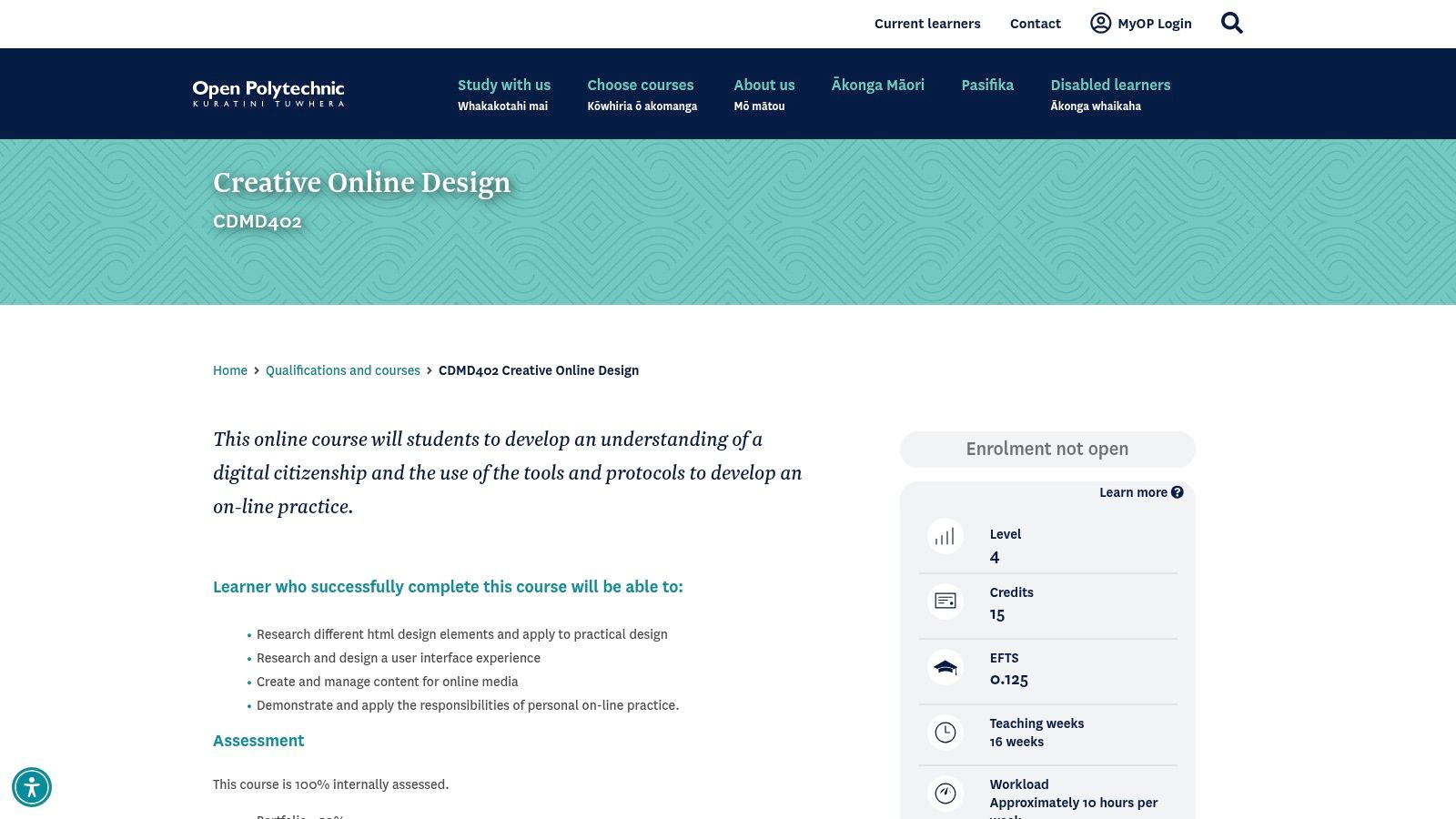
The Open Polytechnic has long been New Zealand's specialist in distance learning, and this course is a prime example of their expertise. It’s built to be accessible and manageable, guiding you through the essential elements of creating for the web. You’ll learn how to structure content with HTML and apply basic design principles, all while considering the user's journey. It’s a practical introduction that helps you understand how current web design trends in NZ translate into real-world projects.
This is where the Open Polytechnic truly shines. The course is designed for part-time, flexible study. It runs for approximately 16 teaching weeks, and with frequent intakes throughout the year, you don’t have to wait for a traditional semester start date. The workload is clearly defined, so you know exactly what you’re signing up for. It’s ideal for upskillers, small business owners who want to manage their own site, or anyone curious about a web design career but not yet ready to commit to a full diploma.
Here’s a quick breakdown of what to expect:
Website: https://www.openpolytechnic.ac.nz/qualifications-and-courses/cdmd402-creative-online-design/
Now let’s dial up the academic rigour, but keep the at-home flexibility.
If you're looking for a university-level credential without stepping onto a physical campus, the University of Auckland’s online offering is a seriously compelling option. Their "Programming with Web Technologies" course isn't a casual weekend workshop; it’s a formal, credit-bearing paper designed to give you a robust, academic foundation in modern web development. This is the path for those who value the weight and recognition that comes with a university qualification.
This course stands out by focusing on the full stack of web technologies, from front-end essentials like HTML, CSS, and JavaScript to server-side logic and database interaction. The goal is to get you building a substantial, dynamic web application from scratch. It’s a project-based course, meaning you won’t just be learning theory; you’ll be applying it to create a real-world project, which is fantastic for your portfolio and practical skills. The curriculum also touches on human-computer interaction (HCI), giving you a more rounded perspective than a pure coding course might.
This is a structured, 14-week online course. While it's delivered online, it has scheduled intakes and a formal learning pace you need to keep up with. Think of it as a proper university paper, just delivered with more flexibility. It's ideal for graduates from non-IT fields looking to pivot into tech, or anyone wanting to add a formal, credit-bearing qualification to their CV. The skills learned here are directly relevant to many web design courses NZ students look for, but with a stronger programming focus.
Here’s a quick breakdown of what to expect:
Website: https://www.online.auckland.ac.nz/courses/science/programming-with-web-technologies/
Finally, let's look beyond New Zealand's borders for a truly global, flexible option.
For those who want university-level learning without the campus commute or rigid schedule, Coursera’s "Web Design for Everybody" Specialization is a fantastic option. This isn't a local NZ polytechnic course; instead, it's a globally recognised series of courses created by the University of Michigan. It’s perfect if you value academic rigour and want the flexibility to learn at your own pace. Think of it as gaining access to world-class education from your home in New Zealand.
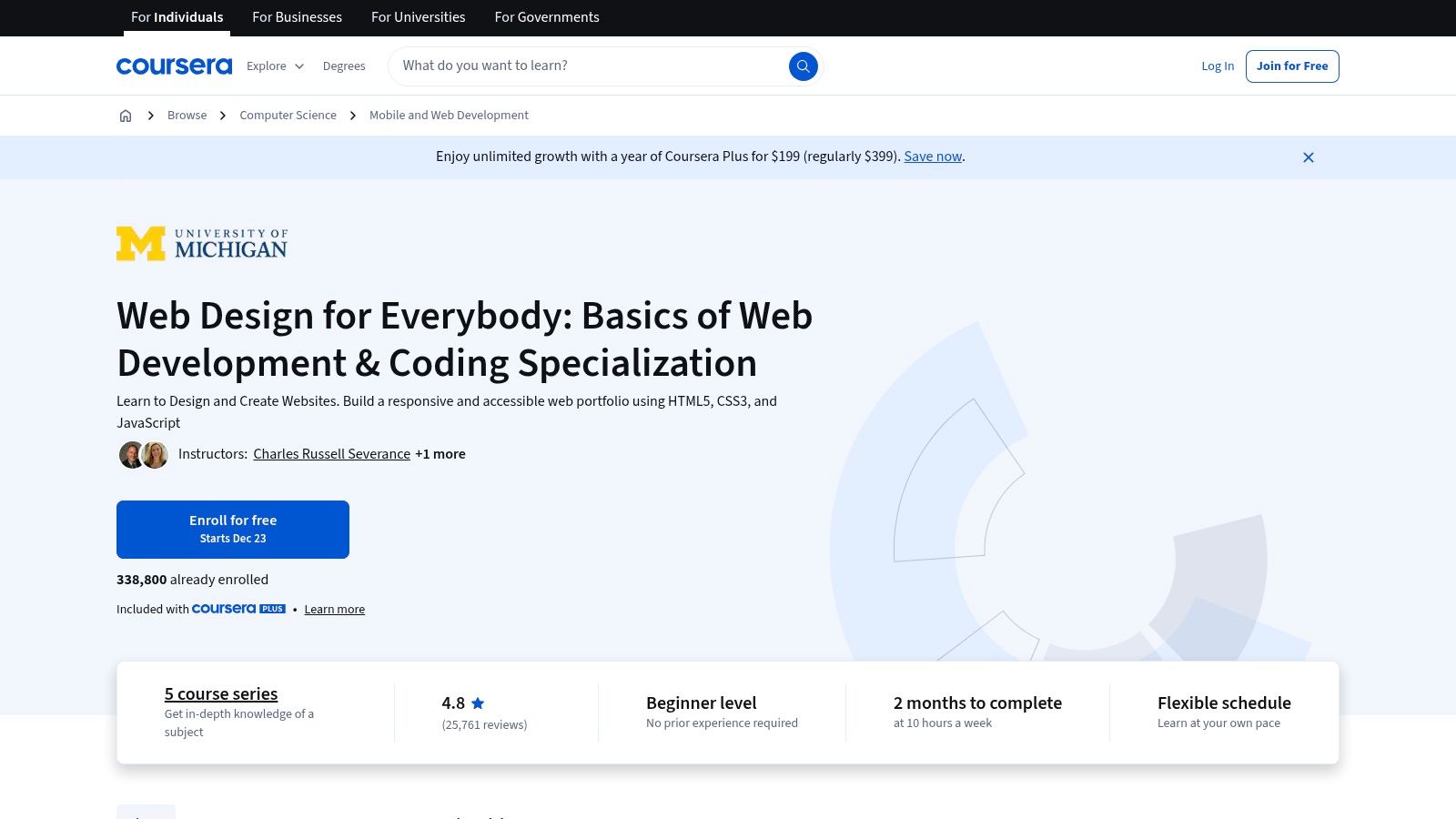
The strength of this specialization lies in its structured, foundational approach. It’s a five-course series that takes you from the absolute basics of HTML5 and CSS3 right through to JavaScript and responsive design. The capstone project is a real highlight, where you pull everything together to build a professional-quality web portfolio. With over 300,000 learners and consistently high ratings, it’s a proven pathway for beginners worldwide looking to get a solid start in web development.
Here's the thing about Coursera: the commitment is entirely up to you. The platform suggests it might take around three months if you dedicate about seven hours a week, but you can go faster or slower. You pay via a monthly subscription, giving you the freedom to pause or cancel as needed. It's an on-demand model, so you can start whenever you're ready. This makes it a standout choice among web design courses in NZ for those who can't commit to a fixed timetable.
Here’s a quick breakdown of what to expect:
Website: https://www.coursera.org/specializations/web-design
| Program | Complexity & Pace 🔄⚡ | Resources & Cost 💡 | Expected Outcomes ⭐📊 | Ideal Use Cases | Key Advantages ⭐ |
|---|---|---|---|---|---|
| Yoobee Colleges — Diploma in Web and UX Design (Level 6) | 🔄 Medium‑High — 120 credits, full‑time (on‑campus or online) ⚡ Moderate | BYOD + Adobe CC; clear domestic/international fees | Portfolio‑ready graduates aligned to local industry; NZQA Level 6 | Career changers seeking practical UX/web roles in NZ | Industry‑aligned curriculum; strong portfolio focus |
| Media Design School — Bachelor of Media Design (Interactive/UX major) | 🔄 High — 3‑year NZQF Level 7 degree ⚡ Slow (full degree) | Campus‑based in Wynyard Quarter; higher tuition | Degree credential, deep UX/interaction skills, strong portfolio | Students seeking a formal degree and industry connections | Well‑known brand; strong creative‑tech industry links |
| Ara Institute — NZ Diploma in Web Development & Design (Level 5) | 🔄 Medium — 1‑year full‑time; combines dev + UX ⚡ Relatively fast | On‑campus (Christchurch); modular/stackable options | Practical, NZQA‑recognised diploma covering design & development | Learners wanting a compact, vocational cross‑discipline program | Broad practical skillset; stackable pathway to further study |
| Unitec | NZ Cert in IT (Essentials) with Web Design Foundations | 🔄 Low — 16‑week, Level 4 short course ⚡ Fast entry | Basic UI and web foundations (15 credits) for beginners | Absolute beginners seeking a quick introduction to web/UI | Short duration; good entry point for further study |
| Open Polytechnic — Creative Online Design (CDMD402) | 🔄 Low — ~16 teaching weeks, fully online ⚡ Flexible pacing with rolling intakes | Fully online; nationally accessible; per‑course fees vary | Foundational HTML/UI/UX skills (15 credits) | Working adults needing flexible, distance study | Fully online with frequent intakes and clear workload guidance |
| University of Auckland (UoA Online) — Programming with Web Technologies | 🔄 Medium — 14 weeks, 30 points; structured university course ⚡ Intense short term | Online but admission/requirements apply; formal timetable | Substantial dynamic web app project; university credit | Learners seeking university‑level credential and project work | Academic rigor and recognised university credential |
| Coursera — Web Design for Everybody (University of Michigan) Specialization | 🔄 Low‑Medium — 5 self‑paced courses + capstone ⚡ High flexibility/speed for motivated learners | Online subscription or per‑course pricing; financial aid available | Capstone portfolio site; beginner→intermediate web skills | Self‑learners wanting flexible, on‑demand learning | University‑produced content, large community reviews and certificate |
We've explored a lot, haven't we? From the comprehensive diplomas at Yoobee and Ara to the specialised bachelor’s degree at Media Design School, the landscape of web design courses in NZ is surprisingly diverse. We’ve looked at flexible online options like Open Polytechnic and Coursera that fit around your life, and foundational certificates from Unitec that give you a solid first step. It's a lot to take in.
The reality? There is no single 'best' course. The right path for you is tangled up in your own goals, your budget, and how you learn best. It’s less about finding a magic bullet and more about finding the right key for your specific lock. Are you a career-changer in Auckland needing to get job-ready, fast? A bootcamp-style diploma from Yoobee or the prestigious degree from Media Design School might have your name on it. Their focus on practical skills and industry connections is designed to get you into the workforce.
On the other hand, if you're based in Christchurch and want a qualification that balances creative design with technical development, the Ara diploma is a brilliant, well-rounded choice. It’s respected locally and gives you a fantastic foundation.
This is where the game really opens up. The rise of remote learning means your location is no longer the barrier it once was. The Open Polytechnic module is a perfect example – you can dip your toes into creative digital media from anywhere in New Zealand, whether you're in Invercargill or Kaitaia. Similarly, international platforms like Coursera offer world-class instruction from institutions like the University of Michigan. The key here is self-discipline. Online learning is fantastic, but you are the one who has to show up every day.
Speaking of learning environments, once you get the hang of web design, you might even think about sharing your own knowledge. The digital education space is massive. If you find yourself wondering how platforms like Coursera actually work behind the scenes, you might find a good online course platform comparison useful down the track. It’s a whole other world, but one that’s built on the very web skills you’re looking to acquire.
So, how do you actually decide? Let's break it down into actionable steps. Forget the noise for a moment and ask yourself these honest questions:
Your answers to these questions will point you toward the right category of course. From there, you can compare the specific providers we've covered. The most important step isn't enrolling tomorrow; it's figuring out what you truly need first. Choose a path, commit to it, and start building. The web isn't going anywhere, and the skills you gain will be valuable for years to come.
Feeling like a full course is more than you need? If your goal is simply a professional, high-performing website for your business without the learning curve, sometimes the smartest move is to call in the experts. At NZ Apps, we specialise in crafting custom websites and applications for businesses across Auckland, Christchurch, and all of New Zealand. Get in touch for a friendly chat about your project.