
Choosing the right website hosting in New Zealand is one of those make-or-break decisions for your business. Honestly, it has a direct impact on your site's speed, its security, and whether your Kiwi customers can actually find you online.
Think of it as the digital land your business is built on. A shaky foundation will cause endless headaches down the road. You wouldn't build a house on a swamp, right? Same idea.
Let's be real, 'website hosting' sounds like one of those techy terms everyone expects you to know. But what does it really mean for your business here in Aotearoa?

Here’s the simple truth: your website isn't just floating around in the ether. It’s made up of real files—images, text, and code—that need a physical home. That home is a powerful computer called a server, which is kept humming along and connected to the internet 24/7.
Website hosting is simply the service of renting space on one of these servers. You’re essentially leasing a plot of digital land where your website can live and be seen by anyone, anywhere. Without it, your site would be totally invisible. An online ghost.
You might be thinking, "Right, I'll just grab the cheapest option and call it a day." I get it. But that's a bit like choosing your shop's location based purely on the lowest rent, without ever checking if people can actually find the front door. Your hosting choice is the very bedrock of your online performance.
A good host makes sure your site is:
The difference is massive. A slow, unreliable site doesn't just annoy visitors; it can seriously ding your brand's reputation. It’s the digital equivalent of a shop with a permanently jammed front door. Not a great look, is it?
It's for this very reason that the local market for website hosting in New Zealand is growing so quickly. The number of data processing and web hosting businesses in NZ shot up to 341 this year, a huge 20.9% increase from the year before. This boom shows just how much Kiwi businesses are demanding dependable, local options. You can explore more about this industry growth and its drivers.
Choosing your hosting is like picking the engine for your car. You can have the slickest design and the best products, but if the engine is sluggish and conks out all the time, you're not going anywhere fast.
This guide will walk you through everything you need to know. We'll cut through the jargon to focus on what truly matters, exploring the big local vs. global debate, breaking down the different types of hosting, and showing you how it all connects back to your bottom line.
So, you're ready to pick a host. This is where you hit the first big fork in the road, and it’s a question every Kiwi business owner mulls over: do you go with a local provider right here in New Zealand, or one of the massive global corporations?
Honestly, this isn't just about 'supporting local', though that's a perfectly good reason on its own. The decision you make here directly affects your website's performance, your customer service experience, and even some legal stuff you might not have thought about. It’s a classic head-versus-heart debate, but with real business consequences.
Let's talk about the big one first: speed. When someone in Dunedin clicks on your website, their computer sends a request to your server. The server then sends your website's data back. The time this round trip takes is called latency.
Think of it like this: posting a letter from Dunedin to Auckland is always going to be faster than posting one to London. Data travels incredibly fast, of course, but distance still matters. Even tiny fractions of a second in delay can add up, creating a sluggish, frustrating feeling for the user. A slow site isn't just annoying; research consistently shows that visitors will bail if a page takes more than a few seconds to load.
Hosting your website on a server physically located in New Zealand—say, in an Auckland data centre—can give you a distinct speed advantage for your local customers. That tiny reduction in latency makes your site feel snappier and more responsive. It's a huge win.
On the other hand, the big international hosting companies have undeniable appeal. They operate at a colossal scale, which often means they can offer incredibly competitive prices. Their massive infrastructure also gives them some serious firepower and features that smaller local hosts might struggle to match.
The trick is that many of these global players now have data centres scattered around the world, including in nearby Australia. Hosting in Sydney is a common middle-ground, offering a decent balance between the performance of a truly local server and the cost savings of a global provider. It’s not quite as fast as hosting in Auckland for a Kiwi audience, but it's a massive improvement over hosting in the US or Europe.
The core question isn't just "Where is the server?" but rather, "Where are my customers?" If your audience is almost entirely in New Zealand, prioritising local server performance makes a world of difference.
This is also where your marketing strategy comes into play. A fast local site is a cornerstone of good technical SEO, especially if you're trying to rank for local searches. For a deeper look, you might be interested in our guide on local SEO for small businesses in NZ, which explains how site performance ties directly into your visibility on Google for Kiwi customers.
Performance isn't the only factor. What happens when your site goes down at 3 PM on a Tuesday? With a local New Zealand host, you're likely to get support staff who are awake, in your time zone, and understand the local context. Dealing with a call centre on the other side of the planet can be a soul-destroying experience when you're in a panic.
Then there's the matter of data sovereignty. This is a fancy term for a simple idea: your data is subject to the laws of the country where it's stored. By keeping your customer data on servers within New Zealand, you ensure it's protected by NZ privacy laws. For many businesses, particularly in health or finance, this isn't just a preference—it's a legal requirement. It provides peace of mind for both you and your customers.
To make things a bit clearer, here’s a quick comparison to help you weigh up the options from a Kiwi point of view.
| Feature | Local NZ Host | Global Host |
|---|---|---|
| Performance | Typically faster for NZ visitors due to lower latency. | Can be slower for NZ visitors unless using an Australian data centre. |
| Support | Support teams are in the NZ time zone, offering local understanding. | Often 24/7 support, but may be from international call centres. |
| Pricing | Can be slightly more expensive due to smaller scale. | Often cheaper entry-level plans due to massive scale. |
| Data Sovereignty | Your data is kept in NZ and protected by local privacy laws. | Data may be stored overseas, subject to foreign laws. |
Ultimately, the choice between local and global hosting comes down to your specific priorities. If your business primarily serves New Zealanders and you value speed, local support, and data privacy, a local host is tough to beat. If you're on a tighter budget or have a more international audience, a global provider with a data centre in Australia could be the perfect fit.
Once you’ve wrestled with the local versus global decision, another menu of options appears. Shared, VPS, Dedicated, Cloud… honestly, it can feel like you need a degree just to understand the choices. Let's cut through all that noise.
Think of it like finding a place to live. The type of website hosting you choose for your New Zealand business is a lot like deciding between renting a room in a flat, leasing a townhouse, or buying your own standalone house. Each one serves a different purpose, and picking the right one means you won't overpay for space you simply don't need.
The following infographic offers a quick visual on how these choices branch out, helping you see the path from big-picture decisions to specific hosting types.
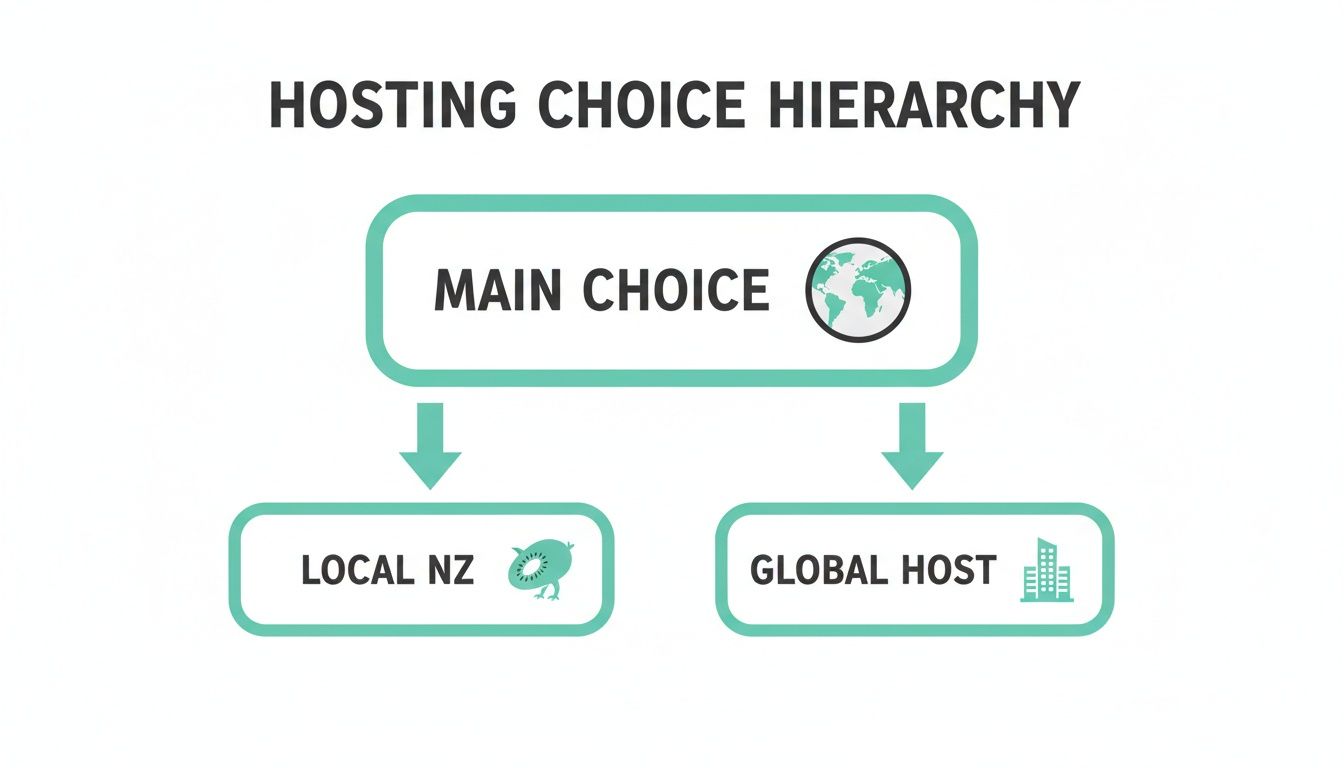
As you can see, the first major split is between local and global, which then leads into the specific 'flavour' of hosting that fits your needs.
Shared hosting is the most common and affordable option out there. It’s exactly like flatting; you and a bunch of other websites all live on the same server, sharing its resources—like memory (RAM), processing power (CPU), and disk space. It's cheap and cheerful, perfect for getting started.
A Virtual Private Server (VPS) is the next step up. Using our housing analogy, this is like getting your own townhouse. While you’re still on a property with other tenants (the physical server), you have your own dedicated, walled-off resources.
No one else can use your allotted RAM or CPU. This gives you far more stability and control than shared hosting, without the cost of a fully dedicated machine. It’s a fantastic middle ground.
When you need total control and power, you go for a dedicated server. This is your own private house. The entire server and all its resources belong to you and you alone. You’re not sharing anything.
This option provides the highest level of performance, security, and customisation. Of course, with great power comes a higher price tag and the responsibility of managing it all yourself (unless you opt for a managed plan).
This choice matters a great deal right now, especially as the local market is bouncing back. IT services revenue in New Zealand is projected to hit NZ$7.12 billion and climb towards NZ$8.52 billion soon. After a period of tighter budgets, this growth shows a renewed focus on solid digital infrastructure, and picking the right hosting is a huge part of that.
Beyond the main three, a couple of other important types of website hosting are worth knowing.
You might not think your web host has much to do with your Google ranking, but honestly, you'd be surprised. It’s easy to get lost in keywords and content, but the technical foundation of your website—your hosting—plays a massive role in your success. Why? Because search engines like Google are completely obsessed with user experience.
And what's the number one killer of a good user experience? A slow-loading website. It's a huge red flag for Google and an instant turn-off for potential customers.

This is where the dots connect directly between your hosting provider and your ability to be found online. A fast, reliable website is one of the most fundamental SEO investments you can make.
Let’s not beat around the bush. Site speed is a confirmed ranking factor for Google. If two websites have similar content, the faster one will almost always rank higher.
A slow site doesn’t just frustrate users; it actively hurts your visibility. Studies have shown that even a one-second delay in page load time can lead to a significant drop in conversions. When you choose your website hosting in New Zealand, you're directly choosing how fast your site will be for your local Kiwi audience.
This is where server location comes roaring back into the picture. A server in Auckland will deliver content to a user in Wellington much faster than a server in Texas. That reduced latency gives you a precious competitive edge in local search results.
What’s worse than a slow website? A website that’s not there at all. Uptime is the percentage of time your website is online and accessible. A good host guarantees 99.9% uptime, which sounds great, but even that small fraction can mean your site is down for several hours over a year.
Think about it. If Google’s crawlers try to visit your site and it’s offline, they can't index your pages. If this happens repeatedly, Google might start to see your site as unreliable and could lower your rankings as a result. Consistent downtime is a clear signal to search engines that your site isn't providing a good experience, and they will penalise you for it.
Your hosting's reliability is a direct reflection of your business's reliability in Google's eyes. Frequent outages are like having a "Closed" sign on your door during business hours—it tells customers (and search engines) to go elsewhere.
Have you ever noticed the little padlock icon next to the URL in your browser? That’s an SSL certificate, and it signifies that the connection to the site is secure and encrypted. Google has been crystal clear that HTTPS (the secure version of HTTP) is a ranking signal.
So, what does this have to do with hosting? Most reputable hosting providers now include a free SSL certificate with their plans. They make it simple to install and maintain. Choosing a host that doesn't prioritise this or makes it difficult to implement is a serious mistake for your SEO. It's not just a technical detail; it's a massive trust signal for both users and search engines.
Ultimately, your hosting choice is the bedrock of your online presence. Investing in a quality provider is a crucial step for any business serious about its digital footprint. For those wanting to get a deeper understanding of the entire process, our comprehensive guide to search engine optimisation in New Zealand covers how technical elements like these fit into a broader strategy. Your hosting is just one piece of the puzzle, but it’s a foundational one you can’t afford to get wrong.
Alright, let's talk money. When it comes to website hosting in New Zealand, the prices can seem all over the place. You might see plans for just a few dollars a month, right next to others costing hundreds. So, what are you actually paying for? Is that cheap option a genuine bargain, or just a headache waiting to happen?
This isn't just about chasing the lowest price tag. It’s about understanding the total cost of ownership and finding real value, so you don’t get a nasty surprise on your invoice twelve months down the track.
Hosting companies are masters of the attractive introductory offer. You see a plan advertised for $3 a month and think, "Sweet as!" But here's the catch you absolutely have to watch out for: the renewal rate. That super-low price often skyrockets after the first year, sometimes jumping by 300% or more.
Suddenly, your budget-friendly hosting becomes a major expense. It's a classic bait-and-switch that catches out so many Kiwi businesses.
Beyond that initial price, you need to dig into the hidden extras. Does the plan actually include everything you need?
These "small" costs add up fast, turning a cheap plan into a mediocre, expensive one. It’s a competitive market, but it's also a massive one. The Data Processing and Web Hosting Services market in New Zealand recently hit $926.3 million in size. While it dipped slightly last year, its strong growth over the last five years shows just how essential this sector is. You can read more about New Zealand's web hosting market trends to get the full picture.
So, where should you invest your money? What features provide genuine value and justify a higher price point? Honestly, it all comes down to what gives you peace of mind and saves you time.
For most businesses in New Zealand, paying a little extra for managed support is a no-brainer. This means having a team of experts on hand (in your time zone!) to sort out technical glitches, monitor security, and handle software updates. Unless you're a web developer yourself, this service is worth its weight in gold.
Enhanced security features, like proactive malware scanning and a web application firewall (WAF), are also worth every cent. The cost and stress of cleaning up a hacked website is far, far greater than the monthly fee for preventing it in the first place.
Chasing the absolute cheapest hosting plan is like buying the cheapest tools to build your house. It might save you money upfront, but you'll pay for it later in repairs, frustration, and a structure that just doesn't perform when you need it to.
So, what should you actually expect to pay? Remember, hosting is just one piece of the puzzle. If you're wondering about the overall investment, you might find our guide on how much a website costs in NZ helpful, as it puts hosting into the broader context of design and development.
Here are some realistic monthly budget ranges for different scenarios:
Choosing the right website hosting in New Zealand is a balancing act. It's about matching your business needs with a plan that delivers reliable performance and support, without any nasty hidden surprises.
Alright, it's decision time. We’ve covered a lot of ground—local versus global, the different flavours of hosting, costs, and even SEO. But with all this information swimming around, how do you actually pull the trigger and choose a provider?
This is where it all comes together. Forget the jargon for a moment; this is your practical, no-nonsense checklist to help you make a confident choice for your website hosting in New Zealand.
Before you even look at a single hosting plan, you need to understand your own requirements. It’s a bit like buying a car—you wouldn't buy a massive ute just to do the school run. Be honest about where your business is at right now.
For those considering more complex setups that go beyond traditional servers, understanding the nuances of cloud architecture is key. For a deeper dive, this technical guide on how to choose a cloud provider offers some really solid insights for making an informed decision.
Once you’ve narrowed down the type of hosting you need, it's time to vet the providers. Don't just look at the price tag. Reach out to their support teams and ask these direct questions. Their answers (or lack thereof) will tell you everything you need to know.
You’re not just buying server space; you’re entering into a partnership. You need to know that your host has your back when things inevitably go sideways. A quick, helpful response to these questions is a great sign.
Here are the essentials to ask:
Making a decision feels final, but it doesn't have to be perfect. The most important thing is to choose a provider that aligns with your current needs and gives you the flexibility to grow. Now, you’re ready.
Still have a few questions swirling around about website hosting in New Zealand? We get it. It can feel like a lot to take in, so here are some straightforward answers to the most common queries we hear from Kiwi business owners.
While it's not a strict technical requirement, having a .nz domain is something we highly recommend for any business that primarily serves New Zealanders. Think about it from a customer's perspective. It immediately signals that you're a local entity, which builds instant trust and can give your local SEO a nice little boost.
Honestly, Kiwi customers are often more likely to click on a .nz result in Google because they know they're dealing with a local business. It’s a small investment that punches well above its weight in reinforcing your local identity.
You know what? It really depends on the type of hosting you choose. For basic shared hosting that comes with a control panel like cPanel or Plesk, you need very little technical skill. These dashboards are designed to be user-friendly, letting you manage things with a few clicks.
However, if you jump up to a VPS or a dedicated server, you will need more technical know-how to manage the server environment yourself. For those who want the power without the headache, managed hosting is the perfect middle ground—the hosting company handles all the tricky technical maintenance for you.
It’s a classic trade-off: the more control and power you want, the more responsibility you generally have to take on. Managed plans let you bypass that learning curve entirely.
Absolutely! You are never, ever permanently locked into a hosting provider. Migrating your website to a new host is a completely normal and common process. In fact, many hosting companies will even offer free migration services to make the switch as painless as possible for you.
The process usually involves transferring your website files and database over to the new server and then updating your domain’s DNS settings to point to the new location. While it can seem a bit daunting, any good provider will guide you through every single step.
At NZ Apps, we don't just build websites; we create the digital foundations that help New Zealand businesses grow. If you're looking for a partner to handle your web design, development, or SEO with a local-first approach, we're here to help. Get in touch for a free consultation and let's discuss how we can bring your project to life.