
Strategic planning turns an organisation's purpose and market context into a limited set of choices, priorities, resource commitments and measures reviewed over time. For a SaaS business, that can mean setting a three-to-five-year direction while testing the assumptions behind near-term decisions.
Your product team wants more engineers. Sales wants a feature for a promising prospect. You're weighing an Australian launch, and the cash forecast leaves little room for mistakes. You don't need a prettier planning document. You need a sound way to decide what deserves your team's time.
The weekly product meeting starts with worthy ideas. Someone proposes better onboarding. Someone else wants an integration. Sales makes a fair case for custom reporting, while the founder raises a new market and a hiring request.
In this hypothetical meeting, nobody's being reckless. Each proposal could help. Yet the same engineers can't build everything, and the annual plan offers little guidance beyond “grow revenue” and “improve the product”.
Strategic planning gives the founder a reason to choose. It connects the customer you serve, the value you promise and the resources you'll commit. It also makes the cost of saying yes visible.

Suppose the team has chosen to serve small service firms that struggle with job handovers. Better onboarding may help those customers reach value sooner. A bespoke reporting suite for an unrelated enterprise buyer might pull the product elsewhere.
The decision isn't that reporting is bad. It's that this customer problem deserves resources before that opportunity.
New Zealand's public-sector planning history offers a useful parallel. Statements of Intent, introduced through the Public Finance Amendment Act 1992, required departments to publish their intended focus for the coming three to five years, connecting direction with accountability (history of strategy in New Zealand's public service).
Practical rule: If your plan can't help you decline a plausible opportunity, it probably hasn't made the hard choices yet.
For a small app business, those choices protect more than cash. They protect engineering focus and the founder's attention. A busy team can ship plenty without getting closer to the business it meant to build.
Think of planning a road trip. Your destination matters, but so do the terrain, fuel and places where you'll check your progress. Picking a destination without checking the tank isn't much of a plan.
In business terms, the destination is your desired future. The terrain includes customers, competitors and market conditions. Your fuel is cash, capability and available time.
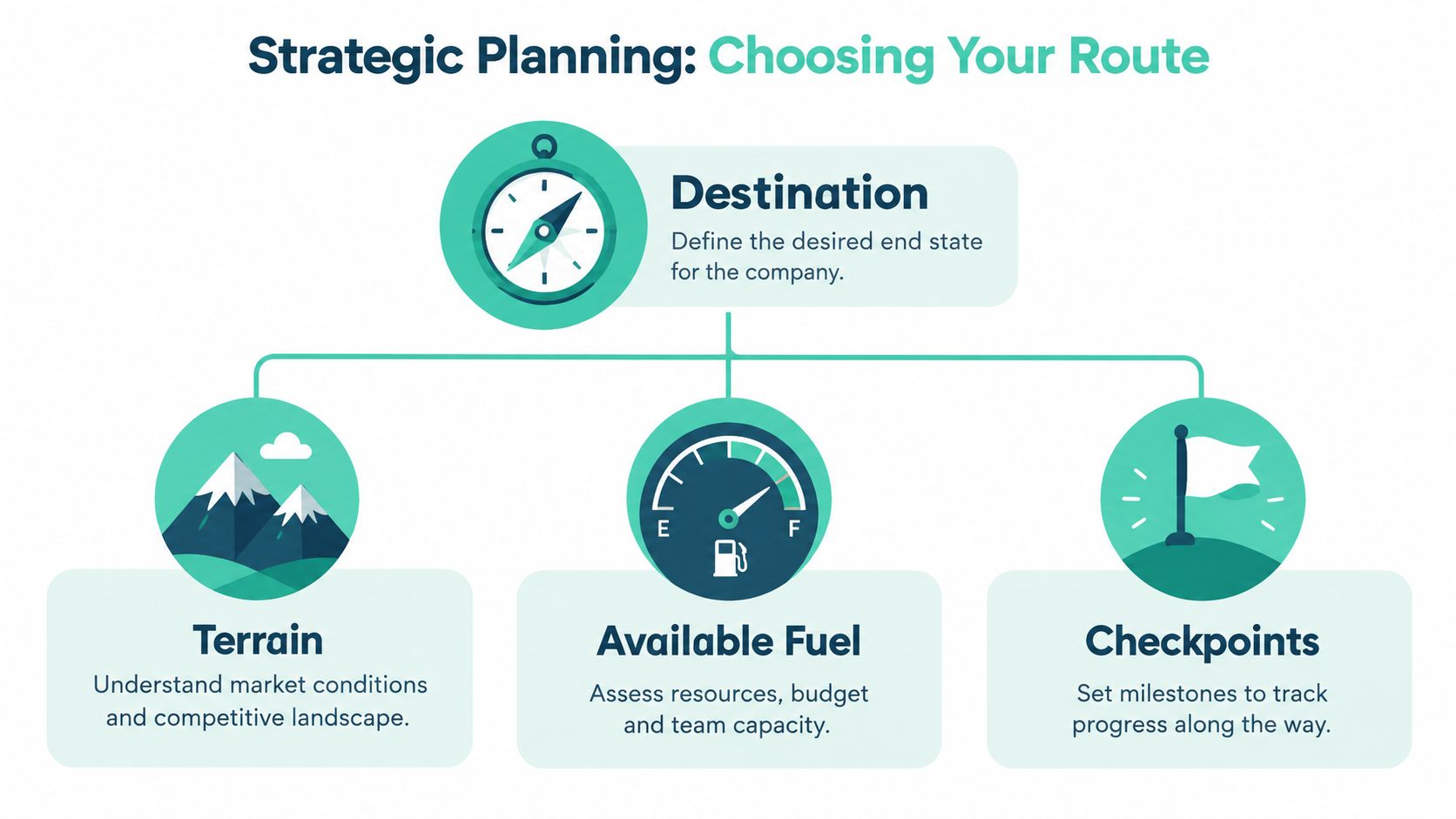
Strategy is the connected set of choices about where you'll compete and how you'll create value. Strategic planning is the work of developing, funding, testing and revising those choices.
Several nearby terms cause confusion:
A forecast estimates what might happen under stated assumptions. A budget authorises spending. An annual business plan describes near-term execution. These support strategy, but none replaces the choice of which customers and problems deserve that spending.
New Zealand councils provide a concrete illustration: their long-term plans connect intended outcomes with activities, costs, funding, service levels and performance measures (Auditor-General's explanation of long-term plans). The useful lesson for founders is the connection between ambition and commitments, not the council paperwork.
Strategic planning is the disciplined work of choosing a future, deciding how to pursue it and using evidence to guide commitments.
When translating those choices into objectives, The OKR Hub's OKR strategic planning insights offer a related resource to consider. Keep the distinction clear: an objective-setting method helps express strategy; it doesn't make the strategic choices for you.
So, what is strategic planning in plain English? It's deciding where you're going, what you'll back and how you'll know whether your reasoning holds.
The language gets less slippery when every term belongs to the same business. Consider a hypothetical NZ SaaS company building job-handover software for small field-service teams.
Its founder wants to reduce the scramble between the office and people on site. That's a starting point, but it still needs to become a set of decisions.
The company's vision might be that small service teams can run reliable jobs without constant chasing. Its mission could be to make job handovers clear for office staff and field workers.
Notice the difference. The vision describes a future; the mission describes the company's role today. Neither needs to sound like it belongs on a conference banner.
Next comes SWOT analysis, which examines strengths, weaknesses, opportunities and threats. Strengths and weaknesses concern internal capability. Opportunities and threats concern external conditions.
For this imagined company, close customer access could be a strength. Limited integration capacity could be a weakness. A poorly served handover task could be an opportunity, while a rival's bundled workflow could be a threat. These are hypotheses to investigate, not facts to declare after a lively workshop.
The useful output is a decision: favour customers who can use the core workflow without heavy custom integration.
Strategic planning components at a glance
| Component | Question it answers | Useful output |
|---|---|---|
| Vision | What future matters? | A clear description of the desired future |
| Mission | Whom do we serve, and why? | A statement of present purpose |
| SWOT analysis | What helps or constrains our choices? | Evidence-backed implications |
| Objectives | What outcome must change? | Defined results with owners and timing |
| KPIs | How will we judge progress? | Measures with clear definitions |
| Roadmap | What work comes before what? | A sequence of initiatives and dependencies |
The company's objective might be to help new accounts complete a useful handover and keep using the workflow. “Build a tutorial” is an activity, not the outcome itself.
Its KPIs, or key performance indicators, could include activation and retention. Define activation through a meaningful customer action, rather than a login that tells you little.
A useful measurement pattern appears in New Zealand's Disability Strategy dashboard: priority outcomes have primary measures supported by more detailed secondary measures (Disability Strategy monitoring dashboard). For the SaaS team, the equivalent is a headline outcome with diagnostic measures underneath.
The roadmap then puts work in sequence: investigate failed handovers, simplify setup, test the revised flow, then consider integrations. Don't turn it into a promise to build every requested feature.
Each component should support a decision. If it doesn't, shorten it, improve it or leave it out.
A founder still testing the customer problem needs a different plan from a company preparing an overseas sales team. Borrowing the latter's hiring plan can look ambitious while skipping the evidence that would justify it.
I'd use discovery, validation and expansion as planning modes, not badges of status. A company can be established in its home market while still doing discovery in a new segment.
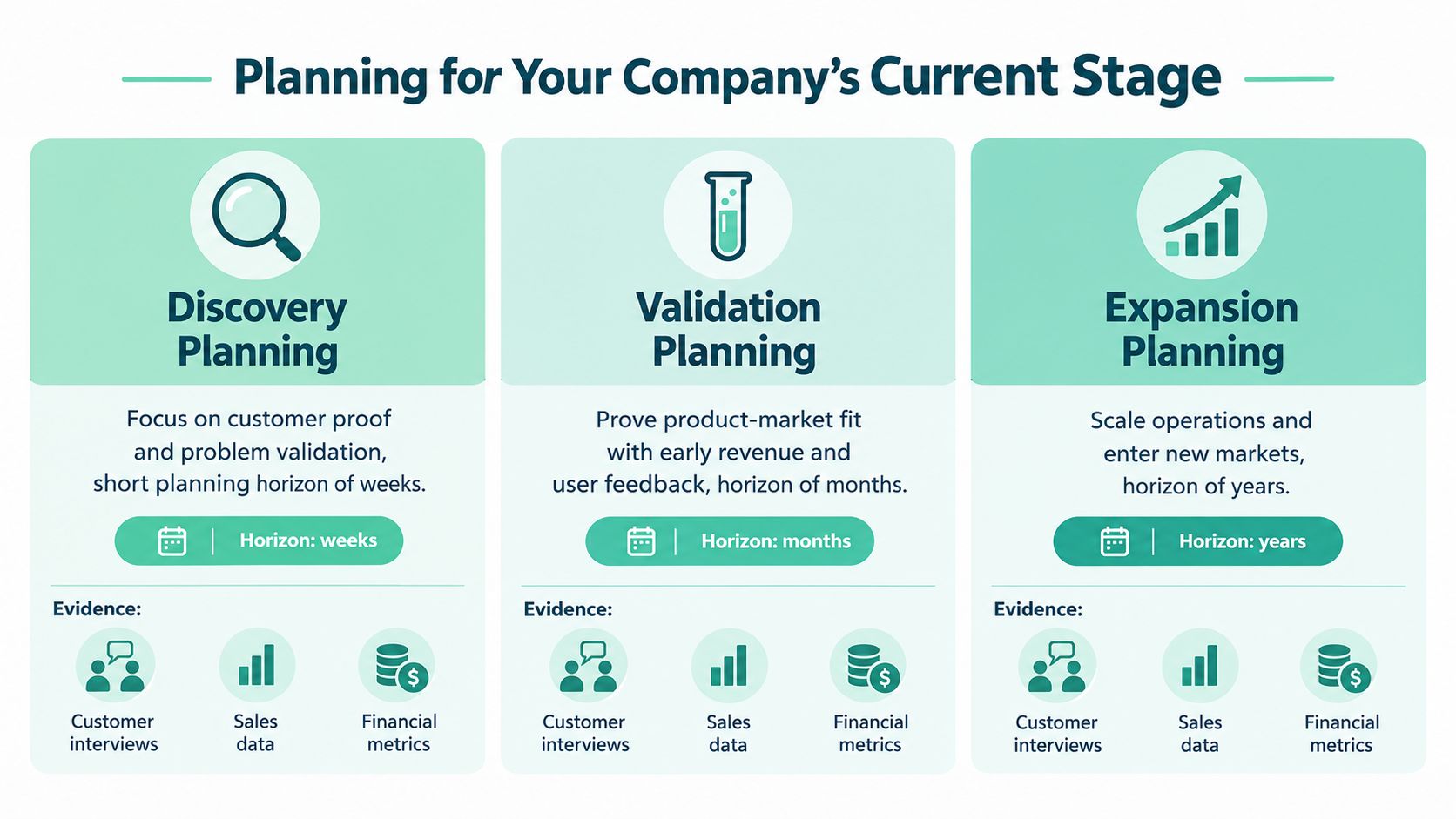
| Planning mode | Main question | Evidence to seek | Management focus |
|---|---|---|---|
| Discovery | Does this problem matter enough? | Customer conversations, observed work, repeat use | Learn before committing heavily |
| Validation | Can we serve these customers sustainably? | Retention, willingness to pay, delivery cost | Prove a repeatable commercial approach |
| Expansion | Where should we commit for growth? | Market-specific demand, acquisition economics, capability needs | Sequence hiring, capital and market entry |
In discovery, a founder might test whether customers value handover software at all. The work needs a short learning horizon, not a detailed overseas revenue forecast.
In validation, attention shifts towards durable use and sound economics. A clear understanding of product-market fit helps frame the question: are customers getting value that they'll keep paying for?
Expansion planning involves larger commitments. An Australian launch may require local selling capacity, support coverage or compliance work. Don't treat those commitments as harmless experiments if reversing them would be costly.
New Zealand recorded 166 startup investment deals and NZ$754 million invested in 2025, while proof-of-concept deals represented 19% of deal volume, according to Dealroom's reporting on the NZ tech ecosystem. The same reporting describes greater concentration in later-stage companies.
My reading for founders is simple: a healthy funding headline doesn't prove that your next expansion bet is ready. Match the size of the commitment to the strength of your own evidence.
Your longer-term direction can stay steady while your current planning mode changes. That's discipline, not indecision.
Begin with a decision you need to make. Perhaps it's whether to deepen the NZ product, enter Australia or fund an adjacent use case. A planning workshop without a live decision can drift into agreeable statements.
Choose a horizon that suits the commitment. Keep long-term direction separate from the period for which you can make firm spending and delivery promises.
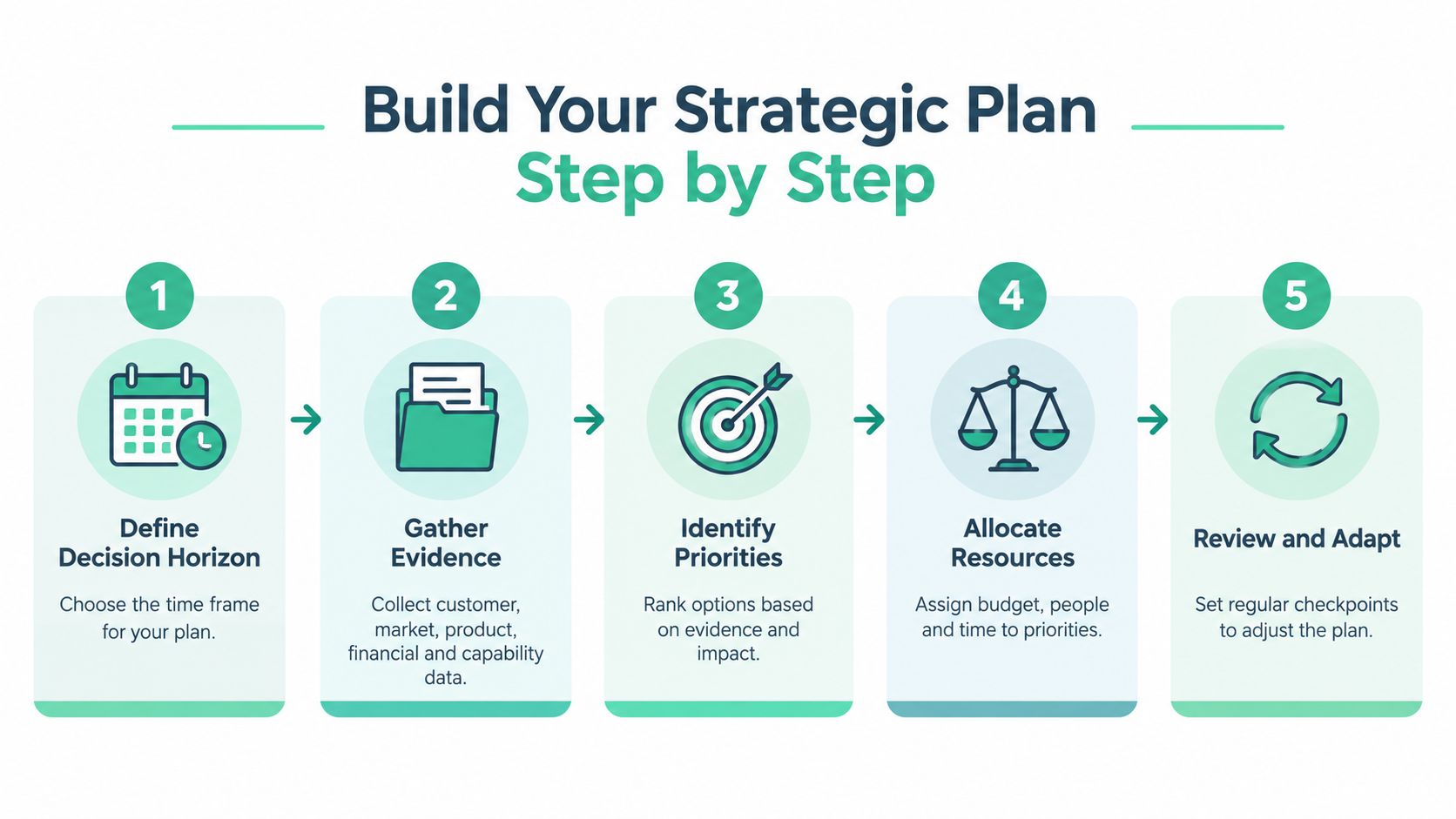
Bring customer interviews, lost-deal reasons, product behaviour, financial forecasts and team capacity into the discussion. Include people who handle support and implementation; they may see friction the founder misses.
For external evidence, use a structured market analysis. Separate what you know about NZ demand from what you assume about Australian buyers.
Then describe the desired future and the choices needed to pursue it. Make your SWOT useful by turning each important observation into an implication. If integration work is already stretching the team, what does that rule out?
Don't settle for “focus on growth”. Name the growth route and the constraints you accept.
Set objectives that describe results. Give each a small KPI set with a definition, baseline, target and review date. Set targets from your own evidence rather than borrowing someone else's dashboard.
Next, sequence initiatives on the roadmap. Assign an owner, budget and capacity, then check dependencies. If the same engineer is essential to every initiative, the plan isn't funded in any useful sense.
MBIE's productivity briefing supports stronger strategic assessment, market intelligence and evaluation as part of a coherent long-term approach (New Zealand's productivity in a changing world). Applied to your company, that means examining an investment before funding it and checking its value afterwards.
A strategic hypothesis: We believe this customer will choose our product for this reason. We'll test that belief through these measures, and reconsider the investment if this evidence appears.
Finish by setting review triggers. These might include weak activation among the chosen segment, support costs beyond the plan's allowance or a platform change that alters delivery economics.
For each trigger, name the decision it would reopen. “Monitor closely” isn't a decision rule. “Pause recruitment while we test the sales assumption” is.
Consider an illustrative founder team, not a reported case study. They're building the field-service handover app introduced earlier and are weighing broad outbound sales against deeper work for their chosen customer segment.
Suppose their interviews and product observations suggest that office-to-field handovers matter most to firms with repeat jobs. They also suspect that these buyers can adopt the core product without extensive custom work. Both points need testing.
Their strategic hypothesis is that a focused handover product will win suitable customers more reliably than a broad operations suite. The vision and mission stay intact; the SWOT implication is to avoid integration-heavy enterprise deals for now.
The team sets an objective around repeat customer value. It funds onboarding and core workflow improvements before adding sales capacity. Positioning centres on dependable handovers, rather than a sprawling feature list.
That choice should carry through to the go-to-market strategy: customer selection, messaging and sales effort need to reflect the same thesis.
| Scorecard area | Measures the team could use | Decision it informs |
|---|---|---|
| Buyer interest | Qualified pipeline and trial conversion | Is the proposition attracting suitable buyers? |
| Customer value | Activation and retention | Are accounts reaching and repeating useful work? |
| Commercial health | Recurring revenue and contribution margin | Can the chosen approach support the business? |
| Delivery effort | Support burden and implementation work | Are customers affordable to serve? |
These aren't suggested performance thresholds. The team must set those from its own baseline, cash position and economics.
If suitable buyers enter trials but don't complete handovers, the team investigates onboarding and workflow value before buying more traffic. If customers retain but need extensive manual support, it revisits delivery cost before adding markets.
This adaptive stance has relevant NZ evidence behind it. A Massey University study of 477 New Zealand SMEs found that adaptive and participative strategy-making approaches contributed to firm performance (Massey research on SME strategy-making).
The founders don't need to abandon their purpose when a hypothesis fails. They need to identify which assumption failed and change the associated commitment.
A polished framework can hide a reluctance to choose. The headings are complete, the workshop felt productive and every department kept its favourite project.
That's the strategic-planning version of a wish list. The hidden assumption is that resources will somehow stretch. The correction is to show what stops, waits or loses funding.
Ambition isn't the problem. Unpriced ambition is. A founder can set a demanding goal while being precise about what the business can afford to test.
The emotional trap is keeping every avenue open because saying no feels uncomfortable. Record the opportunity you're declining and the evidence that would justify reconsidering it. You're making a reasoned choice, not passing judgement forever.
A workshop can start the work, but it can't replace ongoing judgement. South Wairarapa District Council's planning model illustrates distinct rhythms: long-term plans are reviewed every three years, with annual plans used between them (council planning and review cycles).
An app team needs its own rhythm suited to its decisions. Don't copy a public-sector timetable without considering product and market uncertainty.
A reset is overdue when the team can explain why the plan isn't working but can't name what it will change.
At that point, debate the assumption, not the effort people have already spent. Sunk work deserves respect, but not automatic renewal.
Keep the working version short enough to use in a real decision. Supporting research can sit elsewhere; the core plan should make commitments easy to inspect.
Use this single-page template as a working note, not a presentation script.
| Planning field | What to record |
|---|---|
| Horizon and purpose | Decision period, vision and mission |
| Evidence | Customer, market, product and financial findings |
| SWOT implications | Capabilities and conditions that change your choices |
| Strategic choices | Target customer, value proposition and exclusions |
| Objectives and KPIs | Outcomes, baselines, targets and definitions |
| Roadmap and resources | Initiatives, dependencies, budget and capacity |
| Accountability | Owners, review dates and change triggers |
If outbound sales is part of the plan, consider Ever Outbound Inc.'s planner alongside your financial model and customer evidence. A channel-planning tool belongs beneath the strategic choice, not in place of it.
Treat the next 30 days as an implementation exercise, not a claim about how long planning must take. Gather missing evidence, settle the priority choices, confirm capacity with the people doing the work and put the first review in the calendar.
At the monthly check, compare evidence with assumptions. Discuss customer behaviour, spending and constraints, then record decisions rather than just status updates.
Use a fuller quarterly review to reconsider the bets themselves. Keep a brief decision log so the team can distinguish a tested assumption from a founder's strong hunch.
Strategic planning is disciplined choice with accountability and room to learn. You commit to a direction without pretending you can predict every turn.
NZ Apps offers practical founder guides, regional tech coverage and a curated directory of app and tech companies across New Zealand and Australia. Visit NZ Apps to research the local scene and use its market and growth resources to inform your next strategic decision.
Add your NZ or Australian app or tech company to the NZ Apps directory and get discovered by founders and operators across the region.
Get ListedReach tech decision-makers across New Zealand and Australia. Sponsored and dofollow editorial links, permanent featured listings, and sponsored articles on a DA30+ .co.nz domain.
See Options