
Feel like your marketing budget is just disappearing with nothing to show for it? Yeah, it's a common story. But what if there was another way? Affiliate marketing in New Zealand flips that script. It’s a model where you pay for actual results—like a completed sale—not just for clicks or views.
Essentially, you're building a sales team that only gets paid when they deliver. Simple as that.
If you're running a business in New Zealand and haven't seriously looked into affiliate marketing, you could be leaving money on the table. Honestly. This isn't some flash-in-the-pan trend; it's a proven, performance-based marketing channel that is surprisingly underused right here at home.
Think about your usual digital ad spend. You're paying for eyeballs, right? You put money into thousands of impressions or hundreds of clicks, and then cross your fingers hoping a few of them eventually become customers. It's a bit of a gamble, isn't it?
Affiliate marketing turns that entire model on its head.
It’s all about partnership. You connect with bloggers, influencers, or other businesses who promote your products to their own audience. The real magic? You only pay them a commission after they’ve sent a paying customer your way. It’s a genuine win-win. They earn an income for recommending products they trust, and you get new customers without the upfront risk of traditional ads.
Here’s the thing. Our neighbours across the ditch are miles ahead of us on this. In New Zealand, affiliate marketing is still an untapped powerhouse. Right now, only about 15 out of the top 100 retailers have affiliate programmes.
Compare that to Australia, where the number is a massive 70. This gap isn't a weakness; it's your competitive advantage.
It means there’s less noise and much more room for your business to stand out and build strong, profitable partnerships. To really get a handle on the benefits, it's worth understanding the core principles of What Is Affiliate Marketing Program.
So, what does this actually mean for your business?
Here's a quick comparison showing the key differences in cost, risk, and ROI between affiliate marketing and traditional ad spend for NZ businesses. It really puts things into perspective.
| Feature | Affiliate Marketing | Traditional Advertising (PPPC, Social Ads) |
|---|---|---|
| Payment Model | Pay-for-performance (e.g., cost-per-sale, cost-per-lead) | Pay-per-impression (CPM) or pay-per-click (PPC) |
| Upfront Cost | Low to none. Costs are tied directly to results. | High. You pay for ad space or clicks, regardless of sales. |
| Risk | Minimal. You only pay when you make money. | High. Risk of spending a lot with no guaranteed return. |
| Return on Investment | High and easily trackable. Clear link between spend and revenue. | Variable and often difficult to attribute directly to sales. |
| Trust Factor | High. Relies on trusted recommendations and endorsements. | Low. Audiences are often sceptical of direct advertising. |
This table makes it pretty clear: with affiliate marketing, your budget works smarter, not just harder.
Whether you run a boutique shop in Wellington or a growing nationwide brand, this is your chance to build a revenue stream that genuinely works. The market is more than ready for this kind of strategy, something we've seen in the growth of e-commerce in New Zealand.
Now that you're on board, let's get into how you can actually make it happen.
Alright, you're sold on the idea. But let's be honest, where do you actually begin? A successful affiliate marketing programme isn’t just something you throw together over a weekend; it's a carefully designed piece of your business engine. This is your blueprint.
First things first, we need to nail down your goals. What are you really trying to achieve here?
Is it purely about driving direct sales and seeing that revenue number climb? Maybe you're after fresh leads for your sales team to nurture. Or perhaps the goal is simply getting your brand name out there, building awareness across New Zealand.
Your answer to that question changes everything. It dictates the entire structure, from who you partner with to how you pay them. Think of it like building a house—you wouldn't start ordering timber without knowing if you're building a bach or a mansion, would you?
This flow chart below simplifies the shift in thinking from traditional ads to a performance-based model like affiliate marketing.
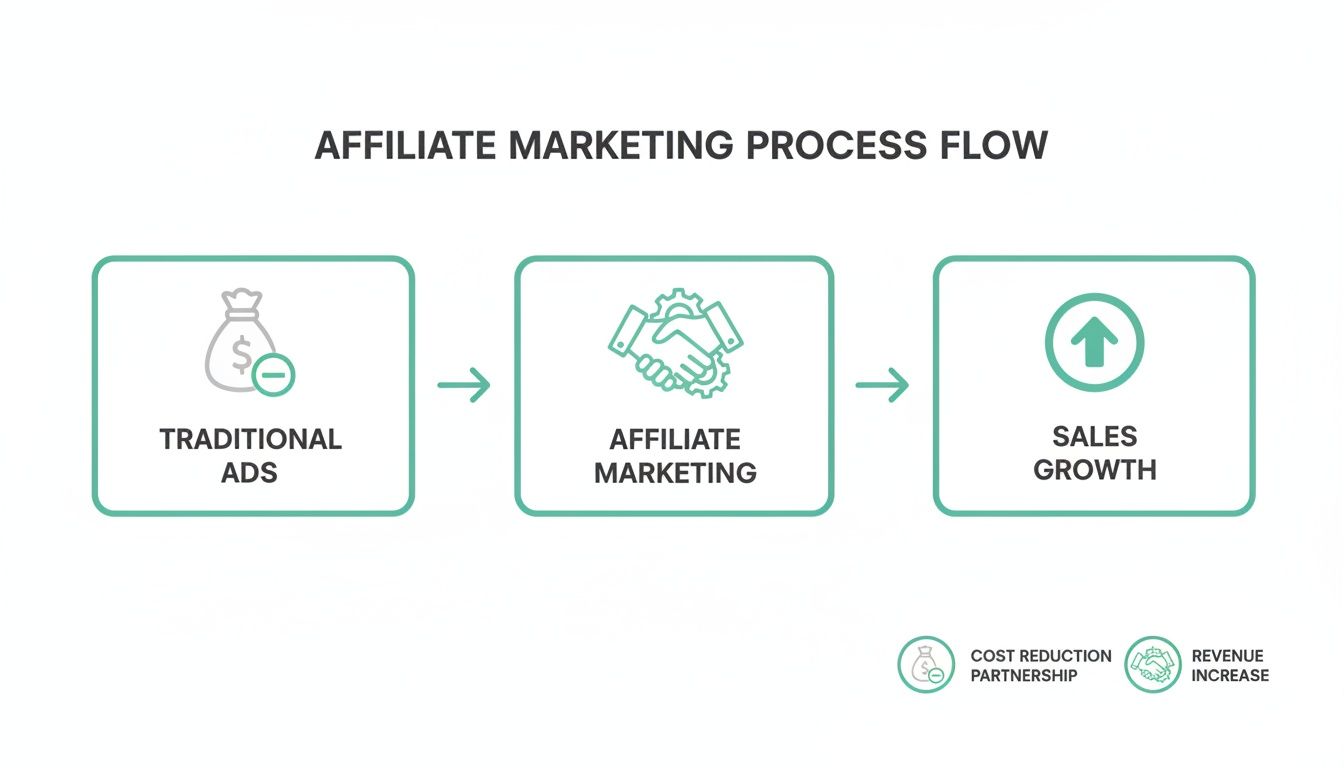
It shows how you move from a high-cost advertising model to a partnership that directly fuels sales growth, turning marketing spend into a predictable revenue driver.
Now for the interesting part—commission models. How are you going to reward your partners for their hard work? This is where many businesses get a bit stuck, but it’s simpler than it sounds. You’ve got a few solid options, and the best one depends entirely on those goals we just talked about.
Cost Per Sale (CPS): This is the most common model and the bread and butter of affiliate marketing. An affiliate earns a commission only when a customer they referred makes a purchase. It’s low-risk for you and directly ties marketing spend to revenue. You could offer a flat fee (e.g., $20 per sale) or a percentage (10% of the total order value).
Cost Per Lead (CPL): This model is perfect if your main goal is lead generation. Instead of a sale, you pay affiliates for every qualified lead they send your way—like someone signing up for a free trial, booking a demo, or joining your email list. It’s a fantastic way to fill your sales funnel.
Tiered Commissions: Feeling a bit more strategic? A tiered system rewards your top-performing affiliates with higher commission rates. For example, partners who drive over 50 sales a month might get a 15% commission, while everyone else gets 10%. This creates a powerful incentive for your best partners to keep promoting you.
Here’s a key takeaway: Don't just pick the cheapest option. A higher, more attractive commission can attract higher-quality affiliates who will ultimately drive more valuable traffic and sales. It's an investment, not just a cost.
So, how do you decide? If you’re an e-commerce store selling physical products, CPS is a no-brainer. But if you’re a service-based business or selling high-value items with a long sales cycle, a CPL model might make more sense to get potential customers in the door.
With your goals and commission structure sorted, it's time to think about who you'll be working with. And here's where a common mistake happens: businesses often chase the influencers with the biggest follower counts.
Honestly, that’s not always the best move.
Sure, a big name can bring a flood of traffic, but is it the right traffic? A niche blogger with a small but fiercely loyal audience of 2,000 readers who hang on their every word can often deliver far better results. These are your micro-influencers and content creators who have built genuine trust within a specific community.
Think about it. Who would you trust more for advice on tramping gear? A famous celebrity who was paid to hold a backpack, or a dedicated Kiwi tramping blogger who has actually tested that gear on the Milford Track?
The answer is obvious. Your ideal partners are the ones whose audience perfectly matches your ideal customer. They might be:
Building your affiliate programme is about laying a solid foundation. Get these three pillars—goals, commissions, and partners—right from the start, and you’ll have a structure that’s built to last and, more importantly, to grow.
Alright, let's get into the tech side of things. Your affiliate programme needs a central nervous system—a way to track every click, sale, and payout. Without it, you’re just flying blind, and the whole "pay for performance" model falls apart.
This technology is the digital handshake that confirms, "Yep, that sale came from Sarah's blog, so she gets her commission." It’s what makes the entire system trustworthy and transparent for both you and your partners.
For most Kiwi businesses dipping their toes into affiliate marketing in New Zealand, the path splits into two main directions. You can either join an established affiliate network or go it alone and manage everything yourself with self-hosted software.
Each path has its own flavour, and neither one is universally "better." It really boils down to your budget, how much control you want, and how much time you can spare.
One option is like joining a bustling marketplace—lots of people, plenty of activity, and a built-in structure. The other is like building your own shop from scratch; you make all the rules, but you also have to build all the walls.
Think of affiliate networks as the matchmakers of the industry. They connect businesses like yours (the merchants) with a whole roster of potential partners (the publishers or affiliates).
In New Zealand, we’ve got some solid local and international players like Commission Factory and SLICE. These platforms are brilliant because they give you instant access to a pool of affiliates who are already looking for Kiwi brands to promote.
Here's the quick rundown:
A network is brilliant for getting started quickly. It takes the technical headache out of the equation and plugs you straight into a community of potential partners.
This approach fits perfectly with the way e-commerce is booming here. Affiliate marketing is blazing a trail in New Zealand, riding a wave of online retail that hit $4 billion last year, making up 9% of total spend. With homegrown networks educating the market and mobile penetration at 115%, the infrastructure is primed and ready.
Now, what if you're the type who likes to be in the driver's seat? Self-hosted software is your answer.
This means you subscribe to a platform (like Tapfiliate or Post Affiliate Pro) and integrate it directly with your website. You are in complete control of everything: the commission structure, the terms, the creative assets—all of it.
This path gives you ultimate flexibility. You build direct relationships with your affiliates, and you're not paying a middleman a cut of every sale. The trade-off? You’re responsible for everything. Finding affiliates, managing payouts, and handling any technical hiccups all fall on your shoulders.
So, how do these two paths stack up for a typical Kiwi business? This table breaks it down.
| Factor | Affiliate Networks | Self-Hosted Software |
|---|---|---|
| Cost Structure | Setup fees, monthly fees, and a network override (a % of commissions). | A fixed monthly or annual software subscription fee. |
| Publisher Access | Immediate access to a large, pre-vetted pool of publishers. | You must recruit every single affiliate yourself from scratch. |
| Control | Less control; you operate within the network's rules and interface. | Total control over commission rates, terms, and branding. |
| Ease of Use | Generally easier to get started as they handle the technical side. | Requires more technical setup and ongoing admin work from your team. |
As you can see, the "best" choice really depends on your resources and goals.
A final, crucial piece of this puzzle is making sure whatever you choose plays nicely with your e-commerce platform. Whether you’re on Shopify or a custom-built site, the integration needs to be seamless. If you're weighing your options, our guide on Shopify vs WordPress for NZ businesses might offer some clarity on platform choices.
A clunky, broken tracking experience is a surefire way to frustrate affiliates and lose sales before you even get started.

You’ve got your strategy sorted and the tech is humming away in the background. Good stuff. But now comes the most important part—the people. How do you find affiliates who will genuinely champion your Kiwi brand, not just stick a link at the bottom of a forgotten webpage?
This is where many businesses get it a bit wrong. They think recruiting is about blasting out hundreds of generic emails, hoping someone bites. Honestly, that approach feels like junk mail and gets about the same level of response. This is more about building relationships than just filling a roster. It’s the human element, and it’s what separates a mediocre affiliate programme from a truly great one.
Let's get practical. Finding potential partners on the New Zealand scene isn't as hard as it sounds. You just need to know where to look. Your ideal affiliates are already talking to your ideal customers; you just need to join the conversation.
Think beyond the obvious. It’s not just about the big-name influencers. Some of your best partners will be hiding in plain sight.
You're looking for authentic voices, not just massive audiences. Someone with 2,000 engaged Instagram followers who trust their opinion is infinitely more valuable than a celebrity with 200,000 followers who couldn't care less about your product.
Okay, you've got a list of potential partners. Now what? You need to reach out, and this is your moment to make a brilliant first impression. Remember, they probably get dozens of pitches. Yours needs to stand out.
What makes someone want to work with you? Let me tell you, it's rarely just about the commission rate. It’s about respect, partnership, and making their life easy.
Your pitch should be personal. I mean actually personal. Mention a specific blog post you enjoyed or a recent project of theirs you admired. Show them you’ve done your homework and aren't just sending a template.
Here’s a simple structure for an email that gets opened and, more importantly, gets a positive reply:
This isn’t just about recruiting affiliates; it's about starting a partnership on the right foot. Clear communication and genuine appreciation from day one will make all the difference.
Alright, let's get into the less thrilling—but absolutely essential—side of running an affiliate programme in New Zealand: making sure you're doing everything by the book. You've got your strategy mapped out and you're starting to find great partners. Now, you need to ensure the entire operation is legally sound.
Honestly, sorting this out from day one will save you a world of headaches down the line. It's not as intimidating as it sounds, I promise. Most of it really just boils down to being transparent and fair.
Here’s the big one, the absolute non-negotiable: being upfront about affiliate relationships. The main piece of legislation you need to know about here is New Zealand's Fair Trading Act. Its whole purpose is to protect Kiwi consumers from misleading or deceptive business practices.
So, what does that mean for your affiliate programme? Simple. Your partners must disclose that they might earn a commission when they recommend your products.
A straightforward disclaimer like, “This post contains affiliate links, which means I may earn a commission if you make a purchase,” usually does the trick. The key is that it has to be clear and easy to find—not buried in the footer in tiny text.
Think of it like this: if a mate raved about a new cafe but conveniently forgot to mention the owner was paying them to do it, you'd feel a bit misled, wouldn't you? The exact same principle applies here. Transparency builds trust, and trust is the currency of great affiliate marketing.
Now for the money. When you pay commissions, there are tax implications for both you and your affiliates. The main thing to get your head around is GST.
How you handle GST really depends on the affiliate's business status.
This is exactly why having crystal-clear payment processes and keeping good records is so important. It makes sure everyone knows where they stand when it's time to file their taxes.
Finally, never, ever rely on just a handshake. A proper affiliate agreement is your best friend in this game. This is the document that clearly lays out all the rules of engagement.
It should cover everything: commission rates, payment schedules, what affiliates can and can’t do when promoting your brand, and the all-important disclosure requirements.
When launching your programme, having a robust Affiliate Agreement is non-negotiable. It isn't just a bit of formal paperwork; it's what protects both you and your partners by ensuring everyone is on the same page from the start. It’s the professional way to set expectations and prevent messy disputes later.
Of course, this isn't formal legal advice, but it's a solid primer to get you asking the right questions. Nailing these fundamentals allows you to build a compliant, sustainable affiliate programme, letting you focus on growth instead of worrying about legal troubles.
So, your affiliate programme is live. Fantastic! But honestly, this is where the real work begins. Now it’s time to pop the bonnet and see what’s actually working.
Getting this part right is all about looking at the data. I'm not just talking about top-line revenue, though that’s obviously important. You need to dig a little deeper into metrics like conversion rates, average order value (AOV), and the performance of individual affiliates.
Let's get real for a second. Are some of your partners sending you heaps of traffic but almost no sales? It's a classic scenario. This could mean their audience isn't the right fit for your brand, or maybe they just need better resources from you—like custom banners or a unique promo code.
On the other hand, you might have a few partners who are absolutely hitting it out of the park. Their conversion rates are high, and the customers they send spend more. These are your champions. What are you doing to support them?
This is where the idea of a constant feedback loop comes in. It’s not about just setting and forgetting; it’s about active management.
The numbers don’t lie. Your affiliate dashboard is a storybook about what your partners and their audiences truly value. Paying attention to it is the difference between a programme that just ticks along and one that becomes an invaluable asset for your business.
This constant analysis lets you fine-tune your approach, properly support your partners, and steadily improve your return on investment.
Once you’ve identified your top performers and those who are struggling, you can start making smart moves. Here’s what that looks like in practice for your New Zealand affiliate marketing efforts:
This isn’t just about number-crunching. It's about relationship management. By using data to guide your decisions, you can build a stronger, more profitable affiliate programme that grows with your business.
Still have a few questions rattling around? That’s completely normal.
When Kiwi business owners first dip their toes into affiliate marketing, the same handful of questions always pop up. It’s one thing to get the theory, but it’s another thing entirely to feel confident about how it all works in practice.
Let’s tackle some of those common queries right now with some straight-up answers. Think of this as a quick chat to clear up any last-minute doubts so you can get started with clarity.
This is the big one, isn't it? Honestly, there’s no single "standard" rate—it really depends on your industry and what you're selling.
But there's definitely a common range. For physical products sold online, you'll often see commissions sitting somewhere between 5% and 15%. For digital products like software or online courses, where your margins are much healthier, rates can jump to anywhere from 20% to 50%.
The real key is to land on a rate that’s competitive enough to attract great partners but also sustainable for your business. Don't just default to the lowest number; a slightly more generous commission can attract top-tier affiliates who will drive far more sales in the long run.
Ah, the million-dollar question. Affiliate marketing isn’t a get-rich-quick scheme; it’s a long game that builds momentum over time. You won't launch your programme on Monday and be swimming in sales by Friday.
Here's the thing: You need to give it time to breathe. Expect to spend the first three to six months just recruiting partners, building relationships, and giving them time to create their content. You might see a trickle of sales early on, but the real, consistent results often start rolling in after the six-month mark as your partners' content starts to rank and gain traction.
Patience is your absolute secret weapon here. The initial grind is real, but the payoff is a sustainable, performance-based revenue stream that works for you 24/7.
If there’s one trap Kiwi businesses fall into time and time again, it’s treating affiliates like just another sales channel instead of as genuine partners. Blasting out generic emails, providing poor-quality creative, and then just hoping for the best is a recipe for failure.
Think of your affiliates as an extension of your marketing team. You need to set them up for success. This means:
Forgetting the human element is the fastest way to build a programme that never gets off the ground.
Ready to build a powerful online presence that drives real growth for your Kiwi business? The team at NZ Apps specialises in crafting custom web solutions and targeted SEO strategies that get results. Let's have a chat about how we can help you achieve your goals. Book your free consultation with us today.