
So, you're looking for a Christchurch web design company. Good on you. But picking the right one isn't just about getting a pretty website, is it? It’s about finding a real partner, someone who builds a digital tool that actually helps your business grow. A great local agency gets the Christchurch market—they know the vibe—and they create an online presence that works like your best employee, bringing in leads and sales 24/7.
Let’s be honest, almost anyone can whip up a website these days. With platforms like Squarespace and Wix, getting something online is easier than ever. But here’s the thing—what good is a beautiful design if no one ever sees it?
It’s like setting up a stunning shopfront in a deserted alley. Sure, it looks fantastic, but if no one ever walks past, what's the point?
This is where the real conversation starts. It’s time to stop thinking about "getting a website" and start thinking about investing in a strategic business asset.
Working with a Christchurch-based web design company gives you a genuine, on-the-ground advantage. You’re not just hiring a supplier; you’re partnering with a team that really gets the local scene. They know a customer browsing in Merivale has different expectations than someone in Hornby. They get the city's unique rhythm and what makes local customers tick.
Think of your website as your digital storefront on Cashel Street. Is it inviting people in, or is its confusing layout causing them to walk right on by? A strategic website becomes your hardest-working employee, one that never takes a day off. Never.
This is especially vital in a place like Christchurch, which is a key part of New Zealand’s booming digital technologies sector. The industry contributed NZD 7.0 billion to the national GDP back in 2021 and has only grown since. In this vibrant market, most local web design firms are small, focused teams, often with project starting points in the NZD 1,000–10,000 range.
It’s easy to get wowed by a slick portfolio full of gorgeous designs. But a pretty picture doesn’t tell the whole story. The real questions are: Did that beautiful website actually increase sales for the client? Did it bring in more phone calls or bookings?
A great website isn’t just an online brochure; it’s a growth engine. It’s designed to convert visitors into customers, solve their problems, and make it incredibly easy for them to do business with you.
That’s the crucial difference between simple design and strategic development. One looks nice, while the other gets results. Before you start your search, it's helpful to understand what different kinds of website developers for small businesses can bring to the table. This guide will help you look past the surface and find a partner who will deliver real, measurable growth for your business. Let’s get into it.
Ever sat in a meeting, just nodding along as acronyms like ‘CMS,’ ‘UX,’ and ‘SEO’ get thrown around? You’re not alone. It can sometimes feel like web designers are speaking their own secret language, and it's easy to get a bit lost in the translation.
Think of this section as your cheat sheet. The goal isn't to turn you into a web developer overnight, but to give you enough confidence to ask the right questions. We want you to feel empowered, not intimidated, when you talk with a potential Christchurch web design partner.
So, to help you get up to speed, here's a quick rundown of the most common terms you'll hear.
| Term | What It Really Means | Why It Matters for Your Business |
|---|---|---|
| CMS | Content Management System. It's the dashboard behind your website (like WordPress or Shopify) that lets you update content without any coding. | It gives you control. You can add a new blog post, update your hours, or change a photo yourself, saving you time and money. |
| Responsive Design | A website that automatically looks and works perfectly on any device, from a big desktop monitor to a tiny smartphone. | With over 60% of traffic from mobile, this is non-negotiable. It ensures you don't lose customers just because they're browsing on their phone. |
| UX | User Experience. How a person feels when they use your site. Is it intuitive and easy, or confusing and frustrating? | Good UX turns visitors into customers. If people can easily find what they need and enjoy the process, they're far more likely to buy from you. |
| SEO | Search Engine Optimisation. The practice of making your site more visible on search engines like Google. | This is how new customers find you online. Strong SEO means when someone in Christchurch searches for your services, you show up, not your competition. |
Understanding these basics is the first step towards a productive conversation with any web design agency. Now, let's look at what each one means in a bit more detail.
Let’s start with a big one: CMS, or Content Management System. Think of it as the control panel for your website. It’s the behind-the-scenes software that lets you log in and easily update text, add new photos, or publish a blog post without ever having to touch a line of code. Simple.
Without a CMS, your website is basically a static digital brochure. Once it’s built, changing anything requires a developer. With a CMS, it becomes a living, breathing tool for your business that you can manage yourself. It's an absolute must-have.
You'll hear the term "responsive design" a lot, and for good reason. All it really means is that your website will automatically resize and rearrange itself to look great and function perfectly on any screen. Whether a customer is on their desktop at the office or on their phone while waiting for a flat white, the experience is seamless.
With over 60% of all web traffic now coming from mobile devices, a non-responsive site isn't just a minor inconvenience; it's actively turning away potential customers.
Two other terms you'll constantly hear are UX and SEO. They might sound technical, but their goals are very human.
Now that you've got the lingo down, let's talk about finding the right people for the job.
So, you've decided it's time to call in the professionals. The big question is, how do you sort the genuinely great from the merely good? It takes a bit more than a quick scroll through their past projects.
A beautiful portfolio is a fantastic start, but let's be honest—it doesn't tell the whole story. It’s like judging a restaurant purely on its Instagram feed. The food might look incredible, but what about the service, the atmosphere, or whether the ingredients are actually fresh?
A slick-looking website is one thing. A website that actually brings in business is another thing entirely.
When you're checking out a potential partner’s portfolio or case studies, try to look past the surface-level aesthetics. Are they actually highlighting real business outcomes, or are they just showing off some nice designs? The best Christchurch web design company will always talk about the problems they solved for their clients.
Keep an eye out for case studies that mention things like:
If their portfolio is all sizzle and no steak—all visuals with zero mention of results—it’s a bit of a red flag. You're looking for a partner who is just as obsessed with your business goals as they are with pixel-perfect design.
Once you get them on a call, asking smart questions is your best tool for figuring out if they're the right fit. You're not trying to catch them out; you're just trying to see if their approach gels with what you need.
How do they think? What do they prioritise? It all comes out in the conversation. Before you jump on a call, it's a great idea to get prepared by reviewing some essential questions to ask a UX design agency to build a solid foundation for your chat.
Here are a few questions that get straight to the point:
Finally, never underestimate the importance of a good cultural fit. Honestly, this can make or break a project. You’ll be working closely with this team for weeks, maybe even months, so you need to feel comfortable having open, honest conversations.
You’re not just hiring a contractor; you’re looking for a partner who feels like a genuine extension of your own business—someone who is as invested in your success as you are.
Do they actually listen to your ideas? Do they explain things clearly, without hiding behind a wall of jargon? Finding a team you genuinely connect with makes the entire process smoother and, frankly, a lot more enjoyable. That human element is often the secret ingredient to a truly successful project.
Right, let’s get straight to it and talk about the elephant in the room—money. Trying to figure out a budget for a new website can feel like a total shot in the dark. How much is too much? And what does "cheap" really get you?
Honestly, it’s one of the biggest points of confusion for business owners. But it doesn't have to be.
The truth is, the cost of a website from a Christchurch web design company isn't some mystical number plucked from thin air. It’s directly tied to the time, skill, and complexity involved in building something that actually works for your business. It's not about finding the absolute cheapest option; it's about making a smart investment that will pay for itself over time.
You’ve probably seen a huge range of prices out there, from a few hundred dollars on TradeMe to tens of thousands for a big corporate build. So what’s the deal? Generally, website projects here in Christchurch fall into a few common brackets.
Consumer guides and local business directories often put typical budgets somewhere in these ranges: NZD 500–2,500 for simple brochure sites, NZD 3,000–10,000 for polished agency builds and small online stores, and NZD 10,000+ for fully bespoke platforms. You can get a sense of these market rates by exploring local resources that outline typical web design pricing. It gives you a rough idea of where your project might land.
Let’s unpack what you typically get for your investment at these different levels.
The "Getting Started" Package (Under $3,000): This usually gets you a straightforward "brochure" website. Think of it as a professional online business card with 3-5 pages, a contact form, and a clean design based on a pre-existing template. It’s a solid entry point, but don't expect a lot of customisation.
The Professional Small Business Site ($3,000 - $10,000): This is the sweet spot where most serious small businesses land. In this range, you’re getting a custom-designed website that truly reflects your brand. This includes deeper strategy, more pages, maybe some basic e-commerce functionality, and a real focus on user experience (UX) to guide visitors toward making a call or a purchase.
The Custom Powerhouse (Over $10,000): This tier is for businesses that need more. We're talking large-scale e-commerce stores with hundreds of products, custom software integrations (like connecting to your inventory system), or unique features built entirely from scratch. This is a significant investment for a site that needs to perform complex, business-critical tasks.
So, why does one website cost $4,000 and another $14,000? Several key factors drive the price up or down.
Remember, every feature, every custom design element, and every page of content represents hours of work for a skilled team of designers, developers, and strategists.
Here are the main things that influence that final number on the proposal:
Understanding these factors helps you read a proposal with confidence and spot any potential red flags. It’s all about knowing what you’re paying for and making sure it relates to the results you need.
So, you’ve picked your partner. You’ve had the meetings, seen the proposals, and shaken hands (digitally or otherwise). Now what? Honestly, a well-defined process is the difference between an exciting, smooth project and a series of frustrating headaches.
Let’s map out a typical web design journey, from that first proper discovery meeting to the day your shiny new site goes live. No surprises, no missed deadlines—just a clear path to launching a website you can be genuinely proud of.
This first step is arguably the most important. It’s less about colours and fonts and more about getting to the heart of your business. Why do you need this website? Who is it for? What do you want visitors to do when they arrive?
A good Christchurch web design company will lead a deep-dive session to understand your goals, your customers, and your competition. This isn’t a quick chat; it’s a proper workshop. Think of this initial strategy phase as pouring the concrete foundation—everything else is built on top of it.
Once the strategy is solid, things start getting visual. You’ll typically see wireframes first—think of them as simple blueprints showing where everything will go. After you approve those, the full-colour design concepts come to life, showing you exactly how the site will look and feel.
This is where your input is crucial. Timely, honest feedback is the fuel that keeps a project moving. After design approval, the developers take over, turning those static images into a functional, clicking, and scrolling website. Modern approaches like design to code automation workflows are becoming more common, especially from tools like Figma to production, and can seriously speed up the development stage.
This infographic breaks down the typical cost tiers you'll see for website projects here in Christchurch.
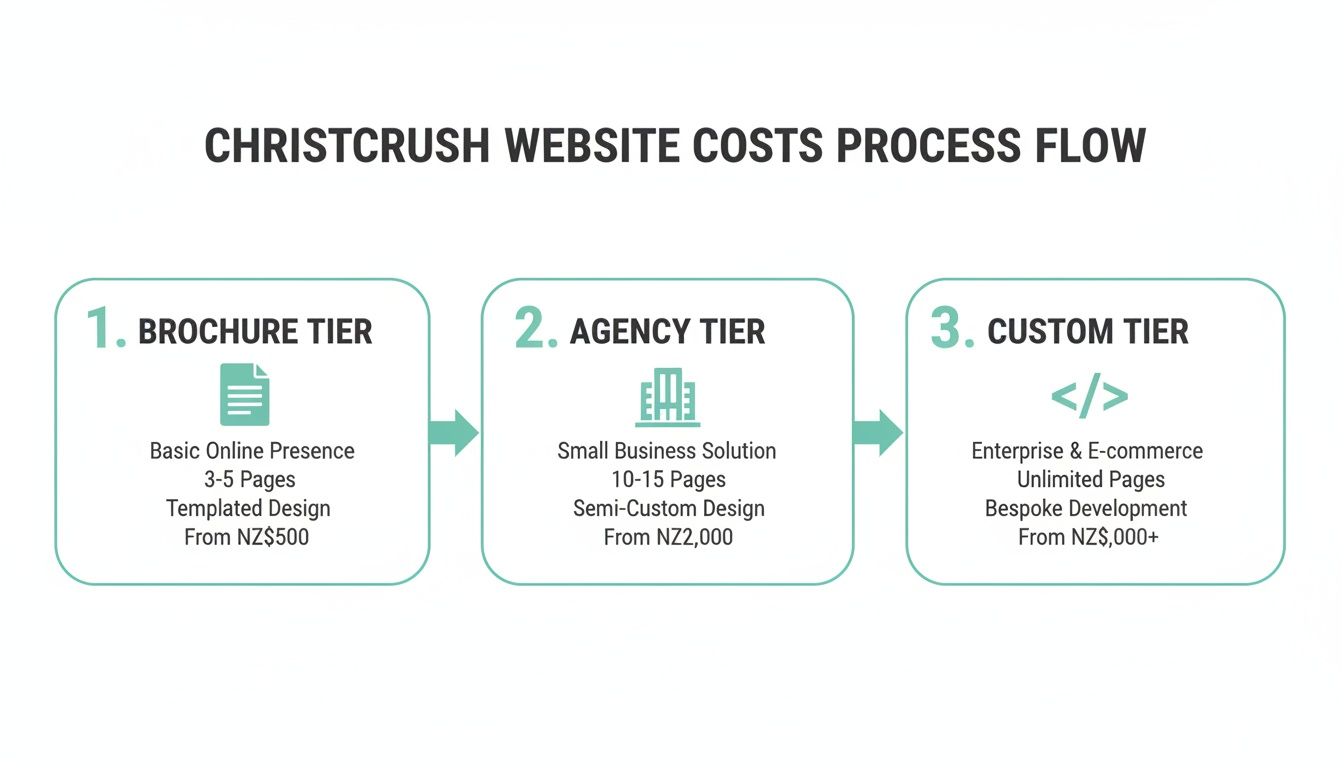 It shows a clear progression from simple brochure sites to more complex, custom-built platforms with corresponding investment levels.
A beautiful website with no content is just an empty shop. While the developers are busy building, you'll be working to supply the text and images that will populate the pages. Some agencies offer copywriting services, which can be a massive help if writing isn't your forte.
Remember, the agency is the expert in web design, but you are the expert on your business. Your knowledge and your content are what will make the site truly authentic and effective.
Finally, before the big launch, there's a thorough testing phase. The agency will check everything across different browsers and devices to squash any bugs. Once everyone gives the green light, your new site is pushed live to the world. It’s a huge milestone, but it's really just the beginning of your website’s journey.
Over the years, we've heard just about every question in the book, and chances are, you're wondering about a few of these yourself. That’s perfectly normal. Getting a new website built is a big deal for any business, and you want to be sure you're getting it right.
This section is all about tackling the most common queries we get from Christchurch business owners just like you. Let's get you some clear, straightforward answers so you can move forward feeling confident.
Honestly, that’s a classic "how long is a piece of string?" question. A simple, clean website with a handful of pages—think a standard brochure-style site—might take around 4-6 weeks from the first kickoff meeting to going live.
If you’re after something more complex, like a full-blown e-commerce store, a custom booking system, or other unique features, you're probably looking at a timeline of 8-16 weeks, and sometimes longer. The biggest factors that influence the timeline are the project's complexity and how quickly we get feedback and content from your end. Any decent Christchurch web design company will lay out a detailed timeline for you right at the start. No surprises, just clear communication.
Think of it like getting a WOF for your company car. It’s absolutely essential for keeping the site secure, running smoothly, and protecting your customers' data. Most agencies, including us, offer monthly care plans that handle all the backend stuff—software updates, security scans, regular backups, and general tech support.
While it’s an added cost, it's a small price to pay for the peace of mind you get from protecting your digital storefront against hackers and technical gremlins. An ounce of prevention is worth a pound of cure, right?
Here’s the straight-up truth: launching a new website is just the beginning. While we build every site on a solid SEO foundation, getting to the top of Google is a long-term game. It's a marathon, not a sprint.
It takes consistent effort—things like writing blog posts, getting links from other local businesses, and fine-tuning your site for specific Christchurch search terms. Many web design firms also offer ongoing SEO services to help you climb the rankings after your site is live. Just don't expect to be number one overnight; it's all about steady, consistent work.
Absolutely! In fact, we insist on it. That’s the whole point of using a proper Content Management System (CMS) like WordPress or Shopify. Any reputable company will build your site on a platform that’s easy for you to use and will give you the training you need to feel comfortable with it.
You should never have to call up a developer just to change a sentence or swap out a photo. Having that control is crucial for keeping your site fresh and relevant without getting nickel-and-dimed for every tiny update.
Feeling a bit clearer on the process? The team here at NZ Apps is ready to help you navigate every step. If you’re looking to build a website that actually delivers results for your Christchurch business, let's have a chat. Schedule your free, no-obligation consultation today.