
Honestly, ‘human centred design’ sounds like another one of those buzzwords cooked up in a boardroom, right? But really, it’s just a practical way of saying ‘solve problems by actually talking to the people who have them.’ Pretty simple when you put it like that.
Human centred design is an approach that puts real people at the heart of the design process, making sure the final product is genuinely useful and maybe even a joy to use.
Let's cut through the jargon. At its core, human centred design (HCD) is a problem-solving mindset. It starts with people—their frustrations, their needs, their secret wishes—and ends with solutions built specifically for them. It’s the secret sauce behind the products and services you can’t imagine living without.
Think of it like designing a custom kitchen for a chef. You wouldn't just build it without asking where they want the stove or how much counter space they need, would you? Of course not. You’d watch how they move, see where they get stuck, and ask what would make their life easier. That’s HCD in a nutshell.
This simple idea is a world away from the old 'build it and they will come' mentality. That traditional approach often leads to businesses burning through cash on ideas that look brilliant on paper but just don't land with actual customers. Why? Because they guessed what people wanted instead of asking.
The old way was usually driven by a business goal or a flashy new piece of technology. The human on the other end was often an afterthought. Human centred design flips that script completely.
It says, "Before we write a single line of code or sketch a single design, let's understand the human on the other side of the screen."
This means the process is less about a rigid checklist and more about a flexible, empathetic journey. It’s all about being curious. It involves observing, listening, and creating with the very people you’re trying to help, not just for them.
This shift is especially powerful for Kiwi businesses trying to make a real impact without a bottomless budget. If you want to get into the nuts and bolts, you can explore what is the design thinking process, which is a very close cousin.
To really see the difference, let’s break down the shift in mindset. It’s a move away from internal assumptions and towards real-world evidence. A pretty big deal, honestly.
| Aspect | Traditional Approach | Human Centred Approach |
|---|---|---|
| Starting Point | "What can we build with this technology?" | "What problem are people actually facing?" |
| Focus | Product features and business requirements. | User needs, behaviours, and pain points. |
| Process | Linear and rigid; build, then test. | Iterative and flexible; learn, create, test, repeat. |
| Measure of Success | Technical performance or sales figures alone. | User satisfaction and successful problem-solving. |
As you can see, the focus moves from the product to the person. This simple change makes all the difference in creating something that people will actually use and love.
Ultimately, human centred design isn't just a process; it's a commitment. It’s a promise to create things that don’t just work but work beautifully for the people using them.
Okay, so we agree it’s all about people. But what does that actually look like when you're in the thick of a project? It’s so much more than just firing off a survey and hoping for the best.
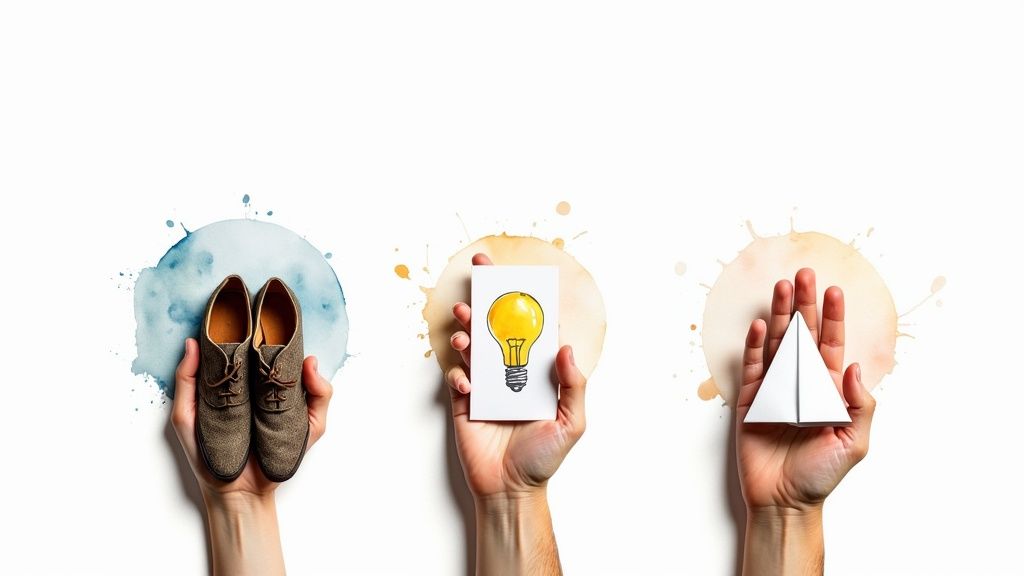
Human-centred design isn't some vague philosophy; it's a practical mindset built on three solid pillars. Think of them as the legs of a stool—if one is wobbly, the whole thing falls over. These pillars are Empathy, Ideation, and Experimentation.
So, let's break down what these really mean, beyond the buzzwords.
First up is empathy, and honestly, it’s the heart of the whole operation. This isn't about feeling sorry for someone; it's about genuinely trying to understand their world from their perspective. It’s about walking a mile in their shoes—even if those shoes are digital.
You're basically becoming a detective for human behaviour. Why did they click there? What were they thinking when they abandoned their shopping cart? What tiny frustration in their day could your app or service solve? This means observing, listening, and asking better questions.
The goal is to uncover the unstated needs—the things people don't even know how to ask for. It's the difference between building what people say they want and creating what they actually need.
This deep understanding is your foundation. Without it, you’re just guessing.
Next comes ideation, which is just a fancy word for brainstorming without limits. This is where you and your team get together and throw every single idea at the wall, no matter how wild or weird it seems. You know what? The most outlandish ideas sometimes hide a tiny spark of genius.
The aim here isn't to find the 'right' answer straight away. It’s about quantity over quality, at least initially. You’re trying to explore every possible angle and every potential solution to the problems you uncovered during your empathy-building phase. This creative free-for-all is essential for pushing past the obvious, boring solutions.
It’s a truly collaborative part of the process, where different viewpoints clash and combine to create something completely new. This is where you connect the dots from your research to potential futures.
Finally, we arrive at experimentation. This is where the magic really happens, where vague ideas become something real that you can touch and test. The key here is to build something—anything—that brings your concept to life. We’re not talking about a fully polished product; we’re talking about the complete opposite.
The idea is to create something tangible, fast. Then, you put these rough models in front of actual users. You watch them interact with it. Do they get it? Where do they get stuck? Their reactions—good and bad—are pure gold.
This isn’t just a one-off step. It’s a cycle of learning and refining. You build, you test, you learn, and you repeat. This continuous loop saves you from the horror of a big, expensive launch failure because you’ve already ironed out the kinks. It's a mindset that keeps you incredibly close to your customers.
The International Standards Organisation even formalises this, defining a human-centred design approach as one that prioritises well-being, satisfaction, and accessibility. This is reflected in New Zealand's strong performance on the Human-Centred Public Services Index, showing how government services are being reshaped around citizen experiences and feedback. You can find out more in the full report on human-centred public services.
Alright, let’s get our hands dirty. Theory is great, but how does this actually work step-by-step? Human-centred design isn't some mystical art; it's a practical, repeatable process. Think of it less like a rigid, straight line and more like a dance—sometimes you take a step forward, sometimes you loop back, but you’re always moving with purpose.
This part of the guide is a practical tour of that process, broken down into four key phases. It’s a cycle of learning and improving, designed to get you from a fuzzy problem to a brilliant solution that people genuinely love.
This is where you put on your anthropologist hat. The first phase, Research & Discovery, is all about building empathy and understanding the world of the person you’re designing for. You can’t solve a problem you don’t truly understand, right?
So, you go out into their natural habitat. This means:
A crucial step in the HCD process is deeply understanding the user journey. Tools like journey mapping can help visualise touchpoints and identify those hidden pain points. The goal here isn't to find solutions yet. It's simply to listen and learn with an open mind.
Once you’re swimming in sticky notes and interview transcripts, it’s time for the Ideation & Definition phase. Here’s the thing: we take all that rich research and start making sense of it. You’re looking for patterns, themes, and recurring problems.
From there, you define the core problem you're actually trying to solve. You might think you're designing a new banking app, but the research might show the real problem is that people feel anxious and confused about their finances. That's a much more powerful problem to solve!
The team comes together to frame a specific challenge. For example, instead of a vague goal like "improve our website," you might define it as: "How might we help new parents easily find trusted financial advice in under five minutes?"
With a clear problem defined, the brainstorming begins. This is a judgement-free zone where every idea is welcome, from the practical to the downright absurd. The aim is to generate a wide range of potential solutions before settling on just one.
Next up is Prototyping, which is easily the most fun part. You take the most promising ideas from the ideation phase and build rough-and-ready versions of them. The key word here is rough. We're not building a polished, finished product.
We're talking about:
Anything that makes the concept real enough to test is perfect. A prototype’s job isn’t to be perfect; its job is to answer a question. Does this flow make sense? Is this button clear? Does this concept even solve the user’s problem? The faster and cheaper you can build it, the better.
And that leads directly to the final phase: Testing & Iteration. You put your scrappy prototype in front of real users. You give them a simple task and then you watch. You see where they succeed, where they struggle, and where they get completely lost.
This isn’t about defending your idea; it's about learning what needs to change. The feedback you get is invaluable. It might send you right back to the drawing board—and that's a good thing! Finding a major flaw at this stage saves a mountain of time and money later.
It's this continuous cycle of learning and improving that lies at the heart of human-centred design. The role of a skilled user experience designer is vital here, as they guide this iterative process of refinement based on real human feedback.
It's one thing to talk about theories like empathy and iteration, but it’s another to see how Kiwi organisations are using these principles to get incredible results. Let’s bring human-centred design to life with some real-world examples from right here in Aotearoa.
These aren't just feel-good stories. They’re proof that this approach works for businesses of all sizes, from government agencies to non-profits and, yes, even small businesses in New Zealand. This isn’t just some Silicon Valley trend—it’s a powerful, practical way to solve real problems for real Kiwis.
Take the healthcare sector, a place where understanding people isn't just important—it's critical. A few years back, a co-design programme was set up to completely change the dynamic between patients and staff. Before this, feedback was often a one-way street, maybe a survey or a complaints form. It was a token gesture, really.
But this new approach flipped the script entirely. It became a genuine partnership.
Instead of just asking for feedback on existing services, the programme brought consumers and patients into the room to help define the very problems that needed solving. Can you imagine the shift in perspective? It’s the difference between asking, “How can we make our waiting rooms better?” and asking, “What does feeling cared for actually look like to you?”
The results were stunning. The most significant change was a massive jump in staff understanding of patient experiences. That’s powerful stuff. The Health Quality & Safety Commission's Partners in Care co-design programme showed that the biggest impact was an improved awareness among staff about how patient experiences could shape better healthcare. You can dive deeper into the findings from this NZ co-design programme.
Seeing it in action helps make the process much clearer. This infographic shows the typical flow of a human-centred design project, moving from broad exploration to a focused, tested solution.
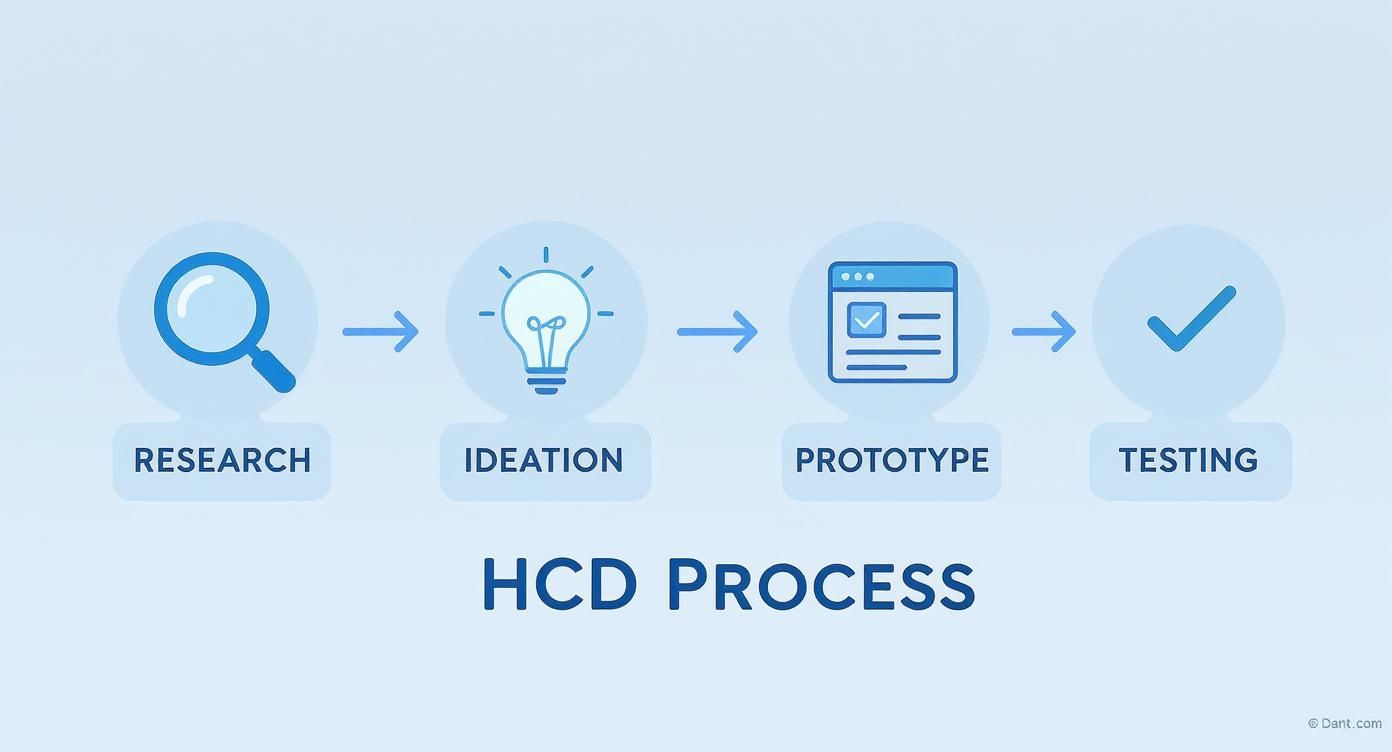
It’s a cycle, not a straight line. Each stage feeds into the next, ensuring the final product is built on a solid foundation of real user insight.
This loop of researching, brainstorming, building, and testing is the engine of human-centred design. It’s what stops you from spending a year building something nobody actually wants.
This iterative nature means you’re constantly checking in with the people you’re designing for. You’re not just hoping you got it right; you're making sure of it, step by step. It's a fundamentally smarter way to build things.
What these local examples show is that human-centred design isn’t a rigid formula you follow blindly. It’s a flexible mindset. It’s about cultivating curiosity and putting your own assumptions aside. For many organisations, this is a huge cultural shift.
Here’s the thing—it’s about changing the questions you ask:
This subtle but profound change in focus is what separates good products from great ones. It ensures that you are creating something that has a real, meaningful place in someone's life. This is precisely the philosophy we champion for small businesses in New Zealand, helping them connect deeply with their customers.

Let's cut to the chase. As much as we love the philosophy behind human-centred design, you need to know how it actually impacts your company’s success. It’s easy to dismiss HCD as a "nice-to-have" focused on warm, fuzzy feelings. But the truth is, happy users and a healthy balance sheet are two sides of the same coin.
This approach isn’t just about making people smile; it’s about making your business run smarter. When you genuinely solve real problems for people, they stick around. They become loyal customers, tell their mates about you, and are far less likely to jump ship to a competitor.
So, what does that mean for your business? It means higher customer retention, lower marketing costs (because your happy users do the talking for you), and a much stronger brand reputation. This isn't just theory; it's the direct result of putting people first.
Businesses often start with a goal like, "We need to increase operational efficiency by 15%." That’s a dry, impersonal target. It doesn’t exactly inspire anyone to do their best work. Human-centred design flips the script entirely by asking a better question.
A fantastic local example of this comes from the banking sector. ANZ was wrestling with a major operational headache: their staff were battling clunky, slow internal systems. This led to long wait times and visibly frustrated customers. The original business goal was probably something clinical, like reducing processing times.
But by applying a human-centred design lens, the project team reframed the problem. The question became: "How can we empower our staff to provide better, faster, more personalised customer service?"
See the difference? One is a business metric; the other is a human goal. This simple shift in perspective was a game-changer. You can read more about it in this case study on human-centred experiences.
The team dived deep, observing and talking to bank staff to understand their daily frustrations. They mapped out workflows and quickly discovered that a huge amount of time was being wasted on manual data entry and navigating confusing interfaces.
The solutions that came out of this were surprisingly simple but incredibly effective. They replaced manual text entry with dropdown menus, which not only sped things up but also massively improved data quality. They redesigned screens to show relevant information upfront, so staff weren't constantly clicking between different windows.
The results were huge. Staff could finally have real, human conversations with customers instead of fumbling with a keyboard.
Service times dropped dramatically. Employee satisfaction went up, and customer satisfaction followed right behind.
This ANZ story is a perfect illustration of a core principle: investing in a better employee and customer experience isn't an expense—it's an investment with a clear, measurable return. By focusing on the human, they directly improved their bottom line. It's a powerful lesson for any Kiwi business.
Feeling inspired? Keen to give this a go? You don’t need a massive budget or a dedicated design team to start thinking in a more human-centred way. Honestly, you can begin right now, with what you have.
This isn’t about big, expensive projects; it's about shifting your perspective. It’s all about taking small, practical steps to get closer to your customers and building a habit of curiosity. The biggest mistake is thinking you need to do everything at once. You don’t. Just start.
The first and most powerful step is simply to listen. You probably think you already know your customers, but there are always surprises hiding just beneath the surface. Real listening means looking for the ‘why’ behind what people do, not just what they say.
Here are a few easy ways to start gathering that gold:
Another brilliant exercise is to map out the entire customer journey. Grab a whiteboard or even just a big piece of paper. Trace every single touchpoint a person has with your business, from the moment they first hear about you to long after they’ve made a purchase.
You’ll quickly uncover hidden frustrations and moments of delight you never knew existed. Where do they get stuck? Where is the process clunky or confusing? This visual map is a powerful tool for building empathy across your entire team.
It forces you to see your business from the outside in. Suddenly, that "simple" checkout process might look a lot more complicated when you're walking in their shoes.
You can also create simple ‘personas’. These aren't real people, but fictional characters based on your research who represent your different types of customers. Give them a name, a job, and a few key goals and frustrations related to your business.
When you’re making decisions, you can then ask, "What would Sarah the busy mum think of this?" It’s a simple trick, but it helps keep real human needs at the centre of every conversation and stops you from designing for yourself.
At NZ Apps, this philosophy is woven into every single project we take on. Whether we’re building a custom mobile app or working with website developers for small business clients, we start with the user. This ensures the final product isn’t just functional—it’s genuinely useful and enjoyable for the people who matter most.
Got a few questions rattling around in your head? You're not alone. When people first hear about human-centred design, the same handful of queries usually pop up. Let’s tackle some of the big ones with straightforward answers to give you a clearer picture.
It's easy to assume this stuff is just for the big players, but that couldn't be further from the truth.
Absolutely not. While big companies with huge budgets have certainly put it on the map, the principles themselves are universal. For a small or medium Kiwi business, you could argue HCD is even more critical. Why? Because it stops you from wasting precious money building something nobody actually wants.
Think about it this way: it’s about being smart and targeted with your resources. You get to create a product or service that finds its audience almost immediately because it was designed for them from the very beginning.
That's a fantastic question, and it really gets to the heart of the matter. Getting feedback is a crucial part of any business, but it's usually reactive—you're asking people what they think about something that already exists.
Human-centred design is proactive. It starts long before you even have a solution by deeply understanding a user's world, their habits, and their unstated needs through genuine observation. It’s the difference between asking, “Do you like the colour of this button?” and asking, “Tell me about the last time you tried to pay a bill online.” One gets you an opinion; the other gets you a story packed with valuable insights.
You're not just collecting feedback; you're uncovering the real, often hidden, problem that needs to be solved. This proactive stance is what separates a good product from a truly great one.
It might feel like an extra step upfront, but it almost always saves a massive amount of time and money in the long run. Here’s the thing: the initial research and testing phase helps you identify and fix major flaws when they are incredibly cheap to fix—at the idea or prototype stage.
It’s a small investment at the beginning of a project to prevent a massive, costly failure after you've already launched. You’re essentially de-risking your entire project by making sure you’re building the right thing, for the right people, from day one.
Ready to build something your customers will genuinely love? The team at NZ Apps uses a human-centred approach to create custom web and mobile apps that solve real problems. Let's have a chat about your idea.