
Let's be honest, trying to get your Kiwi business noticed online can feel like shouting into a southerly. Internet marketing in New Zealand isn't just a scaled-down version of what works overseas; it’s a unique game with its own rules, shaped by our distinct culture and incredibly high digital connectivity.

Here’s the first thing to get your head around: you're not just up against the shop down the road anymore. You're competing in a global arena, but from a very local stage. That might sound intimidating, right? But it's also a massive opportunity if you play your cards right.
Forget the one-size-fits-all strategies you’ve seen a hundred times. We’re talking practical, boots-on-the-ground tactics made for the New Zealand market. Think of this as your starting point—a clear map of what’s possible with a smart, local-first approach.
So, what does it really mean to market a business in one of the most connected countries on earth?
It’s a double-edged sword, really. On one hand, your audience is right there, scrolling on their phones. On the other, everyone's audience is right there. The digital noise is louder than ever, which is exactly why a tailored strategy becomes non-negotiable.
As of early 2025, New Zealand had an impressive 5.03 million internet users. That’s a whopping 96.2% penetration rate. This near-universal access has completely changed the game for businesses from Cape Reinga to the Bluff, making a solid digital plan absolutely essential.
The big takeaway? Your customers expect a seamless online experience. They expect to find you on Google, check your reviews, and maybe even buy from you—all from their device.
Your digital presence is your new storefront, and it needs to be just as welcoming as your physical one. Whether you’re selling products or services, understanding how Kiwis behave online is your first big win. If you're selling goods, our guide to succeeding in eCommerce in New Zealand is a great place to start.
The real challenge isn't just being online; it's being seen and remembered by the right people. It's about cutting through the clutter with a message that resonates with a Kiwi audience.
Think about it: we have our own humour, our own slang, and our own way of doing things. A generic campaign from an overseas playbook will stick out like a sore thumb. This guide is built to help you avoid that, giving you a proper foundation for effective internet marketing that New Zealand businesses can actually use.
Before we get into the nitty-gritty, let's get a bird's-eye view. Below is a quick summary of the core digital channels every Kiwi business should have on their radar.
| Marketing Channel | Why It Matters for NZ Businesses | First Actionable Step |
|---|---|---|
| Local SEO | Kiwis love to "support local." Showing up in "near me" searches is critical for foot traffic and local services. | Set up and fully polish your free Google Business Profile. |
| Website Optimisation | Your site is your digital storefront. It needs to be fast, easy to use on a phone, and clear about what you do. | Run your website through Google's PageSpeed Insights to check for mobile issues. |
| Content Marketing | This is how you build trust and show you're an expert. Think helpful blog posts, guides, and how-tos. | Brainstorm 10 questions your customers always ask, and turn one into a simple blog post. |
| Paid Media (Google/Meta) | Lets you get in front of very specific audiences, fast. Great for promotions or reaching new customers. | Start a small Meta Ads campaign targeting people in your local town with a compelling offer. |
| Email Marketing | Your direct line to your most loyal customers. Perfect for sharing news, special offers, and staying top-of-mind. | Choose a simple platform like Mailchimp and create a sign-up form for your website. |
This table is just the beginning, of course. Each of these channels is a deep well of opportunity. Let's start breaking down exactly how to make them work for your business right here in Aotearoa.
You could have the most beautiful website in the country, but if your customers can't find it, what's the point? It’s a bit like opening a brilliant new shop down a hidden alleyway with no sign out front.
This is where we get into the nuts and bolts of local Search Engine Optimisation (SEO) tailored for the New Zealand market. Forget just stuffing 'Auckland plumber' onto a page a few times and hoping for the best—that old-school approach simply doesn't cut it anymore. Real local SEO is all about proving to Google that you are the most relevant, trustworthy answer for a customer right here in your community.
So, where do we start? The absolute cornerstone of any local marketing effort is your Google Business Profile (GBP). You know those handy map listings that pop up when you search for "cafe near me" or "mechanic Christchurch"? That's your GBP at work.
Getting this right is non-negotiable. It’s your digital storefront on the world's biggest search engine, and it’s completely free to set up. Honestly, think of it as your business's digital handshake; it's often the very first impression a potential customer will have of you. A well-oiled profile can be the difference between getting that phone call and being invisible to someone standing just around the corner.
Just creating a profile isn't enough. You have to consistently feed it good information to keep it healthy and ranking well. It's not a set-and-forget job.
Here’s what you need to nail:
Here's a pro tip: Respond to every review, good or bad. It shows you're engaged and that you care about customer feedback. This builds immense trust with both potential customers and Google itself.
Beyond your Google profile, you need to think about your digital footprint across the wider New Zealand web. Here’s the thing: this is where local citations come in. A citation is simply a mention of your business name, address, and phone number (NAP) on another website.
Think of each consistent citation as a vote of confidence in your business's location and legitimacy. The more consistent votes you have from reputable Kiwi sites, the more Google trusts that you are who and where you say you are.
Which directories really matter here in NZ?
The key here is consistency. An old phone number or a slightly different business name can confuse search engines and water down the power of your citations. Do a quick audit—are your details identical everywhere?
Finally, let's talk about the words on your website. Your content needs to answer the real questions New Zealanders are typing into Google. It's about being genuinely helpful, not just delivering a sales pitch.
Instead of a generic page titled "Our Services," get specific. A builder in Wellington should have distinct pages for "Deck Building Wellington," "Kitchen Renovations Lower Hutt," and "New Home Builds Porirua." This hyper-local focus tells Google exactly what you do and where you do it. This is how you start to win the local marketing game.
For a deeper look into this, check out this fantastic guide on local SEO for small business in NZ to really get into the specifics.
Let’s talk about your website. Is it just a pretty online brochure, or is it actually pulling its weight and bringing in business? Your site is your digital storefront, your 24/7 salesperson, and often the very first handshake you have with a potential customer here in New Zealand.
Honestly, a great website isn't just about looking sharp; it’s about generating real, measurable results. It has one primary job: to turn a casual browser into a paying customer or a warm lead. If it's not doing that, it's just an expensive hobby.
First impressions count, right? When a potential customer lands on your site, they make a snap judgment in seconds. Is it clean and professional? Does it load quickly on their mobile while they're waiting for a flat white? Can they find what they're looking for without having to think too hard?
This all comes down to user experience. It’s not just some fluffy marketing term; it’s about making your website dead simple and even enjoyable to use. A clunky, slow, or confusing website is the digital equivalent of a shop with a broken door and messy aisles. People will just turn around and leave.
Your website needs to instantly answer three questions: What do you do? Who do you do it for? And what should I do next? If a visitor can't figure that out in about five seconds, you've probably lost them for good.
Getting this right often means bringing in an expert. A great user experience designer in New Zealand can be the difference between a site that frustrates visitors and one that guides them smoothly towards making a purchase. It’s an investment that pays for itself over and over again.
Once you've grabbed their attention, what are you actually saying? The words on the page—your website copy—need to do more than just list features. They need to connect on a human level.
Your copy has to speak directly to your ideal client's problems, their hopes, and their needs. Are you a landscaper in Christchurch? Don’t just say you "provide landscaping services." Talk about creating a backyard oasis perfect for those long, lazy Canterbury summer evenings.
This means getting out of your own head and into your customer's. What keeps them up at night? What's the real problem they're trying to solve? Good copy builds a bridge between their problem and your solution.
Here are a few things to keep in mind:
So, you've got a fast, beautiful website with compelling copy. What now? This is where so many Kiwi businesses drop the ball. You have to explicitly tell people what you want them to do next.
This is your Call to Action (CTA), and it needs to be clear, direct, and impossible to miss.
Forget vague, passive buttons like "Learn More" or "Submit." Be specific and action-oriented. Think about buttons like:
Every single page on your website should have a clear goal and a CTA that supports it. This isn't about being pushy; it's about being helpful. You're guiding your visitor on their journey, making it easy for them to take the next step.
With New Zealand's online shopping industry expected to hit $6.8 billion in revenue by 2025, driven by our love for digital convenience, a clear path to purchase is non-negotiable. Making that path as smooth as possible is the whole point of effective internet marketing. You can explore more about Kiwi e-commerce trends and their growth.
Putting your hard-earned money into paid advertising can feel like a bit of a gamble, can't it? You’re essentially placing a bet that you can catch someone’s attention in a sea of digital noise. But it honestly doesn't have to be a game of chance.
Here’s the thing: with a smart, targeted strategy, you can get in front of the right Kiwis at exactly the right time. Let’s break down the two heavyweights for most New Zealand businesses when it comes to paid ads—the platforms where you'll likely get the most bang for your buck.
For most Kiwi businesses, the paid advertising world really boils down to two main players: Google Ads and Meta Ads (which covers Facebook and Instagram).
I like to think of them as two different kinds of fishing. Google is like spear fishing—you're targeting people who are actively hunting for something specific. Meta is more like net fishing; you're casting a wide net over a specific area where you know your ideal customers hang out.
Both are incredibly powerful, but they work in fundamentally different ways. The real magic happens when you understand which one to use, and when.
Google Ads is all about search intent. You're bidding on keywords that people are literally typing into the search bar, which means you're catching them at the very moment they have a problem or a need.
Someone searching for an "emergency plumber Auckland" isn't just browsing; they have a burst pipe and they need help now.
This is what makes Google Ads so brutally effective for service-based businesses, tradies, and anyone selling a product that solves an immediate problem. You can target specific locations, from the whole of the Canterbury region right down to a few suburbs in Christchurch, ensuring your ad dollars are only spent on people who can actually become your customers.
To make sure every dollar is working as hard as possible, it pays to optimize PPC marketing campaigns for maximum ROI.
Now, let's talk about Meta. Facebook and Instagram ads work on a completely different principle. Here, you’re not targeting what people are searching for, but who they are. Meta's power lies in its incredibly detailed demographic and interest targeting.
Want to reach women aged 30-50 in Wellington who are interested in sustainable fashion and yoga? You can absolutely do that. This makes it perfect for businesses with visually appealing products or services that people don't necessarily know they need yet. It's about creating demand, not just capturing it.
And the audience is massive. With social media ad spending in NZ set to hit US$459.46 million in 2025 and 79.1% of Kiwis being active users, it's a huge opportunity.
So, where should you start? This table breaks down the core differences to help you decide where to put your budget first.
| Feature | Google Ads | Meta Ads (Facebook/Instagram) |
|---|---|---|
| Best For | Capturing existing demand. Great for services, high-intent products, and B2B. | Creating new demand. Ideal for e-commerce, visual products, events, and building brand awareness. |
| Targeting | Based on keywords, location, and search history (what people are looking for). | Based on demographics, interests, behaviours, and connections (who people are). |
| User Intent | High. Users are actively seeking a solution. | Low. Users are browsing content, not actively looking to buy. Your ad needs to interrupt and engage them. |
| Cost Model | Primarily Pay-Per-Click (PPC). You pay when someone clicks your ad. | Primarily Pay-Per-Impression (PPM). You pay for your ad to be seen, with options for clicks or conversions. |
| Ad Formats | Text-based search ads, Display (banner) ads, Shopping ads, and YouTube video ads. | Image ads, video ads, carousels, stories, and lead generation forms. Highly visual and interactive. |
| Typical Use Case | A Christchurch law firm targeting "family lawyer Christchurch" to get immediate client enquiries. | A Hamilton-based clothing boutique targeting women aged 25-40 in the Waikato with an interest in local fashion. |
Ultimately, the best strategy often involves using both platforms together. You can use Meta to build awareness and create demand, then use Google to capture that demand when people start searching for you.
The goal isn't just to get clicks; it's to get conversions. A click that doesn't lead to a sale or a lead is just wasted money. It's all about turning that initial interest into a meaningful business outcome.
This simple flowchart shows the quick mental checks a visitor makes before they decide to stick around and convert on your website.
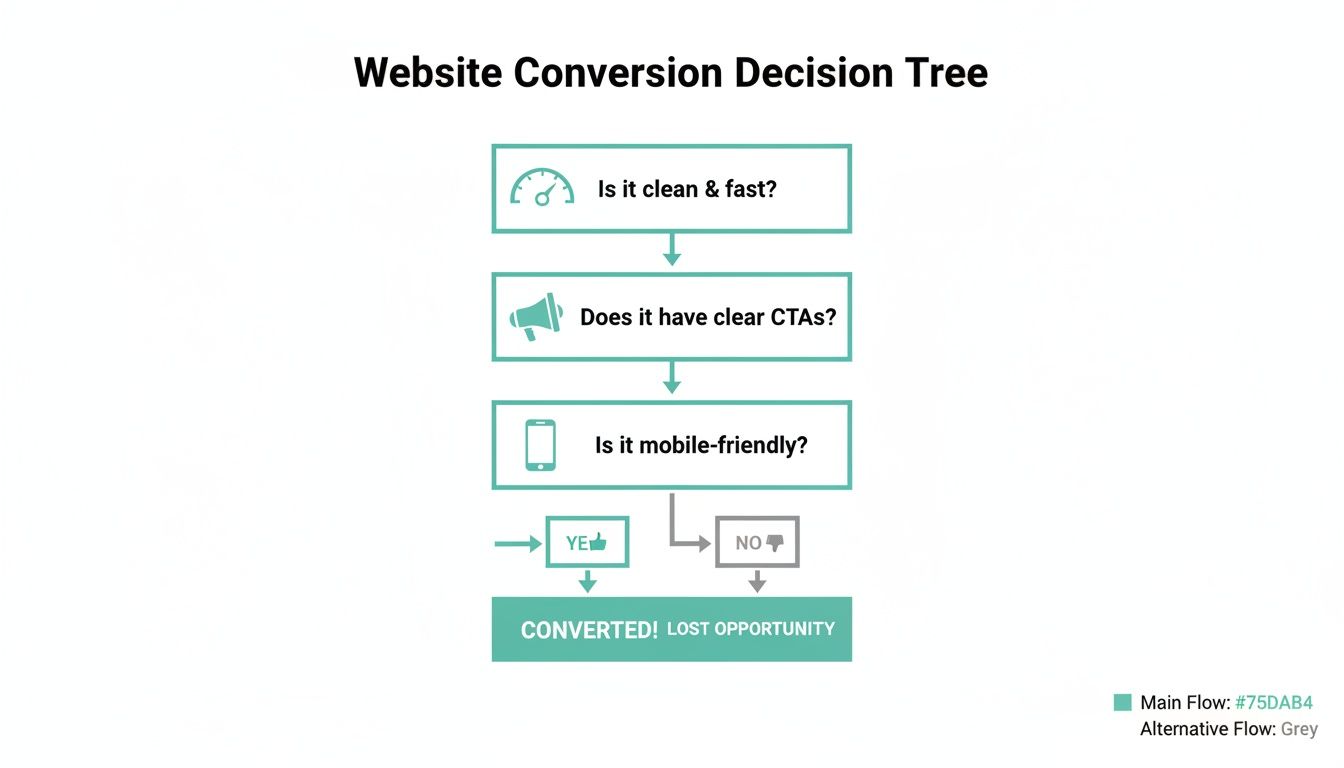
As you can see, getting the click is only the first hurdle. The real work starts once they land on your site.
No matter which platform you choose, remember that the creative—the image, the video, and the text—is what does the heavy lifting. Your ad copy needs to connect, your images need to stop the scroll, and your offer needs to be compelling.
Test, measure, and tweak. That’s the real secret to making your ad budget work for you, not against you.
Right, so you’ve got your SEO humming, your website is looking sharp, and you’re even running a few ads. That’s brilliant. But… what’s next? How do you actually know if any of it is paying off?
This is where we get to the final, and frankly, most crucial piece of the marketing puzzle for your New Zealand business: tracking and measurement. It might sound a bit technical, maybe even a little dry, but it’s really just about knowing what’s working and what isn’t. Without it, you're flying blind.
Think of it this way: running a marketing campaign without tracking is like trying to drive from Auckland to Wellington with a map but no idea where you are on it. You're moving, sure, but you have no clue if you're heading in the right direction.
First things first, let's get one thing straight. We need to stop obsessing over the numbers that make us feel good but don't actually move the needle for the business. These are what we call vanity metrics.
What do they look like? Things such as:
Look, a thousand new followers feels great, but did any of them buy something? Did they even click through to your website? These numbers can be seriously misleading because they have no direct link to your actual business goals. They're nice to have, but they don't pay the bills.
So, what should you be looking at instead? We're talking about actionable metrics—the numbers that directly impact your bottom line. These are the figures that tell you if your marketing efforts in New Zealand are actually generating a solid return.
These are the numbers that truly matter:
To properly gauge how effective your marketing is and drive real growth, it's vital to understand customer retention metrics and see how they fit into your bigger picture.
How do you track all this stuff? The main tool for the job is Google Analytics 4 (GA4). It’s a free, incredibly powerful platform that gives you amazing insight into who is visiting your website, how they found you, and what they do once they're there.
For any Kiwi business with a website, setting it up is non-negotiable. It’s your central hub for data, helping you connect the dots between all your different marketing channels. You can see which channels—like Google search, your Facebook ads, or that email newsletter you send out—are bringing you the most valuable customers.
The real power of measurement isn't just about looking back at what happened. It's about using that information to make smarter decisions about what to do next. It turns marketing from an expense into an investment.
This data-driven approach is how you get better over time. You stop throwing things at the wall to see what sticks and start making informed choices that lead to real, sustainable business growth. It's the difference between hoping for success and actively engineering it.
Right, we’ve covered a fair bit of ground, from local SEO to making sense of your analytics. But let’s be real, when you’re in the thick of running your own business, a few practical questions always pop up. It’s one thing to understand the theory; it’s another to know where to actually start.
So, let's tackle some of the most common questions we hear from Kiwi business owners just trying to get a handle on this whole internet marketing thing. Think of this as a friendly chat over a flat white—just some straight-up answers to help clear the air.
Honestly, this is the million-dollar question, isn’t it? And the frustrating answer is: there's no single magic number that fits every business in New Zealand. A cafe in Ponsonby has wildly different needs than a builder in Invercargill.
But here’s a sensible way to think about it. Many Kiwi small and medium businesses allocate somewhere between 5% and 15% of their total revenue to their marketing efforts. If you're just starting out or you’re in a really competitive market (like professional services in Auckland or Wellington), you might need to lean towards that higher end to get some traction.
The most important thing isn’t the exact dollar amount. It’s about starting with something you can manage consistently, measuring absolutely everything, and then reinvesting what works. You could begin with a modest budget—say, a few hundred dollars a month for some highly targeted local Google Ads—and then grow from there as you start seeing a return.
The key isn't the size of your budget, but the consistency of your effort and your relentless focus on tracking the return on investment. A small, smart budget will always beat a large, unfocused one.
You might think a blog is just for travel influencers or foodies, but for a business, it's one of the most powerful and underrated SEO tools you have. It sounds like a lot of work, and it can be, but the payoff is huge.
Let me explain. Think about it this way: every single blog post you publish is a brand-new page for Google to index. It’s another chance for you to show up in search results when your ideal customers are looking for answers.
For a tradesperson in Christchurch, a simple article titled 'Choosing the Right Heat Pump for Canterbury Winters' can attract highly qualified leads for months, or even years, after it’s published. It does three crucial things:
So, yes. If you want to improve your search visibility and connect with your customers on a deeper level, a blog is a fantastic idea. It’s a long game, but one that’s well worth playing.
This is another classic "it depends" situation, but we can definitely narrow it down. The worst thing you can do is try to be everywhere at once. You’ll just stretch yourself too thin and do a poor job on all platforms.
The real question is: where do your customers hang out online?
The best advice? Pick one or two platforms where you know your target audience spends their time and commit to doing a really good job there. Quality over quantity, always.
Absolutely! One hundred percent, yes. In a world of ever-changing social media algorithms, email marketing might seem a bit old-school, but it consistently delivers one of the highest returns on investment of any channel.
Why is it so powerful? Because unlike on social media, where a platform’s algorithm decides who sees your post, an email lands directly in your subscriber's inbox. It's a direct, personal line of communication with people who have already raised their hand and said they’re interested in what you do.
You own that list. It's an asset.
You can use it to share special offers, provide genuinely helpful tips, announce new products, and build that all-important long-term customer loyalty. Just remember to play by the rules—here in NZ, that means complying with the Unsolicited Electronic Messages Act. Always get permission first!
Feeling ready to put these ideas into action but not sure where to start? The team at NZ Apps specialises in helping Kiwi businesses grow with custom web design, app development, and targeted SEO that gets real results. Book a free, no-obligation consultation with us today to chat about your business goals.