
Okay, let's get one thing straight. Kiwi website design isn't about just slapping a silver fern on your homepage and calling it a day. It's a whole way of thinking—a way of building a digital space that actually clicks with New Zealanders, reflecting our unique culture, our values, and yeah, even our dry sense of humour.
Think about it like this—we've got our own slang, a pretty cruisy attitude, and a massive love for the great outdoors. A good Kiwi website speaks that language. It's the difference between a generic, off-the-shelf template and a site that feels like it’s saying, "Kia ora, mate. We get you."
Honestly, this stuff goes way deeper than just looks; it's about building trust from the very second someone lands on your page. A website that feels local and familiar instantly makes Kiwis feel more comfortable. It tells them you're a real, approachable business, not some faceless corporation on the other side of the planet.
So, how do you nail that genuine Kiwi feel? You know what? It's usually a mix of little things that all work together. It often comes down to a few key ingredients:
A website that feels authentically ‘Kiwi’ isn’t just a nice-to-have; it's your secret weapon. In a sea of online businesses, it creates an immediate bond with your local audience, making them feel seen and understood.
Beyond the general vibe, there's a growing appreciation for designs that respectfully weave in elements of our national identity. This could be the tasteful use of Māori patterns or the thoughtful inclusion of te reo Māori phrases where it feels right. It’s not about ticking a box; it’s about acknowledging the bicultural fabric of Aotearoa in a way that feels genuine.
This local flavour is what turns a simple website into a powerful business tool. It's how you cut through the noise and show your community you're one of them. A successful kiwi website design doesn’t just sell something—it builds a real connection.
Ever landed on a website and just felt... something was off? Maybe the prices were in US dollars, or the shipping options were clearly meant for another hemisphere. That’s the exact feeling a generic, one-size-fits-all website gives your Kiwi customers.
It’s an instant digital disconnect. It tells them this business doesn't quite get them or where they are. And for a New Zealand audience, that tiny moment of hesitation is more than enough to send them clicking away to find a local competitor they know they can trust.
This isn’t just about feelings; it's about cold, hard business reality. You’re not just competing with the shop down the road anymore; you're up against global giants. A thoughtfully crafted Kiwi website design is your home-ground advantage.
These days, your website is your digital front door, and most Kiwis will check it out long before they even think about making a purchase. The numbers don't lie. A huge 90% of Kiwi consumers now research products and services online before buying anything. This makes your website the main gateway for grabbing this huge, tech-savvy audience.
So, what happens if your website doesn't show up in local searches? Or if it fails to instantly signal that you're a proud New Zealand business? You're essentially invisible. You won't even make their shortlist.
A generic design misses the mark because it fails to build immediate trust and relevance. When a customer from Christchurch lands on your site, they need to see themselves—in the language, the imagery, and the overall feel—within seconds.
Here's the thing. Being the local, trusted choice is a huge advantage in a crowded market. When customers feel a business understands their local context, they are far more likely to engage and, ultimately, buy. This isn't just a 'nice-to-have'—it's a core part of a winning business strategy here in Aotearoa.
Let's quickly compare the two approaches. It really shows why a localised design isn't just a small tweak, but a fundamental shift in strategy.
| Feature | Generic Template Approach | Kiwi Website Design Approach |
|---|---|---|
| Trust Signals | Often uses generic stock photos and vague, international language. | Features genuine photos of NZ locations or people and uses local vernacular. Sweet as. |
| Currency & Shipping | May default to USD or have confusing international shipping tables. | Clearly displays prices in NZD and offers straightforward local shipping options. |
| Search Visibility | Struggles to rank for "near me" or city-specific searches like "plumber in Auckland." | Is properly optimised for local SEO, ensuring it appears for relevant NZ queries. |
| User Connection | Feels distant and impersonal, like a faceless global entity. | Creates an immediate sense of familiarity and community, building rapport. Chur. |
As you can see, a generic website might tick the box of "having a website," but it completely misses the chance to actually connect with anyone. It’s like bringing a cricket bat to a rugby match—sure, you're on the field, but you're not playing by the local rules.
To really get ahead, you need to understand why website design is important for your business in the first place. It’s about so much more than just looks; it’s about making your digital presence work for you, right here in New Zealand.
Right, so we've established why a generic, cookie-cutter website just doesn't fly in New Zealand. But what actually goes into making a top-tier Kiwi website? What does it look, feel, and function like under the bonnet?
Let's get practical. Think of this as your checklist for the non-negotiables—the absolute must-haves for any NZ business wanting to make a real go of it online. These aren't just fancy add-ons; they're the foundational pieces that build trust, bring in customers, and ultimately, grow your business.
This diagram shows the shift in thinking from a generic approach to one built for local success.
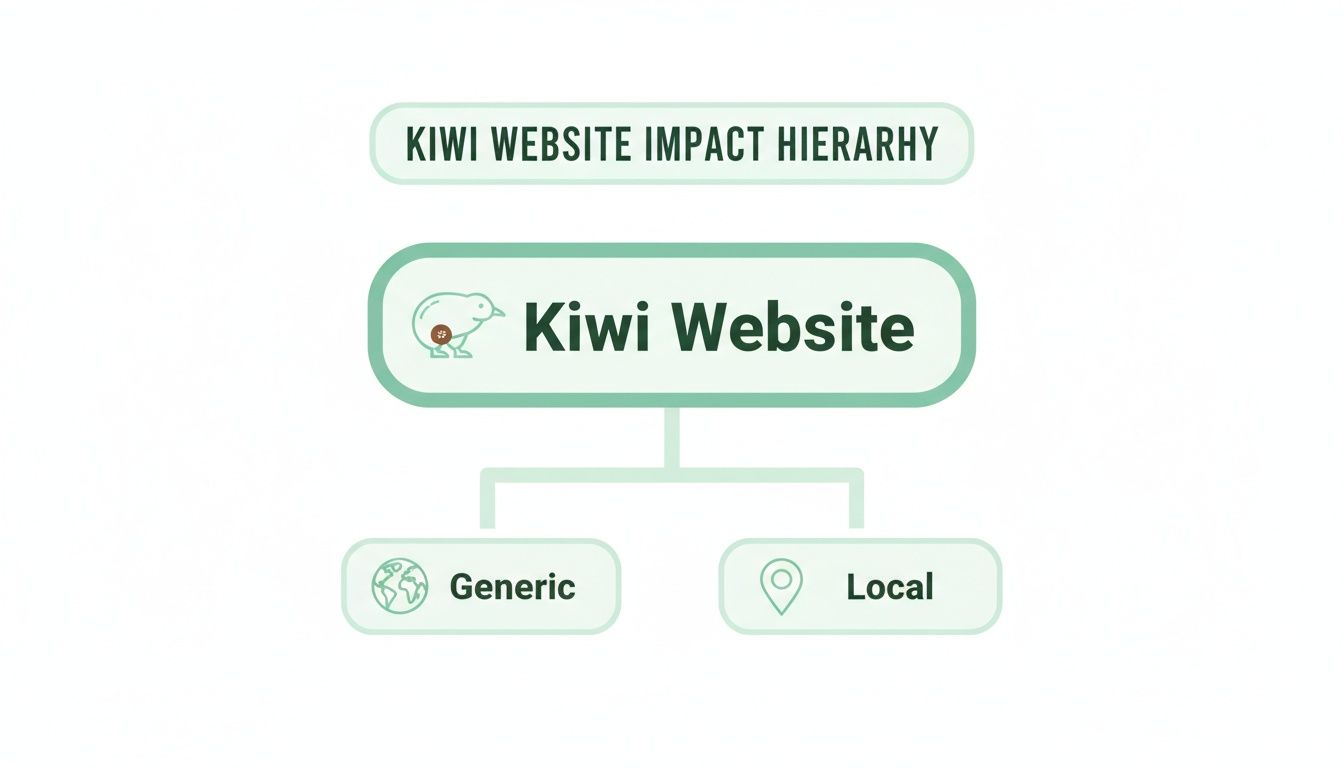
See that? A successful website here is built on a local foundation first, not as an afterthought.
You could have the most beautiful website in the world, but if no one can find it, what's the point? This is where local Search Engine Optimisation (SEO) comes in. It’s all about making sure your site pops up when Kiwis in your area are actually searching for what you offer.
It’s less complicated than it sounds. It means using the phrases people here really type into Google, like "plumber in Ponsonby" instead of just a generic "plumber."
Just as importantly, it means getting your Google Business Profile sorted properly. You know, that little map listing that shows your address, opening hours, and reviews? For a local Kiwi business, it’s digital gold.
Let’s be honest, New Zealanders aren't exactly known for their patience online. If a website takes more than a couple of seconds to load, we’re gone. We’ve all done it—smashed the back button out of sheer frustration.
A slow site doesn’t just annoy visitors; it actively hurts your business. Google knows this and actually ranks faster sites higher in search results. The culprits are often bloated images, messy code, or cheap overseas hosting. A proper kiwi website design tackles this from day one, making sure your site is zippy and responsive.
A one-second delay in page load time can lead to a 7% reduction in conversions. For an e-commerce site making $100,000 a day, that's a loss of $2.5 million a year. Speed isn't just a feature; it's a necessity.
Think about where you do most of your casual browsing. On the couch? Waiting for a flat white? On your smoko break? Chances are, it's on your phone.
Over 80% of Kiwis now browse on their smartphones, which means your website has to work flawlessly on a small screen. This is what we call mobile-first design. It's not about making a desktop site that just "sort of" works on a phone; it's about designing the mobile experience from the ground up and then scaling it for larger screens. This means simple navigation, big buttons that are easy to tap, and text you can actually read without pinching and zooming.
Building a great website is also about building trust. You wouldn't hand over your credit card details in a dodgy-looking shop, and the same rules apply online. This is where a few vital, behind-the-scenes elements come into play.
To truly drive growth, a great Kiwi website must optimize user experience by weaving these technical building blocks into a design that feels local and trustworthy. It's this combination that turns casual visitors into loyal customers.

Alright, you get it. A proper Kiwi website is a must-have. But now what? This is where the rubber meets the road, and you’re faced with two huge decisions: which platform should you build on, and who can you actually trust to build it?
Getting these two things right from the start can save you a huge amount of time, money, and future headaches. Honestly, it's one of the most important business decisions you'll make this year. Let’s make sure it's a smart one.
The world of website platforms can feel like a noisy party where everyone is shouting for your attention. You’ve got Shopify, WordPress, Squarespace, and a dozen others all claiming to be the best.
Here's the real secret: the "best" one is the one that fits your specific business needs like a glove. A local tradie doesn't need the same e-commerce horsepower as a nationwide retailer. Let's break down the big players for the typical NZ small business.
Deciding between platforms like these is a common hurdle for Kiwi businesses. For a deeper look, check out our detailed comparison of Shopify vs WordPress for NZ businesses to see which might better suit your goals.
Now for the even bigger question: who is going to build this thing for you? Choosing the right partner for your kiwi website design is absolutely critical. Do you go with a freelancer from Dunedin or a well-known agency in Auckland?
The right partner does more than just build a pretty website. They act as a strategic guide, helping you connect your business goals to your digital presence. They should understand the New Zealand market, what makes your customers tick, and how to make you stand out from the local competition.
Your web design partner isn't just a supplier; they're an investment in your business's future growth. A good one will challenge your ideas, offer valuable insights, and deliver a tool that brings you leads and sales for years to come.
So, how do you spot a good one? You need to ask the right questions. Don't just ask about price; dig deeper to see if they truly get what you're trying to achieve.
Here are a few questions to get you started:
Listen carefully to their answers. A great partner will be more interested in your business outcomes than just the technical details. They'll speak your language, not just geek-speak, and make you feel confident and understood. That's the real sign of a partnership that's built to last.
Alright, let's talk money. It's the big question every business owner asks, but getting a straight answer can feel like trying to nail jelly to a wall. How much does a website actually cost here in New Zealand?
The honest answer? It varies. A lot.
Think of it like buying a vehicle. You could grab a reliable ute for a few thousand dollars, or you could invest in a high-performance European sports car. Both get you from A to B, but they’re built for completely different purposes and come with wildly different price tags.
A website is much the same. A simple, clean ‘brochure’ site that just tells people who you are and what you do might cost a few thousand dollars. But if you need a full-blown e-commerce store with hundreds of products and custom features, you could easily be looking at tens of thousands.
So, what pushes a project from one end of the spectrum to the other? It usually boils down to the amount of time and specialised skill needed. It’s not just about making things look pretty; it's about building something that works perfectly for your specific business goals.
Here are the main cost drivers:
It’s shocking how many Kiwi businesses are still missing this digital storefront. Despite rising customer expectations, only 53% of New Zealand businesses have a website, a figure that hasn't budged since 2022. This shows a huge opportunity for those willing to invest in a proper online presence. Find out more about how this digital divide impacts local businesses in the latest InternetNZ data.
This is the part that often catches people by surprise. A website isn't a one-and-done purchase. It's more like owning a car; it needs ongoing fuel and maintenance to keep it running smoothly and securely on the road.
Think of ongoing maintenance as your website's WOF. It's a small, regular investment to ensure everything is secure, up-to-date, and performing at its best, preventing costly breakdowns down the line.
These ongoing costs typically include:
.co.nz address.Budgeting for these small but regular expenses from the start is just smart planning. For a more detailed breakdown of what to expect, check out our guide on how much a website costs in NZ. It will help you plan wisely and avoid any nasty financial surprises.
Feeling inspired? Or maybe a little overwhelmed? That’s completely normal. We’ve covered a lot of ground, and the thought of kicking off a whole new website project can feel pretty daunting.
But here’s the good news—it doesn’t have to be. Turning all this information into a real, functioning website is just about taking one simple, manageable step at a time. The goal is to close the gap between reading this guide and actually launching a site that gets you results.
Let’s put the technical talk aside for a moment and make this practical. Before you get bogged down in colours or fonts, grab a pen and paper (or a blank doc) and just jot down your thoughts on these points. This isn’t a test; it’s just about getting your ideas in order.
A great Kiwi website design isn’t just another business expense; it’s a genuine investment. It’s one of the few things you can set up that works for you 24/7, generating leads and building your brand even while you’re asleep.
Getting your website right isn't just a 'nice-to-have' anymore—it’s a massive opportunity. New Zealand's digital technologies sector is an absolute powerhouse, growing at a blistering 10.4% annually. That's more than double the growth rate of the entire national economy. This boom is creating a huge demand for top-notch web design expertise right here in Aotearoa. You can get a deeper look at how this digital boom is shaping the industry.
What does that mean for you? It means that building a new website could be the single best move you make for your business all year. You’re not just putting up a digital brochure; you’re tapping into a thriving part of our economy and setting yourself up for a future where a strong online presence is the key to success. You’re ready for this.
Still got a few things you're wondering about? You're not alone. Here are some of the most common questions we hear from Kiwi business owners thinking about a new website.
It’s totally normal to feel like you're staring up at a big hill when you first start this process. There are a lot of moving parts!
Let’s tackle a few of those lingering queries right now.
This is a classic "how long is a piece of string?" question, but we can give you a rough idea. A straightforward brochure-style website with just a few pages could take anywhere from 4 to 8 weeks to get live.
If you're looking at something more complex, like an e-commerce store or a custom web application, you're probably looking at 3 to 6 months, or sometimes longer. It all boils down to the complexity, how much custom work is involved, and how quickly you can get content and feedback back to us.
Absolutely! In fact, we insist on it. Any modern Kiwi website design should be built on a user-friendly Content Management System (CMS) like WordPress or Shopify.
We always provide training to make sure you feel confident handling the simple stuff, like adding a new blog post, tweaking some text, or uploading new photos. The goal is to empower you, not chain you to us for every minor change.
The real value of a professional website isn't just how it looks on launch day, but how easily it can grow and adapt with your business. Your ability to manage your own content is a huge part of that.
Great question. People often use these terms as if they’re the same thing, but they're really two different sides of the same coin.
You simply can't have one without the other for a successful website. It’s like having a beautiful car with no engine.
Ready to turn these ideas into a website that truly works for your business? The team at NZ Apps is here to help. We specialise in creating bespoke websites that resonate with a New Zealand audience and deliver real results.
Book a free, no-obligation consultation today and let's start the conversation.