
Let's be honest, the thought of getting a logo designed here in NZ can feel a bit overwhelming, can't it? It’s the face of your business, your first impression, and it needs to be just right. But a great logo is so much more than a pretty picture; it’s a seriously strategic tool for your business.
So what does getting a logo designed in New Zealand actually look like? It’s all about capturing the personality—the very soul—of your business. Honestly, it's about getting to grips with your audience and creating something that looks just as sharp on a coffee mug as it does on your website.
Think of it as your visual handshake. It’s that split-second introduction that says, "Here we are, this is what we're about."
A logo is a crucial investment, not just another expense, especially in a competitive market like ours. It's the cornerstone of your entire brand, setting the stage for everything that follows. It needs to tell your story in an instant. What do you want people to feel when they see it?
It’s no surprise that design is such a powerful force in our economy. In New Zealand's creative sector, the design sub-sector alone accounted for 35,845 jobs in a recent study. That just goes to show how vital these services are for businesses trying to make their mark. You can get into the details by reading the full report on NZ's arts and creative sector.
You know what? Your logo is the anchor for your brand. It’s the constant in a sea of marketing messages, the one thing customers will consistently connect with you. Getting it right from the start makes everything else—from building a website to printing business cards—a whole lot easier.
Right, let’s get straight to the point and talk about the elephant in the room—money. It’s the first question on every business owner's mind. Seriously, how much is this actually going to set me back?
The cost of a logo design here in NZ can feel like a complete mystery, with prices flying around from a few hundred dollars to tens of thousands. So, what gives? Why the massive difference?
Here’s the thing: you’re not just buying a pretty picture. You're investing in a whole process that involves research, genuine creativity, and technical skill. A cheap logo might look tempting on the surface, but it often means you're just getting a recycled template with little to no strategy behind it. A bit like buying a suit off the rack versus getting one tailored; one fits, the other just fits.
Let's demystify the pricing spectrum a bit. You really do get what you pay for, and understanding the different tiers will help you budget with confidence. Think of it like buying a car—you can get a reliable runabout or a high-performance machine. Both get you from A to B, but the experience and long-term value are worlds apart.
Below is a quick breakdown of what to expect at different price points for logo design services across New Zealand. This should give you a clearer picture of where your budget fits in.
| Price Range (NZD) | What You Can Expect to Get | Who It Is Best For |
|---|---|---|
| Under $800 | A simple logo mark, often from a junior designer or online platform. Minimal strategy, limited concepts and revisions. | New startups, sole traders, or businesses testing a brand new idea on a very tight budget. |
| $800 - $2,500 | The sweet spot for many NZ businesses. Expect a few unique logo concepts from an experienced freelancer or small studio, a collaborative revision process, and a full suite of final files. | Small to medium-sized businesses (SMEs) that are serious about building a professional brand foundation. |
| $2,500 - $10,000+ | A comprehensive brand identity package from a design studio or agency. This goes beyond the logo to include colour palettes, typography, brand guidelines, and market research. | Established businesses, companies looking to rebrand, or ambitious startups aiming to scale quickly and compete in a crowded market. |
As you can see, the investment scales with the depth of the work. A budget-friendly option, say under $800, might get you a basic logo from an entry-level freelancer. This is often a good starting point for a brand new business just testing the waters.
Move into the mid-range, around $800 to $2,500, and you’re in the ideal spot for most small to medium businesses in New Zealand. At this price, an experienced designer should deliver several unique concepts, work through a few rounds of revisions with you, and supply a solid set of final files. This involves a much deeper process, making sure the design actually connects with your audience.
A professional process is what you're paying for. It’s the difference between a designer asking, "What colours do you like?" and a brand strategist asking, "Who are your customers and what do you want them to feel?"
Once you start pushing past the $2,500 mark, you’re typically moving into the territory of design studios or branding agencies. This isn't just about getting a logo; it's about building a comprehensive brand identity from the ground up.
This level of investment almost always includes:
For larger businesses or those serious about scaling, this strategic approach is where the real magic happens. It reminds me a bit of how we approach website projects; the investment in a custom site has a similar spectrum, which you can read more about in our guide on website design costs in New Zealand.
Ultimately, choosing your budget isn't about finding the cheapest option available. It’s about understanding the value you receive at each level and matching it to your business goals. A solid logo is a hard-working asset that will pay for itself over and over again.
So, you’re at a crossroads: who do you trust to create your new logo? It’s a huge decision. Do you go with a solo freelance designer or a full-blown design agency? The truth is, there’s no single “right” choice. It all boils down to your specific business needs, the budget you’re working with, and the way you like to get things done.
Let's break it down, almost like we’re sitting down over a flat white. It’s the classic head-to-head, and both options have some serious advantages.
Working with a freelancer often feels like a much more personal journey. You’re usually dealing directly with the creative mind who is sketching, clicking, and bringing your logo to life. For small Kiwi businesses or startups that thrive on close collaboration, this direct line can be fantastic.
And you know what? It’s often a faster process. With fewer people in the chain, decisions can be made quickly, and projects can sometimes move from the initial brief to the final files with a bit more speed.
Here’s where a freelancer typically shines:
Now, let's flip the coin and look at agencies. A design agency brings an entire team to the table. We’re talking about strategists, multiple designers, project managers, and maybe even copywriters. It’s a bit like having a Swiss Army knife when you think you only need one blade—but sometimes, you really need all the other tools, too.
This kind of setup is perfect for larger companies or businesses needing a comprehensive brand overhaul that goes way beyond just the logo. An agency will dig deep into market research, competitor analysis, and brand positioning before a single pixel is ever placed. They are built from the ground up to handle complexity and deliver a polished, strategic identity system.
When you hire an agency, you're not just buying a logo; you're investing in a managed, strategic process designed to give your brand a competitive edge in the market.
This comprehensive approach often means you get a more robust final product, complete with detailed brand guidelines to ensure your look stays consistent everywhere. While this is a major strength, it’s important to remember that agencies come with higher price tags and more structured, less flexible timelines. If you're curious about what a full-service creative partner can offer, you can learn more about the benefits of working with a New Zealand website design agency that handles branding and much more.
Either way you go, you're on the right track. Are you after a dedicated, one-on-one creative partnership, or do you need the horsepower and structured process of an entire team? Both paths can lead you to an incredible logo.
Ever wondered what really happens after you give a logo project the green light? It’s not quite magic, but it is a structured, logical journey designed to get the best results. Honestly, knowing the steps makes the whole experience smoother and less mysterious.
It all kicks off with a deep conversation—what designers call the creative brief. This isn't just a quick chat; it's where you download everything about your business. We're talking about your story, your goals, who your customers are, and the feeling you want your brand to evoke.
From there, the designer goes into a bit of a creative cocoon. This is the research phase. They'll be digging into your industry, checking out your competitors in the NZ market, and soaking up inspiration to see what’s working and where the opportunities are to create something unique.
Then comes the fun part. Armed with all that knowledge, the sketching begins. These aren't polished masterpieces just yet; they are rough, rapid-fire ideas exploring all sorts of different creative directions. The strongest of these concepts are then developed into more refined digital versions, ready for your eyes.
This is where the feedback loop starts. You’ll be presented with a handful of the best concepts, and your input is absolutely critical. What resonates with you? What feels off? This back-and-forth is what shapes the final design, so clear, honest feedback is gold.
This infographic shows a typical flow for finding your design partner, which is the very first step in this whole process.
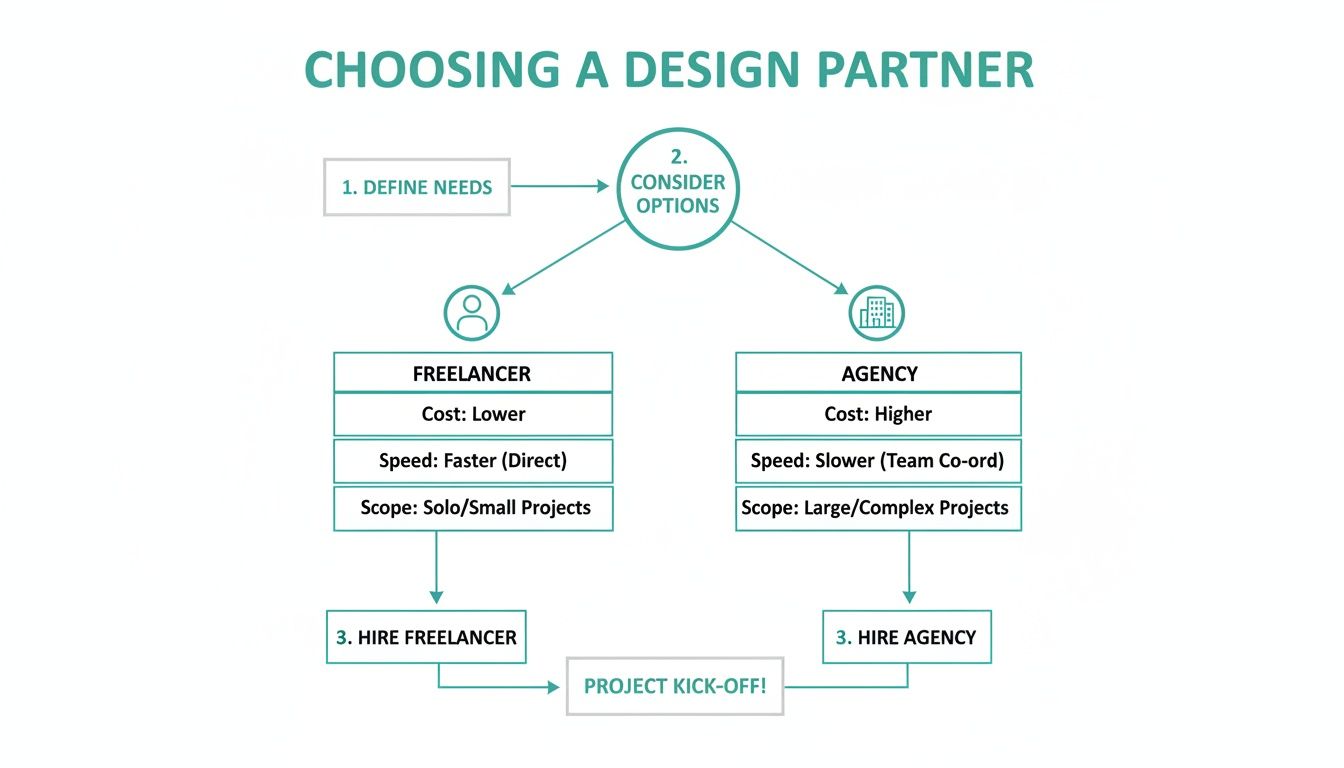
The chart highlights that whether you choose a freelancer for flexibility or an agency for a broader skillset, the initial discovery and briefing stages are crucial for both paths.
Once a direction is chosen, it’s all about refinement. The designer will meticulously tweak the colours, perfect the typography, and ensure every line and curve is just right. This stage might involve a few more rounds of minor adjustments until it’s absolutely perfect.
Finally, with your enthusiastic approval, the designer prepares your logo package. This isn’t just one file; it's a whole suite of them for every possible use you can think of. Consider it the final handover, where you get the keys to your brand-new visual identity.
You’ve signed off on the final design—fantastic! But honestly, the job isn't quite done until you have the correct files sitting safely in your inbox. This might sound a bit technical and maybe a little boring, but getting it right now saves you from massive headaches later.
Getting the wrong files is like being given a car key that only opens the boot. You need the full set to actually go anywhere. We’ll break down the essential file formats you need and explain what they’re for in plain English.
The most important distinction to get your head around is the difference between vector and raster files. It's the one thing that will pop up again and again, whether you're talking to a printer in Christchurch or a web developer in Auckland.
Think of a vector file like a recipe. It's a set of mathematical instructions that can be scaled up or down infinitely without losing any quality. Need your logo on a huge billboard? No problem. Need it embroidered on a tiny polo shirt? Easy. Vector files are your master key.
On the other hand, a raster file is like a photograph. It's made up of tiny little dots, or pixels. Stretch it too far, and it becomes blurry and pixelated—not a good look. These are perfect for digital use, like on your website or social media, where their size is fixed.
A good designer will always provide you with a full suite of both vector and raster files. If they don't, you need to ask why. This is a non-negotiable part of any professional logo design NZ project.
So, what specific files should you be looking for in that final handover folder? Here’s a quick cheat sheet so you know exactly what to expect from your designer. You should receive your logo in these core formats:
Beyond just the file types, practical artwork submission tips can help you prepare your logo for various uses, ensuring it looks perfect every single time.
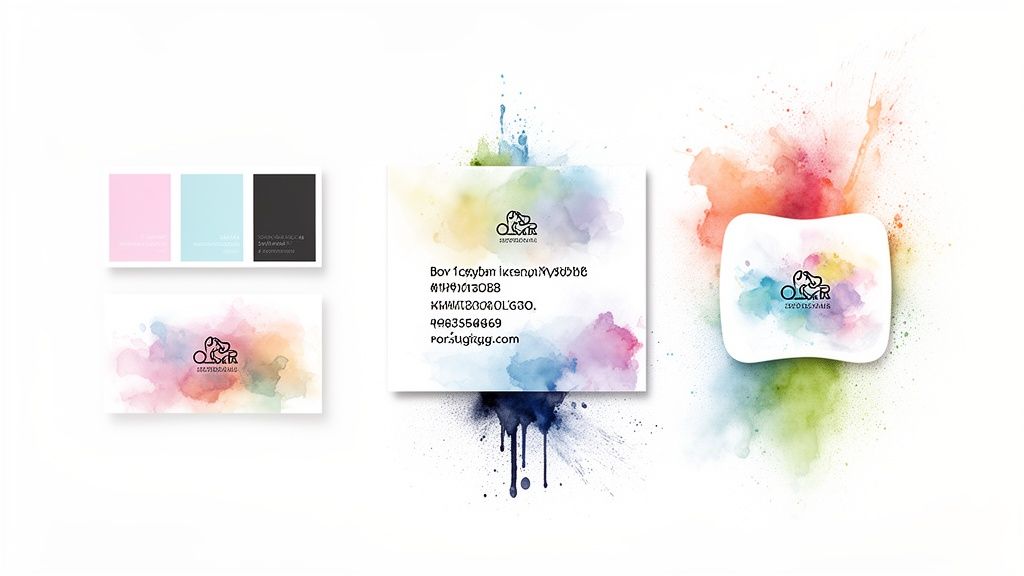
Here’s something you need to get your head around: a brilliant logo is just the beginning. It might be the star player, but it can’t win the game on its own. To really make an impact, you need the whole team, and that’s where your full brand identity comes in.
Think about it this way—your brand identity is the complete look, feel, and voice of your business. It’s the reason a well-known Kiwi brand feels instantly familiar, whether you see their logo on a ute, an invoice, or an Instagram story.
At its core, it’s all about creating a consistent and memorable experience for your customers. This consistency is absolutely essential for building trust and recognition. So, what are we actually talking about here? A few key ingredients:
This cohesive system tells a compelling story about who you are and what you stand for. It’s what turns a simple logo into a living, breathing personality that people actually connect with. A logo is a mark; a brand is a feeling.
Once you’ve got these elements sorted, you can apply them to everything you do. Knowing how your logo and brand colours work across different items is a game-changer. For example, learning the ins and outs of putting your logo on notebooks for stand-out branding can give your brand a tangible presence that people can touch and feel.
This entire ecosystem is what separates a fleeting business from a memorable brand. It’s the strategic thinking behind every successful logo design NZ project and a cornerstone of any decent digital marketing strategy in NZ. It’s how you make sure your business doesn’t just look good, but feels right.
Got a few more questions rattling around in your head? You're not alone. When Kiwi business owners start thinking about a new logo, the same sorts of queries tend to pop up. Let’s tackle some of the most common ones head-on so you can move forward with confidence.
It’s completely normal to want to get all your ducks in a row before diving in. After all, your logo is a big deal for your business.
That’s a classic "how long is a piece of string?" question, but I can give you a pretty good ballpark. A typical logo design NZ project takes anywhere from 2 to 6 weeks from start to finish. A simple logo from a freelancer might land on the quicker end of that scale.
But if you’re going for a full brand identity package from an agency, it’ll naturally take longer. That’s because it involves a lot more deep-dive research and strategy. The timeline also really depends on you—how quickly you give clear, decisive feedback at each stage is a huge factor in keeping things moving.
While it’s not something you have to do right away, trademarking your logo is a very smart move, especially if you have big plans for your business. Think of it as putting a legal lock on your most valuable visual asset.
A trademark gives you exclusive rights to use your logo for your specific goods and services in New Zealand. This is what protects you from copycats and stops customers from getting confused down the line. The process involves an application through the Intellectual Property Office of New Zealand (IPONZ), and it's a good idea to chat with a legal pro to make sure it’s all done correctly.
A logo is a visual mark that identifies your business. Your brand, on the other hand, is the entire experience and perception people have of your company. Your logo is a critical part, but the brand is the whole story.
This is such a great question because people use the two terms interchangeably all the time, but they’re fundamentally different things.
Your logo is the symbol—the graphic shortcut that people use to recognise you in an instant. It's the Nike swoosh or the golden arches. It’s a visual handshake.
Your brand? That’s the entire gut feeling people have about your business. It's your reputation, your customer service, the way you answer the phone, your values, and your visual style all rolled into one. Your logo is the star player, but your brand is the entire team, the stadium, and the fans.
Ready to create a logo that truly represents your Kiwi business? The team at NZ Apps specialises in creating strategic, memorable brand identities that set you up for success. Let's have a chat about your vision today.