
An Auckland SaaS founder opens a forecast from the finance team, then a message from an investor. A competitor has launched “AI-powered” retention features, and the product team wants a churn model before the next board meeting. Engineering runway is tight. Customer data is scattered across billing, support and product systems. Nobody can quite explain what the model should do when it gets a prediction wrong.
That's a familiar pressure point. Machine learning applications can improve a product, but they can also become an expensive side project with no clear owner, weak data and a demo that never reaches production. The useful question isn't whether your company should “do AI”. It's whether a specific decision, workflow or customer problem is suited to learning from data.
The local signal is no longer a handful of curious experiments. MBIE's AI strategy records that 67% of larger New Zealand businesses used some form of AI in 2024, up from 48% in 2023, while 68% of SMEs reported no plans to evaluate or invest in AI (MBIE's AI strategy). That split matters. Enterprise teams are moving models into workflows, while many smaller firms are still deciding whether the effort is worth the bother.
The same material identifies lack of expertise as the main barrier for 43% of non-users (MBIE's strategy and adoption discussion). For a founder, that changes the buying decision. The hard part may not be finding a model. It may be cleaning the data, setting a sensible success measure, giving a product manager enough control, and keeping the feature safe when the input changes.
A two-person team can now call a hosted model, build a prediction service or add a ranking layer without forming a research department. That makes experimentation easier, not production automatically successful. The jump from a working notebook to a dependable customer feature still needs data access, monitoring, privacy review and a rollback path.
New Zealand also has deeper technical roots than the latest chatbot cycle suggests. The University of Waikato released WEKA in 1996, and MBIE says it remains in use and has been cited in more than 25,000 research and science publications (MBIE on New Zealand's science and innovation system). The country isn't starting from scratch.
Practical rule: Treat ML as a product and operations decision. Start with the decision being improved, not the model being advertised.
That's the thread running through this guide. What data can you use? What happens when the prediction is wrong? Does the feature reduce cost, improve retention or shorten a queue? And can the team support it after launch, when the first tidy dataset becomes a messy stream of real customer behaviour?
Machine learning is software that finds patterns in examples and uses those patterns to make a prediction or choose an action. Traditional rules say, “if this happens, do that.” A model says, “given these signals, this outcome is more likely.” That distinction sounds small, but it affects testing, ownership and risk.
Supervised learning uses examples with known answers. A Wellington accounting product might train on labelled invoices, where each record has a category such as rent, software or travel. The model learns from past labels, then suggests a category for a new invoice.
Unsupervised learning looks for structure without a supplied answer. A Christchurch retailer could group support tickets by language or topic, revealing that delivery delays, damaged goods and account access need different service paths.
Reinforcement learning learns through feedback from actions. An NZ on-demand app might test how different recommendation policies affect completed bookings, then give more weight to choices that lead to useful customer outcomes. That setup needs careful guardrails, because a short-term click can be a poor long-term result.
The training loop usually follows a practical sequence:
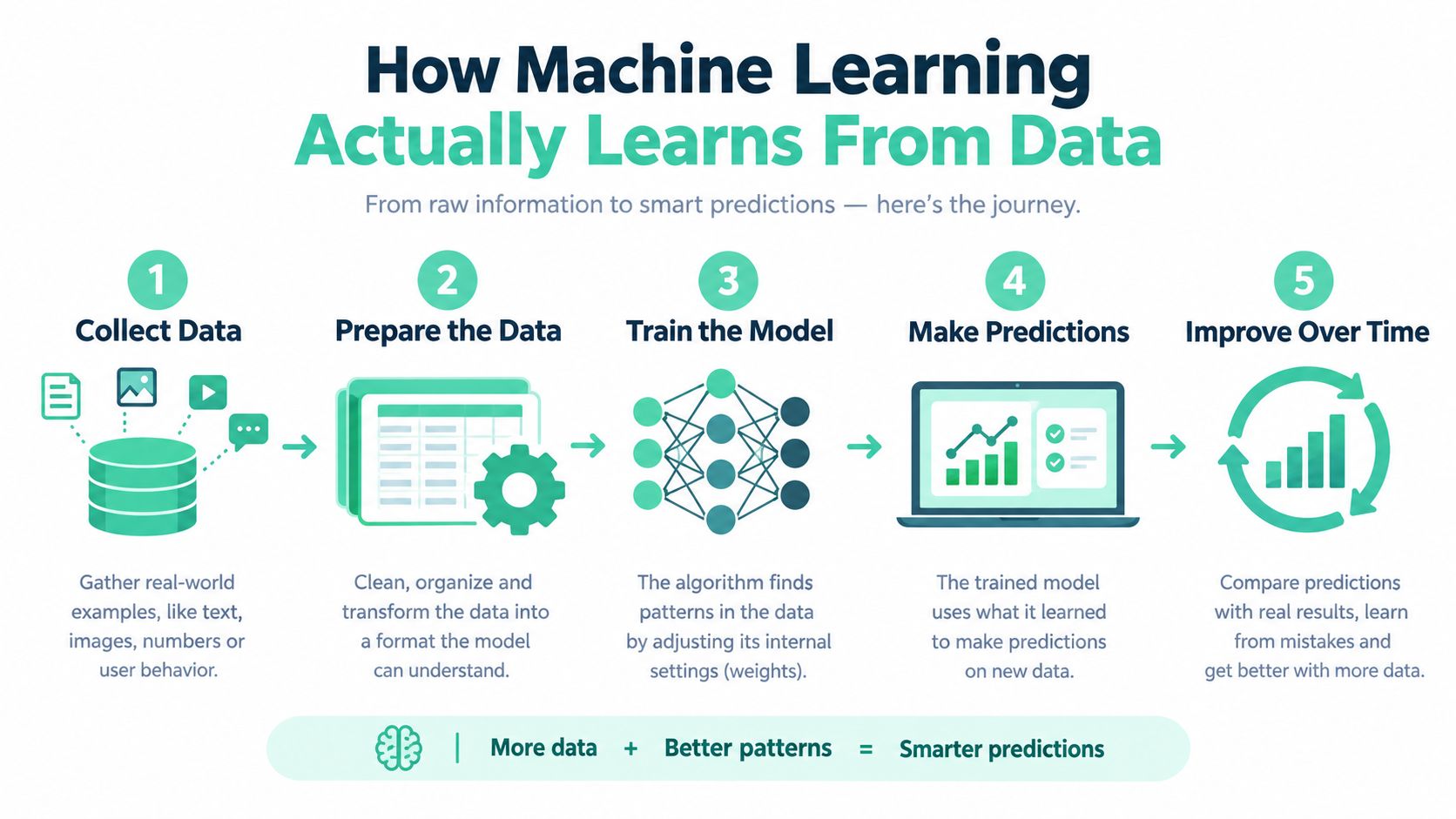
A churn classifier, fraud score or demand forecast usually produces a structured output. Generative AI creates text, images, code or other content. The systems can work together, but they have different failure modes. A forecast can drift as buying patterns change. A language model can produce a confident answer that isn't supported by the source data.
A problem is a good ML candidate when you have repeated examples, a measurable outcome and some tolerance for wrong answers. If every case follows a stable rule, ordinary software will be cheaper and easier to audit. If you can't define the outcome, the model has nothing useful to learn.
The most visible AI features are chatbots and copilots. The most durable machine learning applications often sit behind the screen: scoring a lead, ranking a search result, detecting an odd transaction or estimating demand. These jobs suit models because people struggle to review large volumes of similar records with consistent attention.
An AI Forum New Zealand report found AI uptake at 82% across surveyed organisations, with the highest use in transport, postal and warehousing, information, media and telecommunications, and public administration (AI Forum New Zealand's AI in Action report). The number should be read with care. “Using AI” can cover a production model, a controlled trial or a narrow internal tool. Adoption breadth doesn't prove operational depth.
SaaS teams use classification, lead scoring, search ranking, support routing and churn risk signals. In accounting software, coding suggestions and reconciliation help reduce repetitive review. In customer platforms, the valuable output is often a prioritised queue, not a flashy conversation.
Fintech uses anomaly detection, transaction categorisation, identity checks and credit-risk modelling. The trade-off is sharp. Missing suspicious activity is costly, but flagging too many legitimate payments creates customer friction and manual work.
Healthtech applies models to imaging, triage and risk estimation. The model can help clinicians focus attention, but it shouldn't hide uncertainty. Clinical workflows need clear escalation paths, traceable inputs and human review.
Edtech uses adaptive practice and learner-risk signals. Personalisation helps when the system sees enough meaningful work. It becomes noise when a learner has too little history or when the platform confuses fast completion with understanding.
Ecommerce relies on demand forecasting, product recommendations, search ranking, stock planning and fraud checks. These systems can improve the shopping path, but stale catalogue data and stock availability can undo a clever model in a hurry.
| Vertical | Common ML applications | Local examples | Adoption depth |
|---|---|---|---|
| SaaS | Coding suggestions, search, lead scoring, churn signals | Xero and local business software teams | Quietly embedded in workflows |
| Fintech | Fraud detection, anomaly scoring, categorisation | Airwallex and Australian banking products | Operational, with high governance needs |
| Healthtech | Imaging, triage, risk estimation | Harrison.ai and regional health platforms | Production in selected clinical settings |
| Edtech | Adaptive practice, learner classification | Noonga and similar learning products | Mixed, often dependent on data quality |
| Ecommerce | Forecasting, recommendations, ranking | Kmart and The Warehouse | Strongest where transaction and stock data are rich |
For a wider look at how local firms apply automation and ML, the NZ Apps guide to AI in business automation is a useful companion. The pattern is consistent: quiet ML tends to survive when it improves an existing queue, forecast or review process. Headline features need a clear reason to exist.
The strongest regional examples don't begin with “we added AI”. They begin with a narrow operational problem, a defined data stream and a human team that knows what to do with the output.
Xero applies ML to accounting workflows such as bank reconciliation, coding suggestions and cash-flow forecasting. The relevant inputs include transaction history, invoice information, payment behaviour and account context. The product outcome is not a prediction for its own sake. It helps small businesses and advisers spend less time sorting routine records and more time reviewing exceptions.
Orion Health, founded in Christchurch, uses predictive models in population-health software. Health systems can combine patient records and clinical signals to identify risk patterns across a population. The important lesson is deployment context. A model may support planning and prioritisation across health services, but sensitive data and clinical accountability still sit around the prediction.
Airwallex and Australian financial institutions show why transaction anomaly detection is a practical ML application. Payment amount, merchant context, timing, account behaviour and device signals can help flag activity for further review. The model doesn't prove fraud. It ranks risk, and the operations team decides how to respond.
New Zealand public agencies provide unusually clear examples of decision support. The Ministry of Social Development uses a machine-learning algorithm to identify young people at risk of long-term unemployment and target support. Inland Revenue says its algorithms work across large datasets for advanced analytics, decision support, predictive modelling and compliance-risk intervention design (the government algorithm assessment report). These applications direct scarce human attention, which is useful, but they also require explainability, bias checks and privacy controls.
| Company | Sector | ML application | Data inputs | Reported outcome |
|---|---|---|---|---|
| Xero | SaaS and accounting | Reconciliation, coding suggestions, cash-flow forecasting | Transactions, invoices, payment behaviour and account context | Less routine review and better visibility of likely cash movement |
| Orion Health | Healthtech | Population-health prediction | Patient and clinical records | Helps health systems identify patterns and prioritise attention |
| Airwallex | Fintech | Transaction anomaly detection | Payment, merchant, timing, account and device signals | Surfaces unusual activity for operational review |
| Ministry of Social Development | Public sector | Long-term unemployment risk identification | Social-service and client data | Supports targeted intervention and resource prioritisation |
A useful caution sits underneath all four. The model doesn't deliver the outcome alone. A good queue, clear escalation rule and capable staff member turn a score into a service improvement. Without that surrounding workflow, ML is a dashboard ornament.
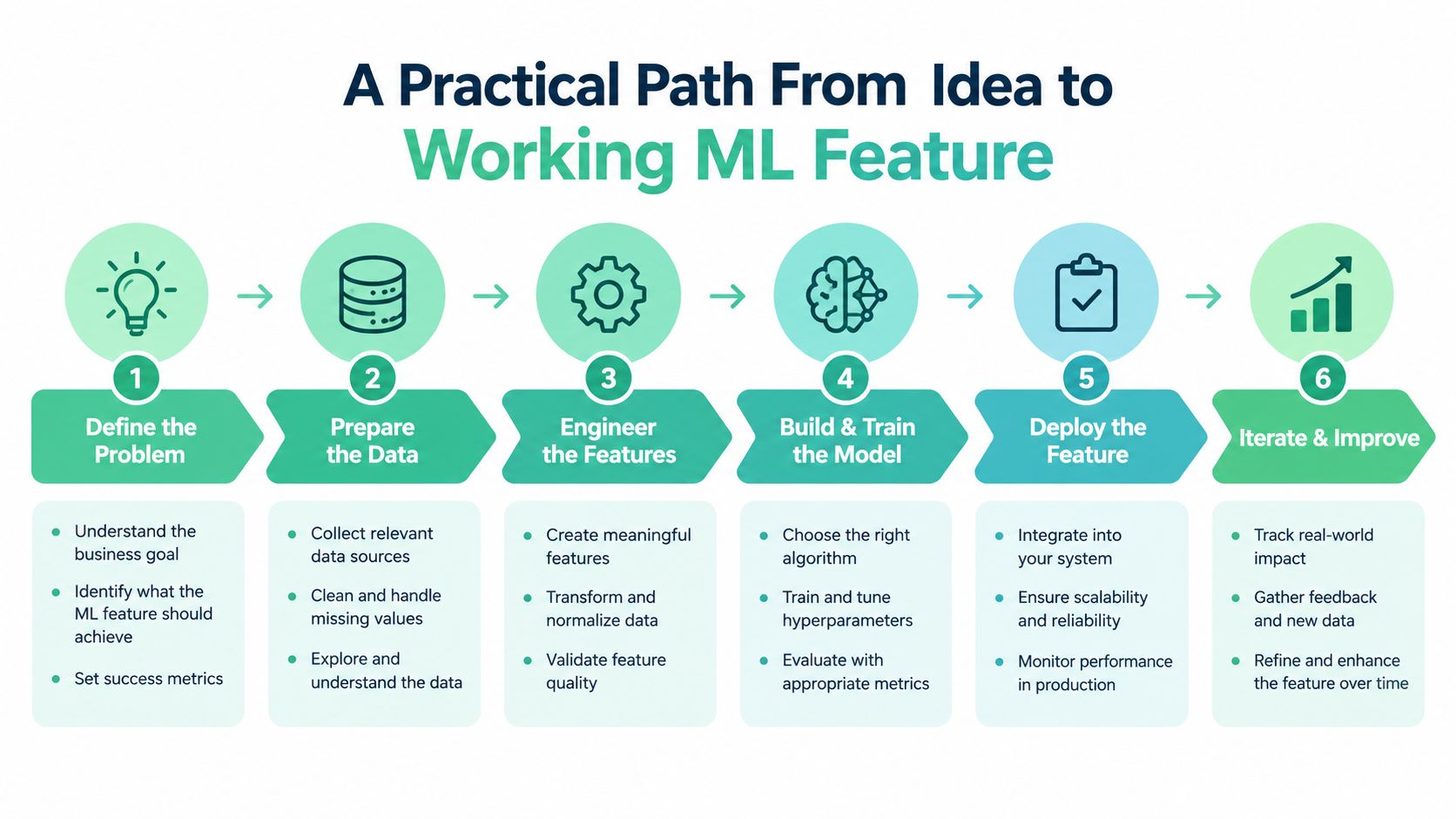
Small teams get into trouble when they start by choosing a model. Begin with the business question, then work towards the least complex system that can answer it.
Define the decision. “Predict churn” is too broad. Ask whether the customer success team needs a weekly list of accounts that may need help, and what action follows each score.
Audit the data. Check volume, quality, labels, access rights, missing fields and time coverage. Look for leakage, where the training data contains information that wouldn't exist at prediction time. Many NZ pilots die, not during model fitting.
Choose the lightest suitable tool. A hosted API from OpenAI or a managed service in Google Vertex AI may suit text and classification work. AWS SageMaker JumpStart can shorten model selection. For a structured prediction problem, scikit-learn is often enough. PyTorch makes sense when the team has a genuine need for custom deep learning and the skills to operate it.
Build a baseline. Compare the model with a rule, a simple score or the current manual process. If the model can't beat that baseline on a business-relevant measure, stop or change the problem.
Ship with control. Put the feature behind a flag, log inputs and outputs, monitor drift, and keep a rollback path. A prediction that changes customer treatment is not a finished feature.
A two-person Auckland SaaS team probably shouldn't train a bespoke transformer. It can call a hosted API and place a guardrail layer around it, with input checks, output validation, rate limits and human review. The trade-off is vendor dependence, data handling and recurring inference cost.
A custom scikit-learn model may be the better route when the data is structured, the prediction is narrow and explainability matters. PyTorch can offer more control, but control brings maintenance. Keep the first release boring. Boring systems tend to get monitored.
Shipping an ML feature doesn't create value by itself. New Zealand's adoption data shows the tension clearly: a 2025 NZ State of AI Index found 87% of organisations using some form of AI, but only 12% had rolled it out across their entire business, with skills shortages, data integration and shadow AI among the barriers (Datacom's 2025 State of AI Index). A pilot can look impressive while the operating model remains unfinished.
Suppose a Christchurch SaaS team builds churn prediction. Customer success staff already contact the same accounts because they know the product and the customers. The model adds hosting, monitoring and review time, but churn doesn't fall. That's not a modelling failure alone. It's a failure to change the decision around the score.
For ecommerce, test whether recommendations change useful behaviour, not merely clicks. For fraud, measure manual review hours and false positives alongside prevented loss. For a support classifier, track routing accuracy, resolution time and the cost of correcting bad routes.
| ML use case | Business KPI | Model metric | Watch-out |
|---|---|---|---|
| Churn prediction | Retention and useful interventions | Precision, recall and calibration | Staff may already target the same customers |
| Recommendations | Conversion, margin or attributable revenue | Ranking quality and measured lift | Clicks can rise without profitable sales |
| Fraud detection | Prevented loss and review workload | False-positive and false-negative rates | Excessive blocking harms trust |
| Support routing | Resolution time and queue balance | Classification accuracy | Labels may reflect old team habits |
| Forecasting | Stock availability and waste | Forecast error by product and period | Demand shifts can break historical patterns |
Track inference cost per 1,000 predictions, latency and the staff time needed to review results. A feature that raises gross revenue but consumes more contribution margin may not be a win. The NZ Apps ROI calculation guide can help frame the wider business case, but the product team still needs a controlled test.
ML deserves the same cost accounting and experiment discipline as any other product change.
The useful contrast is an ecommerce recommendation system where attributable revenue and customer behaviour move together. That case earns further investment. Founders who treat ML as an engineering investment, rather than a magic layer, are more likely to keep the feature after the launch glow fades.
New Zealand's light-touch, principles-based approach doesn't mean a founder can feed customer data into a model and hope nobody asks questions. MBIE says existing privacy, consumer-protection and human-rights frameworks are technology-neutral and broadly applicable to AI (MBIE on barriers to AI uptake). The obligation often appears through an ordinary privacy, consumer or sector rule.
| Regime | Scope | ML-specific obligation |
|---|---|---|
| Privacy Act 2020 | Personal information across organisations | Define purpose, control access, document data lineage and assess the model's handling of personal information |
| Health Information Privacy Code | Health information and health services | Apply tighter controls to clinical data, access, retention and disclosure |
| Consumer credit obligations under the CCCFA | Lending and credit decisions | Make sure automated assessment doesn't create unfair or unexplained treatment |
| Algorithm Charter for Aotearoa New Zealand | Government algorithm use | Support transparency, accountability, human oversight and public confidence |
A practical review should cover training-data provenance, a Privacy Impact Assessment, cross-border transfers and vendor terms. Australian and US hosting regions may be commercially convenient, but the team still needs to know where data travels and who can access it. Keep decision logs so an internal reviewer can reconstruct what happened.
For health, credit and public services, bias is both a legal and reputational concern. Models can treat Māori, Pasifika and other groups unfairly when historical data reflects unequal access or past decisions. Treaty-grounded expectations make cultural competence part of responsible delivery, not a late communications exercise. The NZ Apps overview of the Privacy Act provides a starting point for the wider privacy conversation.
Winning a government contract can turn voluntary commitments into commercial requirements. A buyer may ask for audit evidence, explainability, retention controls and incident procedures even where a particular checklist isn't directly mandated by statute. That's sensible procurement, not red tape for its own sake.
Use this as a go or no-go screen before assigning engineers.
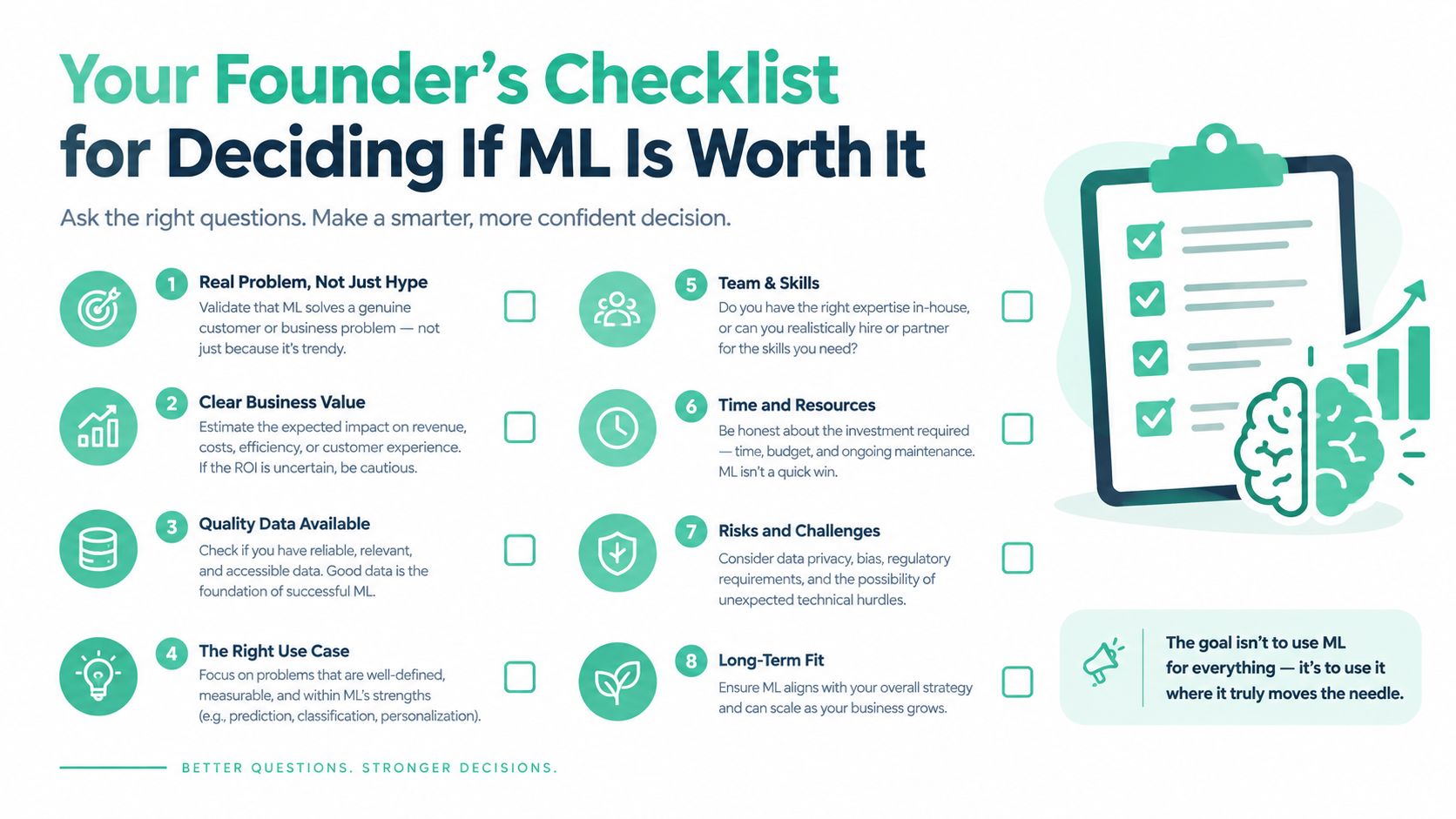
The wrong tool is often obvious once the glamour is removed. Tiny datasets, stable rules and workflows already handled well by affordable SaaS rarely need a custom model. So ask the blunt question: will this prediction change a decision enough to pay for its data, engineering and oversight? If the answer is vague, keep the rule, improve the workflow or wait for better evidence.
NZ Apps covers the tools, companies and practical technology choices shaping the New Zealand and Australian market, including machine learning applications for automation, analytics and forecasting. Visit NZ Apps to compare regional software options, research local providers and find a more grounded starting point for your next product decision.
Add your NZ or Australian app or tech company to the NZ Apps directory and get discovered by founders and operators across the region.
Get ListedReach tech decision-makers across New Zealand and Australia. Sponsored and dofollow editorial links, permanent featured listings, and sponsored articles on a DA30+ .co.nz domain.
See Options