
That lightbulb moment hits—a killer app idea. It feels huge, right? But turning a concept into a functioning app for customers in Auckland or Wellington is a whole different ball game. Before you even start looking for mobile app developers, you’ve got to get your foundation sorted first.
It’s easy to get swept up in the excitement. Honestly, who wouldn’t? You’ve pictured the logo, the colours, and maybe even how the splash screen will animate. But let's pump the brakes for a second. Before we even think about writing a single line of code, we need to get the most important part crystal clear.
It has nothing to do with technology. It's all about your 'why'.
Why does this app actually need to exist?
Is it going to solve a genuine, nagging problem for your customers? Or is it an internal tool designed to make your operations run smoother than a freshly paved road? Perhaps it’s a bold move to tap into a completely new market. Nailing this part is everything.
Okay, so you’ve got your 'why'. Now, let's talk about 'who'. Who are you building this for? And please, don't say "everyone." That's a trap many businesses fall into. A truly successful app speaks directly to a specific group of people with a specific need. It feels personal.
Think about your ideal user. What does their day look like? What are their biggest frustrations? How will your app slide into their life and become something they can't imagine living without?
This isn't just marketing fluff; it's the core of building something people will actually download and keep. This process, often called human-centred design, is all about putting the user at the heart of every single decision you make.
The difference between a good app and a great one often comes down to this: a great app feels like it was made just for you. It anticipates your needs and solves your problems effortlessly.
With your 'why' and 'who' sorted, it's time to think about the 'what'. What will your app actually do?
The big temptation here is to create a wish list with fifty different features. You need to resist that urge. For your first version, the focus must be on the absolute essentials—the core functionality that delivers on your main promise.
This is what we in the industry call a Minimum Viable Product (MVP). It’s not about building a stripped-down, cheap version of your idea. It’s about building the right version—the one that solves the main problem efficiently and gets you valuable feedback from real users, fast.
Let's break down what that could look like:
Nailing this part—the idea, the audience, the core features—puts you way ahead of the game. It transforms your idea from a vague concept into a tangible plan. Once you've solidified your app idea, understanding the principles for building mobile apps is essential to guide your development efforts. It gives your future mobile app developers a clear roadmap to follow, which saves you an enormous amount of time, money, and headaches down the line.
Right, you've got your brilliant app idea sorted. Now comes the big question: who's actually going to build this thing? This is a massive fork in the road for any Kiwi business, and getting it right can genuinely make or break your entire project before a single line of code is written. It's the classic showdown between three very different ways of getting your app built.
Freelancers offer incredible flexibility, no doubt about it. They’re often more budget-friendly for specific, well-defined tasks, and you can find a specialist for almost any tech you can imagine. For a small proof-of-concept or a Minimum Viable Product (MVP), a great freelancer can feel like a secret weapon.
But you have to think long-term. What happens six months down the track when a critical bug pops up? Or when Apple releases a new iOS version that breaks your login screen? Is your freelancer still going to be available? It can feel like a bit of a gamble, as you're totally reliant on one person's skills, time management, and continued availability.
Hiring your own developers means you're building a permanent asset. Your team becomes deeply embedded in your business goals and can react quickly as your strategy evolves. That kind of dedicated focus is powerful, especially if this app is central to your company's future.
The flip side? It’s a hefty commitment, and not just in salary. You’re on the hook for everything: training, high-spec equipment, office space, and all the overheads that come with a full-time employee. Plus, finding and attracting top developer talent in New Zealand's competitive tech market is a real challenge.
And that brings us to the third path: partnering with a dedicated app development agency. Think of an agency as the whole package, ready to go from day one. You don't just get a coder; you get an entire, well-oiled machine.
This typically includes:
An agency brings a battle-tested process to the table. They’ve seen what works (and what bombs) across dozens of projects. They can guide your idea from a rough sketch on a napkin all the way to a polished product on the App Store and Google Play.
Here’s the thing many people miss: choosing an agency isn’t just about outsourcing the work. It’s about importing a massive amount of experience and a structured system directly into your business, instantly.
This kind of structure is especially valuable in New Zealand's booming tech scene. The local IT services market, which is the engine behind all this app development, is projected to hit $4.12 billion in revenue by 2025. It's a robust ecosystem where specialised firms are delivering incredible results for Kiwi businesses. You can explore more about New Zealand's mobile development market on TechBehemoths.com to see the calibre of agencies out there.
To help you decide, here’s a quick comparison of your options.
| Factor | In-House Team | Freelancer | Agency |
|---|---|---|---|
| Cost | Highest (salaries, benefits, overheads) | Lowest (for short-term tasks) | Medium (upfront project cost) |
| Control | Full control over the team and process. | High control over the specific task. | Collaborative control; you guide the vision. |
| Expertise | Limited to who you can hire. | Highly specialised in one area. | Broad team: design, development, QA, strategy. |
| Speed | Slowest to assemble the team. | Fast to start on a small, defined task. | Fastest to start a full project. |
| Scalability | Difficult and slow to scale up or down. | Flexible but limited to one person's capacity. | Easy to scale resources as needed. |
| Risk | High initial investment and long-term cost. | Risk of unavailability or single point of failure. | Lower risk due to team structure and contracts. |
Ultimately, the right choice for you depends on your specific situation.
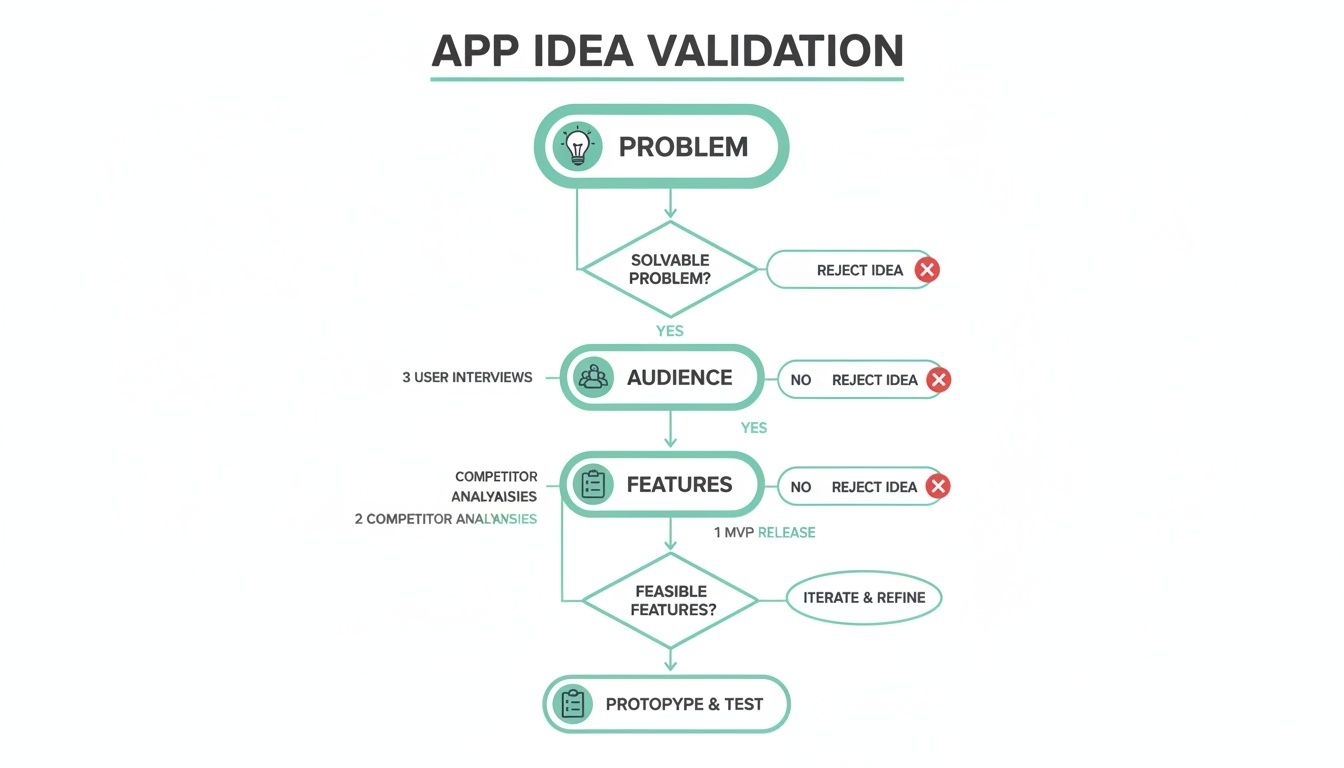
This process shows that having a clear problem, a defined audience, and essential features locked in are the non-negotiable first steps, regardless of who you end up hiring to build it.
So, what’s the right call? A scrappy startup on a tight budget might lean towards a freelancer for an MVP. An established company building a mission-critical tool might invest in an in-house team. But for many Kiwi SMBs, an agency offers the perfect balance of world-class expertise, security, and flexibility. It's the whole team, without the long-term overhead.
Alright, let's get straight to the point and talk about the elephant in the room: money. How much is this app actually going to set you back?
The honest, slightly annoying answer is… it depends. But that’s not very helpful, is it? Let's ditch the vague talk and get into some real-world numbers for the New Zealand market.
Thinking about your app's cost is a lot like planning to build a house. A simple one-bedroom bach has a very different price tag than a multi-level architectural home with a pool and home automation. They’re both houses, but the complexity and features dictate the final bill. Apps are exactly the same.
A simple user login screen is one thing; integrating a secure payment gateway like Stripe or Windcave is another kettle of fish entirely. Every button, every screen, and every piece of data has a cost attached.

You need a starting point—a rough idea of what to budget. From what we're seeing in the local market, a simple app will likely cost between NZD $25,000 to $45,000 and take about two to three months to build.
Got bigger plans? A more complex app with custom features like AI integrations or augmented reality can easily climb to NZD $90,000 to $200,000+, with a timeline stretching from six months to a year. For context, local Kiwi agencies typically charge between NZD $90 and $160 per hour.
A popular middle ground for many NZ businesses is a cross-platform app. Because they work on both iOS and Android from a single codebase, they're a huge cost-saver. These projects often fall in the NZD $40,000 to $120,000 range. For a deeper dive into the numbers, our comprehensive guide on app development costs in NZ breaks it down even further.
It's not just about the number of features you list on a document. It's the complexity behind those features that really moves the needle on the price.
Here’s what I mean:
While our focus is on New Zealand, you can get a broader perspective on the financial side of things in this article which gives a detailed breakdown of mobile app development costs.
Here's the bit that catches so many people out. The cost of hiring mobile app developers to build your app is just the beginning. An app isn't a one-off purchase; it's an ongoing commitment.
An app is like a garden. You can’t just plant the seeds and walk away. It needs constant watering, weeding, and attention to thrive. Forgetting this is the fastest way to a dead garden—or a dead app.
You need to factor these ongoing expenses into your budget from day one:
The goal here is total transparency. Walking into a conversation armed with a realistic budget saves everyone from nasty surprises down the line.
Alright, you’ve got your plan mapped out and a sensible budget ready to go. That’s fantastic. Now for the really interesting bit: where do you actually find these talented Kiwi mobile app developers?
The tech scene here in New Zealand is definitely buzzing, especially in hubs like Auckland and Christchurch. But let's be real—it’s a small pond. This can actually work massively in your favour. You’re not just another name in a global queue; you're looking for a partner in a community where reputation and personal connection still mean a lot.
Finding a list of potential developers is one thing. Figuring out if they're the right partner for you? That's the real art.
You can forget about just scrolling through endless, generic online directories. The best fits are often found in places where a genuine passion for tech is on full display. It’s less about casting a massive net and more about fishing in the right spots.
Here’s where I’d start looking:
It's a surprisingly focused ecosystem. New Zealand has a vibrant but pretty niche developer community, with exactly 563 Kiwi developers actively publishing on Google Play. It might sound small—less than 1% of the global total—but it shows how our local talent really punches above its weight. You can see more insights about New Zealand's developer community on 42matters.com.
So, you've shortlisted a few promising candidates. Their portfolios look slick and their past projects seem impressive. Time to hire one? Not so fast. A polished portfolio proves they can build something that looks good. What you really need to find out is if they can build something that works flawlessly and if they’re the kind of people you can count on when unexpected challenges pop up.
Because, trust me, they always do.
You know what I’ve found? The most important skills aren't even the technical ones. They're communication and problem-solving.
A developer who can write a complex algorithm is great. But a developer who can explain that algorithm to you in plain English, really listen to your feedback, and then work with you to make it better? That's a game-changer.
Instead of just drilling them on their favourite coding languages, try throwing in a few questions that reveal how they think, communicate, and handle pressure. These often tell you far more than a technical test ever could.
Here are a few of my go-tos:
"Tell me about a project that went off the rails. What happened, and what did you learn from it?"
This isn't a trap. You’re looking for honesty, a sense of accountability, and the ability to learn from setbacks. A developer who immediately blames the client or makes excuses is a giant red flag.
"How would you explain a complex technical issue to someone with zero tech background?"
This one is massive. If they can’t break down complicated ideas into simple terms, you’re in for a world of communication headaches. You need a partner, not a technician who speaks in jargon.
"What’s your process for handling user feedback and bugs after an app goes live?"
This tells you if they see the bigger picture. A great developer knows that launch day is just the starting line. They should have a clear plan for gathering feedback, squashing bugs, and rolling out future updates.
Finding the right mobile app development partner in NZ is one of the most critical decisions you'll make, and our team has helped countless businesses navigate this exact process. You can learn more about our approach to mobile app development in New Zealand to get a feel for how a structured, collaborative partnership should work.
At the end of the day, this vetting process is about finding a true collaborator. You're not just hiring someone to type code; you're investing in a relationship that will bring your entire vision to life. Take your time, ask smart questions, and always trust your gut.
Getting your app onto the Apple App Store and Google Play feels like crossing the finish line, doesn't it? After months of planning, designing, and building, seeing it live is a massive achievement.
But here’s the thing I’ve seen time and time again—it's actually the starting line.
An app isn't a one-and-done project. It’s a living, breathing product that needs continuous care to stay relevant, functional, and secure. Honestly, the real work is just beginning.
Think of your app like a new car. It runs beautifully off the lot, but you wouldn't drive it for years without an oil change or a Warrant of Fitness, would you? Your app needs the same kind of routine check-up to keep performing at its best.
Every year, Apple and Google release major updates to iOS and Android. These aren't just cosmetic changes; they often introduce new security protocols, hardware compatibilities, and API requirements. An app that isn't updated can quickly start to feel clunky, slow, or worse—it might just stop working altogether on newer devices.
This is where a reliable maintenance plan with your mobile app developers becomes non-negotiable. Regular updates are the digital equivalent of that essential tune-up, handling things like:
This ongoing work is the foundation of your app's long-term health. Without it, even the most brilliant app idea will eventually fade into obscurity.
Maintenance isn't just about fixing what's broken. It's about listening, learning, and evolving.
Once your app is in the hands of real Kiwi users, you’re going to get feedback—the good, the bad, and the brilliant. This feedback is absolute gold. You've got to have a system for collecting and analysing it, whether it's through in-app forms, App Store reviews, or direct emails.
That one user who suggests a small tweak to the checkout process? They might have just identified a point of friction that’s costing you sales. Every comment is a clue telling you what to build next.
Your first users are not just customers; they are your co-creators. They are showing you, for free, exactly how to make your product better. Ignoring them is one of the biggest mistakes you can make.
This stream of user insight is what helps you build a feature roadmap. It's a living document that outlines what you'll build over the next six to twelve months, prioritised by what will deliver the most value. It stops you from guessing and starts you building what people actually want.
Finally, let's talk about growth. It's the best kind of problem to have. What happens when you go from 100 users to 10,000? Or 100,000?
Suddenly, your app's backend infrastructure—the servers and databases working hard behind the scenes—is under a lot more stress. Will it hold up, or will your app crash right when it's going viral?
This is a conversation to have with your mobile app developers before you hit that growth spurt. A good team will have built your app with growth in mind from day one, choosing a server architecture that can handle spikes in traffic without breaking a sweat. It’s all about creating a long-term strategy that ensures your app's success doesn't become its downfall.
Look, talking about app development can feel like you're trying to learn a new language. There's a lot of jargon and plenty of twists and turns you don't see coming. We've been doing this for years, and we've heard just about every question from Kiwi business owners like you.
So, let's cut through the noise. Here are the most common questions we get, with clear, straight-up answers.
This is a big one, and it sets the foundation for your whole project.
Think of a native app like a suit custom-tailored by a master tailor. It's built specifically for one platform—either an iPhone (iOS) or an Android device. Because it's written in the device's own language (like Swift for iOS), it's incredibly fast, responsive, and feels completely seamless to the user. It’s the top-shelf option.
A hybrid app, on the other hand, is like a high-end, all-weather jacket from Macpac. It's built once using more universal web technologies (like React Native or Flutter) and then packaged to work beautifully on both iOS and Android. The massive advantage? You're not paying to build and maintain two separate apps. This saves a huge amount of time and budget, which is why it's such a popular choice for Kiwi SMBs.
This is the classic "how long is a piece of string?" question, but we can give you a realistic ballpark. It all hinges on complexity.
A straightforward Minimum Viable Product (MVP) with just the core, essential features could be up and running in as little as 2-4 months. But if your vision is bigger—maybe an app that integrates with other software, processes payments, or has a completely custom design—you're more likely looking at 6-12 months, sometimes even longer.
And remember, that timeline isn't just coding. It covers the crucial groundwork:
Short answer: yes. Absolutely, 100%. You could build the most brilliant app in New Zealand, but if no one can find it on the App Store or Google Play, it's a bit like a tree falling in the forest.
App Store Optimisation (ASO) is essentially SEO for your app. It’s the process of making your app more visible in store search results, which is where most users discover new apps.
This involves choosing the right keywords for your app’s name and description, creating compelling screenshots, and encouraging those all-important positive reviews. Getting ASO right is often the difference between launching to the sound of crickets and launching to a crowd of eager customers.
This isn't an "if"—it's a "when." A good app is a living thing; it grows and adapts based on user feedback and your business goals. Any decent team of mobile app developers builds your app from day one with this in mind.
It means writing clean, well-documented code that’s easy to expand on. Think of it like building a house with solid foundations and a logical layout. When you want to add an extension (a new feature), it’s a straightforward job, not a complete structural overhaul. This is exactly why building a long-term partnership with your developers is so much more valuable than a one-off project.
Here are some of the most frequently asked questions we get about developing a mobile app in New Zealand, with straightforward answers to help you on your way.
| Question | Answer |
|---|---|
| What's the first step to creating an app? | It all starts with a Discovery phase. This is where you define your app's core purpose, identify your target audience, and map out the essential features for your MVP. |
| How much does an app cost in NZ? | Costs vary wildly based on complexity. A simple app might start around $25,000, while a complex one could easily exceed $150,000. We always recommend getting a custom quote. |
| Do I own the code once the app is built? | You should! Always clarify intellectual property (IP) ownership in your contract. With a reputable agency, the IP for the code you paid for should belong to you. |
| What's the difference between UI and UX? | UI (User Interface) is what the app looks like—the buttons, colours, and fonts. UX (User Experience) is how it feels to use—is it intuitive, easy to navigate, and enjoyable? Both are critical for success. |
| How do apps make money? | Common models include one-time purchases, in-app purchases (for extra features or content), subscriptions, advertising, or as a tool to drive sales for an existing business (e.g., an e-commerce app). |
Hopefully, that clears a few things up! Every app journey is unique, but these fundamentals apply to almost every project we see.
Ready to turn your app idea into a reality for your Kiwi business? At NZ Apps, we've helped countless businesses navigate these questions and more. Let's have a chat about your vision and how we can bring it to life, together. https://nzapps.co.nz