
Let's be honest. Figuring out online marketing can feel like trying to navigate Auckland traffic during rush hour. It's a gridlock of choices. Where do you even begin? A solid digital strategy isn't just a nice-to-have for Kiwi businesses—it's absolutely essential for survival and growth in our connected country.

Honestly, it’s easy to feel swamped. You’re running a business, managing staff, and keeping customers happy. Who has the time to become a digital expert overnight?
The good news? You don’t have to. The core of effective online marketing in New Zealand is just about connecting with Kiwis where they already spend their time—online. It’s about being the first business that pops up when someone in Christchurch searches for a service you offer, or building a genuine community with your followers in Auckland.
You can’t just copy and paste a strategy from overseas and expect it to work here. Our market is unique. We value authenticity, community, and a good yarn. A successful plan speaks directly to this local flavour. A bit of personality goes a long way.
This guide is your friendly roadmap to making sense of it all. We’ll skip the confusing jargon and focus on what actually moves the needle for a small or medium-sized New Zealand business. We'll cover:
A robust online marketing strategy is key to success. For instance, consider using a comprehensive social media marketing strategy template to lay out your approach. It helps organise your ideas before you start posting.
Think of this guide as a practical, no-fluff walkthrough. By the end, you'll have a clear picture of how to build a digital presence that gets your phone ringing and helps your business thrive.
Ever wondered how your competitors always seem to pop up first on Google? It’s not some kind of dark magic; it’s a smart, deliberate strategy called local Search Engine Optimisation (SEO). At its core, it’s simply about making your business impossible to miss for the people who matter most: your neighbours, your community, and the Kiwis right around the corner.
This is your playbook for making sure that when someone nearby needs what you offer, your business is the first one they find. It all starts with the most powerful free tool in your local marketing kit.
Think of your Google Business Profile (GBP) as your digital shopfront. When someone searches for a "cafe in Ponsonby" or "tyre repairs in Christchurch," Google often shows a map with a list of top businesses. Being on that list is non-negotiable, and a well-cared-for profile is what gets you there.
Getting it right isn't a "set and forget" task. It's a dynamic profile that needs a bit of ongoing attention. Here’s what really moves the needle:
Now, let's talk about keywords. This sounds technical, but it’s really just about using the same words your customers use when they’re searching. If you’re a plumber in Dunedin, you absolutely want to show up when someone searches for "plumber Dunedin," not just "plumber." Simple, right?
These are 'local keywords,' and they are the absolute foundation of being found in your area. They connect your business directly to a customer with an immediate need, right in your service area.
Think about the specific questions people ask. "Emergency electrician Auckland" or "best coffee Wellington CBD." These are the exact phrases you want to weave into your website content, your GBP description, and even your blog posts. It’s a simple shift that makes a world of difference. To really nail this, you can learn more about how to approach keyword research in our NZ-focused guide.
Ultimately, local SEO is about building trust signals online. It's the digital equivalent of a friendly handshake or a great recommendation from a neighbour. Every positive review, every local directory listing, and every geo-tagged photo strengthens your connection to your local community. Get these fundamentals right, and you'll be the first business Kiwis think of.
Sometimes, even the best organic strategy needs a bit of a nudge. That’s where paid advertising comes in. It sounds complex, but honestly, it’s just about paying to put your message directly in front of the right people, precisely when they need it.
Let's break down the main channels for online marketing in New Zealand. It’s not about spending big; it’s about spending smart.
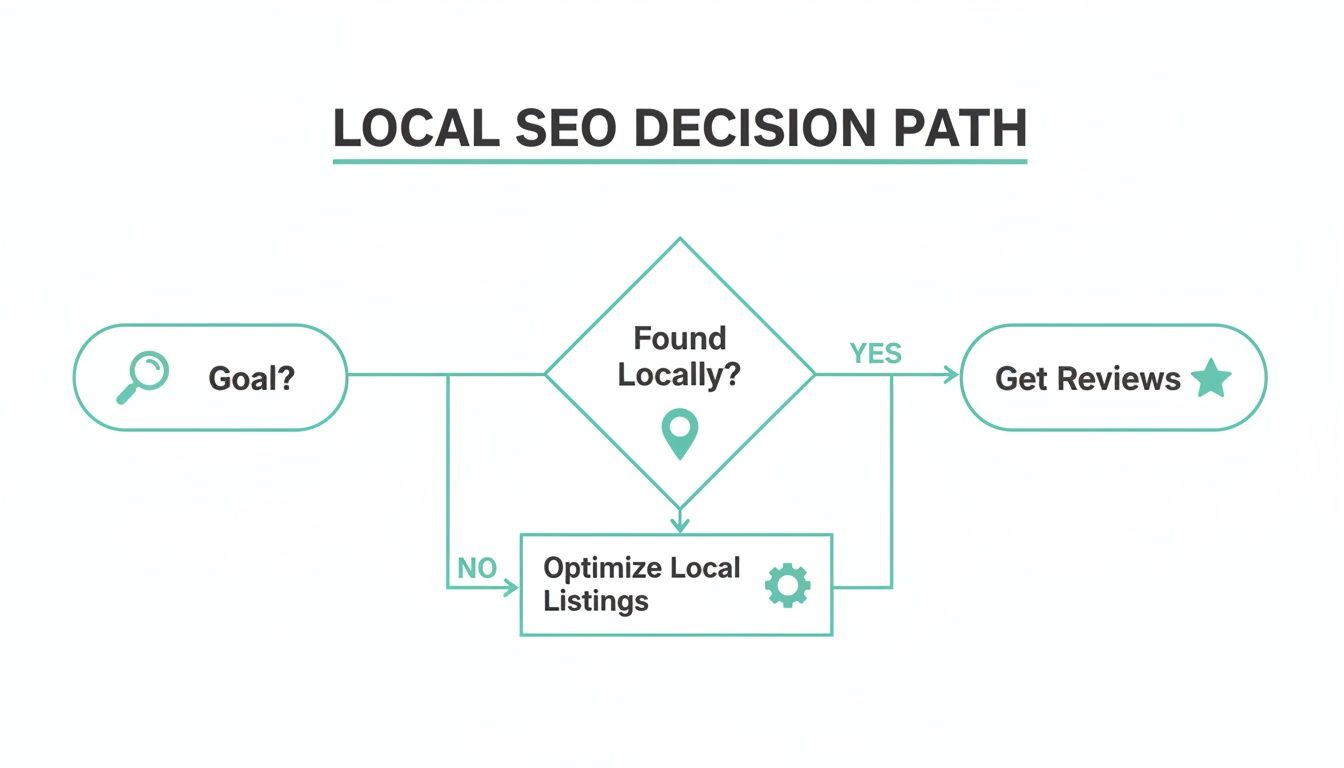
Think of this flowchart as the foundations of your house. Before you start spending money on ads, you need to have these core local SEO steps nailed down—from setting your goals to getting those all-important customer reviews. Each step builds on the last, creating a solid base for your paid campaigns to launch from.
Think of Google Ads as renting a billboard on the internet’s busiest highway. When someone in New Zealand searches for something they need right now—like "emergency plumber Auckland"—they have what’s called high purchase intent. They aren't just browsing; they have a problem and are actively looking for a solution.
Your ad pops up right at the top of their search results, capturing that immediate need. The beauty of it is you only pay when someone actually clicks on your ad. This makes it an incredibly powerful tool for generating leads and sales, especially for service-based Kiwi businesses. If you want to get into the nuts and bolts, this is a great overview of the core search engine marketing concepts.
So what about reaching people before they even know they need you? That's the magic of social media advertising. Platforms like Facebook and Instagram are less like a billboard and more like having a friendly chat at a local market.
Here’s the thing: these platforms know an incredible amount about their users' interests, which lets you target your ads with amazing precision.
It’s a completely different game from Google Ads. Instead of capturing existing demand, you’re creating it by putting an appealing idea in front of a receptive audience. You’re building brand awareness and nurturing potential customers over time.
Both approaches have their place, but they serve different purposes. Google Ads is brilliant for immediate, intent-driven conversions. Social media ads excel at building a community and generating interest in your brand for the long haul. Many successful Kiwi businesses use a mix of both, creating a well-rounded strategy that covers all the bases.
To help you decide where to put your ad spend, here’s a quick comparison of the most popular platforms for Kiwi businesses.
| Platform | Best For | Typical Audience | When to Use It |
|---|---|---|---|
| Google Ads | Capturing immediate demand; lead generation | People actively searching for a specific product or service | You sell something people search for when they have an urgent need (e.g., trades, professional services). |
| Facebook/Instagram | Building brand awareness; community engagement; e-commerce | Broad consumer demographics; highly visual and interest-based | Your product is visually appealing, and you want to build a loyal following over time (e.g., retail, hospitality, fashion). |
| YouTube Ads | Storytelling; product demonstrations | Wide range of demographics, especially younger audiences | You have compelling video content that can show your product or service in action. |
| LinkedIn Ads | B2B lead generation; professional networking | Business professionals, decision-makers, specific industries | You sell to other businesses and need to target by job title, industry, or company size. |
Each channel has its strengths. The right choice—or combination—really depends on who your customers are and what you’re trying to achieve. Don’t be afraid to experiment with a small budget to see what delivers the best results for your business.

Let's be real for a second. Social media isn't a megaphone for shouting about your latest sale. Think of it more as a place to have a good yarn, build a genuine community, and show the real, human side of your business. The best online marketing in New Zealand feels less like an ad and more like a great conversation with a mate.
So, how do you actually create content that Kiwis want to see? The secret is to stop selling and start helping. What problems are your customers facing? What stories can you tell that really connect with our local culture?
This is where content marketing and social media link up perfectly. It’s all about being genuinely useful or entertaining, not just another interruption in their feed.
Honestly, nobody logs onto Facebook hoping to see an ad. They log on to connect with people and discover interesting things. And that right there is your opening. When you share something valuable, you stop being just another business and become a trusted resource.
Imagine a local landscaping company in Christchurch. Instead of a generic "50% off lawn mowing!" post, they could share:
This kind of content builds authority and trust. It shows they're experts who are passionate about what they do. And when it comes time for someone to hire a landscaper, who are they going to call? The company that’s been giving them great advice all year, of course. For businesses wanting to get this right, looking into social media management in New Zealand can provide a clear roadmap.
The goal is to make your online presence something people genuinely look forward to seeing. It's about shifting from an interruption they tolerate to a destination they seek out.
The sheer number of Kiwis online is a massive opportunity. In early 2025, New Zealand had 4.14 million active social media users, with people spending an average of 2 hours and 3 minutes scrolling every single day. That’s a lot of time to make an impression.
But you don’t need to be everywhere at once. It’s far better to be brilliant on one or two platforms than to be average on five. If you sell beautiful homewares, Instagram is your best friend. If you offer B2B services in Auckland, LinkedIn is the professional hub where you need to be. To really nail your presence there, check out these 12 Proven Ideas on What to Post On LinkedIn.
Your content plan doesn’t need to be a massive undertaking. Start small. Aim to post a few times a week with content that helps, inspires, or just gives people a laugh. Show what happens behind the scenes, celebrate your team, and share your passion. That's how you build a real, lasting connection.

Here's a hard truth about online marketing in New Zealand—or anywhere, for that matter. Pouring your time, energy, and budget into a campaign without measuring what comes back is just guesswork. You might as well be throwing money into the wind.
This is the point where a lot of Kiwi business owners start to feel a bit overwhelmed, picturing complicated spreadsheets and nonsensical graphs. But honestly, you don't need a degree in data science. You just need to learn how to read the story your numbers are telling.
Turning good marketing into great marketing comes down to answering a few simple questions. Are those Facebook ads actually bringing in paying customers? Is that blog post you spent hours on driving people to your services page? Let’s pull back the curtain on analytics and make it feel a lot less intimidating.
First things first: forget about drowning in data. For most small to medium businesses, a handful of key metrics will give you 80% of the insights you really need. Think of them as the vital signs for your marketing's health.
Here are the big ones to get you started:
Ready for the good news? You can start tracking all of this without spending a dollar. Google Analytics is an incredibly powerful and completely free tool. It can look a bit full-on at first, but the basics are surprisingly straightforward.
Connecting it to your website is like installing a smart visitor counter at the front door of your shop. It doesn't just count the people coming in; it tells you how they found you, what they looked at, and how long they stuck around.
You can pull simple reports to see which pages on your site are the most popular or where your traffic is coming from—whether it's Google search, a link from Facebook, or a referral from another local business's website. This information is pure gold.
It tells you what's working so you can do more of it, and what's falling flat so you can stop wasting your time and money. It’s all about making informed decisions instead of just crossing your fingers and hoping for the best.
Alright, let's get down to business. Theory is one thing, but you're probably asking two very practical questions: how much is this going to cost, and when will I actually see a return on my money? It’s the question every Kiwi business owner asks when they start looking at marketing online.
The short answer? You don’t need a massive corporate budget to make a real difference with online marketing in New Zealand. But—and this is a big one—you do need a healthy dose of patience. Good marketing is more like growing a garden than flicking a switch; results take time and consistent effort.
Honestly, there’s no one-size-fits-all answer here. A local cafe in Christchurch might kick things off with a few hundred dollars a month on targeted Facebook ads, whereas a growing Auckland e-commerce store could be investing thousands.
A solid place to start is to think of your marketing spend as a percentage of your revenue, maybe somewhere around 5-10%.
The trick is to begin with a modest budget, track everything meticulously, and then reinvest in the channels that are actually bringing you customers. Forget throwing money at the wall to see what sticks; this is about making smart, data-driven decisions.
Before you go any further, we need to have a quick chat about the legal side of things. It's not the most glamorous part of marketing, but getting it wrong can cause some serious headaches down the line.
In New Zealand, the big piece of legislation to be aware of is the Privacy Act 2020. It sets the rules for how you collect, handle, and use your customers' personal information. If you're running a newsletter, for example, you have to be completely clear about what you're doing with those email addresses.
Now, this isn't formal legal advice, of course—just a friendly reminder to be a good sort. Be upfront with your customers, make sure your advertising claims are honest, and always, always respect their privacy. It's the only way to build a Kiwi brand that people genuinely trust.
And that trust pays off. The online shopping scene in NZ is set to hit a massive $6.8 billion market size by 2025. With a whopping 75% of that spending staying with local Kiwi retailers, it's clear that customers want to back businesses they can rely on. You can dig into more of these local consumer trends over at IBISWorld. Building that trust begins with doing things by the book.
Right, you've probably got a few questions buzzing around. That's completely normal. Most Kiwi business owners we talk to are trying to figure out the exact same things, wondering which path to take with their online strategy.
Let's tackle some of the most common questions we hear about online marketing in New Zealand. We'll give you straight-up answers to help you get moving.
Honestly, there’s no single magic number that fits everyone. But a solid rule of thumb is to put aside about 5-10% of your total revenue for marketing. If you’re just starting out, you might need to push that a little higher at the beginning just to get your name out there and build some momentum.
The most important thing is to start with a budget you're comfortable with. You could kick things off with just a few hundred dollars a month on a local Google Ads campaign, see what kind of results you get, and then double down on what’s actually working.
This one comes down to a single, critical question: where do your customers hang out online?
If you're a cafe in Wellington trying to catch the eye of young professionals, then Instagram and Facebook are your best bet. They’re perfect for sharing mouth-watering photos and daily updates with your local community.
But if you’re a B2B consultancy based in Auckland, your people are on LinkedIn. That's their professional stomping ground. The biggest mistake is trying to be everywhere at once. It's far smarter to pick one or two platforms where your customers actually are and really nail your presence there.
Think of SEO as a marathon, not a sprint. You might spot some small upticks in a few weeks, but for the kind of results that really move the needle, you’re typically looking at 4-6 months. This is especially true in competitive spots like Auckland or Christchurch.
Consistency is everything. If you regularly publish genuinely helpful content and keep your website technically sound, it will pay off massively in the long run. The goal is to build a steady stream of traffic and leads that you don't have to pay for with every single click.
Ready to turn these ideas into action? The team at NZ Apps specialises in creating websites and digital strategies that get real results for Kiwi businesses. Get in touch for a free consultation and let's have a chat about your goals.