
The usual advice on sponsored content vs native advertising is to choose the format that looks most like editorial. That's a poor place to start. A click won through confusion isn't worth the same as a visit from someone who knows they're reading paid content.
For NZ and AU founders, the better choice rests on three things: what you're buying, how readers will recognise it, and when you'll judge the result. Search value and launch-day exposure need different briefs. Neither should come with an implied independent endorsement.
Sponsored content describes the asset: an editorial-style article a sponsor funds or shapes, usually published on its own URL. Native advertising describes the presentation: paid material designed to fit the page, feed and reading experience around it.
One article can be both. Say a SaaS founder pays for a product explainer on a .co.nz tech publication. The article sits in the normal feed, uses the publication's design and carries a clear Sponsored label. It's sponsored content presented natively.
The split matters too. You can buy a native feed card that sends readers straight to your website, with no publisher article involved. Or commission a sponsored article without buying feed distribution.
Sponsored content vs native advertising side by side
| Criterion | Sponsored content | Native advertising |
|---|---|---|
| What is sold | Editorial-style article commissioned or funded by a sponsor | Paid placement designed to match the surrounding page |
| Core unit | A written asset with its own URL | An impression, click or sponsored card in a feed |
| Typical lifespan | Months to years through search and referral, if retained | Days to weeks, tied to the campaign flight |
| Main value | Organic search, referral traffic, branded search, lead quality | Labelled exposure and fast outbound clicks |
| Pricing basis | Flat fee per article or package | CPM, CPC or flat placement fee |
| Disclosure focus | Prominent label near the headline | Label stays recognisable within the feed design |
| Best measured by | Assisted conversions and referrals over 30–90 days | Viewability, CTR and cost per result within the flight |
These are buying patterns, not promises of traffic or permanence. Confirm publication duration and distribution separately.
Digital-only advertising represented 60.4% of total New Zealand advertising expenditure in the ASA's 2024 advertising revenue report. That describes the wider digital market, not native revenue alone.
For a contrasting local-market approach, Silver Spoon Agency's resource on native advertising solutions for NYC brands provides useful context. Treat overseas approaches as ideas, not NZ performance forecasts.
For your budget, start with lifespan and measurement window. Sponsored articles suit sustained discovery; native placements suit a defined burst of paid distribution.
A native unit can win the click and still be a bad buy. If readers mistake it for independent coverage, they may feel misled when they spot the sponsor. You bought attention, but at what cost?
Both formats have sound uses. A sponsored article gives a founder room to explain a product, show its limits and answer buying questions. Native placements give a launch team a way to buy exposure around a fixed date, without waiting for readers to find an article through search.
Sponsored articles take writing, editing and advertiser fact-checking. Search and referral value aren't guaranteed. Native distribution stops when the booked campaign ends, unless you've bought another arrangement.
The commercial stakes are substantial: the IAB New Zealand digital advertising revenue report recorded NZ$2.967 billion in digital advertising revenue in 2025, up 12% year on year. That's no reason to blur the line between commercial format and editorial credibility.
Before spending, record trust costs alongside media costs: reader complaints, requests to clarify sponsorship, label corrections and time spent resolving disputes. Don't pretend each has a neat dollar value. Give each an owner and a reporting field.
Editorial rule: Buy room to explain your product, not the appearance of an independent verdict.
There's a related trap with customer stories. A paid testimonial doesn't become independent because a customer supplied the words. Our guide to user-generated content helps distinguish who created material from who funded or controlled its publication.
For a .co.nz publication, the sound trade-off is plain: visible disclosure, advertiser fact-checking, no guaranteed positive verdict, and links chosen for reader use. A factual company profile can serve readers well. Dressing a sales pitch as a tested review cannot.
Use separate conversion paths, not a single engagement score. A native card earns a click. A sponsored article may help a buyer understand the product before they return through another channel. Those aren't interchangeable outcomes.
Start with your own baseline. Compare campaigns with ordinary editorial pages in the same tech category, while noting differences in promotion and audience intent. Public NZ sources don't provide reliable comparative CTR, acquisition-cost or conversion-rate averages for these formats, so don't import overseas averages as targets.
The Marketing Association's Marketing Communications Code of Practice provides a compliance reference for claims; for campaign reporting, use a 30- to 90-day post-publication window to distinguish immediate response from longer-tail article effects. Treat that as a measurement plan, not a promised payback period.
Which metrics matter for each format, and how to track them
| Metric | Sponsored content | Native advertising | How to track it |
|---|---|---|---|
| Labelled impressions | Secondary | Primary | Platform or ad server report during the flight |
| Viewability | Secondary | Primary | Viewability vendor or platform report during the flight |
| Engaged sessions and scroll depth | Primary | Secondary | Analytics engagement events during the agreed window |
| Outbound CTR | Secondary | Primary | Placement click report and UTM-tagged destination links |
| Link-attributed referral sessions | Primary | Low | UTM plus referral report after publication |
| Branded search lift | Primary | Secondary | Search Console against a pre-campaign baseline |
| Assisted conversions | Primary | Secondary | Dedicated landing page plus conversion-path reporting |
| Lead quality | Primary | Primary | CRM tagged by source and reviewed as leads progress |
For native placements, check labelled impressions and viewability first. An impression count tells you what the platform served. Viewability helps you assess whether readers had a chance to see it. Neither proves attention or buying intent.
Then check outbound CTR and cost per result. Define the result before launch: a completed demo request, a trial registration or another useful action. A cheap visit that never reaches a relevant page isn't a win.
For sponsored articles, inspect engaged sessions and scroll depth together. Deep scrolling can suggest interest, but it can also mean the reader struggled to find an answer. Check what happened next: a product-page visit, a useful download or a qualified enquiry.
A reader who leaves with the right answer may be worth more than one who stays because the page is confusing.
Use UTM parameters on campaign links, with consistent source, medium and campaign names. Send readers to a dedicated landing page that matches the promise in the placement. Test the form, analytics events and CRM hand-off before publishing.
UTMs identify campaign traffic; they don't calculate CTR on their own. You still need the placement's impression and click counts. Likewise, a dedicated landing page helps separate traffic, but it doesn't prove that the article caused every later sale.
Watch branded queries in Google Search Console. Keep a note of other activity, such as a product launch, conference appearance or email campaign, that could explain a rise. Don't hand the sponsored article credit for everything happening at once.
For both formats, carry campaign source into HubSpot, Salesforce or your CRM of choice. Have sales mark whether each lead fits the target market and has a real need. Our guide to social media advertising is useful when paid social runs alongside publisher placements and needs its own attribution.
Keep one reporting sheet, with a row per campaign and a named window for every metric. Include production, placement and landing-page costs, plus trust-related issues. That gives the next budget decision something firmer than a screenshot of clicks.
In New Zealand, the key test is control and presentation, not whether the sales deck calls the package content marketing. Under Rule 2(a) of the ASA Advertising Standards Code, advertising must be recognisable as advertising, whatever the platform.
Advertiser-controlled articles, blogs and native placements don't become independent editorial because a publisher wrote them. Get the disclosure settled before the designer builds the card or the writer starts the draft.

The ASA's identification-of-ads guide explains shared responsibility and treats payment broadly, including free products or services. A review supplied in exchange for software access can therefore need disclosure even when no cash changes hands.
Sponsored is a useful default for an article or company spotlight. Put it above the headline, on the feed card and at the start of social copy. Use readable contrast and text size, not pale small print.
Advertiser Content works when the material clearly belongs to the advertiser's commercial message. Use the same wording across the article, card and social preview so readers don't have to decode different labels.
Partner Content is less direct. If you use it, add plain wording that says the content is paid advertising. A partnership could mean many things; readers shouldn't have to guess which one applies.
Acceptance test: Can a first-time reader spot the commercial relationship before weighing a recommendation, claim or link?
Keep format and editorial purpose separate. A factual company profile can describe what a business does without claiming to have tested it. A paid product review needs disclosure and a clear account of what was assessed. Don't let the review headline imply evidence the writer doesn't have.
The ASA's 2025 Annual Report recorded 955 complaints concerning 306 advertisements across all media in New Zealand. That's context for taking disclosure seriously, not a native-ad complaint rate or a scare story.
Australian teams buying NZ placements should build these checks into the campaign hand-off. Don't assume an existing Australian approval settles every NZ publication question.
Keep the wording short enough to survive a busy production desk. Replace the bracketed text, then check that each statement matches the actual arrangement. A disclosure that invents an editorial safeguard is still misleading.
Article label, above the headline:
Sponsored
Sponsored by [Brand]. This article is paid content, and the brand checked its factual claims.
Use that final clause only if the brand did check the facts. Fact-checking should cover matters such as features, availability and supported claims, not a right to remove criticism.
Feed card, visible before the click:
Sponsored
[Headline that states the reader benefit without implying an independent verdict.]
Social preview, in the opening copy:
Sponsored. [Brand] explains [specific topic or problem]. Read the paid feature below.
Don't rely solely on a link preview, which may be cropped or replaced. If you use a tool such as the ShortGenius AI ad generator to prepare supporting video creative, carry the disclosure into that creative and its accompanying post. A production tool doesn't decide whether the label is adequate.
Your commissioning brief should contain these fields:
For a review tied to free access, use:
This review is labelled as advertising because [Brand] provided free access in exchange for coverage. No verdict was promised.
Only use that wording when it describes the deal. Check the live page, feed card and social post before release, not just the document approved in email.
Choose a format around the job you need done. A SaaS founder building regional awareness has a different problem from an AI tool launching next week. The following choices are starting points, not guarantees.
Format fit by situation for NZ and AU tech teams
| Situation | Better fit | Disclosure needed | Measure first |
|---|---|---|---|
| SaaS founder needs .co.nz links and search lift over a quarter | Sponsored article on a DA30+ .co.nz domain | Sponsored label near the headline | Branded search and referral sessions at the quarter-end review |
| AI tool needs fast exposure before a launch date | Native placement | Label visible on the feed card and preview | Viewability and outbound CTR within the flight |
| Australian firm entering NZ wants a local SEO signal | Sponsored article plus permanent listing | Sponsored label on the article and listing | Referral sessions and assisted conversions |
| Team given free access in exchange for a review | Labelled review, or no paid slot | Advertisement label, even with no cash paid | Lead quality from the CRM |
| Top list or market report meant as independent editorial | Keep separate from paid placements | No paid slot on the list; any paid mention needs a Sponsored label | Engaged sessions and returning readers |
A sponsored article makes sense when readers need context before they'll consider the product. Explain the use case, who it suits and where it falls short. Link to a relevant product or use-case page, rather than sending every reader to a broad homepage.
At NZ Apps, we offer sponsored articles on a DA30+ .co.nz domain. That identifies the publishing environment. It isn't a forecast of rankings, search traffic or leads.
If your starting requirement is a .co.nz dofollow link, pause before making that the whole brief. Ask what the article will help a local buyer understand. A link without a useful reason to click leaves you with a weak acquisition plan, whatever the domain metric says.
For an Australian firm entering New Zealand, a local article can explain practical fit: supported currency, availability, service coverage or other substantiated details. A permanent listing can then give readers a stable place to find the company. Neither replaces clear NZ-facing information on your own website.
An AI tool with a fixed release date usually needs paid distribution first. Native placement lets the team schedule exposure and test whether a headline attracts relevant visitors during the booked flight.
Keep the promise narrow. If the card offers a workflow demo, send readers to that demo, not a generic sign-up wall. A clear path makes the result easier to interpret.
A sponsored article can support the launch if the product needs explanation, but don't confuse publication with guaranteed reach. Buy and report distribution separately from the article itself.
Independent top lists need a selection method readers can trust. Selling a place within the ranking changes the nature of the list. Keep paid mentions in a visibly separate area, rather than letting payment determine an apparently independent position.
Commission-based links raise a related question about incentives. Our guide to affiliate marketing in New Zealand is useful when referral payments form part of the arrangement.
For every situation, decide what failure looks like before spending. It might be irrelevant leads, poor landing-page response or readers misunderstanding the sponsorship. Those are different problems, and each needs a different fix.
Don't sign for an article when you need distribution, or for clicks when buyers need a proper explanation. Choose the commercial job first. Then set who controls the message, how readers will recognise the relationship and what evidence will count as success.
Use this checklist before commissioning the work.
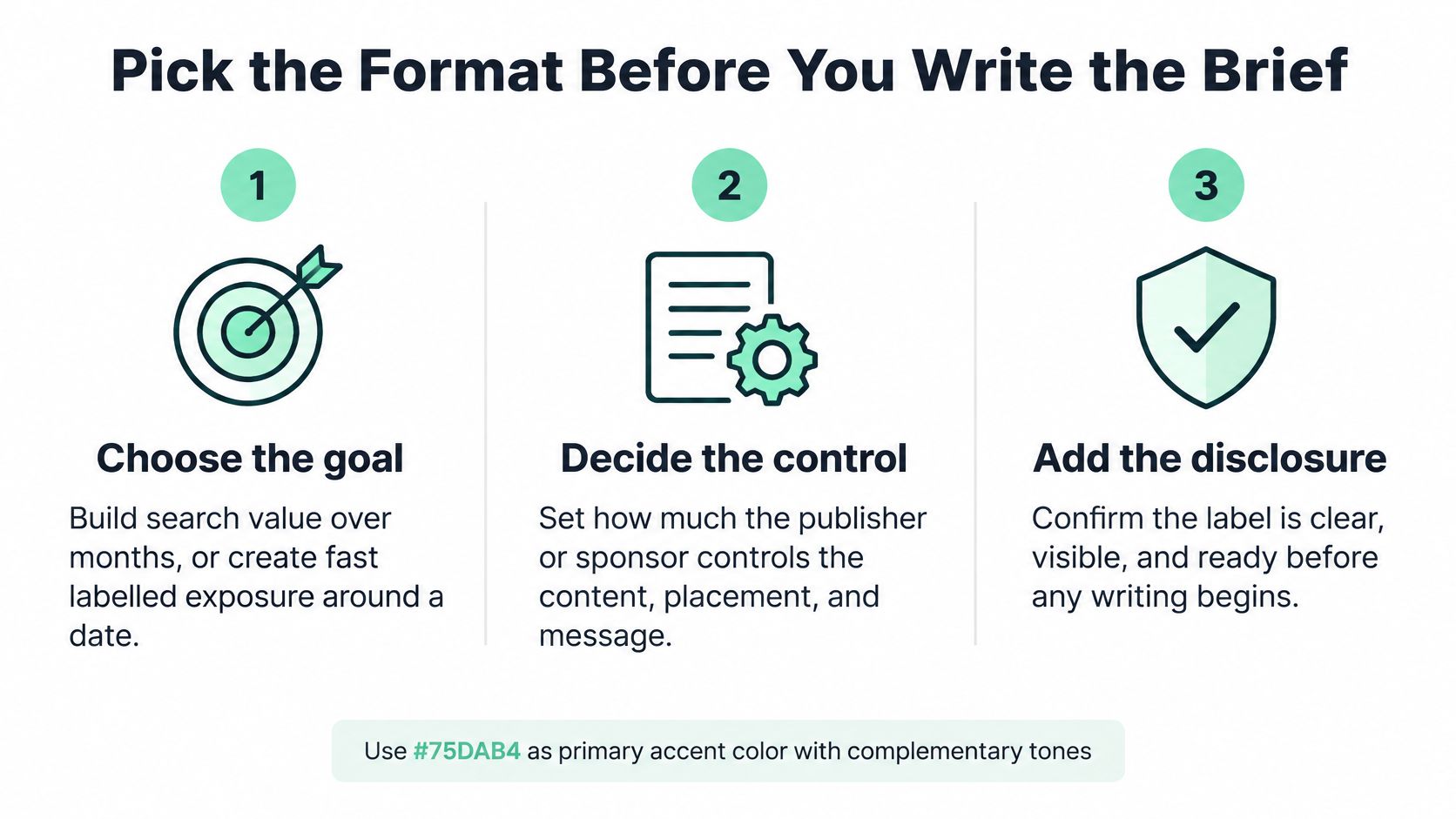
Separate the items on the order. A sponsored article, permanent featured listing and editorial link placement are different purchases. At NZ Apps, we offer sponsored and dofollow editorial links, permanent featured listings, and sponsored articles; choose the item that supports the reader path you've planned.
Don't treat a link description as a ranking promise. Confirm the destination, placement, disclosure and publication terms in the written agreement.
Before approval, put these decisions on a single page:
Request written confirmation that factual review won't become an advertiser veto over a negative finding. Attach the disclosure copy and a sample report to the brief so production and measurement start from the same agreement.
If the package can't survive those questions, don't patch it with a clever headline. Change the package before the budget goes in.
NZ Apps offers sponsored articles, permanent featured listings, and sponsored and dofollow editorial links, with advertising that reaches tech decision-makers across New Zealand and Australia. Visit NZ Apps to discuss the format that fits your goal, and bring your proposed label, landing page and measurement window to the conversation.
Add your NZ or Australian app or tech company to the NZ Apps directory and get discovered by founders and operators across the region.
Get ListedReach tech decision-makers across New Zealand and Australia. Sponsored and dofollow editorial links, permanent featured listings, and sponsored articles on a DA30+ .co.nz domain.
See Options