
Look, effective web design for small business isn’t just about having a pretty online brochure; it's about building your hardest-working employee. For many Kiwi businesses, this digital team member is missing entirely, creating a huge gap between what customers want and what they can find.
Let's be honest, running a small business in New Zealand is a real labour of love. You pour your heart and soul into your craft, but what happens when potential customers can’t even find your front door online? It sounds a bit dramatic, doesn’t it? But for many, it’s the stone-cold reality.
Here's the thing: there's a massive disconnect between what Kiwi consumers expect and what local businesses are delivering. We're talking about a serious opportunity that's being left on the table.
You might think your friendly word-of-mouth reputation and a sporadically updated Facebook page are enough to keep the lights on. For a while, maybe they were. But times are changing, and relying on social media alone is becoming a risky game. It really is.
Recent data paints a startling picture. According to a comprehensive study, a staggering 47% of New Zealand small businesses operate without a dedicated website. This is despite consumers overwhelmingly preferring websites as their top tool for engaging with businesses—almost three-quarters named it the most important channel. You can read more about these findings on Kiwi consumer trends.
Your website is your digital storefront, open 24/7, even when you're asleep. It works tirelessly, answering questions, showcasing your work, and bringing in new customers without ever asking for a day off.
This isn't just a small gap; it's a chasm. While nearly half of small businesses are invisible online, the vast majority of your potential customers are actively searching for them there. It’s like hiding your shop down a dark alley with no sign. How can anyone find you?
Relying solely on a social media page puts your entire online presence in someone else's hands. What if the platform changes its algorithm? Or worse, what if your account gets suspended for a reason you don't understand? Honestly, you could lose everything overnight.
A professional website is different. It’s an asset you own and control. It’s the central hub where all your marketing efforts—from social media to email campaigns—should point back to. It’s where you truly get to tell your story, build trust, and turn casual browsers into loyal customers.
A website gives your business legitimacy and permanence. It shows you’re serious, professional, and here for the long haul. Think about your own habits. When you're looking for a service, do you trust the business with a polished website or the one with just a basic social media profile? The answer is pretty clear, isn't it?
This guide is designed to show you why a great website is more than just a digital brochure; it's the engine of your business's growth.
So, you're on board with needing a website. Fantastic. But what actually separates a great website from a digital paperweight? It’s about so much more than just looking pretty. A great small business website is your superstar employee—the one who works 24/7, never calls in sick, and always knows the right thing to say.
This is about building something that delivers real, measurable results for your business. It's time to look under the bonnet and see what parts really make the engine run. Let's break down the non-negotiables.
Here's a quick-glance checklist of the core components and why they're crucial for connecting with your NZ customers.
| Feature | Why It Matters | Simple Analogy |
|---|---|---|
| Responsive Design | Makes your site work perfectly on any device, especially mobiles. | A one-size-fits-all jacket that actually looks good on everyone. |
| Intuitive Navigation | Helps visitors find what they need without getting frustrated. | A well-signposted department store where everything is easy to find. |
| Fast Load Speed | Keeps impatient visitors from leaving before your page even loads. | The difference between a quick-service cafe and a restaurant with a long wait. |
| Clear CTAs | Tells your customers exactly what you want them to do next. | A clear, friendly instruction from a helpful staff member: "Pay here." |
| On-Page SEO | Helps Google understand your business so you can be found. | Putting a big, clear sign on your shop so people know what you sell. |
| Quality Content | Builds trust and shows you're an expert in your field. | Having knowledgeable staff who can answer any customer question. |
Ultimately, these aren't just features; they're the foundations of a website that actually works for your business.
Ever tried to browse a website on your phone where you have to pinch and zoom just to read a sentence? It’s a terrible experience, right? You probably gave up and left.
That's why responsive design isn't a "nice-to-have" anymore; it's the absolute standard. It’s non-negotiable.
Responsive design simply means your website automatically adjusts its layout to look and work perfectly on any screen size, from a massive desktop monitor to a tiny smartphone. Given that a huge chunk of your customers will find you on their phones—often while they're out and about in Auckland or Christchurch—this is critical.
If your site isn’t easy to use on mobile, you’re basically telling a huge portion of your potential customers that you don’t care about their business.
Beyond just looking good, how does your website feel to use? This is the core of User Experience (UX) design. It’s the invisible architecture that guides your visitors smoothly from one point to the next, making their visit effortless.
Think of it like walking into a well-organised retail shop. You know exactly where to find what you need, the aisles are clear, and the checkout process is quick and painless. Good UX is the digital version of that. It’s about creating a frustration-free journey for your customers. To make this happen, it often helps to bring in a specialist; a skilled user experience designer can map out these customer journeys with expert precision.
Good UX design involves things like:
A website with confusing navigation is like a maze with no exit. Your visitors will get frustrated and leave, likely never to return. The goal is to make their experience so effortless they don't even have to think about it.
Honestly, how long are you willing to wait for a page to load? Three seconds? Maybe five if you’re feeling generous? The reality is, patience online is incredibly thin.
Site speed is a massive factor in keeping visitors on your page. A slow-loading website doesn't just annoy users; it actively drives them away to your competitors. This is especially true for local searches. If someone is looking for a cafe in Wellington on their phone, they want results now. Every extra second your site takes to load is a potential customer lost forever.
On top of that, search engines like Google also pay close attention to how fast your site is. A zippy website is rewarded with better visibility in search results, while a sluggish one gets pushed down the rankings. It’s a double whammy you can’t afford to ignore.
Making your site fast involves optimising images, using efficient code, and choosing good hosting. It's technical, but it’s one of the most important investments you can make. This extends to every interactive element; applying effective form design best practices is essential for converting visitors into leads without slowing things down.
You could have the most beautiful, functional website in the world, but if nobody can find it on Google, does it even exist? It’s a tough question, but one every Kiwi business owner needs to ask. This is where Search Engine Optimisation (SEO) comes in.
Honestly, "SEO" sounds like one of those overly technical, scary acronyms, doesn't it? But all it really is, at its heart, is the art and science of getting your website to show up when people search for what you offer. It’s about being visible to the right people, right when they need you.
For a small New Zealand business, it gets even better. We're not talking about trying to compete with massive global companies; we’re focused on local SEO. This is pure gold for any business with a physical shopfront or a specific service area, whether you're in Auckland, Christchurch, or a smaller town like Taupō.
Think about how you search for things these days. You don't just type "plumber" into Google. You’re more likely to search for "plumber near me" or "best coffee in Wellington." These are local searches, and they signal that the person is ready to either buy something or visit a location.
When someone makes one of these local searches, Google often shows a "map pack"—that little box at the top of the results with a map and three business listings. Getting your business into that box is like having a billboard on the busiest street in town. It puts you directly in front of customers who are actively looking for exactly what you do.
Being invisible in local search is like having an unlisted phone number in the old days. Your customers are out there looking for you, but they simply can’t find you. Effective web design for small businesses absolutely must include a solid local SEO foundation.
So, how do you start climbing those local search rankings? It’s not nearly as complicated as it sounds. It all starts with a few foundational things that your web designer should be talking to you about from day one.
Here are the key ingredients:
Let me explain something simple but surprisingly powerful. Having a .nz domain name does more than just show you're a local business; it builds instant trust. For Kiwi customers, a .nz address signals that you're based here, you get the local market, and you're part of the community.
From a technical perspective, it also gives search engines a clear signal about your geographic location. This can give you a small but meaningful edge when you’re up against businesses with generic domains like .com. It’s a subtle but important piece of the local SEO puzzle.
Building a solid local presence online takes a bit of time, but it’s one of the most valuable investments you can make for your business. For a deeper dive into the nuts and bolts, our complete guide to local SEO for small business in NZ is a great next step. After all, getting found is the first step to getting chosen.
This is it—the big question on every Kiwi business owner's mind: "So, how much is this actually going to set me back?" Let's get right into it. The truth is, the cost and timeline for building a website can vary wildly, and it’s important to understand why.
Asking "how much for a website?" is a bit like asking "how much for a car?" A basic runabout will have a very different price tag than a custom-built Ute with all the bells and whistles. The same logic applies to web design. It's not about one single price; it’s about what you need the website to do for your business.
The final cost isn't just a number pulled out of thin air. It’s a direct reflection of the time, skill, and complexity needed to build something that genuinely helps your business grow. A simple, clean informational site is one thing; a full-blown e-commerce store with hundreds of products and payment gateways is a completely different beast.
Here are the main ingredients that go into the pricing recipe:
It’s easy to think of a website as just another business expense, but that’s the wrong way to look at it. Honestly, it’s an investment. A recent report from Xero revealed that when Kiwi SMEs invest in digital tools like modern websites, they see productivity gains of $2.40 to $3.10 for every dollar spent. You can check out more insights from the Xero small business productivity report.
Alright, let's talk turkey. While every project is different, you can use these figures as a rough guide for professional web design here in New Zealand. For a much deeper breakdown of the numbers, our guide on how much a website costs in NZ is a fantastic resource.
A cheap website that doesn't bring in customers is an expense. A well-built website that generates leads and sales is an investment that pays for itself over and over again.
The infographic below shows how a typical local SEO timeline runs alongside your website launch, outlining the key stages from keyword research to achieving better rankings.
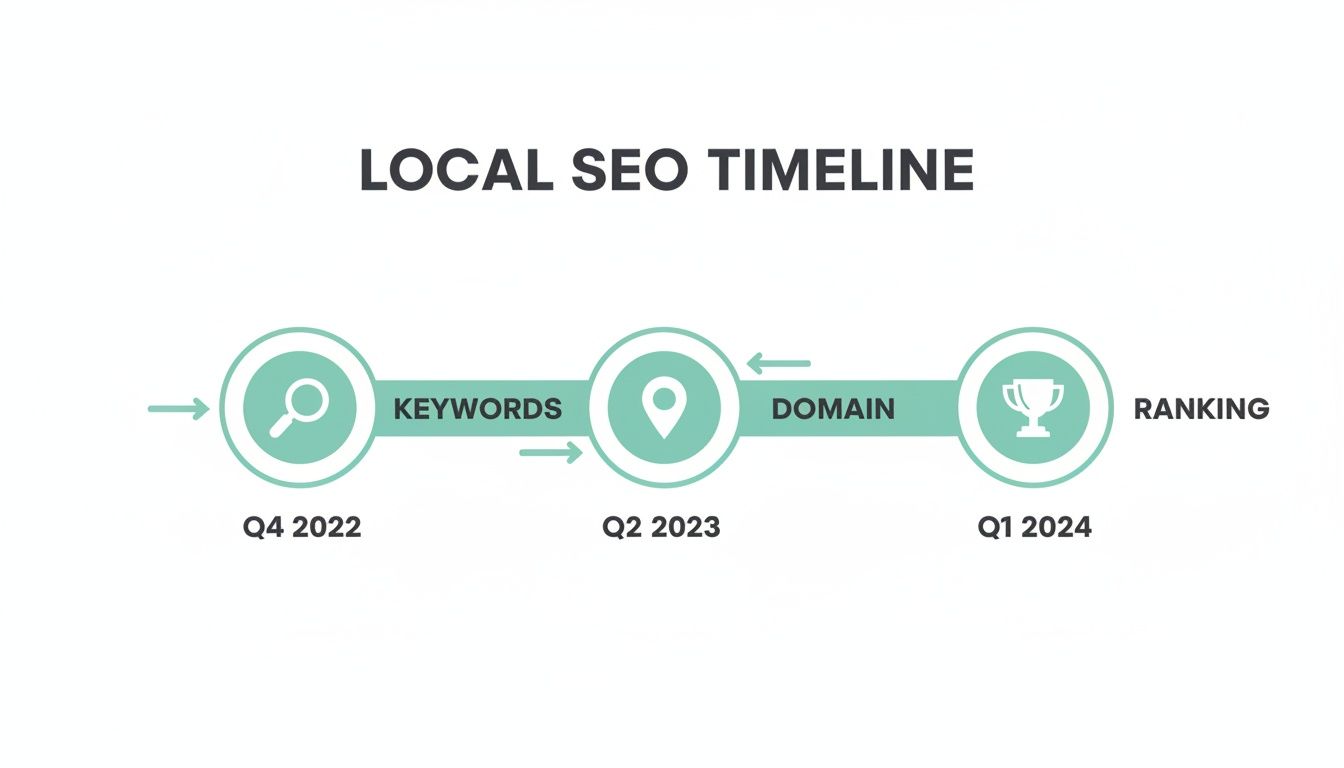
This visual helps to show that SEO isn't an afterthought; it's a parallel process that needs to start early to ensure your new site is visible to Google from day one.
One final point—and it’s a really important one. A website isn't a one-and-done purchase. Just like your business vehicle, it needs a bit of ongoing love to keep it running smoothly and securely.
Be sure to budget for these so-called 'hidden' costs from the start:
Understanding these costs from the get-go means there are no nasty surprises down the line. It ensures your investment remains a powerful asset for your business, not a technical headache.
So, you’ve decided to invest in a professional website. That's a huge step. But now comes the really big question: who do you actually trust to build it? Honestly, choosing a web design partner is a lot like picking a business partner—get it right, and you're set up for success; get it wrong, and you're in for a world of headaches.
This decision isn't just about finding someone who can make things look pretty. You need a team that gets your vision, understands your customers, and is genuinely invested in your growth. This is about finding a long-term ally, not just a one-and-done project vendor.
Here's the thing: you can find plenty of people who can build a website. What you really need is a partner who starts by asking, "What are your business goals?" not "What colours do you like?" A great web design partner is a strategist first and a designer second.
They should be curious. They should ask tough questions about your ideal customers, your sales process, and what success looks like for you in a year. If their first move is to show you a bunch of templates without understanding your business, that’s a big red flag.
A true partner focuses on the why behind your website. They're building a business tool designed for results, not just a piece of digital art. Anyone can push pixels around; a partner builds a growth engine.
Before you sign any contracts, you need to do your homework. It’s a bit like hiring a key employee—you wouldn’t do that without checking references, would you?
Here’s a simple checklist to help you evaluate your options.
When you’re chatting with potential designers, it’s your chance to dig deep. Don’t hold back. Think of it as an interview where you’re the one in charge.
A few questions worth asking:
Their answers will tell you a lot about their professionalism and whether they're the right fit. Remember, you’re looking for someone who makes you feel confident and supported.
Part of this involves their ability to advise on technical aspects like how to choose a hosting provider for SMBs that aligns with your business needs. If they can't explain these things clearly, it might signal trouble ahead. Finding the right partner is the key to creating an online presence that truly delivers.
Right, you've absorbed a lot of information. But knowledge without action is just trivia. Let's turn all this insight into a concrete plan for your business.
This is where the real work begins. We’ll take everything we've covered and break it down into clear, manageable steps. Whether you’re starting from scratch or giving your existing site a long-overdue makeover, you'll know exactly where to begin.
The path to a great website starts with a single step. Here’s where to put your foot first.
Before you even think about calling an agency, it’s worth taking a moment to get your own thoughts in order. A little bit of prep work right now will save you a ton of time and headaches later on. Trust me, it’s a game-changer.
Start by asking yourself these key questions:
Getting clear on this stuff first means you can lead the discussion with a potential web design partner, instead of just reacting to their suggestions.
Think of your website as a solution to a business problem. If you define the problem clearly from the outset, you empower your design partner to build the most effective solution. It’s the difference between commissioning a sharp new tool for your business and just buying a pretty ornament.
Small businesses across New Zealand are really starting to see the value in a smart online strategy. In fact, a huge 93% of newer SMBs now view technology as vital for their growth. And 76% are planning to use their websites to integrate things like AI into their marketing by 2025. You can dig into more of these trends in the ANZ small business now report.
You’re part of this shift. So, when you’re ready to have that first conversation, treat it as a collaboration. Be ready to share your goals, your customer insights, and your budget. A good web design team won’t just nod along; they’ll ask you tough questions and bring fresh ideas to the table.
Ultimately, that first chat is about checking the chemistry. Do they seem to get your vision? Do their ideas excite you? This is your opportunity to find a partner who can help you build a website that delivers real, measurable results.
We get asked a lot of questions from small business owners trying to make sense of the web design world. It's an industry packed with jargon, and it's easy to feel a bit lost. So, let's cut through the noise and answer some of the most common queries we hear.
You absolutely can, and for many people starting out, it's a great option. DIY platforms like Wix or Squarespace are brilliant for getting a presence online quickly, especially when you're watching every dollar.
Think of it like buying a suit off the rack. It looks pretty good, it gets the job done, and it's ready to go straight away. It's a perfectly valid starting point.
The catch often comes later. As your business grows, you might start to feel the limitations in customisation, performance, or search engine potential. A custom website built by an agency is more like a tailor-made suit—it’s crafted to fit your brand, your customers, and your business processes perfectly. It gives you a truly unique identity and much more room to grow.
Good question! This one sounds more technical than it actually is.
Simply put, website hosting is the service that stores all of your website's files—the text, the code, the images—and makes sure they're visible on the internet 24/7. It’s like renting a plot of land online where your website gets to live. Without a place to live, your site can’t exist for anyone to visit.
So, yes, every single website needs hosting. When you work with a team like ours, we typically manage all the technical hosting details for you. That means we make sure your site is fast, secure, and always online, so you can focus on what you do best: running your business.
Let me be direct here: it’s critically important. A website isn't a "set it and forget it" kind of deal. You wouldn't buy a new van for your business and then just never service it, right? Your website needs that same regular care to keep it running smoothly and securely.
Neglecting website maintenance is like ignoring a slow puncture in your tyre. It seems fine for a little while, until one day you're suddenly stranded on the side of the road with a much bigger, more expensive problem.
Regular maintenance covers essential tasks that keep your site healthy:
Skipping these jobs can lead to a slow website, broken contact forms, or worse, a security breach. Any of those can do real damage to your reputation and your sales.
Feeling a bit clearer on things? The first step toward a great website is just a simple conversation. The team at NZ Apps is here to help you figure out your best options and build a site that actually delivers results for your business. Book a free, no-pressure chat with us today at https://nzapps.co.nz.