
So, you want to know the real cost of a website in New Zealand? It’s the million-dollar question, isn’t it? Almost literally, sometimes.
The short answer is this: a basic brochure website from a freelancer might set you back $1,500–$4,000, while a more complex, custom-built site from a digital agency in Auckland or Christchurch can easily hit $5,000–$15,000+.
Honestly, asking "how much for a website?" is a bit like asking 'how much is a car?'. A simple runabout has a very different price tag than a high-performance sports car with all the trimmings.
Let’s cut to the chase. You're a Kiwi business owner, and you need a number, not a vague "it depends." I get it.
The truth is, the cost of a new website is all over the map. It's dictated entirely by who builds it and, more importantly, what you need it to do. We're not just talking about pretty colours and fonts; this is about the engine under the bonnet. The real machinery that makes your business hum.
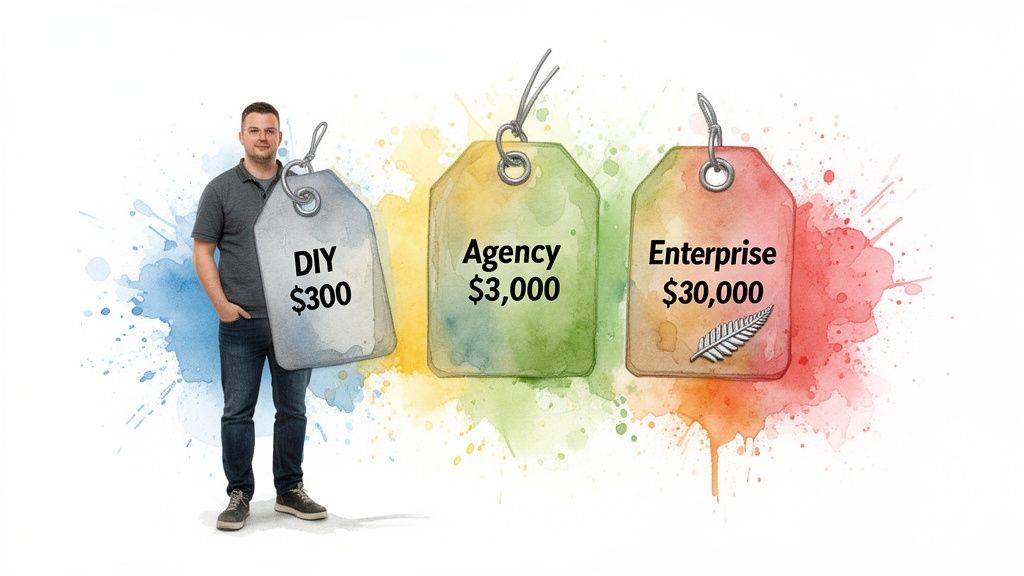
Here's the thing: you absolutely get what you pay for. A cheap website might look okay at first glance, but will it actually bring in customers? Or will it just sit there, a lonely digital business card collecting dust? A painful thought, right?
To help you make sense of it all, we've broken down the main options you'll find here in New Zealand. This table gives you a ballpark idea of where your project might fit.
| Website Type | Typical Price Range (NZD) | Best For |
|---|---|---|
| DIY Website Builder | $30 – $60 / month | Startups, sole traders, or anyone needing a simple online presence on a tight budget. |
| Freelance Web Designer | $1,500 – $4,000+ | Small to medium businesses needing a professional, well-designed site without the agency overhead. |
| Digital Agency | $5,000 – $15,000+ | Established businesses needing custom features, e-commerce, or complex system integrations. |
As you can see, the investment varies wildly based on the approach you take. So let's dig into what each of these tiers really means for your business, because the price tag is only half the story.
To make sense of it all, let's break down the main options you'll come across here in New Zealand:
Recent New Zealand pricing guides show a clear split between these options. A standard 5–10 page small business website can cost NZ$400+ per year on DIY platforms, jump to NZ$1,500–$4,000 for a freelance build, or hit NZ$5,000–$15,000+ with an agency. You can explore more about these NZ-specific costs and what drives them.
So, we’ve looked at the general price brackets. But what really separates a $3,000 website from a $30,000 one? It all comes down to the details. This is where we get into the nitty-gritty of what shapes that final number on your quote.
Think of it like renovating a kitchen. A basic flat-pack setup from Bunnings has a clear, predictable price. But the moment you start talking about custom cabinetry, marble benchtops, and high-end European appliances, that cost is going to soar. It’s exactly the same with websites. Every custom touch adds time.
Ultimately, the web design price is a direct reflection of the hours, expertise, and complexity required. Are we building a simple digital brochure or a sophisticated, interactive machine for your business? Every feature, every page, and every custom touch adds time to the project. Simple as that.
This is probably the biggest fork in the road when it comes to your budget.
Using a pre-made template is like buying a suit off the rack—it's fast, affordable, and can look pretty sharp with a few tweaks. Your designer will pick a solid foundation and then customise it with your branding, colours, and content. It gets the job done efficiently. No shame in that.
A fully custom design, on the other hand, is a bespoke, tailored suit from a Savile Row tailor. It starts with a blank canvas. The designer maps out every single element—the user journey, the button placement, the animations—all specifically for your brand and your customers. This approach takes significantly more time for strategy, design, and development, which is directly reflected in the price.
A template gets you online quickly and affordably. A custom design gives you a competitive edge by creating a unique user experience that no one else has. Neither is wrong; they just solve different business problems.
The next major factor is functionality. What does your website actually need to do? The more interactive and complex the features, the higher the web design price. It's a simple equation of time and skill.
Here are a few common examples that push the cost up:
To give you a better idea of how features scale up, here’s a quick breakdown.
This table shows how different features and scope decisions can affect the overall cost and timeline of your project.
| Feature or Scope | Lower-Cost Approach | Higher-Cost Approach | Impact on Price |
|---|---|---|---|
| Design | Template-based with brand customisation | Fully custom, bespoke UI/UX design | Significant |
| Content Management | Standard WordPress or Shopify CMS | Headless CMS or custom-built backend | High |
| E-commerce | Basic store (e.g., <20 products) | Large inventory, custom rules, integrations | Very High |
| Booking System | Simple embedded third-party calendar | Custom-built booking with payments | Medium to High |
| SEO | Basic on-page setup | Comprehensive keyword research, content strategy | Medium |
| Integrations | Manual data entry | Automated integration with CRM/accounting software | High |
As you can see, the choices you make have a real, tangible impact on the final invoice. It's all about balancing your must-haves with your budget.
To fully grasp what influences your web design price, it's also crucial to understand the roles involved, such as the distinction between web developers and web designers, and their associated costs. A designer makes it look good; a developer makes it work—and you often need both for complex features.
Speaking of e-commerce, let’s be clear: building an online store is a whole different beast. It’s not just a website; it’s a complex piece of software that has to handle money securely and reliably, 24/7.
The choice of platform, like Shopify or WordPress with WooCommerce, plays a huge role here. While platforms like Shopify offer a slick, all-in-one solution, customising it heavily to fit your unique brand can get expensive. On the flip side, a custom WordPress e-commerce site offers endless flexibility but usually requires more development time upfront. For a deeper look, you can read our detailed comparison of Shopify versus WordPress for Kiwi businesses.
New Zealand data shows that the type of website and its functional depth are the main drivers of price. Recent benchmarks list a simple brochure site at NZ$3,000–$6,000, but an e-commerce store starts around NZ$7,000 and can easily exceed $20,000 depending on product volume and payment integrations. Custom web apps? They often start at NZ$15,000 and climb from there, sometimes costing 3–5 times more than a standard marketing site.
Right, let’s get into the nitty-gritty of how you actually pay for a website. It’s not always one simple, upfront number, which can be a real head-scratcher if you’re not prepared for it. Web design agencies and freelancers here in New Zealand tend to use a few different models, and knowing the difference can save you a world of pain down the track.
Understanding these structures is the key to figuring out the true web design price for your project. To see the bigger picture, it helps to consider how agencies think about sales and profitability in general, which includes having insights into proven pricing strategies. It helps put their quotes into a larger business context.
Let's break down the most common ways this is handled: a fixed project price, an hourly rate, and a monthly retainer.
This is the one you’ll come across most often, especially for standard websites. The agency gives you a single, all-in price for a very clearly defined scope of work. Simple, right?
A fixed price is brilliant for your budget because you know exactly what you’re in for from day one, which makes financial planning an absolute breeze. Honestly, for most small to medium Kiwi businesses needing a solid marketing website, this is the way to go. It keeps everyone on the same page.
But what if you want to add a new feature halfway through? That's where it gets tricky. Any changes outside the original agreement will need a new quote, which can slow things down and add to the cost. It’s a bit like building a house—deciding to move a wall after the framing is already up is going to cost you extra.
This flowchart gives you a good idea of how project complexity builds up, which is often the basis for a fixed price quote.
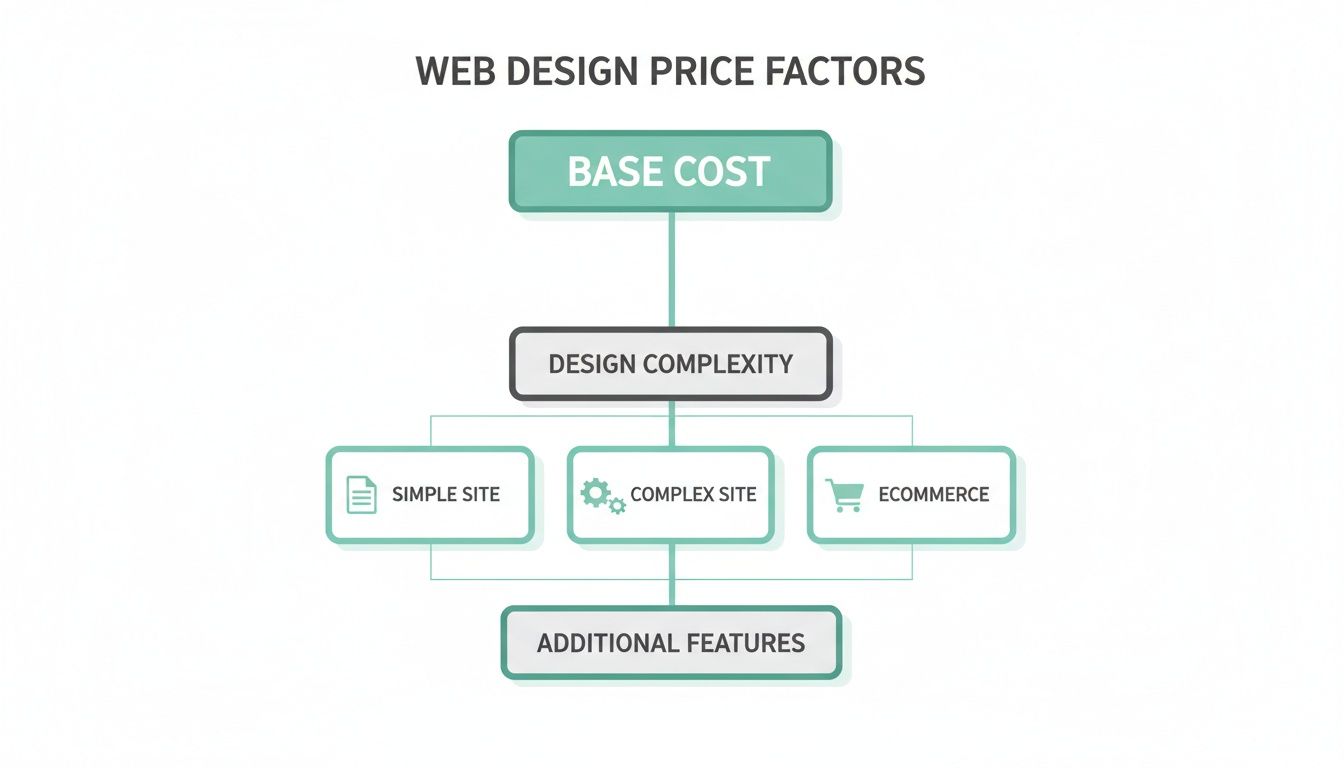
As you can see, moving from a simple site to a complex e-commerce store adds layers of work that have a huge impact on the final fixed cost.
Next up is paying by the hour. This model gives you incredible flexibility and is perfect for projects where the scope isn't completely locked down, or for ongoing tweaks and improvements after your site has launched.
Need to add a new section or experiment with a different layout? No problem. You just pay for the time it takes the designer or developer to do it. This can be great for agile projects where you’re figuring things out as you go.
The downside? It can feel a bit like a blank cheque if it's not managed properly. Without a clear cap or regular check-ins, the costs can spiral. You need a lot of trust in your agency and crystal-clear communication to make sure you’re not hit with a surprise bill for $10,000 when you were expecting $4,000.
For this to work, you absolutely need a partner who provides detailed time-tracking reports. Transparency is completely non-negotiable here.
Finally, we have the retainer. This is less for a one-off build and more for an ongoing partnership. You pay a fixed fee each month, and in return, the agency dedicates a set number of hours to your website.
This is a fantastic model for businesses that need continuous support, SEO work, content updates, or new feature development. It’s proactive. Instead of just fixing things when they break, your agency is actively working to improve your site every single month.
A retainer essentially puts a web expert on your team without the cost and hassle of a full-time employee. It’s an investment in growth, not just a one-time build. It also turns the web design price from a big capital expense into a predictable operational cost, which can be much easier for some businesses to manage.
Here’s a little secret from inside the industry: the web design price on that shiny proposal often isn't the final number. It’s like buying a house; the sale price is just the beginning. Then come the rates, insurance, and the unexpected leak in the roof. A website is exactly the same—it’s not a one-off purchase, but a living asset that needs ongoing care.
This is where we pull back the curtain on the expenses that can catch you by surprise. It's not meant to scare you off; it's about giving you the full picture so you can budget properly. You wouldn't buy a car without thinking about petrol and insurance, right? Same deal here.
Let’s talk about building a realistic budget for your website's entire lifecycle, not just for launch day.
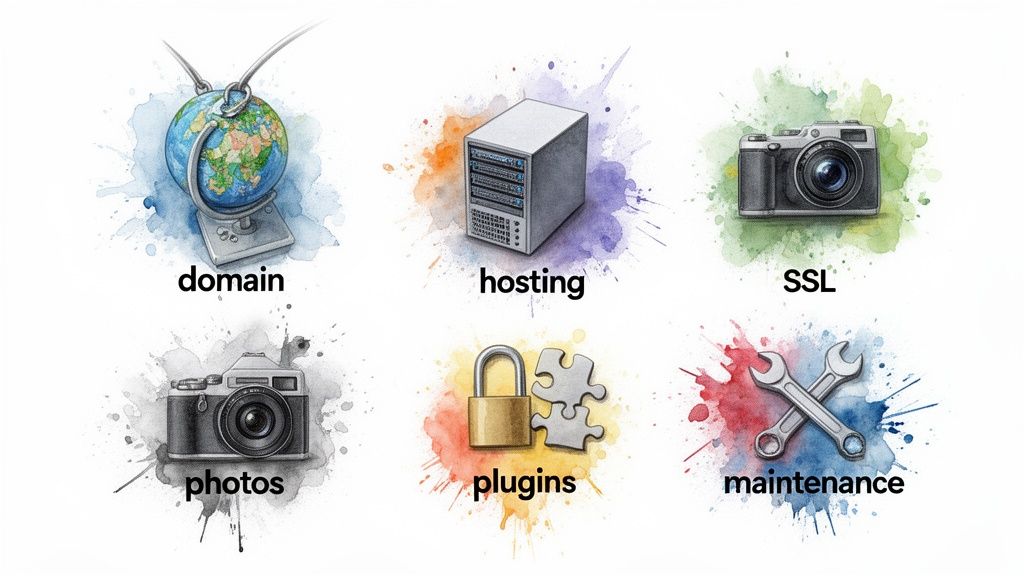
First up are the non-negotiables. These are the foundational costs you’ll have every single year, no matter who builds your site. They’re the digital equivalent of keeping the lights on.
Think of them as the basic utilities for your online property:
yourbusiness.co.nz). It’s a small annual fee, usually around $20–$50 per year, but it's essential. No address, no website.These three are the bare minimum. Every single website needs them to function, so make sure you factor these annual fees into your budget from the very beginning.
Now, let's move beyond the basics. These are the costs that are easy to forget when you’re focused on the initial design, but they make a massive difference to the quality and effectiveness of your site. Honestly, skimping here is where a lot of businesses go wrong.
It’s these finishing touches that turn a functional site into a professional one.
A website is a dynamic tool, not a static brochure. The moment it launches, it begins to age. Ongoing investment is what keeps it sharp, secure, and effective.
So what else should be on your radar?
These "hidden" costs are what separate a professional, secure, and high-performing website from one that just… exists. They aren’t just expenses; they are crucial investments in your site's long-term health and success.
It’s easy to look at a five-figure web design price and feel your stomach drop. Let’s be honest, it’s a lot of money. But for a moment, let’s reframe this. Is that number an expense, or is it an investment in the future of your business?
A well-built website is so much more than a digital brochure. It’s your 24/7 salesperson, your always-on customer service hub, and your single most powerful marketing tool. It works tirelessly while you sleep, generating leads and building your brand.

Thinking about it this way shifts the question from 'How much does this cost me?' to 'What value will this create for my business?'. And that changes everything.
Let’s get practical. A cheap website that brings in zero customers isn’t a bargain; it’s a waste of money. A more expensive site that generates $5,000 in new business every month? Well, that’s not an expense at all—it's a profit-making machine.
The real return on investment (ROI) comes from what your website does. It's all about tangible, measurable results that directly impact your bottom line.
A great website doesn't just sit there looking pretty. It actively works to find new customers, nurture leads, and make the sales process smoother for everyone involved. It’s an employee who never takes a day off.
So, how does this actually happen? How does a collection of code and images turn into a valuable business asset?
Think about how much time you or your team spend answering the same questions over and over. A professional website can automate a huge chunk of that. It can qualify leads, provide instant quotes, and guide potential customers to the exact information they need.
Imagine these scenarios:
Each of these small wins adds up, turning your website from a static page into a dynamic part of your sales funnel. It becomes an active participant in your business's growth.
Have you ever landed on a clunky, outdated website and immediately clicked away? Of course you have. We all have. Your website is often the very first interaction a potential customer has with your brand.
A professional, modern design signals that you are a serious, trustworthy business. It builds brand credibility that pays dividends for years to come. That first impression can be the difference between a new customer and a lost opportunity.
Here’s the thing: a higher web design price often reflects a deeper level of strategy. It’s not just about aesthetics; it’s about understanding your audience and building a user experience that guides them effortlessly towards a purchase. It’s about building a digital foundation that will support your business as it grows.
This isn't about spending the most money possible. It’s about making a smart, calculated investment in a tool that will deliver a real, measurable return for your business for years to come.
Right, so you're ready to start talking to agencies and web designers. Brilliant! This is the exciting part, but it's also where things can get a bit tricky. How do you get a web design price you can actually rely on, and more importantly, how do you spot a dodgy quote from a mile away?
Getting a solid quote isn't just about asking for a number; it's about having a clear, confident conversation. And that conversation really starts with you. Before you even think about sending an email, you need to do a little homework.
I can't stress this enough: don't skip this part. Walking into a conversation unprepared is the fastest way to get a vague, unhelpful quote. A good designer can only give you an accurate price if they know exactly what they’re pricing.
So, what should you have ready?
You’re not expected to have all the answers. But having a clear vision for what you want to achieve will make the entire process smoother and ensure you’re comparing apples with apples when the quotes start rolling in.
Okay, now for the interesting bit. Once the proposals land in your inbox, how do you sort the good from the bad? A trustworthy quote is detailed and transparent. A dodgy one often hides in vague generalities.
Here are a few tell-tale signs of a quote you should probably run away from:
Getting a clear and reliable web design price is all about preparation and asking the right questions. When you're ready to have that conversation, you can get a detailed quote from our team to see what a transparent proposal looks like. This groundwork empowers you to choose a partner who truly understands your vision and is upfront about all the costs involved.
We talk about web design pricing every day. Let’s be honest, it can feel like a bit of a maze trying to figure out what you should be paying. So, let’s clear the air and tackle some of the most common questions we hear from Kiwi business owners just like you.
Think of this as the final, straight-talking chat to button up any lingering doubts.
You know what? For some businesses, you absolutely should. Platforms like Squarespace or Wix are fantastic for getting a simple, good-looking site online fast. They’re a great first step for a lot of people.
The real difference comes down to three things: customisation, control, and future growth. A custom website gives you total freedom to build exactly what your business needs, without being boxed in by a template’s rules.
It’s like renting a flat versus building your own house—one is quick and convenient, while the other is built perfectly for your family’s needs, both now and for years to come.
This is a big one, and the answer is a classic: it depends. You should always, always ask this question when getting a quote.
Foundational, on-page SEO should be part of any professional build. This is the nuts and bolts stuff—a mobile-friendly layout, fast load speeds, and a logical site structure that Google can easily understand. It’s about building a house with good bones.
However, a full-blown SEO strategy is a different beast entirely. That involves ongoing work like creating content, building links, and optimising for local search. Think of it as the ongoing marketing to get people to visit your well-built house. A good quote will cover the technical basics, but a proper campaign is a separate, ongoing service.
Time is money, as the old saying goes. A more complex website simply takes longer to design and build, which naturally pushes the price up. It’s a direct reflection of the hours our team needs to pour into your project.
A simple brochure website might take 4-6 weeks from start to finish. A custom e-commerce store with all the bells and whistles? That could easily take 8-12 weeks, maybe even more.
The timeline is tied directly to the scope—every extra page, every custom feature, and every design revision adds hours to the clock, which is reflected in the final web design price.
At NZ Apps, we believe in transparent pricing and clear communication from day one. If you’re ready to get a detailed, no-surprises quote for your project, let’s talk. We build websites that don’t just look great—they deliver real results for your business.
Start your project with a free consultation today