
Finding a great partner for web design in Wellington means looking beyond a flashy homepage. A truly effective website is your hardest-working employee, your 24/7 digital storefront, and your best salesperson—all rolled into one impressive package. It's got a big job to do.
Let’s be honest. You already know you need a website. But have you ever stopped to think about what that really means for a business trying to make its mark here in Wellington? It's about so much more than just having an online brochure that looks nice. Honestly.
Think of it like setting up a shop on Lambton Quay. You wouldn't just put up a sign and hope for the best, would you? Of course not. You’d think about the window display, the layout, and how to make every customer feel welcome. Your website is that digital shopfront, and it needs the same thoughtful approach.
Here’s the thing. An incredible number of local businesses are practically invisible online. It’s a huge gap in the market, creating a massive opening for you to step in and connect with customers.
A striking statistic shows just how big this digital gap is. Only about 31% of firms in Wellington have an active website, which means nearly 69% of local businesses are missing out. In a country where Kiwis are online constantly, this is a real head-scratcher—and a huge opportunity for you to get ahead.
This is exactly why choosing the right web design partner is so important. You need a team that understands our unique city, from the creative energy of Cuba Street to the corporate hum of The Terrace. You know what I mean.
A pretty design is just the beginning. The real magic happens when that design is built on a solid foundation that actually serves your customers' needs. Does your website make it easy for someone to find what they're looking for, or does it feel like a confusing maze?
Your website should solve a problem for your visitor. Whether that’s finding your opening hours, buying a product, or booking a service, its primary job is to be genuinely useful.
This philosophy is the very core of a user-focused approach. It’s about building an online experience that feels intuitive and effortless from the moment someone lands on your page.
This isn't just a trendy term; it's a fundamental principle that separates a good website from a great one. For a deeper look, check out our guide on human-centred design to see how putting the user first shapes every decision. A website built this way doesn't just attract visitors; it turns them into loyal customers.
And that's really what this is all about.
Right, so you've started your search for a web design agency in Wellington. You’re clicking through portfolios, and after the third or fourth one, everything starts to look… the same. A sea of glossy screenshots, slick logos, and glowing client testimonials.
It’s easy to get lost in the visual noise.
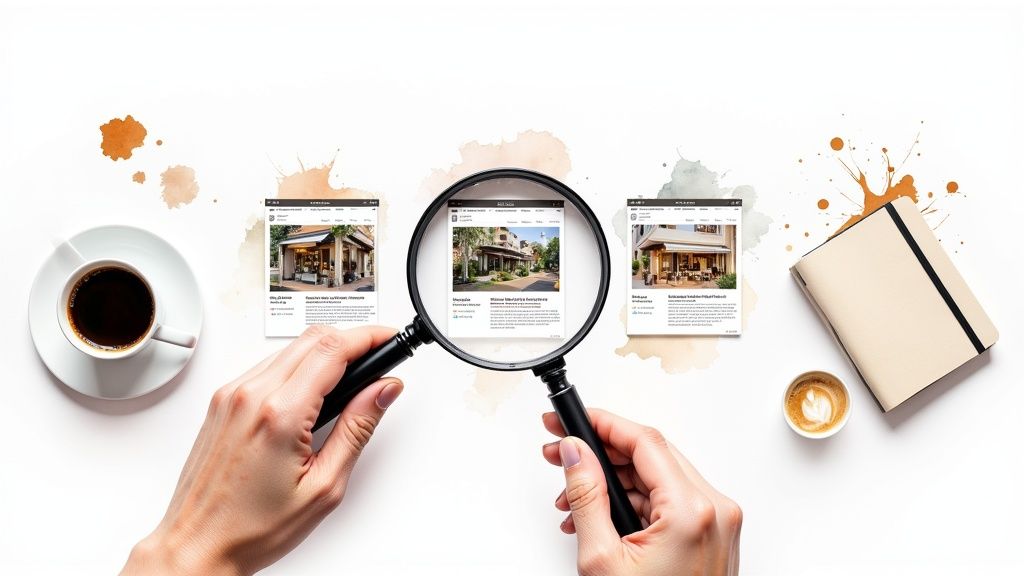
But here's the thing: you’re not just looking for a pretty picture. You're looking for proof that they can build something that works for your business. Reading a portfolio is a skill, and it’s about looking past the shine to find the substance underneath.
Think of a portfolio like an artist's gallery; it shows you what they're capable of. But you need to be a savvy critic.
First up, take a wide view. Do all their websites have the same vibe? A one-trick pony is fine if that one trick is exactly what you want, but a diverse portfolio shows adaptability and a real creative range. A good designer can match their style to the client's brand, not the other way around.
Then, narrow your focus. Have they worked with businesses like yours? It doesn’t have to be another cafe on Cuba Street, but seeing experience in your industry—whether it's professional services, e-commerce, or a local trade—is a huge green flag. It tells you they already get your audience’s expectations.
A portfolio that only showcases trendy, flashy designs might look impressive, but ask yourself: does it show they can solve real business problems? Look for case studies that explain the why behind the design, not just the what.
If you're curious to see what this looks like in practice, you can explore a variety of our past projects [https://nzapps.co.nz/project.php] to get a feel for how strategy informs design. It’s that connection between aesthetics and results that you’re really hunting for.
This is where you stop being a viewer and start being a user. Don't just look at the static images in their portfolio; click through to the live websites they've built. This is non-negotiable.
How does it feel to navigate the site? This is what we call User Experience (UX). It’s just a professional term for something you already understand intuitively: is the site easy and enjoyable to use, or is it a frustrating mess?
Here’s a quick mental checklist to run through as you click around:
Honestly, if you find yourself getting annoyed or confused while exploring one of their client's sites, that's a big warning sign. Remember, you’re not just buying a design; you're investing in a partnership with a team that needs to understand your customers. Their portfolio is your first and best clue as to whether they truly get it.
Moving on from portfolios, let's talk about the first real conversation.
You’ve done the hard yards. You’ve sifted through portfolios and narrowed your list down to a few promising agencies for your web design in Wellington. Now comes the first real chat—the moment of truth.
This initial meeting is where you separate the genuine partners from the smooth talkers. It’s your chance to dig deeper and see if they truly understand your business and have the chops to deliver. But what on earth should you ask?
Let's get past the obvious "How much will it cost?" and into the questions that really matter. These are the queries that reveal how an agency works, what they value, and whether they’re the right long-term fit for you. Honestly, getting clear answers now will save you a world of headaches down the track.
Before you even talk about design mock-ups, you need to understand how they operate. A project can easily fall apart due to poor communication, even with the most talented designers on board. Think of this as checking the foundations before you start admiring the paint colour.
You need to know how they’ll keep you in the loop. Are we talking scheduled weekly calls, a shared Slack channel for quick questions, or just a flurry of emails when a deadline is looming? There’s no single right answer here, but their process absolutely needs to match how you like to work.
Here are a few sharp questions to get you started:
I've put together a more detailed list of questions to help you cover all your bases. Don't feel like you have to ask every single one, but use this as a checklist to make sure you're not missing anything critical.
| Question Category | What to Ask | Why It's Important |
|---|---|---|
| Process & Strategy | What's your discovery process like? How will you get to know my business, my customers, and my goals? | A good agency digs deep first. This shows if they’re building a strategic tool or just a pretty brochure. |
| Communication | Who is my main point of contact, and how often will we communicate? | Establishes clear lines of communication and sets expectations for how you’ll be kept in the loop. |
| Design & UX | How do you approach user experience (UX)? Can you show me an example of a site you built that solved a specific user problem? | You want a site that's easy for your customers to use, not just one that looks nice. This tests their user-centric approach. |
| Technical & SEO | What platform (e.g., WordPress, Shopify) do you recommend, and why is it the best fit for my business? | The right platform is crucial for future growth and ease of use. Their reasoning reveals their expertise. |
| Local SEO | How will you ensure my website is visible to customers here in Wellington? | Tests their knowledge of local SEO, which is vital for attracting nearby customers. They should mention Google Business Profile. |
| Launch & Handoff | What kind of training is provided once the site is live? | Ensures you and your team know how to manage and update the website without having to call them for every small change. |
| Ongoing Support | What happens after launch? Do you offer maintenance plans, and what do they include? | A website needs ongoing care. This clarifies if they’ll be a long-term partner or if you're on your own post-launch. |
| Scope & Revisions | How many rounds of revisions are included in the price? What’s the process if we need more? | Avoids "scope creep" and unexpected bills. It’s important to understand the boundaries of the initial agreement. |
Asking these questions gives you a 360-degree view of the agency, moving the conversation from a simple sales pitch to a proper technical and strategic discussion.
You don't need to know how to code, but you do need to feel confident that they do. This part is about ensuring the website they build is fast, secure, and most importantly, visible to your future customers. After all, a beautiful site that no one can find is just a very expensive piece of art.
So, how do you probe their technical chops?
A great place to start is asking about their approach to making sure Wellingtonians can actually find you on Google. A good agency should bring up local SEO from the very beginning. They should mention things like optimising your content for local keywords and properly setting up your Google Business Profile.
A key, often overlooked question is: "What happens after the site goes live?" You need to know if they offer ongoing support and maintenance, or if you're suddenly on your own. This isn't just a transaction; it's the start of your website's life.
Finally, ask about the technology they use. Are they building on a platform like WordPress, Shopify, or a fully custom solution? More importantly, why are they recommending that specific platform for your business? A great web design partner will have a solid reason that connects directly back to your specific goals. They aren’t just building a website; they’re building a powerful tool for your business's success.
Let’s talk about the elephant in the room: money.
Getting a straight answer on website pricing can feel like trying to nail jelly to a wall, can't it? The classic answer from pretty much any agency is, "Well, it depends." While that's true, it doesn't exactly help when you're trying to figure out your budget.
Honestly, it can be a frustrating dance. You just need a number, but agencies need to really dig into your goals before they can give you an accurate one. So, let’s pull back the curtain and break down the real-world costs for web design in Wellington to give you a much clearer picture.
Thinking about the cost of a website is a bit like buying a car. A basic run-around will get you from A to B, no problem. But a high-performance vehicle with all the bells and whistles? That’s going to cost significantly more.
The same logic applies here. The final price is shaped by the project's complexity, any custom features you need, and the level of expertise you’re paying for.
A simple "brochure" website for a local cafe, with just a menu, opening hours, and a contact form, is going to sit at the lower end of the spectrum. But an e-commerce store for a retailer on Victoria Street, complete with payment gateways, live inventory management, and customer accounts? That's a different beast entirely.
So, what can you actually expect to pay? The web design market here in New Zealand covers a huge range. A typical website build can start from around NZD 1,000 for something very basic and go all the way up to NZD 35,000 or more for a complex, custom-built platform.
This range shows a healthy, varied market that serves everyone from sole traders to large companies across Wellington and the rest of the country. For a much more detailed breakdown of what different price points get you, check out our guide on how much a website costs in NZ.
The key takeaway is this: you're not just buying a design. You're investing in a critical business tool. The right investment pays for itself through new leads, increased sales, and a stronger brand presence.
Here’s the part that often catches people by surprise: the ongoing costs. A website isn't a one-and-done purchase; it’s more like a garden that needs regular tending to thrive. To get a better handle on the financial side, it can be helpful to see how different platforms price their services, which helps you understand general website pricing models.
Make sure you ask potential agencies about these often-unmentioned expenses:
.co.nz address needs to be renewed every year.Understanding the full investment—both the upfront build cost and the ongoing fees—is the only way to get a fair deal and avoid any nasty surprises down the line. It helps you value the work properly and ensures the partnership kicks off on solid, transparent ground.
A stunning website is a fantastic start, but let's be blunt: it’s just a digital billboard in the desert if nobody in Wellington can find it. What’s the point of a beautiful site if your potential customers on Courtenay Place or in Khandallah never see it?
This is where local Search Engine Optimisation (SEO) comes into play. It’s the secret sauce that gets your business to show up when someone searches for ‘best flat white near me’ or ‘plumber in Te Aro’.

Here’s the thing—generic, one-size-fits-all SEO just doesn't cut it for a local Wellington business. The competition here is getting fiercer by the day. You're not just competing with other businesses; you're competing for the attention of a very specific audience.
Think about how you search for things yourself. You don’t just type ‘coffee’; you type ‘coffee Lambton Quay’. You're looking for something close, convenient, and relevant to where you are right now. Your customers are doing the exact same thing.
A good web design Wellington agency gets this. They should be all over your local SEO strategy from day one, not treat it as an afterthought. This involves much more than just stuffing "Wellington" into your website content a few times.
It's about the technical, behind-the-scenes work that signals to Google that you are a legitimate, local business serving this specific community.
A truly effective local SEO strategy is about making sure you're highly visible to the people who can actually walk through your door or hire your service: your fellow Wellingtonians. It’s about geographic relevance, plain and simple.
So, what does this actually look like in practice? It starts with the fundamentals. Your chosen web agency should immediately be talking about your Google Business Profile (GBP). This is that little map and info box that appears in search results—and it’s pure gold for local businesses.
Beyond that, it’s about optimising your site for the keywords your actual neighbours are using. This involves understanding local slang, landmarks, and the unique character of our city.
In a competitive market, you need every edge you can get. It's not just about basic visibility anymore. For instance, understanding how Google reviews impact SEO can give your online presence a significant boost.
The digital sector is a huge part of our local economy. In fact, Computer System Design and related services are a massive driver here, which just shows how critical a solid digital presence is for any business trying to thrive. Your website is your ticket to being part of that growth.
Right, you’ve done it. You’ve reviewed the proposals, picked your web design partner, and signed the contract. A massive congratulations are in order! It’s a huge step forward for your business.
But as the initial excitement settles, you might be thinking… what happens now? It's a common feeling. A top-notch agency won't just take your deposit and vanish. They'll have a clear, structured process to guide you from this moment right through to launch day. Knowing what’s coming makes the whole experience feel less like a mystery and more like the creative partnership it should be.
Let’s pull back the curtain on what really happens between signing that contract and popping the champagne on launch day.
The first step isn't about picking colours or fonts. It's all about talking. This is the discovery phase, and honestly, it’s one of the most critical parts of the whole project. Your agency needs to get right under the bonnet of your business—what are your goals? Who are your customers? What does your competition look like? What does success actually mean for you?
Think of it as laying the foundation for a house. You can't build a solid home on shaky ground, and you certainly can't build a website that gets results without this deep initial understanding. Expect workshops, in-depth questionnaires, and a lot of questions. Be ready to share everything you know; your expertise in your own business is absolutely priceless here.
Once the strategy is locked in, the creative gears start turning. This usually kicks off with something that looks a bit abstract, like a wireframe. A wireframe is essentially the architectural blueprint for your website. It maps out where everything will go—buttons, text blocks, images—without any of the flashy design. The focus is purely on structure and how a user will move through the site.
After you’ve given the wireframes the thumbs-up, the real visual magic begins. The designers will create mock-ups, which are static, full-colour images of what your final website will look like. This is where your brand's personality truly comes to life through:
Your feedback during this stage is crucial. It’s your best opportunity to make sure the visual direction feels right before a single line of code is written.
With the designs approved, the developers step in. They’ll take those beautiful, static mock-ups and transform them into a fully functional, interactive website. You might not hear from them every day during this phase, but rest assured, there's a huge amount of work happening behind the scenes.
Before the site goes anywhere near the public, it undergoes rigorous testing. The agency will be hunting for bugs, making sure it works perfectly on every device (phones, tablets, and desktops), and testing its loading speed. You’ll also get a link to a private 'staging' version of the site to click through and ensure everything works exactly as you envisioned.
Here's a pro tip: One of the most overlooked details in any contract is intellectual property. Always make sure you own the final website outright once the final payment is made. It's your business, and the site should be your asset, with no strings attached.
After your final approval, it's launch day! The agency will handle all the technical bits and pieces to make your new website live for the world to see. A great partner won't just wave goodbye at this point, either—they'll provide training on how to use your new content management system and talk you through ongoing support options to keep your site secure, updated, and performing at its best.
Ready to start a partnership that takes the guesswork out of building a brilliant website? The team at NZ Apps is here to guide you through every step of the process, ensuring your project is a success from discovery to launch and beyond. Get your free consultation today!