
Think of a proper website as your business's digital home base. It gives you a level of credibility and control that a social media page just can't deliver. It’s the central hub for your brand, a space you actually own, that makes your business visible to customers who are actively looking for what you offer. You know?
Let's cut straight to the chase. Relying only on a Facebook page or an Instagram profile for your business is like renting a market stall instead of owning your own shop. You're definitely visible, but you're operating in someone else's space, and you have to play by their rules. What happens when the algorithm changes yet again? Poof.
The strange reality is that a huge number of Kiwi businesses are still on the digital sidelines. In New Zealand, a staggering gap remains, with only 53 percent of NZ businesses currently having a website—a figure that's been stubbornly stuck since 2022. This is especially wild when you learn that 61 percent of businesses themselves say a website is their most critical digital tool. There’s a massive disconnect between knowing what you need and actually getting it done. Honestly, it's a bit mad.
This isn't just about looking professional; it's about being found. When a potential customer in Auckland or Christchurch needs a plumber, a cafe, or a consultant, their first move usually isn't scrolling through social media. They head straight to Google.
If you don't have a website, you are, for all intents and purposes, invisible to them.
Think about your own online habits for a moment. When you’re checking out a new business, don't you almost instinctively look for their website? It’s a quick credibility check. A well-put-together site says a few important things:
A social media page, with its constant distractions and unpredictable formats, just doesn’t build that same sense of authority. It's a fantastic place for conversations and quick updates, but your website is your digital storefront. It's the one place where you control the entire customer journey, from their first impression to the final sale. It’s your permanent address on the internet.
Here’s the thing: you don't actually own your social media followers. The platform does. Your account could be suspended, your reach could be strangled overnight, or the platform could simply fall out of fashion. All the hard work you poured into building an audience could vanish.
Your website, on the other hand, is an asset you own completely. You control the design, the content, and the data. It's the foundation upon which you can build a resilient, long-term marketing strategy that isn't dependent on the whims of a tech giant.
And you can go far beyond a static site. A dedicated mobile web application can act as a central hub for your operations, integrating powerful features like customer loyalty programmes directly into your digital home base.
This guide is all about closing that gap between knowing you need a website and actually getting one that works hard for your business. We'll walk through the entire process, making sure the website design for your small business gives you a real competitive edge, not just another tick on your to-do list. Let's get to work building your digital headquarters.
Alright, let's talk about the elephant in the room. Money.
It’s the one question every single business owner has, and honestly, it’s the hardest one to answer with a simple number. Asking "How much will my website cost?" is a bit like asking, "How much does a house cost?" Well, are we talking about a tidy little bach or a sprawling mansion?
The same logic applies to building a website for your small business. The final price tag is a direct reflection of what you need it to do. Are you after a simple, elegant online brochure to establish your presence? Or do you need a complex e-commerce machine to handle hundreds of products and secure payments?
The good news is you don’t need a corporate-sized budget to get a professional, effective website in New Zealand. It's time to shift your thinking from "cost" to "investment"—because a great website isn't just an expense; it's a hard-working asset that generates leads, builds trust, and makes you money while you sleep.
Let’s get down to brass tacks. While every project is unique, we can definitely talk about some typical investment ranges you can expect here in NZ.
For a new business just getting started, a professional, well-designed "brochure" website—think a handful of pages like Home, About, Services, and Contact—can start from around $2,000 NZD. This gets you a custom, polished online presence that blows any DIY attempt out of the water.
When you start adding more complexity, like the ability to sell products online, you're looking at a different ballpark. E-commerce platforms are far more involved, requiring product databases, shopping carts, and secure payment gateways that work smoothly for Kiwi customers. These projects often start from $3,500 and can go over $10,000, sometimes much more depending on the scale.
The key takeaway is this: you're not just buying a design. You're investing in a strategic tool built to achieve specific business goals. A $5,000 website that brings in $20,000 of new business in its first year is a phenomenal investment, isn't it?
To give you a clearer picture, here’s a breakdown of what you might expect to invest for different types of websites.
| Website Type | Estimated Cost (NZD) | Best For |
|---|---|---|
| Starter "Brochure" Site | $2,000 - $4,000 | New businesses needing a professional online presence to build credibility and showcase services. |
| Small Business Site | $4,000 - $8,000 | Established businesses needing more pages, custom features like a blog, or advanced contact forms. |
| Basic E-commerce | $5,000 - $10,000 | Businesses ready to start selling a small catalogue of products online with secure payments. |
| Custom E-commerce | $10,000+ | Businesses with large product inventories, custom shipping rules, or specific integration needs. |
These are just guideposts, of course. The final figure will always depend on your specific requirements, but this should give you a realistic starting point for your budget.
Okay, so why the big range? A few key factors determine the final quote. It's not arbitrary—it’s based on the time, skill, and resources required to build exactly what you need.
Let’s break down the main culprits that influence the cost:
Understanding these elements helps you see where your money is going. You’re paying for expertise and time—the focused effort it takes to build a digital tool that genuinely serves your business. You can explore more about what's involved by checking out our guide on website design costs in New Zealand. It’s all about getting real value, not just a low price.
Before you even think about colours, fonts, or fancy animations, we need to talk strategy. Honestly, jumping straight into design without a solid plan is a recipe for disaster. It’s like a builder showing up to a site with no architectural drawings – you might get four walls and a roof, but good luck finding the front door.
This initial planning stage is where you save yourself a world of future headaches, time, and, surprisingly, a lot of money. It’s all about being deliberate and asking the big questions first.
First up, what is your website's main job? It sounds almost too simple, but it's staggering how often this gets glossed over. A website without a clear goal is just a pretty online brochure, and your business deserves better than that.
Is its primary purpose to:
Nailing the 'why' behind your website is the foundation for everything else. It dictates every single decision that follows, from the layout of your homepage to the exact words on your contact button. Without a clear goal, you’re just throwing things at the wall and hoping something sticks.
Okay, so you know what you want the site to do. But what about your customers? A website isn't really built for you; it's built for them.
You have to put yourself in their shoes. Picture your ideal customer – maybe they're a busy parent in Christchurch or a small business owner up in Auckland. What problem are they trying to solve when they stumble upon your site? Are they in a rush? Are they scrolling on their phone while waiting for a flat white?
A successful website is designed to meet the needs and preferences of a clearly defined target audience. It anticipates their questions and makes it ridiculously easy for them to find the answers.
This means your website needs to be more than just a list of what you sell. It needs to speak their language, understand their pain points, and guide them effortlessly towards the very solution you offer. A bit of empathy goes a very long way.
This flowchart shows how planning your budget is directly tied to the complexity and goals you set for your website.
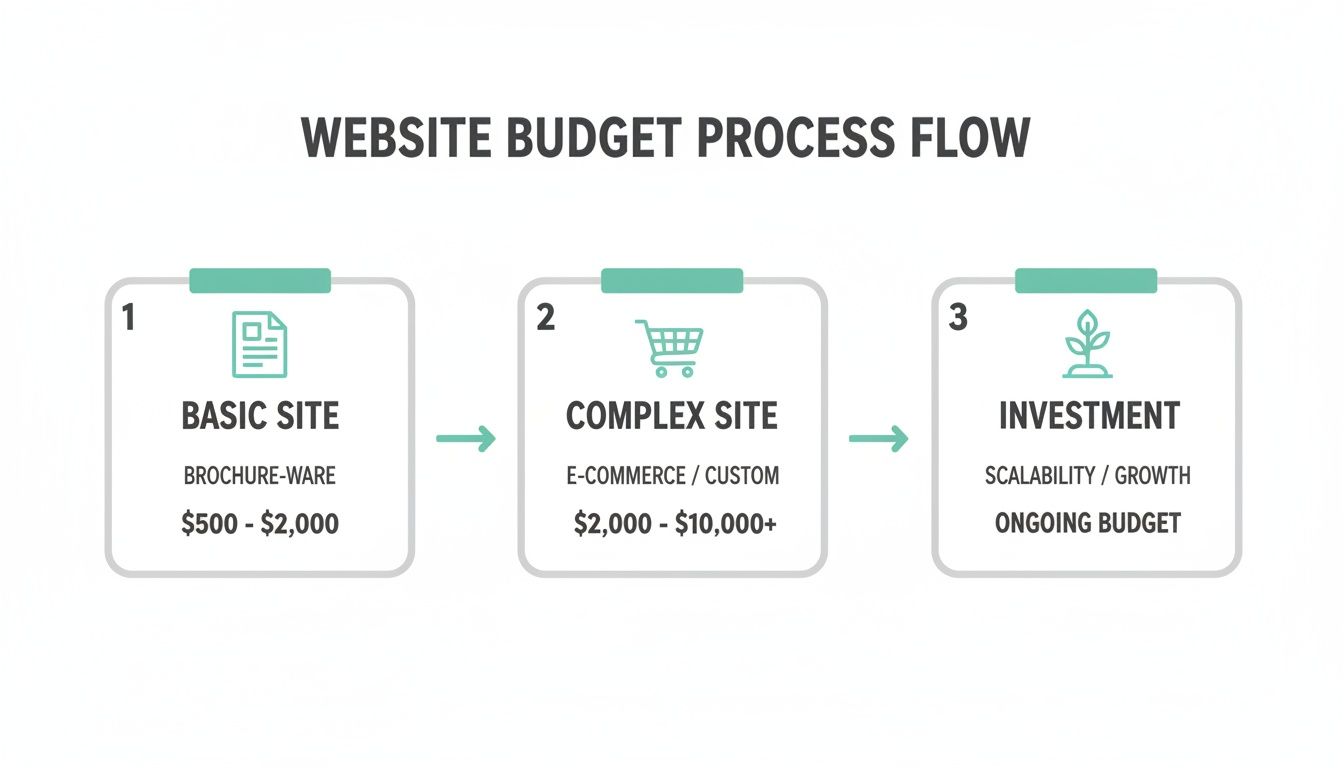
As you can see, a simple brochure site meets basic needs, but a more complex build is a long-term business investment designed for growth.
Once you know your goal and your audience, it’s time to sketch out the map. This involves planning the key pages and, crucially, how a visitor will move between them. In the industry, we call this a sitemap or a user journey.
You don’t need any fancy software for this part. A pen and paper or a simple whiteboard session works perfectly. Start with the non-negotiables that pretty much every Kiwi small business website needs:
From that base, you might add a blog to share your expertise, a gallery to show off your projects, or a testimonials page to build trust. The key is creating a logical, intuitive flow. Each page should lead a visitor naturally to the next step, guiding them from casual interest to decisive action. This strategic blueprint is what separates a website that just looks good from one that actually works.
Here’s a hard truth about website design: a beautiful site that’s a nightmare to use is completely useless. Imagine walking into a stunningly designed cafe but having no idea where to order. You can admire the decor, but you’ll eventually leave without your flat white.
This is where we need to talk about the two sides of the design coin: User Interface (UI) and User Experience (UX). Think of UI as the ‘look’—the colours, fonts, and images that create your visual vibe. UX is the ‘feel’—how easy and enjoyable it is for someone to actually use your site. You absolutely need both working together.
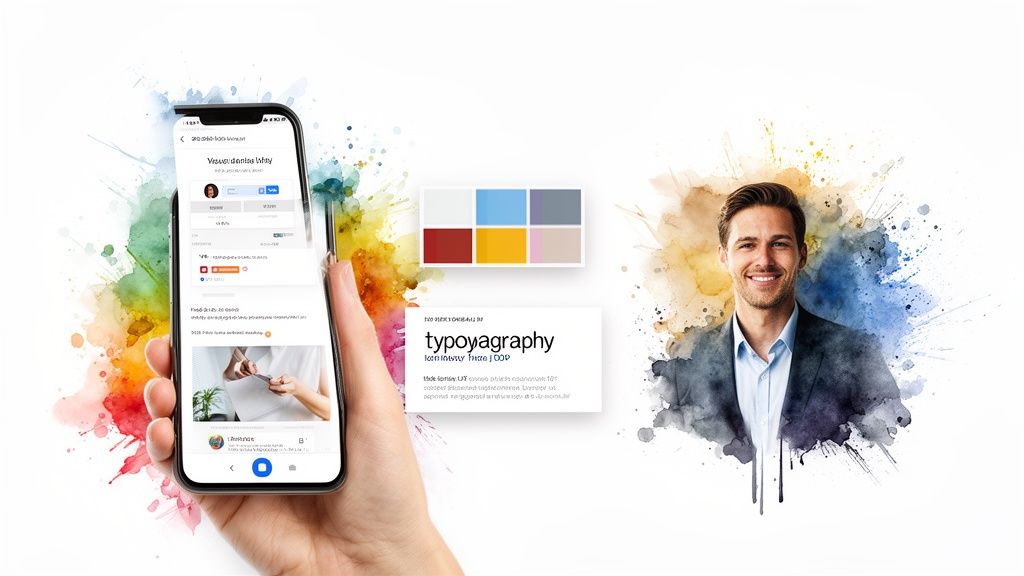
A great design doesn't just look pretty; it guides your visitors. It anticipates what they need and puts it right where they expect to find it, preventing that frustrating feeling of being lost and clicking away to a competitor.
Your visual identity is so much more than a logo plopped in the top corner. It's the entire aesthetic that communicates your brand's personality before a visitor reads a single word. Is your brand warm and friendly? Sleek and professional? Edgy and modern?
Getting this right involves a few key ingredients:
These elements work together to create a cohesive look that feels authentic. This isn't just about decoration; it's about making a genuine connection and a great first impression.
This is where we get into the magic of User Experience. UX is the invisible architecture of your site. It’s less about how it looks and more about how it works. A good UX designer is obsessed with one question: how can we make this easier for the user?
Let me explain. Good UX means that when someone lands on your homepage, they immediately understand what to do next. The navigation is logical, the buttons are clearly labelled, and the path to making a purchase or getting in touch is incredibly straightforward.
A common mistake is designing a website for yourself, based on your own knowledge of the business. You have to remember: your visitors don’t have that inside information. A truly effective website is designed for them, from their perspective.
This is where a human-centred design approach becomes so important. It’s all about empathy—understanding the user’s goals and frustrations to build something that genuinely helps them. Check out our guide on what human-centred design means in practice for a deeper look.
This attention to detail pays off in a big way. The impact of professional website design for small businesses is clear when you see the results. For example, we've seen firms achieve an incredible 98 percent renewal rate among over 1,000 clients nationwide, with only 2 percent lost to business closures. That kind of customer loyalty doesn’t happen by accident; it's built on user-friendly designs that deliver real returns.
Let's be blunt: if your website isn't great on a phone, it's not a great website. End of story.
The days of designing for a big desktop monitor and then shrinking it down for mobile are long gone. Today, the approach is mobile-first. This means the design process starts with the smallest screen and works its way up. Why? Because it forces you to focus on what’s truly essential.
There’s no room for clutter on a mobile screen. You have to prioritise the most important information and actions, ensuring the experience is clean, fast, and intuitive. A mobile-friendly website isn't just a "nice to have"; it's a fundamental requirement for any serious business in New Zealand today. When a customer is looking you up on their phone from their car or a cafe, that first interaction will make or break their decision to engage with you.
You can have the most stunning website on the internet, but if no one can find it, does it even exist? Honestly, that’s not an exaggeration. This is where a slightly intimidating term comes into play: Search Engine Optimisation (SEO).
But don’t let the jargon scare you off. SEO is just the process of making your website more attractive to search engines like Google. When you get it right, it means you show up at the exact moment someone in Auckland or Dunedin is actually searching for what you offer.
It’s the difference between having a shop hidden down a back alley versus having prime real estate on the main street. Any good website design for a small business has to include a solid plan for SEO from day one.
So, where do you even start? The biggest mental shift is to stop thinking about what you call your services and start thinking about what your customers are typing into Google.
Most people aren't searching for your business by name, especially if they’ve never heard of you. They search for a solution to their problem.
These phrases are called keywords. Your job is to figure out which keywords your ideal customers are using, then gently weave them into your website's content. This isn’t about stuffing words everywhere; it’s about naturally answering the questions people are asking.
The core idea of SEO is simple: be the most helpful answer to a customer's problem. When your website provides genuinely useful information, Google takes notice.
Helpful content is the absolute fuel for your SEO engine. And it’s not just about blog posts, either. It’s the words on your homepage, your service descriptions, and even your 'About Us' story.
For most Kiwi small businesses, trying to compete for national or global attention is a massive waste of time and money. What you really want is to capture the attention of customers right in your local area. This is called local SEO, and it’s your secret weapon.
A huge piece of this puzzle is your Google Business Profile (you might remember it as Google My Business). Ever searched for a business and seen that box pop up on the right with their hours, phone number, and a map? That’s it.
Getting this profile set up and optimised is non-negotiable. It’s a powerful, free tool that shouts to Google that you’re a legitimate local business. This is exactly how you show up in those all-important "near me" searches and on Google Maps.
Let's talk about the content itself. A blog or a "News" section on your website is one of the single best things you can do for your local SEO. Why? Because it keeps your website fresh and active, which search engines absolutely love.
More importantly, it gives you a platform to answer those specific customer questions we talked about earlier.
See how that works? You’re not just selling; you’re helping. You're proving your expertise, building trust, and naturally using the exact phrases your local customers are searching for. Every new post is another signpost pointing people back to your website.
This kind of strategy builds incredible long-term value. For a more detailed breakdown, our friends at NZ Apps have put together an excellent resource on local SEO for small businesses in NZ that is well worth a read.
At the end of the day, SEO isn't some dark art. It's about understanding your customers, being genuinely helpful, and making sure the technical side of your site is tidy so Google can easily see what you're all about. Get this right, and you'll have a steady stream of local customers finding their way to your digital front door.
We get it. Commissioning a website is a big decision, and it’s natural to have a few questions swirling around. We’ve heard them all over the years, so let's tackle some of the most common ones we hear from Kiwi business owners, with straightforward answers to give you some clarity.
Honestly, it varies. A simple, professional website can often be turned around in 4-6 weeks. If you're after something more complex with e-commerce, custom bookings, or unique features, you’re likely looking at 8-12 weeks, maybe a bit longer.
The biggest variables are always the complexity of the design and how quickly you can provide your content and feedback. A good partner will always map out a clear timeline upfront so there are no surprises down the track.
You certainly can, and for some hobby businesses or brand-new ventures, it might seem like a good place to start. But here’s the thing you need to know: DIY builders come with some real limitations.
They can be restrictive when you want a unique design, need specific functions, and especially when it comes to SEO. Getting found by local customers in New Zealand is much harder when your site isn't properly optimised from the ground up.
Think of it like the difference between a kitset shed and an architecturally designed home. One gets the job done for now, but the other is built from the ground up for long-term value and growth.
A professional website design for your small business ensures your site is truly one-of-a-kind and can grow with you, not hold you back.
A website isn't a 'set it and forget it' project; it’s a living part of your business that needs ongoing care to perform at its best.
Once your site is live, it needs attention. This typically includes:
Many agencies offer monthly maintenance plans for complete peace of mind. You'll also want to think about adding fresh content over time, like new project galleries or helpful articles. This not only keeps your site interesting for visitors but also gives your search rankings a healthy boost. If you're new to this, check out this simple guide to SEO for small business for some great starting points.
Feeling clearer about the path ahead? At NZ Apps, we specialise in creating websites that not only look fantastic but also work hard for your business. Let's chat about building your digital headquarters. Get in touch for a free consultation today!