
Right, let's get straight into it. You’re here because you want to know about website design prices in New Zealand. For a Kiwi small business, a simple website can kick off from around $2,000, but more complex e-commerce or custom-built sites can easily climb to $15,000 to $50,000+. Honestly, the final figure boils down to one simple question: what do you need your website to do?
Trying to nail down a single price for a website is a bit like asking, "How much does a vehicle cost?" Are you after a reliable ute for weekend runs to Mitre 10, or a heavy-duty truck ready to haul serious gear across the country? They both get you from A to B, but their purpose—and their price tag—are worlds apart.
A website is exactly the same. It's not just an online brochure; it's your most dedicated employee, working around the clock without ever stopping for a smoko.
Before you start hunting for quotes, it helps to know which ballpark you're playing in. A basic online presence for a local Christchurch café is a completely different project to a sophisticated e-commerce platform for a fashion brand shipping out of Auckland. You wouldn't buy a Ferrari just for the school run, would you?
To help, here’s a quick look at where your project will likely fit.
A website is a business tool, and its price tag should reflect the value it's expected to create. A $2,000 site should establish your credibility, while a $20,000 site should be actively generating revenue and making your operations more efficient.
To give you a clearer idea, here's a rough breakdown of what you can expect to pay for different types of websites in New Zealand.
This table offers a snapshot of typical price ranges for small to medium-sized businesses across the country. Think of it as a starting point for your budget planning.
| Website Type | Typical Price Range (NZD) | Best For |
|---|---|---|
| Brochure Website | $2,000 – $5,000 | Tradies, consultants, artists, and small local businesses needing a professional online presence. |
| Small Business Website | $5,000 – $12,000 | Growing businesses wanting to generate leads with features like a blog, case studies, and lead capture forms. |
| Small E-commerce Store | $8,000 – $20,000 | Retailers and startups looking to sell a curated range of products online with standard payment gateways. |
| Large E-commerce / Custom | $20,000 – $50,000+ | Established businesses needing a powerful online store with custom features, integrations, and high traffic capacity. |
Remember, these are ballpark figures. The final cost will always depend on your specific needs and the unique features your site requires.
You'll quickly find that quotes can vary wildly from one designer or agency to the next. This isn't usually because someone is trying to pull a fast one; it's because everyone's approach is different. Some might use pre-made templates to keep costs down, while others will build everything from scratch for a truly one-of-a-kind result.
When you're presented with different packages, mastering the art of designing a clear price table can make a massive difference in how you perceive the value on offer. It helps you compare what’s included in each tier, making sure you know exactly what you're paying for.
Getting that clarity right from the start is absolutely essential. It cuts through the confusion and ensures everyone knows what's what from day one.
Every Kiwi business, big or small, has to start somewhere online. For most, that first step is what the industry calls a ‘brochure’ website. Honestly, that name sells it short.
Forget flimsy paper pamphlets. Think of it more like your digital handshake. It’s your 24/7 salesperson, your always-on receptionist, and the best way to build a bit of trust before a customer even picks up the phone. It's the online equivalent of a firm, confident introduction.
This kind of site is the perfect launchpad for a local tradie, a consultant, or a new cafe in places like Christchurch or Dunedin. It’s all about looking professional and making it incredibly easy for people to find you and get in touch. It just nails the basics.
So, what does your money actually get you at this entry-level? We’re talking about a clean, professional site that has all the core pages a customer expects to find.
This chart gives you a quick visual summary of where a basic brochure site sits in the grand scheme of things.
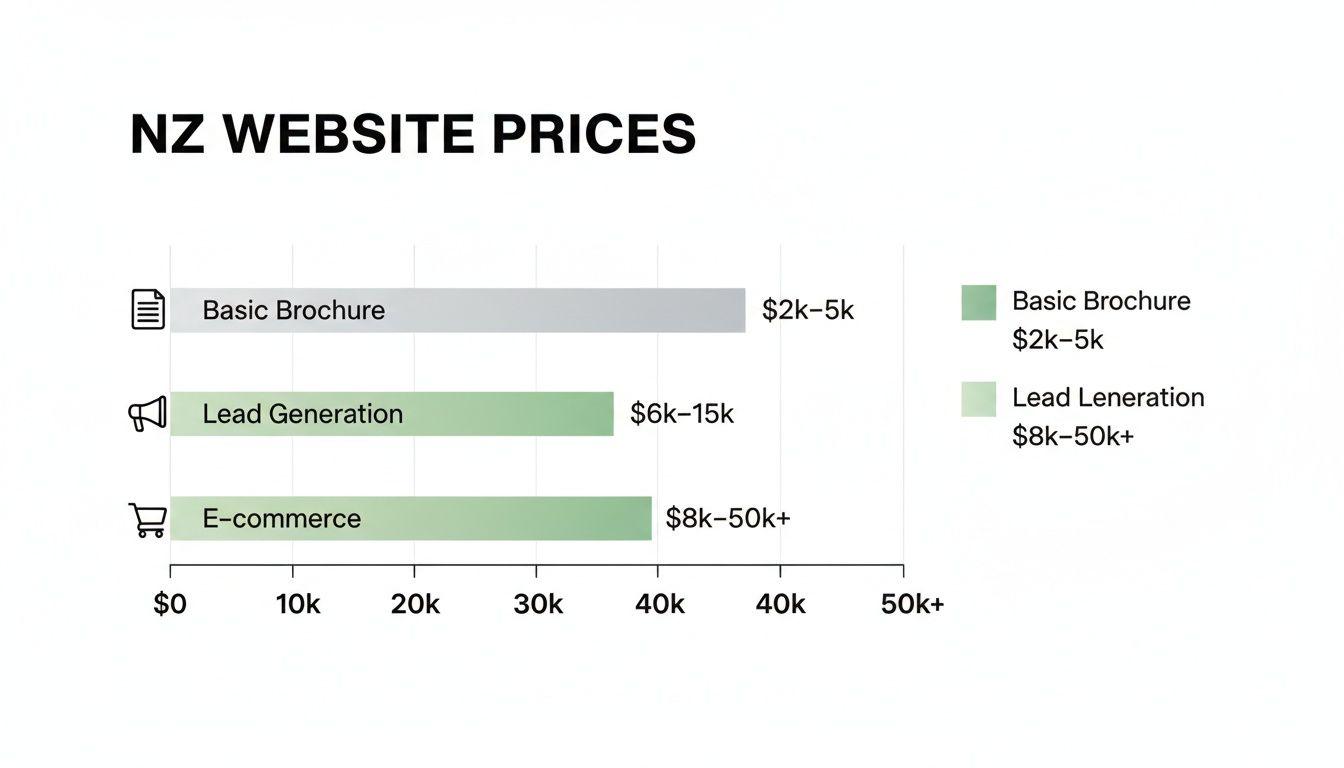
As you can see, the brochure site is the most accessible entry point. Costs naturally climb as you add more complex features like lead generation tools or full e-commerce functionality.
In New Zealand's market, small businesses can expect website design prices for these essential brochure sites to start around $2,000 to $5,000 NZD. That price usually covers those crucial 3-5 pages. An interesting local tip is that Christchurch prices are often 10-20% lower than Auckland's, which is handy to know if you're a startup watching every dollar.
At this price point, you’re generally looking at two different ways of building the site: template-based or semi-custom.
A template is a bit like buying a suit off the rack. It looks sharp and gets the job done, but it wasn't made specifically for you. A designer will take a pre-made design and drop in your logo, brand colours, and content. It’s a fast and very affordable way to get online.
A semi-custom approach is more like getting that off-the-rack suit tailored. The designer starts with a solid, proven foundation but then modifies the layout, fonts, and structure to better fit your unique brand. It costs a little more, but you end up with a more distinctive online presence. For a lot of small businesses, finding the right website developers for small business who understand this balance is the key to getting great value.
A "mobile-responsive" design isn't a luxury feature anymore; it's a basic requirement. It simply means your website will automatically adjust to look great and work perfectly on any screen, from a big desktop monitor to a tiny smartphone.
Have you ever tried to use a website on your phone where you have to pinch and zoom just to read anything? It’s a total nightmare. A properly responsive site ensures every customer has a smooth experience, whether they’re looking up your address from their laptop at home or booking an appointment from their phone while on the bus. Getting this right is absolutely fundamental.
Alright, so you've moved past needing a simple digital business card. The basic brochure site has done its job, but now you’re hungry for more – a website that doesn’t just sit there looking pretty but actually gets to work bringing in new business. You're ready for a lead generation machine.
This is where things start to get really exciting. It's the difference between a static flyer and an interactive sales presentation that’s working for you 24/7.

So, what does this next-level website actually have? Why do the website design prices start to climb a bit here? It all comes down to adding features that turn passive browsers into active leads.
These sites are built for action.
Ultimately, a well-designed website aims to build trust and drive action, and this is massively helped by showcasing effective website testimonials that highlight your proven success. They turn a simple claim into a believable story.
Here’s the thing—at this level, a cookie-cutter template just won't cut it anymore. You need a design that captures the unique personality of your brand. It’s about creating a look and feel that instantly tells visitors, "Yep, you're in the right place."
This is where custom design and a thoughtful user experience (UX) become absolutely critical. A good designer will think deeply about your ideal customer. What are their pain points? What information do they need to make a decision? The entire site is then structured to guide them smoothly from initial curiosity to making contact.
A lead generation website isn't just about looking good; it's a strategic tool. Every element, from the button colours to the page layout, is chosen with a single purpose in mind: to encourage a visitor to take the next step.
This kind of investment is especially valuable for professional services—think lawyers, accountants, consultants—and specialised trades like high-end builders or electricians. When a single lead can be worth thousands of dollars, a website that consistently brings them in pays for itself over and over again.
And let's not forget the magic ingredient that makes it all work: foundational SEO. What’s the point of a brilliant website if nobody can find it? This is where a bit of technical wizardry comes into play.
A growth-focused site is built with search engines in mind right from the start. This means optimising page titles, writing keyword-rich content, and making sure the site is technically sound so Google can easily understand what you're all about. This is exactly how you start showing up when a potential customer in your area searches for the services you offer. If you want to dive deeper, our guide on search engine optimisation in New Zealand is a great place to start.
For established small to medium businesses in New Zealand looking for a proper lead-generating website, you can expect design prices in 2025 to be in the $6,000 to $15,000 NZD range. This is often seen as the sweet spot for a multi-page site with a blog, solid SEO, and features that drive real results.
Interestingly, if you're based in Christchurch, you might find prices at the lower end of that scale—around $5,000–$15,000—which is often 10-20% below typical Auckland rates.
Ready to start selling online? This is where we step into a completely different league. If a simple business website is like a digital brochure, an e-commerce site is a full-blown retail store. It's got the shop front, the stockroom, the tills, and the customer service desk, all humming along 24/7.
It’s no surprise, then, that website design prices take a serious jump here. You're not just paying for a nice-looking gallery of your products; you're investing in the complex machinery that keeps the whole operation running smoothly behind the scenes.
The conversation shifts from displaying information to building powerful, reliable systems that have to work flawlessly, every single time. It's a big step up.
When you begin selling online, the list of ‘must-haves’ grows surprisingly fast. You're no longer just putting up information—you're handling sensitive financial transactions, managing customer data, and creating a seamless shopping journey from start to finish.
Here’s a small taste of what's going on under the bonnet:
Getting all these different parts to talk to each other is a complex job, and that's what drives a huge chunk of the cost.
Every website is a collection of features and functions, and each one adds to the final price tag. Some have a small impact, while others represent a significant investment in time and technology. Here’s a quick breakdown to help you see where the costs lie.
| Cost Factor | Low Impact (Included in Basic) | Medium Impact (Adds Cost) | High Impact (Significant Investment) |
|---|---|---|---|
| Pages | 5-10 standard pages | 10-50 pages with blog/news | 50+ pages, complex architecture |
| E-commerce | Not included | Basic product listings, Stripe | Full inventory, accounts, shipping |
| Custom Design | Template-based design | Customised template, unique branding | Fully bespoke UI/UX from scratch |
| Integrations | Social media links, basic contact form | CRM, email marketing (Mailchimp) | Custom API, booking systems, portals |
| SEO | Basic on-page setup | Advanced on-page, local SEO | Comprehensive national/technical SEO |
| Content | Client provides all content | Basic copy editing & stock photos | Professional copywriting & photography |
Understanding this table helps you see why a simple quote isn't so simple. A "website" can mean anything from a digital business card to a fully automated online business, and the price will reflect that reality.
One of the first big decisions you’ll face is whether to use an established platform like Shopify or go all-in with a custom-built solution.
Think of it like this: Shopify is like leasing a perfectly good retail space in a busy mall. It comes with walls, lighting, and security already sorted. A custom build is like buying a plot of land and designing your own flagship store from the ground up.
Shopify is fantastic for getting off the ground quickly. It handles a lot of the heavy lifting, but you have to work within its system. A custom e-commerce site, often built with tools like Magento or WooCommerce for WordPress, gives you complete freedom but demands more technical expertise and a bigger budget. Our guide on e-commerce website design can help you weigh the pros and cons.
The investment for a proper e-commerce presence in New Zealand is substantial. For 2025, expect a range from $8,000 to $50,000+ NZD. Most agencies will price a standard e-commerce site with product listings and payment gateways in the $10,000–$30,000 bracket. Fully custom platforms with complex business logic can easily climb from $20,000 to $100,000+.
But what if you're not selling t-shirts or coffee beans? What if your business runs on a process that’s completely unique to you? Maybe you're a tour operator in Queenstown needing a sophisticated booking system, or a financial advisor in Auckland who requires a secure client portal for sharing sensitive documents.
This is where custom web applications come into play. These aren't just websites; they're bespoke software built to perform specific functions that you simply can't get off the shelf. They are designed to automate your core operations, saving you an incredible amount of time and money in the long run.
Pricing for these is entirely project-based because each one is one-of-a-kind. While the upfront cost is higher, the value they deliver by making your business more efficient is often immense, making the initial investment a very smart move.
Right, you've done it. The website is built, it looks the part, and you’ve finally pushed the big "go live" button. That’s a massive milestone, and you should definitely pop the bubbly. But—and there's always a but, isn't there?—launching your website isn't the finish line. In all honesty, it's just the starting blocks.
Think of your shiny new website like a new car you've just driven off the lot. It’s perfect right now, but you wouldn't just drive it for years without changing the oil, checking the tyres, or filling it with petrol, would you? Of course not. A website is exactly the same; it's a living, breathing asset that needs ongoing care to keep it running smoothly and, most importantly, securely.
Let’s pull back the curtain on the running costs you should absolutely be factoring in after the initial build. Knowing about these upfront saves you from any nasty surprises when an unexpected invoice lands in your inbox down the track.
First up, the absolute basics: hosting and your domain name. These are non-negotiable costs for keeping your site online, but the good news is they're also the most predictable.
yourbusiness.co.nz). You register it annually, and it typically costs around $25 to $50 per year. It's a small fee to secure your unique spot on the internet.These two are the bare minimum. Without them, your website simply doesn't exist online. They're the digital equivalent of paying rent and having a sign on your door.
Now for the really important stuff. What happens when a new security threat pops up, or a software update suddenly breaks a key feature on your site? This isn't a matter of if it will happen, but when. The software that powers your website—like WordPress and its plugins—is constantly being updated to add new features and, crucially, to patch security holes.
Ignoring these updates is like leaving your front door wide open for hackers.
A website maintenance plan is essentially your digital insurance policy. It's a small monthly fee paid to your web developer or agency that buys you complete peace of mind. They’ll handle all the technical upkeep in the background, so you don't have to.
A good maintenance plan isn't just about fixing things when they break; it's about preventing them from breaking in the first place. It’s the ongoing work that keeps your investment safe, secure, and performing at its best.
Most solid plans will cover the essentials:
For a small to medium-sized business in NZ, you should expect to pay anywhere from $75 to $300+ per month for a decent maintenance plan. It might seem like just another expense, but trust me, compared to the cost and stress of cleaning up a hacked website, it’s an absolute bargain.
Finally, there are the costs that come with actually growing your online footprint. Just having a website isn’t enough; you need to give people a reason to visit it and make sure they can find it on Google in the first place.
This includes ongoing activities like:
These aren't "hidden costs" in the same way maintenance is, but they are crucial ongoing investments if you want your website to be more than an online brochure. This is the work that turns your website from a passive asset into an active, lead-generating machine for your business.
Alright, you’re ready to start talking to web designers. This is a big step! But let's be honest, it can feel a bit like walking onto a car yard—how do you know if you're getting a fair deal or being taken for a ride?
Getting a straight, honest quote for your website isn't about luck; it's about doing your homework first. The clearer you are about what you need, the better the quotes you’ll get back. A vague request only ever gets a vague (and probably inflated) price.
Before you fire off that first email, you need a project brief. Don't worry, this isn't a university thesis. It's just a simple document that tells a designer what you're trying to do. A good brief is your best mate in this process.
You'll want to include:
Think of it like ordering a coffee. "I'll have a coffee" is confusing. "I'll have a large flat white with trim milk" gets you exactly what you want, every time. It’s the same with a website.
Once the proposals start rolling in, it's your turn to ask the hard questions. Don't be shy! A good agency will be happy to answer everything clearly. If they get defensive or vague, that’s a massive red flag.
Here are a few to get you started:
Choosing a web designer isn't just about comparing website design prices. It's about finding a partner who gets your vision and is genuinely keen to help your Kiwi business succeed. It’s a relationship, not just a transaction. Take your time, do your homework, and trust your gut.
We get it. Trying to figure out a budget for a new website can feel like you're navigating a maze. A lot of questions pop up, and it’s easy to get confused. We hear these all the time from Kiwi business owners, so here are some quick, straight-up answers.
This is a great question. You might get one quote for $2,000 and another for $10,000 for what looks like the same job on the surface. What gives?
The difference almost always boils down to three things: experience, process, and what’s really going on ‘under the hood’. A cheaper quote often comes from a freelancer using a pre-made template. It's a fast and often effective way to get online, no doubt about it.
That higher price tag? It usually belongs to an established agency. They’re not just picking a template; they're building a custom design from the ground up, diving deep into your business strategy, and often including professional copywriting and SEO right from the start. Think of it like a kitset shed versus an architecturally designed home. Both give you shelter, but the process, quality, and final result are worlds apart.
Honestly? You absolutely can. Tools like Wix and Squarespace are brilliant for getting a simple, good-looking site up and running quickly, especially if you're on a tight budget. For many small businesses just starting out, they are a fantastic choice.
The trade-off, however, is your own time and the built-in limitations of the platform. A professional designer brings expertise in user experience, conversion strategy, and the nitty-gritty of technical SEO that a DIY platform simply can't replicate on its own. It really comes down to what you have more of right now: time or money.
Here’s the thing: This decision isn't just about the initial website design prices. It's about long-term value. A professionally built site might cost more upfront, but it could generate significantly more leads, save you countless hours, and make you more money in the long run.
At NZ Apps, we believe a website should be more than just a pretty online brochure; it needs to be a powerful business tool designed to get you results. If you’re ready for a website that works as hard as you do, let's have a chat. Contact us for a free, no-obligation consultation today.