
Let's be honest, a great website design in Wellington is about so much more than a pretty homepage. It’s a serious business tool, built to get you results. It has to mix easy navigation, zippy loading speeds, and a design that works perfectly on a phone with a look that captures your brand's unique Welly vibe.
Frankly, it’s the difference between a forgotten online flyer and your hardest-working employee.
Saying you need a "website" is a bit like saying you need a "vehicle." Are we talking about a zippy little scooter for dodging Cuba Street traffic, or a heavy-duty truck for big jobs out in the Hutt? The world of website design in Wellington is just as varied. You know what I mean?
A simple online placeholder just won’t cut it anymore.
Your website isn't just a digital business card. It’s your main sales tool, your customer service desk, and your brand's first impression, all rolled into one. Does it load quickly when someone's on that spotty public Wi-Fi at the waterfront? Can a customer easily find your phone number or book a service on their mobile while waiting for a flat white? These aren't just little details; they’re everything.
A gorgeous design that confuses people is, to put it bluntly, a failure. The best websites are built on a solid foundation that puts the user’s journey first. This is where you’ll hear techy terms like User Experience (UX) and User Interface (UI) thrown around.
Here’s an easy way to think about it:
You absolutely need both. A website that focuses on what the user wants to achieve is what we call https://nzapps.co.nz/human-centred-design.php, a philosophy that puts people right at the centre of the process. When a site is easy to use, visitors stick around longer, trust you more, and are way more likely to become customers. It really is that simple.
Okay, so what are the non-negotiables? Every effective website today, especially in a competitive town like Wellington, must stand on three core pillars: performance, security, and visibility. If one is weak, the whole structure starts to wobble.
Performance is all about speed and reliability. Security is just as vital; you have to protect your business data and your customers' information. To keep your business and users safe, make sure your site follows essential website security best practices. And visibility? That's just making sure people can actually find you on Google in the first place.
In Wellington, web design is a key part of our broader creative and tech scene, which happens to have the highest concentration of such businesses in all of New Zealand. This density is a huge advantage, giving local companies access to an incredible pool of digital talent. For small businesses in the capital, a professionally designed website is no longer a luxury—it's the baseline to even get in the game.
Alright, let's get straight to the big question on every Wellington business owner’s mind: How much does a website actually cost? It often feels like asking, "How much for a car?" – are we talking about a trusty hatchback or a high-performance ute? The price depends entirely on what you need it to do.
But it’s not a complete mystery. We can absolutely clear up the costs of website design here in Wellington so you know exactly what you’re paying for.
The real difference between a $1,000 site and a $10,000 one isn’t just how it looks; it’s the engine running under the bonnet. The cost boils down to a few key things that directly affect the time, skill, and resources needed.
This chart breaks down the absolute must-haves for any modern website.
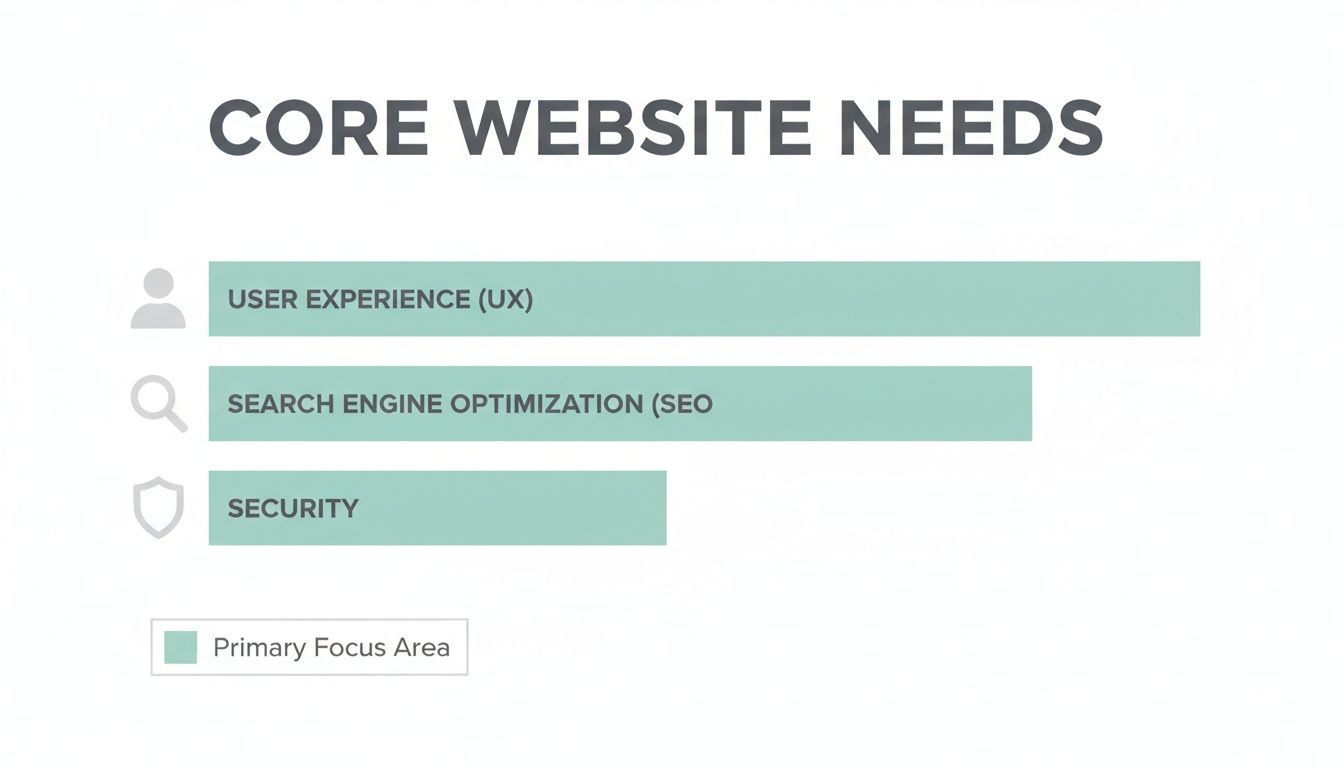
As you can see, a great user experience, solid SEO, and strong security aren't just nice-to-haves; they are the core components that make a website a genuine asset for your business.
So, what should a small to medium business in Wellington actually expect to budget? It helps to think in tiers. Let’s take a look at some typical figures to give you a clearer picture.
| Website Type | Typical Page Count | Estimated Cost (NZ$) |
|---|---|---|
| Simple Brochure Site | 3-5 pages | $1,500 – $3,000 |
| Small Business Website | 5-10 pages | $3,000 – $6,000 |
| E-commerce Store (Basic) | 10+ pages | $4,000 – $8,000 |
| Custom Web Application | Varies | $10,000+ |
These are just ballpark figures, of course. The final cost will always depend on your specific needs, like custom features, design complexity, and how much content needs to be created from scratch.
Ultimately, your website is an investment, not just an expense. A cheap site that doesn’t bring in customers—or worse, actively turns them away—is far more costly than getting it done right the first time.
For businesses needing more advanced features, the numbers climb. A basic e-commerce store in Wellington generally starts at NZ$4,000. If you're looking at a premium online store with a huge product catalogue, complex payment systems, and a highly customised design, you could be looking at a range from NZ$8,000 to NZ$15,000+. Honestly, it all comes down to the complexity.
Thinking about the investment can be daunting, but having a clear picture helps. For a more detailed breakdown, you might find our general guide on how much a website costs in NZ useful, as it explores these figures in more depth. By understanding where your money is going, you can make a smart, informed decision that pays dividends in the long run.
So, you’ve invested in a brilliant website. It’s slick, fast, and perfectly captures your brand’s unique Welly vibe. But what happens if nobody can find it? It's a bit of a problem, right?
Having a beautiful website that nobody in Wellington can find is like opening a fantastic café down a hidden alleyway with no sign. It doesn't matter how great your coffee is if no one knows you're there.
This is where local Search Engine Optimisation (SEO) comes in. It’s the big, bright, digital sign pointing everyone your way.
Honestly, for any local business, it's non-negotiable. Forget the complicated jargon for a moment. At its heart, local SEO is about making it incredibly easy for your neighbours—the people actually in Wellington—to find and choose you when they need your services.
Think about how people search these days. When someone’s pipes burst in Karori, they don't just search for "plumber." They search for "plumber near me" or "plumber Wellington." When a tourist is wandering down Cuba Street looking for a good flat white, they're searching for "best coffee Cuba Street."
These are called "near me" searches, and they have exploded in recent years. Google knows the searcher's location and prioritises showing them relevant, nearby businesses.
If your website isn’t set up for local search, you simply won't appear in these crucial results. You'll be invisible to a huge chunk of your potential customer base.
You’re not just competing with other businesses; you’re competing for local attention. Effective local SEO ensures that when a potential customer in your suburb is ready to buy, your name is the first one they see.
Getting this right means showing up prominently on Google Maps, appearing in the coveted "local pack" (that little box with three businesses under the map), and ranking high for searches that include Wellington-specific terms. This isn't about tricking Google; it's about providing clear signals that you are a relevant, trustworthy, and local solution.
So, how do you actually do it? Here's the thing: it's not a single magic trick but a combination of consistent, focused efforts. Think of it as building a local reputation online, piece by piece.
It starts with some fundamental components that Google looks for to verify your business's location and relevance.
Mastering these elements is the foundation of a strong local presence. For business owners eager to get ahead, it's worth exploring expert advice on improving local SEO rankings to get an even deeper understanding of these strategies. Our team also specialises in a dedicated approach to SEO in Wellington, focusing specifically on what works for businesses in the capital.
Ultimately, your website design in Wellington and your local SEO strategy must work hand-in-hand. One without the other is a missed opportunity. A great website gives customers a reason to choose you, and great local SEO makes sure they find you in the first place.
Okay, so you’re ready to pull the trigger on a new website. But who do you actually hand the keys to? Choosing a web designer can feel a lot like dating – you need to find the right chemistry, and the sheer number of options can feel a bit overwhelming.
This isn't just about finding someone who can make things look pretty. It's about finding a real partner who gets your business, understands what you're trying to achieve, and knows the unique pulse of Wellington.
Let's break down how to sort through the local scene and find a team that just gets it.
First things first, you'll notice the website design Wellington scene is generally made up of three types of outfits. Each has its pros and cons, and the best fit for you really boils down to the size of your project and how you like to work.
The Freelancer: Often a one-person powerhouse, a freelancer can be a brilliant, cost-effective choice for smaller projects. You get a super personal touch because you’re talking directly to the person doing the work. The only potential catch? They might be juggling a few projects, so availability can be tight, and their skillset might be more focused than a larger team's.
The Small Studio: This is your classic boutique setup, usually a close-knit team of 2-10 specialists. They hit a sweet spot, offering that personal service but with a wider range of skills under one roof—think a designer, a developer, and an SEO pro all collaborating. They're typically very nimble and have their finger on the pulse of the Wellington business community.
The Large Agency: These are the big players. They’ve got larger teams, established systems, and are set up to handle complex, enterprise-level projects. While they have a huge amount of resources to draw on, you might find you have less direct contact with the designers and developers, and their higher overheads are usually reflected in their pricing.
There’s no single "correct" choice. A local café in Te Aro will probably find a freelancer or small studio is the perfect match, while a national corporation with its head office on The Terrace might need the horsepower of a large agency.
Once you've got a shortlist, how do you actually check them out? You wouldn't bring someone onto your team without an interview, and the same thinking applies here. You need to ask some smart questions to see if there's a genuine spark.
Here are a few non-negotiables to kick off the conversation:
Can I see your portfolio of work with other Wellington businesses? This is the big one. You need to see proof that they've helped businesses just like yours connect with a Wellington audience.
How do you approach mobile-first design for a local customer? So many of your customers will find you on their phone while walking down Cuba Street or waiting for a meeting. A flawless mobile experience is absolutely essential, and their answer will reveal how modern their thinking is.
What does your process look like from start to finish? A great partner will have a clear, transparent roadmap. They should be able to walk you through every step, from the initial chat to the final launch and what happens afterwards.
Who will be my day-to-day contact? For a smooth working relationship, you need to know exactly who you'll be communicating with.
How do you handle feedback and revisions during the project? Building a website is a team sport. You want a partner who is open to feedback and sees it as part of the creative process, not one who gets precious about their designs.
Just as important as asking the right questions is knowing what warning signs to look out for. It’s easy to be swayed by a slick presentation, but you’ve got to dig a little deeper.
Tread carefully with anyone who:
Choosing your web design partner in Wellington is a big decision, so don't rush it. Do your homework, ask good questions, and trust your gut. Find a team that feels as committed to your success as you are, and you’ll be on your way to building a digital home that truly delivers.
It’s easy to get lost in the jargon—SEO, UX, mobile responsiveness—and forget to ask the most important question: what's the actual payoff? What can a well-built website really deliver for a small or medium business right here in Wellington?
Let's cut to the chase. A great website isn't just another expense on a spreadsheet; it's a powerful asset designed to make you money. Think of it as your hardest-working employee—the one who never sleeps, never takes a holiday, and is always ready to talk to a new customer.
We're talking about tangible, bottom-line results you can see and feel. It’s not just about looking professional; it’s about driving real, sustainable growth.
Honestly, if your website is just a static online version of your printed brochure, you're leaving a massive opportunity on the table. A modern, strategic website is a dynamic tool. It's an engine for generating leads, a platform for building trust, and a system for making your day-to-day operations a whole lot easier.
Think about it. How much time do you or your team spend on the phone answering the same basic questions? Or manually booking appointments? A well-designed website handles all of that. It can be your front-of-house, your booking agent, and your primary salesperson, all at once.
This frees you up to focus on what you actually do best: running your business. It turns your online presence from a passive placeholder into an active contributor to your success.
So, what does this look like in the real world for Kiwi businesses? We're not talking about vague promises; these are real outcomes backed by solid data.
A recent survey of 1,000 New Zealand small and medium firms revealed some pretty compelling numbers for businesses that invested in a professional website. These findings highlight just how much a good site can pay for itself.
| Business Outcome | Percentage of SMEs Reporting Improvement |
|---|---|
| Significant increase in new client inquiries | 40% |
| Increased competitiveness in the local market | 35% |
| Direct lift in revenue | 29% |
The data is clear. A professional website isn't an abstract marketing concept; it's a direct driver of business performance.
You read that right. 40% reported a significant increase in inquiries from prospective clients. Just imagine a 40% jump in potential new business, simply from having a solid digital front door.
Your website is your 24/7 salesperson. It's constantly working to find new customers, answer their questions, and convince them that you are the right choice. A cheap, poorly designed site does the opposite—it actively drives them to your competitors.
The benefits don't stop there. The same report found that 35% said their website made them more competitive in their local market, while 29% of businesses saw a direct lift in revenue. These aren't pie-in-the-sky figures; they're achievable results for Wellington businesses ready to get serious about their digital presence.
Ultimately, a professional website design in Wellington isn’t about vanity. It’s a strategic investment with a clear and measurable return, building trust and turning casual browsers into loyal customers.
Even after we've covered the big stuff, you’ve probably still got a few questions rattling around. That’s completely normal. Getting a new website is a big decision for any business, and it pays to have all your ducks in a row before you jump in.
So, let’s run through some of the most common questions we hear from Wellington business owners when they start thinking seriously about a new site. These are the practical, nuts-and-bolts queries that pop up once you get down to brass tacks.
Ah, the million-dollar question. The honest answer is always: it depends.
For a simple, clean brochure-style website with around 3-5 pages, we can often have it designed, built, and live in as little as four to six weeks. It's a pretty streamlined process when the scope is clear.
But if you’re after something more complex—say, an e-commerce store with hundreds of products or a custom booking system for your consultancy—the timeline naturally stretches. These bigger projects can take anywhere from two to four months, and sometimes longer. The main things that influence the timeline are the project's complexity, how quickly you can give us feedback and content, and our current project schedule.
Yes, but you definitely don’t have to handle it alone. A great way to think about your website is like a new company car. You need a safe place to park it (that’s your hosting), and it needs regular servicing to keep it running well (that’s maintenance).
Hosting: This is simply the server space where all your website’s files live so people can find you online. A good web partner will either sort out reliable hosting for you or point you toward a top-notch provider they trust.
Maintenance: This is the ongoing work of keeping software updated, running security scans, and taking regular backups. Skipping this is like never changing the oil in your car—sooner or later, something is bound to break.
Most Wellington web designers, including us, offer ongoing care plans to take all of this off your plate. It means you can get on with running your business without having to worry about the technical side of things.
Your website isn't a "set and forget" asset. Just like your physical shopfront needs upkeep, your digital one requires ongoing attention to stay secure, fast, and effective. It's a small, ongoing investment to protect a much larger one.
This is a fantastic question, because the best websites are always a team effort. You’re the expert on your business, your customers, and your industry. We’re the experts on turning that knowledge into a high-performing website. The magic happens where those two things meet.
To get the ball rolling, it’s incredibly helpful if you have a clear idea of:
Having a rough idea of these things helps your web design partner get inside your head and understand your vision right from day one.
Ready to turn these ideas into a reality for your business? The team at NZ Apps specialises in creating websites that not only look fantastic but also deliver real, measurable results for Wellington businesses. Let’s have a chat about what you need. https://nzapps.co.nz