
So, you're thinking about your business in New Zealand and realise having a killer online presence is, well, non-negotiable. And for any Kiwi business, that journey starts with a professional website. Here's a fun fact: over 74% of New Zealanders really trust .nz domains. A great website isn’t just a nice-to-have anymore; it's the main tool for building trust and making sales in our buzzing market.
It’s a bit of a head-scratcher, isn't it? In a country where Kiwis are so quick to support local .nz businesses, a shocking number of them don’t even have a website. This isn't just a quirky stat; it’s a massive, flashing neon sign that says "OPPORTUNITY."
Think of your website as your digital storefront on the busiest high street in New Zealand. Right now, nearly half the shops haven’t even unlocked their doors. They’re completely invisible to thousands of potential customers walking past every single day. Crazy, right?
Here’s the reality. A recent report from InternetNZ painted a very clear picture: in 2025, only 53 percent of New Zealand businesses have a website. That number has barely budged since 2022, even though 61 percent of those same businesses say a website is their most important digital tool. There's a massive gap between knowing what’s important and actually doing something about it.
For businesses in places like Auckland and Christchurch, this is really telling. A third of Kiwi companies see their websites as direct sales drivers, yet so many are trying to get by without one. You can check out the full '.nz Consumers and Businesses Research Summary' for the nitty-gritty.
So, what does this actually mean for you?
Your website is your 24/7 salesperson, your marketing hub, and your customer service portal all rolled into one. It’s the heart of your modern business, working tirelessly even when you’re not.
Across the country, from the big smoke to the small towns, how people shop has completely changed. People don’t just stumble upon businesses anymore; they search for them. They’ll look up reviews, compare prices, and check your opening hours before they even think about picking up the phone or walking into your store.
Without a website, you’re just not part of that conversation. Honestly, you're leaving money on the table.
This situation puts clever business owners in a fantastic position. By investing in professional website development in NZ, you’re not just building a site; you’re building a vital connection to a local market that’s ready and waiting. It’s all about meeting your customers where they are—online. You're not just getting ahead; you're stepping into a space that, bizarrely, many others have left wide open.
So, what actually goes into building a website? It can sound like some complex, code-filled mystery, but really, it’s a lot like building a house here in New Zealand. You wouldn’t just rock up to a section and start throwing up walls, would you? Of course not.
There’s a proper sequence to it all, a blueprint that makes sure the final result is solid, works perfectly, and is actually what you wanted in the first place.
First up, we have the strategy phase. This is like an architect drawing up the blueprints for your new home. We get crystal clear on what the website needs to do. Is it for a local plumber in Christchurch who just needs a simple way for people to request a quote? Or is it for a growing Auckland fashion label that needs a full e-commerce setup? This is where we nail down the purpose and map out the entire structure before a single design element is even thought about.
Next, we get into UI/UX design. Don't let the jargon scare you; this is just the interior design and floor plan of your new digital space.
A website with great UX just feels right; it works the way you expect. But one with poor UX? That’s like fumbling for a light switch in a dark, unfamiliar room—frustrating, and most people will just give up and leave.
This infographic really shows the gap between what Kiwi businesses need from their website and what they're actually getting. It highlights a huge opportunity for those who get the plan right.
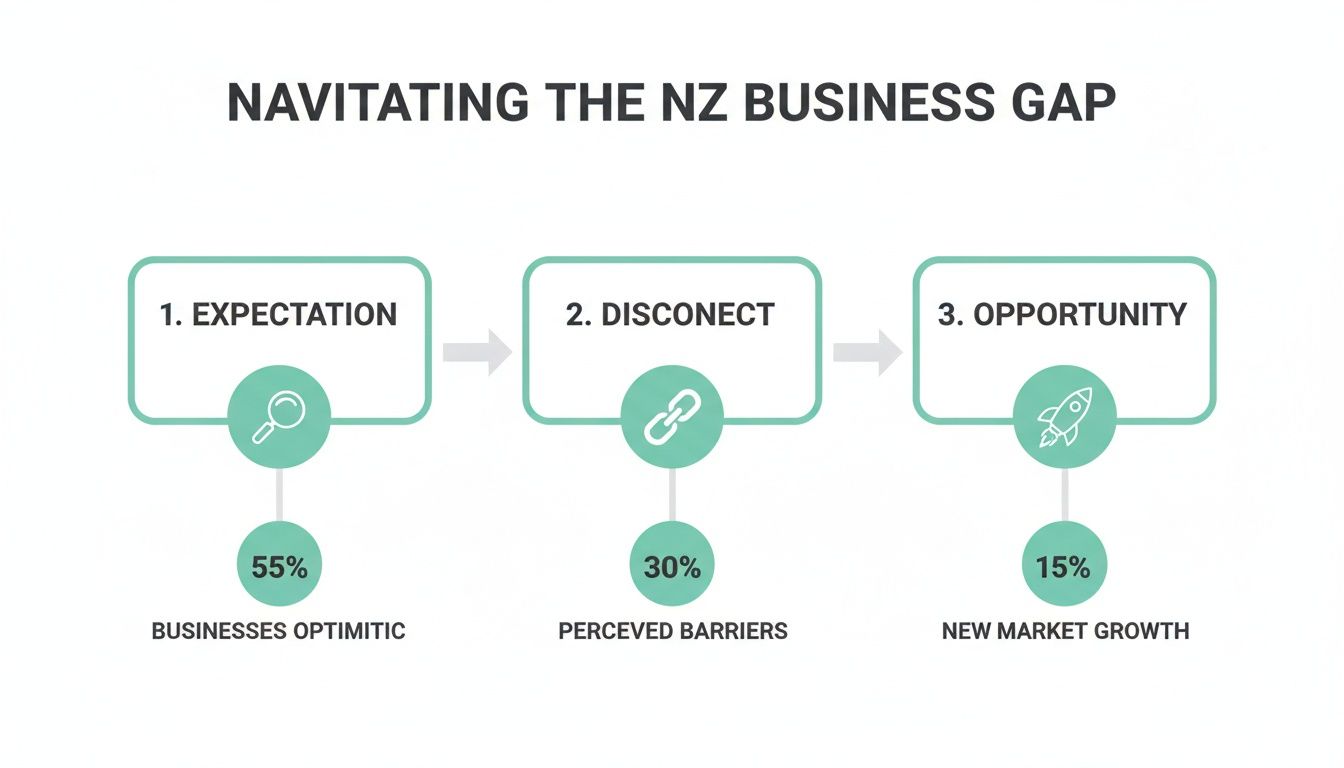
See? A clear blueprint can turn a common business problem into a real market advantage.
Once the plans are signed off, we get into development. This is the construction phase. Our developers take the beautiful designs and turn them into a living, breathing website. They write the code that acts as the foundation, walls, and roof of your site. This is where the magic happens behind the scenes.
For anyone curious about the bigger picture, understanding the broader field of software development can offer some great context. It’s all part of the same family: creating useful digital tools with code.
Think of it this way: a simple 'brochure' website is like a sturdy, single-level home—pretty straightforward to build. An advanced e-commerce machine is more like a multi-storey smart home with complex wiring and automation. Both are valuable, but the scope dictates the timeline and investment.
Finally, we hit the testing and launch phase. Just like a building inspector checks for leaky pipes or dodgy wiring, we rigorously test every single part of the website. Does the contact form send emails correctly? Do all the links go to the right place? Does it load quickly on a phone with patchy reception out in the wop-wops? We iron out every single kink.
Launch day is when we officially hand over the keys to your brand-new digital property. But our job doesn’t stop there. Just like a house needs a bit of upkeep, a website needs ongoing care to stay secure, fast, and effective. It's a real investment in your business’s future, giving you confidence that you’ve built something that will last.

Alright, let's talk tech without the technobabble. You’ve probably heard names like Shopify and WordPress thrown around, or maybe a mate mentioned getting something 'custom coded'. What on earth is the right engine for your business?
This isn’t about picking the flashiest option; it's about finding the right tool for the job. Honestly, it's just like choosing a vehicle.
A local Christchurch café that just needs to show its menu and opening hours? That’s like needing a reliable, easy-to-drive sedan—WordPress is perfect for that. But an innovative Auckland tech startup with a unique subscription model might need a custom-built, high-performance race car to handle its special features.
The choice you make here has a huge impact on your budget, your flexibility, and how much time you'll spend managing things down the track. Let’s break it down.
Most websites are built on a Content Management System (CMS). That's just a fancy term for a platform that helps you manage your website’s content without needing to be a coding whiz. Think of it as the dashboard of your car—it gives you all the controls you need in one easy-to-use place.
The big players you’ll hear about in any conversation on website development in NZ are WordPress, Shopify, and the custom-built route. Each one serves a very different purpose.
Choosing a platform is like picking a business partner. You need one that’s reliable, plays well with others (integrations!), and won’t hold you back when you’re ready to grow. Get this right, and everything else gets a whole lot easier.
For Kiwi businesses weighing up the two most popular options, our deep dive comparing Shopify vs WordPress for NZ businesses is a must-read. It’ll really help clear things up.
To make this super clear, here’s a quick look at the most common platforms. This table should help you figure out which one fits your business needs, your budget, and how hands-on you want to be.
| Platform | Best For | Pros | Cons |
|---|---|---|---|
| WordPress | Blogs, service businesses, informational sites. It’s the ultimate all-rounder. | Immensely flexible with thousands of plugins. You have total control over design and functionality. | Requires regular updates and security monitoring. Can get slow if overloaded with plugins. |
| Shopify | E-commerce, hands down. If you’re selling products online, this is built for you. | Incredibly easy to use for selling. Handles payments, shipping, and inventory beautifully. | Can get expensive with transaction fees and app subscriptions. Less design freedom than WordPress. |
| Custom Code | Unique web applications, startups, or businesses with very specific needs. | The only limit is your imagination (and budget). Built for speed and perfect for your exact workflow. | The most expensive and time-consuming option. You're completely reliant on your developer for changes. |
Choosing the right platform from the start saves a massive amount of hassle later on. It ensures your website can grow with your business, not hold it back.
Once you've picked your vehicle, you need somewhere to park it. That's your web hosting. It's the plot of digital land where your website lives online.
You know what? This is one area where going local really pays off. Choosing a New Zealand-based hosting provider can give your website a noticeable speed boost for Kiwi visitors. Why? Because the data doesn't have to travel halfway around the world. It’s like having your shop right on the main street instead of in the next town over.
And tied directly to this is security. It’s not the most exciting topic, I get it, but it’s absolutely critical. A solid technical foundation guards against critical web application security risks like the OWASP Top 10, which is the industry standard for keeping web applications safe from the most common threats.
Making a smart choice here—on the platform, the hosting, and the security—arms you with the knowledge to have a confident chat with any developer. It ensures the foundation of your website truly serves your business goals, now and well into the future.

Here’s the thing about website development in NZ—you can build the most stunning, slickest website on the planet, but if nobody can find it, it's just an expensive digital hobby. It's like opening a brilliant café down a hidden alleyway with no sign. You might have the best flat whites in town, but no one will ever know.
This is where Search Engine Optimisation (SEO) comes in. And no, it’s not some dark art or technical wizardry reserved for gurus. Honestly, it’s just about making your website speak Google’s language in a distinctly Kiwi accent.
So, what does that actually mean for a business in New Zealand? It means getting laser-focused on what your local customers are really typing into that search bar.
Think about it. No one is searching for "beverage provider." They’re searching for "best coffee Auckland CBD" or "craft beer delivery Wellington." A tourist isn’t looking for "regional accommodation"; they’re searching for "Queenstown hotel with lake view."
Your goal isn't just to rank on Google; it's to rank for the exact phrases your ideal Kiwi customers are using when they're ready to make a decision. That's the difference between getting random traffic and getting actual, paying customers.
To do that, your website needs to be built with a few non-negotiables from day one. It's not something you can just tack on at the end and hope for the best.
Getting your site to show up in local searches involves a few key ingredients. Think of them as the fundamentals of a good pavlova—if you miss one, the whole thing just collapses.
Local Directory Listings: Getting your business name, address, and phone number consistent across platforms like Google Business Profile and local directories is massive. It’s like putting your business on the digital map, telling Google, "Hey, we're a real, legitimate operation right here in Christchurch."
Mobile-First Design: This isn't a suggestion anymore; it’s a rule. Most Kiwis are searching on their phones, whether they're on the bus in Auckland or waiting for a friend in Dunedin. If your site is a clumsy, pinch-and-zoom nightmare on a mobile device, Google will notice and rank your competitors above you. It's that simple.
Site Speed and Security: A slow-loading website is a customer-repellent. If your pages take more than a couple of seconds to load, people are gone. Likewise, a site that isn’t secure (look for the little padlock in the address bar) screams "don't trust me with your details." Google prioritises fast, secure sites because they provide a better, safer experience for users.
This is just scratching the surface, of course. For a deeper look into what it takes to get noticed, learning more about a proper search engine optimisation New Zealand strategy is a great next step. The key takeaway is that SEO isn't separate from your website build; it’s woven into its very fabric.
Getting this right ensures your website development investment actually translates into tangible results—more phone calls, more bookings, and more foot traffic through your door. It’s how you turn that hidden café into the busiest spot on the main street.
Choosing a partner for your website development in NZ is a massive decision. It feels a bit like picking a co-pilot for a long-haul flight, doesn't it? You need someone you trust, who knows the route, and who won't panic if you hit a little turbulence. So, how do you sort the genuine experts from the cowboys?
It’s about more than just picking the one with the flashiest portfolio. Honestly, a portfolio of pretty pictures is nice, but it tells you very little about what really matters: proven, measurable results.
Did that beautiful website for a Christchurch cafe actually increase their online bookings by 40%? Did the sleek e-commerce site for an Auckland retailer handle a massive Boxing Day sales rush without crashing? These are the real questions. You aren't just buying a product; you're building a relationship with a team that should become a key part of your business's growth.
When you’re checking out a potential web development partner, you need to dig a bit deeper. Their past work is a great starting point, but you have to look at it with the right lens.
A great portfolio shows three things:
Think of it like this: a great chef can make a dish look stunning, but a truly exceptional one makes a dish that tastes incredible and brings customers back again and again. You’re looking for the full package—a team that delivers both style and substance.
Now, you could hire a developer from anywhere in the world, often for a fraction of the price. So why stick with a local NZ team? Here’s the thing—it’s a huge advantage.
A local partner, whether they’re based in Auckland or Christchurch, just gets it. They understand the subtleties of the Kiwi market. They know what makes local customers tick, they’re in your time zone for quick chats, and they’re not going to suggest a marketing strategy that feels completely alien to New Zealand culture.
The demand for skilled local talent is huge right now. New Zealand's digital technologies sector is booming, contributing $7 billion to GDP in 2021 and growing at more than double the rate of the national economy. This incredible momentum is driving a sustained need for web professionals, especially in hubs like Christchurch and Auckland, with thousands of new roles opening up.
Okay, you've shortlisted a few agencies. It’s time for a chat. To avoid getting swept up in sales talk, go in armed with some smart, direct questions. This isn't an interrogation; it's a conversation to see if you’re a good fit.
Here are a few to get you started:
Their answers will tell you everything you need to know about their communication style, their transparency, and their process. If you’re looking for guidance on what to expect, exploring how a professional website development company structures its partnerships can be incredibly helpful.
Ultimately, you’re looking for a team that listens more than it talks and is as invested in your business's success as you are.
You’ve probably got a few questions buzzing around by now. That’s a good thing. It means you’re taking this seriously, and frankly, you should be. Getting a website built is a significant step for any Kiwi business.
So, let's jump straight in. We're going to tackle some of the most common questions we hear from business owners right across New Zealand. No fluff, no confusing jargon—just straight-up, practical answers to help you see the path forward.
Ah, the million-dollar question. Or, hopefully, not quite that much. The honest answer is: it depends. I know that’s probably not what you wanted to hear, but it's the simple truth. Asking "how much for a website?" is a bit like asking "how much for a car?". Are we talking about a reliable runaround for getting from A to B, or a high-performance Ute with all the trimmings?
A simple, professional "brochure" website for a local service business—say, a builder in Christchurch—might start from around $3,000 to $7,000. This gets you a sharp-looking, mobile-friendly site that clearly tells people who you are, what you do, and how to get in touch.
But if you need to sell products online, integrate a custom booking system, or connect with other business software, you're moving into a higher price bracket. A more complex e-commerce or custom web application project could range anywhere from $10,000 to $50,000+. It all comes down to the amount of time and specialised skill required to build it.
Think of it not as a cost, but as an investment. A cheap website that doesn't bring in any business is a waste of money. A well-built website that generates leads and sales every single week pays for itself over and over again.
Timeframes are another "it depends" situation, but we can definitely give you a good ballpark figure. Just like the cost, the timeline is directly tied to how complex the project is. A simple site with clear requirements can be turned around relatively quickly.
Here’s a rough guide to what you can expect:
The single biggest thing that slows projects down? Content. Nine times out of ten, waiting for text and photos from a client is the main bottleneck in the entire website development process.
Okay, this is a big one, and a fair question. You’ve paid for the website, it’s live, and it looks fantastic. So why would you need to keep paying someone?
Here’s the thing: a website isn't like a printed brochure that you can just leave on the counter. It's a living piece of software, connected to the internet 24/7, and built on other pieces of software (like WordPress and its plugins) that are constantly being updated by their developers.
Without regular maintenance, a few things start to happen:
Think of it like the Warrant of Fitness for your car. You get it checked to make sure everything is safe, secure, and running smoothly. A small monthly fee for a maintenance plan is your insurance policy against major headaches—and potentially very expensive emergency repairs—down the line. Plus, the whole industry supporting this is growing; New Zealand's Data Processing and Web Hosting Services sector is set to hit a market size of $939.2 million in 2025, which shows just how critical this digital infrastructure has become. You can read more about the industry's growth on IBISWorld.
Hopefully, that clears up a few of the big questions. Getting a handle on the likely cost, time, and upkeep gives you the confidence to start a proper conversation and take the next step.
Ready to turn these answers into action? The team at NZ Apps is here to give you a clear, no-obligation plan for your website. Let’s have a chat about your specific goals and figure out the best path forward for your business.
Book Your Free Consultation Today