
At its core, a UI/UX design consultant is a strategic problem-solver. Honestly, that’s the gig. Their entire focus is on making your digital products—whether it's a website or a mobile app—feel effortless and even enjoyable for people to use. Think of them as the architect of your digital space, making sure every room, hallway, and doorway is logical and intuitive.
Let's cut through the jargon for a moment. You've got a brilliant idea for an app or a website, right? But how do you make sure people actually like using it? How do you sidestep that frustrating feeling when a button seems to be hiding, or a checkout process is just plain clunky?
That’s precisely where a UI/UX design consultant comes in.
It helps to think of their role as two distinct, but deeply connected, jobs.
Okay, not really. But the UX (User Experience) part of their job is like drawing up the architectural blueprint for a house. It's all about the underlying structure, flow, and logic. A UX specialist obsesses over questions like:
This involves a whole lot of research, mapping out user flows, and creating wireframes—the basic skeleton of your digital product. At this stage, they aren't worried about colors or fonts; the focus is purely on function and feel. To get a better handle on this crucial role, you can explore the journey of a dedicated user experience designer and the thinking behind their process.
Then, you have the UI (User Interface) side of things. This is the interior designer who arrives after the architect has framed the house. They handle all the visual and interactive elements people will see and touch:
So, while UX makes a product useful, UI makes it beautiful. A top-tier consultant handles both, ensuring the stunning visuals are built on a rock-solid, user-friendly foundation.
A seasoned UI/UX design consultant brings a deep understanding of the latest key user experience design best practices, ensuring your product doesn't just look current but functions flawlessly for modern users.
Ultimately, their job isn’t just to make things look 'pretty'. It's a critical investment for any NZ business aiming to build a loyal customer base. They prevent the digital equivalent of a door that opens the wrong way—those small frustrations that cause big problems and send potential customers running straight to your competition.
Ever wonder if bringing a UI/UX design consultant onto the team actually pays off? The short answer is a loud and clear ‘yes’. This isn't just about making your users happy; it’s about tangible, measurable business growth that you can see on a balance sheet.
Let's move past the theory. Good design isn't some fluffy, nice-to-have extra—it’s a hard-nosed business strategy. Imagine building a house without a proper blueprint; it’s a recipe for expensive, soul-crushing mistakes. That's exactly what launching a digital product without expert design input is like.
Bringing a consultant in early saves you a fortune by sidestepping costly redesigns later. It’s all about building the right thing, the right way, right from the start.
It’s easy to think of design as just the visual layer, but that’s missing the point entirely. A UI/UX design consultant connects the dots between a thoughtful design process and the real-world outcomes that executives care about.
Here’s what that looks like in practice:
A study by McKinsey & Company found that companies prioritising strategic design achieved 32% higher revenue growth and 56% higher total returns to shareholders compared to their competitors. It's a powerful business case for putting users first.
The table below breaks down the typical outcomes you can expect from professional design versus a do-it-yourself approach.
| Business Metric | With a UI/UX Consultant | DIY Approach |
|---|---|---|
| Conversion Rates | Significantly higher due to optimised user journeys and reduced friction. | Often low and stagnant due to guesswork and usability issues. |
| Customer Loyalty | Strong and growing; users enjoy the experience and become advocates. | Weak; frustrating experiences lead to high churn rates. |
| Support Costs | Drastically reduced as the intuitive design pre-empts common user problems. | High and persistent; staff are constantly fielding the same questions. |
| Development Rework | Minimal, as user research validates the design before a line of code is written. | Frequent and expensive, as features are built, then fixed or scrapped. |
| Time to Market | Faster, with a clear, validated roadmap avoiding wasted effort. | Slow and unpredictable, marked by dead-ends and redesigns. |
| Return on Investment | High, driven by increased revenue, loyalty, and lower operational costs. | Poor to negative, as initial savings are erased by lost opportunities and rework. |
As you can see, the initial investment in a consultant pays for itself many times over by preventing costly mistakes and building a product that truly connects with your customers.
And let me tell you, this isn't just a global trend; it's happening right here in our backyard. In New Zealand's booming digital economy, the demand for skilled UI/UX design consultants has skyrocketed. This was fuelled by a massive 64% increase in digital capabilities between 2015 and 2019, positioning NZ as one of the world's fastest-growing IT markets.
With the IT services market now boasting revenues of $4.12 billion, smart design is no longer optional.
From an Auckland startup trying to disrupt a market to an established firm in Christchurch looking to modernise, the principle is the same. Investing in design is investing in your business’s future. It's about building products based on a human-centred design philosophy, where every decision is validated by real user needs. You can learn more about how human-centred design drives success in our detailed guide.
To truly realise these business perks, it's essential to understand and implement leading methodologies. You can get a head start by exploring these 13 best UX design practices which consultants use to elevate digital products. Ultimately, strategic design is one of the smartest, most impactful moves an NZ business can make today.
So, you're considering bringing a UI/UX design consultant on board. Good call. But what does that actually look like day-to-day? It's a fair question, as the whole process can feel a bit like a black box from the outside.
Here’s the thing: it’s not about just handing over a brief and waiting for a perfect design to magically appear. It’s a proper partnership. Think of it as a collaborative dance between your deep business knowledge and their design expertise. Let me pull back the curtain on the typical journey.
This structured process ensures every design choice is backed by solid evidence, not just someone's opinion on a Tuesday morning. It’s all about building a product based on what your users actually need and want—the most reliable path to creating something they'll love using.
First up is the discovery phase. Picture the consultant as a detective, ready to immerse themselves in your world. They’ll likely kick things off with a workshop involving your key people—from marketing and sales to the development team—to get everyone on the same page about the project’s core goals. What problem are we really trying to solve here? And who are we solving it for?
This isn't just a casual meet-and-greet. It’s a focused deep-dive into your business objectives, any technical limitations, and what a successful outcome looks like to you. The consultant needs to grasp your vision inside and out before they can even think about bringing it to life. This is where the foundation for the entire project is laid.
After the workshop, the real research begins. A top-tier consultant will get out there and talk to your actual customers. They might conduct interviews, send out surveys, or analyse competitor products to pinpoint gaps and opportunities. It’s all about gathering raw, unbiased data to build a crystal-clear picture of your user’s world.
This infographic shows how this kind of strategic design directly translates into key business results.
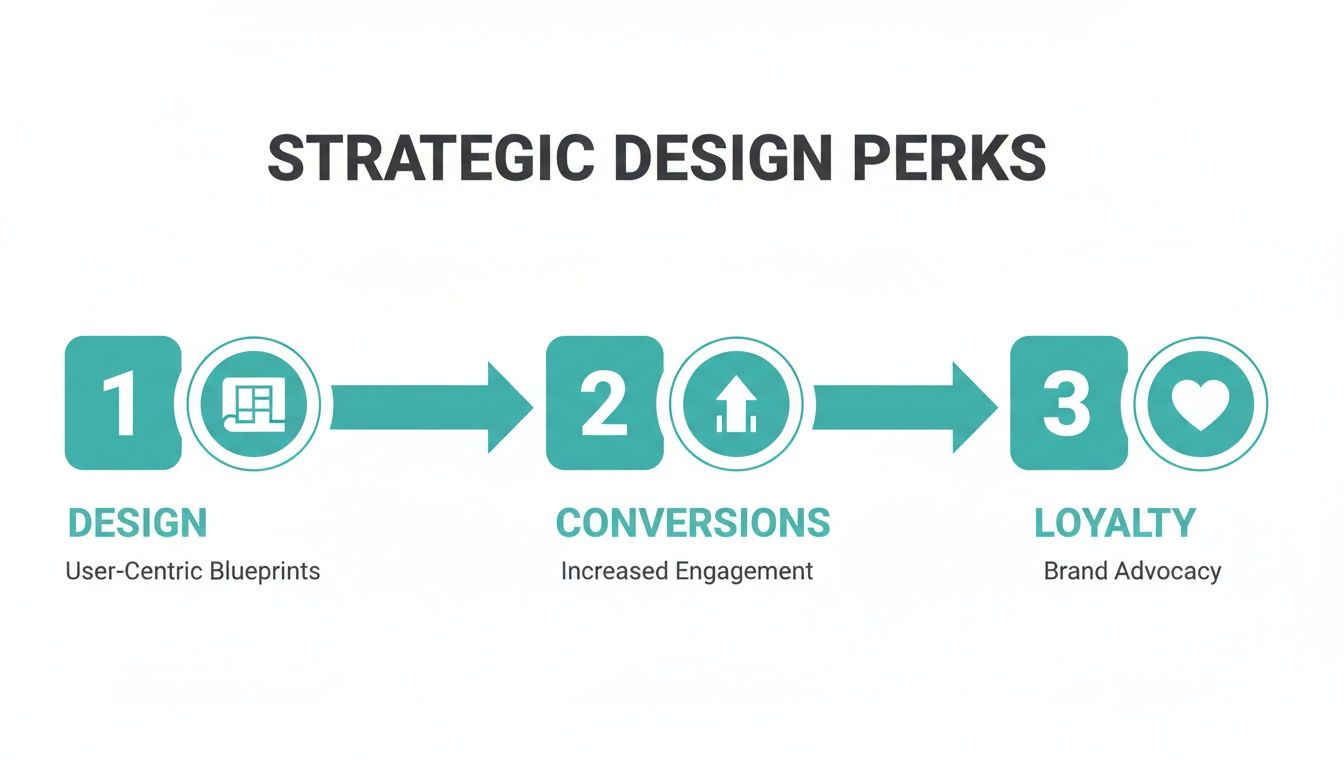
As you can see, a solid design foundation drives better conversions, which in turn builds genuine, long-term customer loyalty.
With a heap of research in hand, the consultant starts translating those insights into tangible structures. This is where you’ll start seeing your product take shape, but maybe not in the way you'd expect. Don't plan on seeing polished, colorful screens just yet.
Instead, you’ll get deliverables like:
From there, these static wireframes are often brought to life as interactive prototypes. Using tools like Figma or Adobe XD, the consultant creates a clickable model of your product. You can actually navigate through the screens as if it were a real, working app. This step is a game-changer. It allows you to feel the user flow and catch awkward spots long before a single developer writes any code.
Now for the moment of truth: usability testing. The consultant will put that interactive prototype in front of real users—people who match your customer personas—and simply watch them try to complete specific tasks. Do they get stuck? Is the navigation confusing?
The feedback from these sessions is pure gold. It’s not about collecting opinions; it’s about observing actual behavior. Armed with these findings, the consultant will go back and refine the prototype, smoothing out the rough edges and making confusing paths more intuitive. This cycle of testing and refining might happen a couple of times to get it just right.
Once the user experience is solid, the consultant moves on to the high-fidelity mockups. This is where the UI (User Interface) design really shines. They’ll apply your brand identity, colors, typography, and iconography to the validated wireframes, creating pixel-perfect screens that look exactly how the final product should.
Finally, they will prepare a detailed handover package for your development team. This is much more than a folder of pretty pictures. It includes a comprehensive design system—a full library of reusable components, style guides, and detailed specifications that ensure the final build is perfectly consistent and stays true to the design vision.
Alright, let’s get straight to the elephant in the room: money. It’s the first question on every business owner’s mind. How much is hiring a top-notch UI/UX design consultant actually going to set you back here in New Zealand?
The honest answer? It depends. I know that’s not what you wanted to hear, but the cost isn't a simple, one-size-fits-all number. It’s a bit like pricing a building project; the final figure is shaped by the scope, the materials, and the experience of the crew you hire.
But this isn't just another line item on your budget. The key is to frame this as a strategic investment—one that delivers a powerful return. Let’s break down the different pricing models you’ll likely run into.
When you start talking to a UI/UX design consultant, they’ll probably suggest one of three ways of working together. Each has its pros and cons, and the right one really comes down to your project’s needs.
Okay, okay, what do those models translate to in actual dollars? The figures can vary quite a bit, especially between a major tech hub like Auckland and other regions across the country.
Here's a snapshot of the local market. UI/UX design consultants in New Zealand command competitive salaries that reflect their crucial role, with mid-level professionals earning a median of NZ$82,500 annually. Entry-level consultants start around NZ$62,500, while seniors with more experience average NZ$112,500. Freelancers often charge more to cover their own overheads, with hourly rates typically sitting between NZ$34-NZ$63, depending on their seniority. You can learn more about local salary benchmarks on UIUXJobsBoard.com.
Remember, these are just averages. A highly specialised consultant with a killer portfolio and a decade of experience in your specific industry will naturally command a higher rate than a junior just starting out.
Beyond experience levels and pricing models, a few other key factors will influence the final quote you receive. Thinking about these can help you better prepare a brief and understand the value you're getting.
The biggest factor is project complexity. Is this a simple five-page website, or are we talking about a complex web application with multiple user types and integrations? The more moving parts in the user flows and the more screens that need designing, the more time and expertise it requires. If you're curious about general web project costs, our guide on how much a website costs in NZ can provide some useful context.
Another consideration is the scope of services. Do you just need wireframes and mockups? Or are you looking for a full engagement that includes in-depth user research, persona development, journey mapping, and usability testing? A more comprehensive service package will, of course, carry a higher price tag—but it also delivers deeper, more impactful results.
Alright, you’re ready to bring in an expert to shape your digital vision. But let's be real—searching for the right UI/UX design consultant can feel a bit like dating. You’re looking for someone who just gets you, shares your goals, and has the skills to bring it all to life.
Not all consultants are created equal. And with so much talent out there, how do you sift through the noise to find the one who will genuinely elevate your project? Don’t worry; it’s not about luck. It’s about having a smart, methodical approach.
Finding top talent in New Zealand isn’t as hard as you might think, if you know where to look. Gone are the days of just posting a job ad and hoping for the best. The real gems are often found through more focused channels.
Your search should probably start with professional networks. LinkedIn is the obvious heavyweight champ here. You can search for a “UI/UX design consultant” and filter by location to find experienced professionals right in Auckland, Christchurch, or Wellington. But don't just look at profiles; look at the recommendations and articles they share. It gives you a feel for their thinking.
Beyond that, you have specialised agencies and platforms where you can find curated talent. New Zealand's UI/UX design landscape features at least 53 dedicated firms, alongside powerhouses like NZ Apps that integrate these services into full-spectrum digital solutions. Agencies such as Somar Digital in Wellington charge around $160/hour, while others in Auckland might be closer to $149/hour. This diversity is perfect for Kiwi businesses of all sizes. You can find out more about local agency rates and services on DesignRush.
Okay, you've got a shortlist. Now comes the most important part: the vetting process. It's incredibly tempting to get wowed by a portfolio full of slick, beautiful designs. But here’s the thing—pretty pictures don't tell the whole story.
A great portfolio isn't a gallery of finished art. It's a collection of solved problems. You're not just hiring a designer; you're hiring a strategic thinker who uses design as their tool.
When you review a consultant's work, look past the final mockups. Are there case studies that walk you through their process? You want to see the messy middle—the wireframes, the user research notes, the failed prototypes. That’s where the real magic happens. It shows they don't just jump to conclusions; they build solutions based on evidence.
Here's a quick checklist for what to look for:
Once you’ve reviewed their work, it’s time to talk. An interview is your chance to see if their communication style and strategic thinking are a good fit for your team. This is where you separate the good from the great. A truly exceptional UI/UX design consultant will ask you as many questions as you ask them. They’ll be curious, analytical, and ready to challenge your assumptions—in a good way.
To help you get past the surface-level chat, we've put together a few questions to dig into what really matters.
| Question Category | Sample Question | What You're Looking For |
|---|---|---|
| Process & Methodology | "Can you walk me through your typical design process for a project like ours, from start to finish?" | A clear, structured, and user-centred process. Look for mentions of research, testing, and iteration, not just designing mockups. |
| Problem-Solving | "Tell me about a time when user testing results completely changed the direction of your design. How did you handle it?" | Evidence of flexibility and a commitment to data-driven decisions. You want someone who embraces feedback, not their own ego. |
| Collaboration | "How do you prefer to work with developers, project managers, and other stakeholders? How do you handle disagreements?" | A collaborative mindset. Look for someone who values teamwork and can communicate their design rationale clearly and respectfully. |
| Measuring Success | "How do you define and measure the success of a design project? Can you give me an example?" | An understanding that design is about business results. They should talk about metrics like conversion rates, user satisfaction, or task completion times. |
Asking these kinds of questions shifts the conversation from "Show me your pretty pictures" to "Show me how you think." It’s the best way to find a true partner who will drive real value for your business.
We’ve covered a lot of ground, haven’t we? From what a UI/UX design consultant actually does, all the way to figuring out how to find the right one for your New Zealand business.
If there’s one thing to take away from all this, it’s that great design isn't some happy accident. It never is. It’s a deliberate, thoughtful process that puts your users right at the center of everything. Honestly, that’s the secret sauce.
For any digital product you're building—a custom web application, a slick new mobile app, or a much-needed website refresh—investing in professional user experience is one of the smartest calls you can make. It’s the difference between building something that simply works and creating something people genuinely love to use. And when people love using your product, your business reaps the rewards.
Thinking about all this can feel a bit overwhelming, but it doesn't have to be. It all starts with a simple conversation. You have a vision for what your digital presence could be, and a skilled UI/UX design consultant has the tools and expertise to help you build it on a solid foundation.
The most expensive design is the one that fails your users. The most valuable design is the one they barely notice because it just feels right.
This isn't about guesswork; it’s about making informed, strategic choices that drive real results. It’s about building a stronger, more resilient business by listening to the people who matter most: your customers.
Ready to see how expert design can bring your vision to life? Let's talk. Taking that first step is often the hardest part, but it's also the most important. A simple chat can clarify your goals and map out a clear path forward, turning your big ideas into an experience that truly connects with your audience.
Good. You should. Bringing on a UI/UX design consultant is a big decision, and it pays to be curious. Here are some of the most common questions we hear from business owners across New Zealand.
Let's use an analogy. Imagine you're building a new house.
UX (User Experience) is the architectural blueprint. It dictates the flow of the house—where the doors go so you don't have to walk through a bedroom to get to the kitchen, the height of the benchtops, and the overall feeling of space and logic. It’s the core structure that makes the house liveable and intuitive.
UI (User Interface) is the interior design. It’s the color of the walls, the style of the light fittings, the texture of the carpet, and the satisfying click of the light switches. It's everything you see and touch that makes the house feel like your home.
You know what? You can’t have one without the other. A stunningly beautiful house with a terrible layout is a nightmare to live in. And a perfectly functional house that looks drab and uninviting just isn't appealing. A great consultant is both an architect and an interior designer for your app, ensuring the beautiful interface is built on a solid, user-friendly foundation.
Honestly? Before you've written a single line of code.
The biggest value a UI/UX consultant brings is in the early-stage research and strategy. Getting them involved when your product is just an idea allows you to test that concept with real people before you sink a fortune into development. It stops you from building features nobody actually wants or needs. Think of it like talking to an architect before you start buying bricks—it saves a massive amount of time and money on rework down the track.
Already have a product on the market? That's fine, too. A consultant can jump in and perform a UX audit, quickly identifying the friction points that are frustrating your users and creating a clear roadmap for improvements.
Let's be clear: this isn't just about making your app look pretty. The work of a skilled UI/UX design consultant has a direct and measurable impact on your bottom line. You can expect to see tangible improvements in a few key areas:
When all is said and done, a good consultant connects your product directly to the real-world problems of your users. That connection is what fuels real, sustainable growth for your business.
Ready to see how a strategic focus on design can improve your business outcomes? The team at NZ Apps offers a free consultation to help you map out the next steps for your digital product. Find out how we can help at https://nzapps.co.nz.