
Look, you want a straight answer, right? So, how much does a website actually cost in New Zealand? The honest answer is it can be anything from a couple of thousand dollars for a simple online presence to well over $10,000 for something more complex, like a full-blown e-commerce store. Honestly, the final figure really boils down to what you need the website to do for your business.
Asking "how much for a website?" is a bit like asking "how much for a car?". It’s a fair question, but the answer depends entirely on whether you’re after a trusty Toyota to get from A to B or a high-performance machine built for the racetrack. Simple.
For Kiwi businesses, it’s exactly the same. Are you just after a digital business card, or do you need a powerful sales engine working for you around the clock? There’s just no one-size-fits-all price tag. The cost is a direct reflection of the design complexity, the custom features you need, and the level of expertise you bring on board to build it.
To give you a clearer picture, here's a quick breakdown of what you can expect to invest in New Zealand.
| Website Type | Typical Price Range (NZD, excl. GST) | Best For |
|---|---|---|
| Brochure / Starter Site | $2,000 - $5,000+ | Service-based businesses, tradies, consultants needing a professional online presence to showcase work and capture leads. |
| E-commerce Store | $5,000 - $15,000+ | Retailers and businesses wanting to sell products directly to customers online, requiring payment processing and inventory management. |
| Custom Web Application | $10,000 - $50,000+ | Businesses needing a unique solution, like a custom booking system, a client portal, or software integration to solve specific operational problems. |
These figures are a starting point, of course. The final cost will always depend on the specifics of your project.
Most projects fall into one of three buckets. This isn’t about finding the cheapest option; it’s about matching your business goals with the right tool for the job. You wouldn't use a sledgehammer to hang a picture, would you?
Here’s a simple chart that shows the typical starting prices for these website types in NZ.
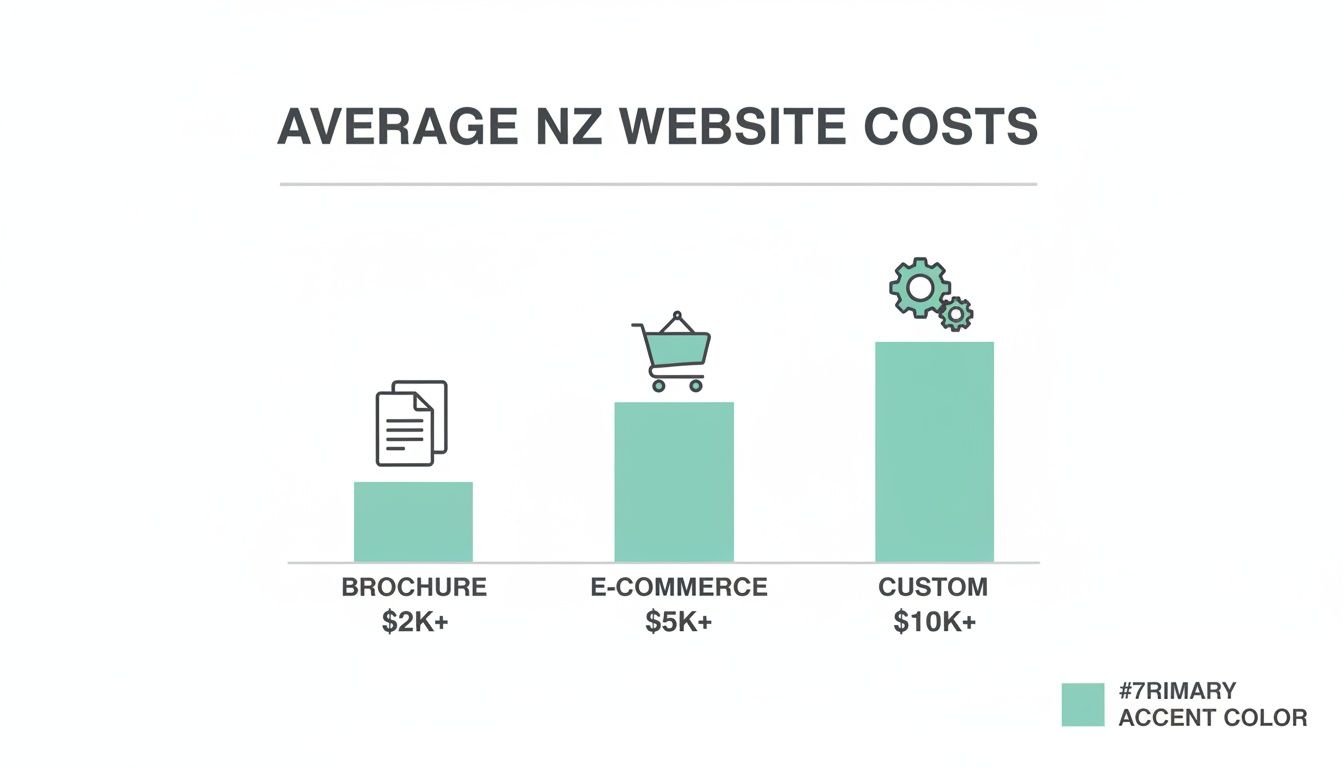
As you can see, the investment climbs as the website's role gets more sophisticated and demands more specialised work. A simple brochure site is there to introduce your business, while a custom build is designed to solve a unique business challenge. It makes sense when you think about it.
Think about what you need right now. Are you a local tradie in Christchurch who just needs a clean, professional site to show off your projects and get quote requests? Or are you an Auckland-based retailer looking to sell products to customers all over the country?
Answering that simple question is the first real step to figuring out your budget. The main factors that will nudge your website construction cost up or down are:
Getting your head around these basics is your cheat sheet to setting a realistic budget. It helps you move from a vague idea to a solid plan, so there are no nasty surprises down the track.
Ever received a website quote and felt like you were trying to read a different language? It’s a common feeling. Let's be honest, a website isn't just one single item; it’s a collection of critical parts all working in sync, and each of those parts has its own price tag.
So, it's time to pull back the curtain and make sense of that invoice.
Think of it like building a house. You're not just paying for a pile of timber and some nails. You’re paying for the architect's vision, the builder's skill, the plumber's precision, and all the materials that turn it into a home. A website is no different—it's the sum of its expertly built parts.
First up is the design, which covers both the UI (User Interface) and UX (User Experience). This goes way beyond just picking pretty colours and fonts. It's the actual blueprint for how your customers will interact with your business online. It’s pretty crucial stuff.
A bespoke design from an Auckland agency will naturally cost more than a pre-made template. Why? Because you're paying for a designer's time to deeply understand your brand, your customers, and what you're trying to achieve. They are crafting an online experience that is unique to you.
A great design isn't just about what it looks like. It’s about how it works. A user who can’t find your contact form in three seconds is a user who is already gone.
This stage involves creating wireframes (the basic skeletal layout), mockups (the visual design), and ensuring the site is intuitive and easy to use on a phone, tablet, and desktop. It's all about the strategy behind the visuals.
Next, we have development. This is where the visual design is brought to life and turned into a functional, working website. It’s the code that makes everything click, scroll, and submit. This is often split into two key areas:
The complexity here is what really drives the website construction cost. A simple five-page brochure site involves far less development work than a custom booking system that needs to sync with your calendar and payment gateway.
So, how do you update your website once it’s live? That’s where a Content Management System (CMS) comes into play. Think of it as the admin dashboard for your site.
A CMS like WordPress or Shopify, or even a custom-built system, allows you to add new blog posts, change text, and upload images without having to call a developer every time. You’re paying for the initial setup and customisation of this system so it’s easy for you to manage day-to-day.
The right CMS really depends on your needs. Shopify is fantastic for e-commerce but comes with ongoing fees. WordPress is incredibly flexible but requires a bit more attention to security and updates. To really get a handle on what you're paying for, it helps to understand the full picture of how much you need to build and manage your website.
Each of these components—design, development, and the CMS—requires specialised skills and time. When you get a quote, you're not just buying a product; you're investing in the expertise needed to build a powerful business tool from the ground up.
Let's be honest. Not every Kiwi business needs a massive, all-singing, all-dancing website. Sometimes, you just need a professional online space to build trust, answer the common questions, and let people know who you are and what you stand for.
That’s where the brochure website comes in. It’s the quiet achiever of the internet, and for a huge number of businesses, it's the perfect starting point.
Think of it as your digital front door or an online business card that’s always working. It’s a fairly straightforward site, usually between four to seven pages, designed to give potential customers the key information they need about your business. The goal isn't to sell products directly; it's to sell your business.
Its primary job is to establish your credibility, clearly outline your services, and make it incredibly easy for people to get in touch. It’s the ideal launchpad for tradies, consultants, and local service businesses who need a digital presence that’s open 24/7.
So, what are the essential ingredients? A solid brochure website almost always boils down to these core pages:
The real power of a great brochure site lies in its simplicity and focus. It steers visitors exactly where you want them to go: towards picking up the phone or sending an enquiry.
Alright, let's get down to brass tacks. The website construction cost for a well-made brochure site is one of the most accessible entry points for any small business. In the New Zealand market, businesses looking for a professional but straightforward website should budget between NZD $2,000 and $5,000. Local web design firms often cite this range as covering the essentials like a clean design, contact forms, and foundational SEO. To get a better feel for what's involved, you can learn more about what a small business website design entails.
This investment gets you more than just a pretty design; it gets you a functional business tool. It covers a professional build that is responsive, which means it looks great and works perfectly whether someone is viewing it on their phone during their morning commute or on a desktop at the office. This is absolutely critical.
A smart investment in this area can pay for itself many times over through new leads and a stronger reputation. It’s not an expense—it's the foundation of your online credibility.
Alright, let's move beyond the standard website. We've covered the brochure site – it's your digital handshake, a solid and essential presence. But what if your business needs more than just a handshake? What if it needs a custom-built engine?
This is where things get really interesting. We’re stepping away from the digital storefront and into the world of custom-built machinery designed just for your business.
If you’ve ever caught yourself saying, “I just wish we had a tool that could…” – you’re thinking about a custom build. This is no longer just a website; it’s a web application. It could be a secure client portal, a bespoke booking system that talks directly to your team's calendars, or a clever piece of software that finally automates that one painful, time-sucking part of your workflow.
Think of it like this: a brochure website is like buying a great suit off the rack. It looks sharp, it's professional, and it does the job. A custom web application, however, is like going to a tailor. Every single stitch and cut is designed to fit your specific shape and needs perfectly.
This level of bespoke work is why the website construction cost for these projects takes a pretty big leap. In New Zealand, you’re generally looking at a budget somewhere in the NZD $10,000 to $50,000+ range. It’s a serious investment, no doubt, but the payoff can be game-changing. The truth is, a generic, one-size-fits-all solution can sometimes cause more headaches than it solves. If this is a path you're considering, our guide on custom software versus off-the-shelf options is a great read.
You're not just buying a website; you're commissioning a unique piece of business infrastructure. It's built to solve your specific challenges and give you a powerful competitive edge.
So, why the big price difference? What exactly are you paying for when you get into this territory? Let's pull back the curtain.
A custom project is a completely different animal. The process goes so much deeper than just picking a design and adding some text. It's a proper partnership to build a system that slots seamlessly into how you already do business.
Here’s a glimpse of what's going on behind the scenes:
Industry data from across New Zealand supports this. Custom builds with complex functions or database-driven features typically start around NZD $15,000 and can easily sail past $50,000, especially when they involve custom UX design and tricky software integrations. For Kiwi businesses looking to automate core processes, this is where you start to see real, measurable gains. You can find more detailed pricing info in this NZ web design price guide.
A custom build isn’t just another expense. It's a direct investment in efficiency, a tool for creating a standout customer experience, and a way to carve out a genuine, lasting advantage in your market.
Launching your new website feels like crossing the finish line, doesn't it? It’s a huge milestone and definitely something to celebrate. But here’s a little secret from someone who's seen it all before: launch day isn't the end. It's the start of the real journey.
Think of it like buying a new car. You wouldn't just drive it for years without getting a WOF or changing the oil, right? Your website is the same. It's a living, breathing business asset that needs regular care to keep it performing at its best and keeping your investment safe.
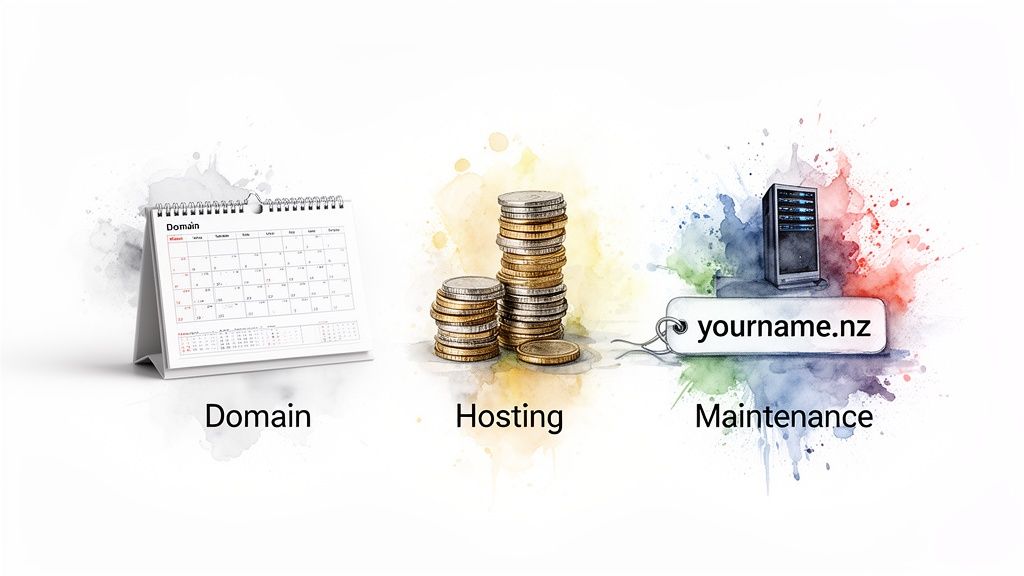
Let's have an honest chat about the costs that pop up after your site goes live. These aren't scary surprises if you know they're coming. They're just a standard part of owning a professional digital presence.
There are a few things you absolutely must budget for every year to keep your website live, secure, and functioning properly. Ignoring these can quickly turn your shiny new site into a security risk or, worse, a digital ghost town.
Here are the big three everyone needs:
yourbusiness.co.nz. You're essentially renting this address, and it’s an annual fee that typically costs around $20 - $50 per year in New Zealand. It's a small but critical expense.So, what does this all add up to? The total cost varies, but it’s vital to factor it into your annual budget from the get-go.
To give you a clearer picture, here’s a breakdown of the typical recurring costs for a business website in New Zealand.
| Service | Typical Annual Cost (NZD) | Why It's Important |
|---|---|---|
| Domain Name | $20 - $50 | Your unique web address. Without it, no one can find you. |
| Website Hosting | $180 - $600+ | The "home" for your website's files on the internet. |
| SSL Certificate | Often free - $150 | Encrypts data, shows the padlock icon, and is vital for trust and SEO. |
| Maintenance Plan | $600 - $2,500+ | Keeps software updated, secure, and running smoothly. Prevents hacks. |
| Premium Plugins | $50 - $500 | Annual licenses for specific features like booking systems or forms. |
Remember, these are ongoing investments, not just expenses. They ensure your website continues to be a valuable, secure, and effective tool for your business.
Think of ongoing costs as an insurance policy for your online investment. You're paying a small, predictable amount to protect a valuable business asset from breaking down or becoming vulnerable.
For more complex web applications, hosting on cloud platforms can involve significant ongoing costs. If you're heading down that path, it pays to check out a technical guide to cloud computing cost reduction to make a smart investment. For most Kiwi businesses, though, a simple, solid maintenance plan is all you'll need.
These recurring fees are what keep your initial website construction cost from going to waste. By planning for them from day one, you ensure your website stays powerful, secure, and effective for years to come—no nasty financial surprises hiding around the corner. It's just smart business.
We’ve talked a lot about the numbers and the technical bits that make up your website construction cost. But let’s take a step back for a moment. What’s the difference between an expense and an investment?
An expense is just money gone. An investment, on the other hand, is money you put to work to get something back. Your website should absolutely be an investment—a hard-working asset that generates leads, closes sales, and maybe even frees up some of your admin time.
So, how do you make sure your website budget is truly an investment in your business's growth?
Here’s a piece of advice I give every client: the cheapest quote is almost never the best value. It’s a classic trap. You get three proposals, one is way lower than the others, and it feels like you've struck gold.
But what are you actually getting for that rock-bottom price? More often than not, it means a rushed job, a generic template that looks like a dozen other sites, and—worst of all—zero thought put into your actual business goals. You might save a couple of thousand dollars upfront, but if the site doesn't bring in a single new customer, was it really a saving? I think we both know the answer to that.
A great website isn’t just a digital brochure; it’s a business development tool. The right agency understands this. They’re not just quoting for a build; they’re proposing a solution to a business problem.
When you’re looking over a proposal, don't just flip to the final page to see the total. Read through the details. Does it include a strategy session? Is keyword research part of the package? Who’s writing the content? These are the things that turn a website from a static online flyer into a lead-generating machine.
Choosing a web design agency is less like hiring a tradie and more like finding a business partner. You need someone who actually gets what you’re trying to achieve.
Here’s a quick checklist for vetting potential agencies:
Feeling a bit daunted by the potential cost? You don’t have to build your dream website all at once. A really smart strategy, particularly for bigger projects, is to plan the build in phases.
For example, Phase 1 could be launching a sharp, professional brochure site. It gets you online, establishes your credibility, and starts capturing leads right away. It gets you in the game.
Then, a few months down the line, Phase 2 could involve adding a full e-commerce store or a custom booking system, funded by the revenue your new site is already bringing in.
This approach makes the investment much more manageable. It also gives you a chance to learn from your initial launch and make even smarter decisions for the next stage. It’s a savvy way to manage your cash flow while still making real, tangible progress.
Your website construction cost shouldn’t feel like a burden. It should feel like an exciting and strategic step forward. By choosing the right partner, focusing on long-term value over short-term price, and planning smartly, you’re not just building a website. You’re building a foundational asset for your business’s future.
We hear these questions all the time, so let's get right into them. When you're looking at a big investment for your business, it's only natural to have a few things on your mind.
That's a fantastic question, and you're right to ask it. The massive gap you see in website quotes almost always comes down to what’s actually happening behind the scenes. It's rarely a straight, apples-to-apples comparison.
A lower quote, for example, might be based on a generic, pre-made template with very little room for customisation. On the other hand, a higher quote is likely for a completely bespoke design and build, created from the ground up just for your business.
The price also reflects the level of strategy, project management, copywriting, and SEO expertise baked into the process. An experienced agency in Auckland or Wellington charges for a proven method that gets results, whereas a freelancer might just be charging for the build itself.
The key is to always compare the project scopes in detail, not just the final number at the bottom of the page.
You absolutely can, and you know what? For some very small businesses just getting started on a shoestring budget, these platforms can be a perfectly fine launchpad. They get you online, and that’s a great first step.
But there are always trade-offs. You're pretty much boxed in by the platform's templates and features, which makes it incredibly tough to stand out from your competition. More importantly, you become responsible for everything—the design, the technical setup, the SEO, the security, and all the troubleshooting when things go wrong.
A professional build saves you a huge amount of time and stress. It also guarantees your site is structured correctly for performance and search engines from day one, an investment that often pays for itself pretty quickly.
Honestly, it really depends on how complex the project is.
The timeline is massively influenced by custom features, tricky integrations with other software (like your inventory system), and the sheer amount of content that needs to be created. Any good agency will give you a clear, realistic project timeline before a single line of code is written.
Ready to find out what a professionally built website would cost for your business? The team at NZ Apps offers a free consultation to map out your needs and provide a clear, no-obligation quote. Let's build something that truly works for you. Find out more at https://nzapps.co.nz.