
So, you want to know the real cost of building a website? The classic, frustrating answer is always "it depends," but let's be honest, that doesn't help you plan a budget. Not one bit.
A simple, professional website for a small Kiwi business—think of it as your digital front door—typically starts at around NZD 1,000. But if you're looking at a more complex e-commerce store, that number can easily climb to NZD 5,000 and way, way beyond.
Right, let’s get down to brass tacks. You’re a business owner in Auckland, a tradie in Christchurch, or a startup in Wellington, and you just need a number. What’s the damage going to be?
Thinking about website costs is a bit like buying a vehicle. You could get a reliable second-hand ute, a brand-new family SUV, or a completely custom-built machine. Each serves a different purpose and, naturally, comes with a very different price tag. It just makes sense, right?
The same logic applies to your website. A straightforward site that just tells people who you are, what you do, and how to get in touch is one thing. A full-blown online store that processes payments, manages inventory, and handles customer accounts? That's a completely different beast altogether.
To give you a clearer picture, here’s a quick rundown of what you can expect to invest for different types of websites here in New Zealand.
This table breaks down the typical costs based on common business needs. Think of it as a solid starting point for your budget.
| Website Type | Typical Price Range (NZD) | Best For |
|---|---|---|
| Template-Based Website | $1,000 – $4,000 | Small businesses, sole traders, and startups needing a professional online presence quickly and affordably. |
| Bespoke Website | $5,000 – $25,000+ | Established businesses wanting a unique design, custom features, and a site built to specific marketing goals. |
| E-commerce Store | $5,000 – $50,000+ | Businesses selling products online, requiring secure payment gateways, inventory management, and customer accounts. |
| Web Application | $30,000 – $150,000+ | Companies needing complex, interactive platforms like booking systems, SaaS products, or online portals. |
These figures are a great guide, but remember, the final cost will always come down to the specific features and level of customisation your project requires. Always.
For most small businesses in New Zealand just getting their feet wet online, a basic "brochure-style" website is the perfect entry point. It builds trust, looks professional, and starts generating enquiries without needing a bunch of complicated features. Think of it as your digital handshake, available 24/7.
Industry insights from local web design agencies back this up. For a simple but effective site, you're generally looking at a cost between NZD 1,000 to NZD 6,000. This range typically gets you a 5 to 8-page site with all the essentials: a homepage, services page, blog, and a contact form.
Some agencies even offer one-page microsites for as little as NZD 800 if you're just looking to test an idea. You can get more details on local pricing from firms like Four Stripes.
The key takeaway? You don't need to spend a fortune to get a professional online presence. The goal is to start with a solid foundation you can build on later.
It’s all about making a smart, initial investment to get your brand in front of customers who are searching for you online. From there, the sky's the limit.
Now that we've got some numbers floating around, let's talk about what you're actually buying. Not all websites are created equal. In the digital world, your main options boil down to three distinct flavours. You've got template-based sites (think Squarespace or Wix), custom-designed sites built on a flexible platform like WordPress, or entirely bespoke web applications built from the ground up.
Let's unpack what each of these means for your business, your budget, and—honestly—your sanity. We’ll look at the pros, the cons, and most importantly, the typical website creation cost for each.
First up are the template-based website builders. These are the DIY darlings of the internet—platforms like Squarespace, Wix, and Shopify Lite. You pick a pre-made design (the template), drag and drop your content in, and voilà, you’re online.
It sounds simple because, well, it is. For a small business in Christchurch or a sole trader in Auckland just needing a basic online brochure, this can be a brilliant starting point. But what's the catch? You’re limited by the template’s design. It’s like painting by numbers; you can choose the colours, but you can't change the lines.
This infographic shows how the cost stacks up as complexity increases from a simple brochure site to a full e-commerce setup.
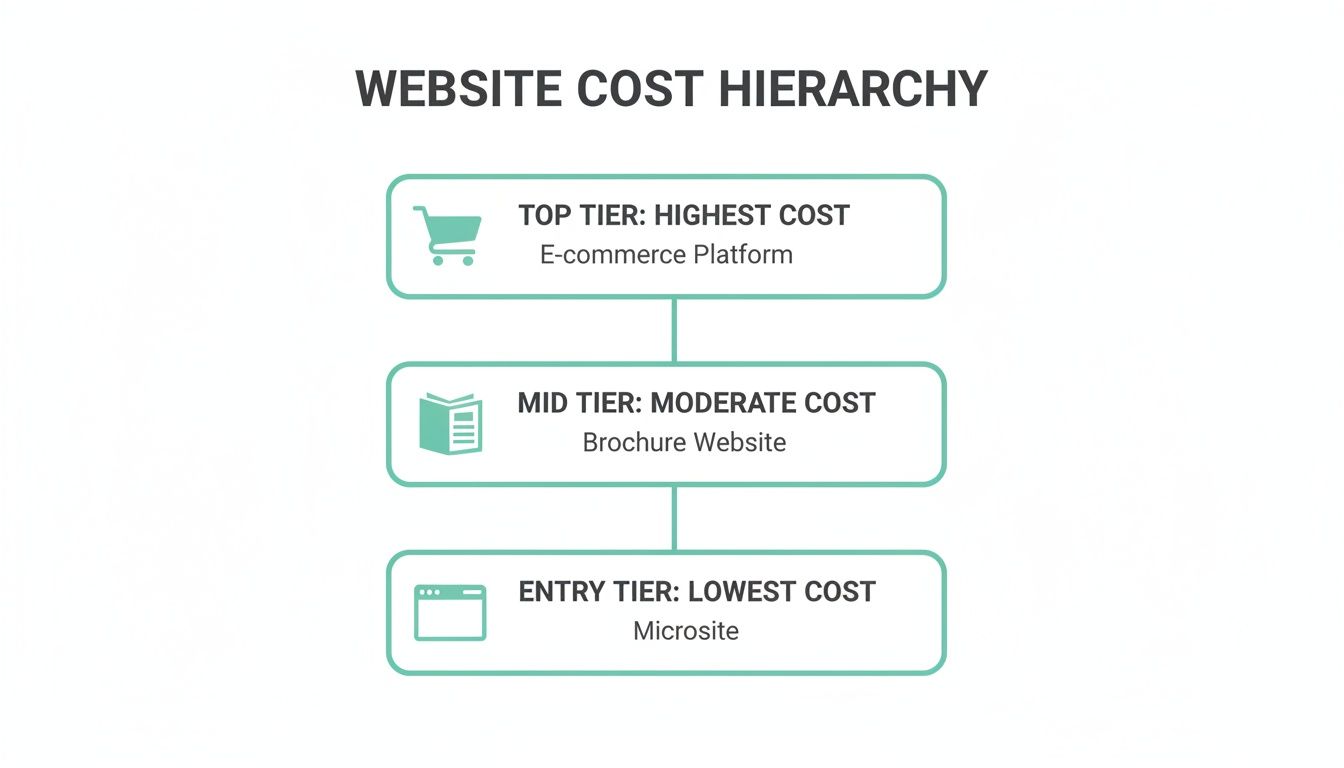
As you can see, adding features like a shopping cart dramatically moves the needle on your overall investment.
Now we’re moving into custom-built territory. This is where you work with a designer or an agency to create a website that’s uniquely yours, often using a powerful Content Management System (CMS) like WordPress. A good Content Management System comparison can help you understand the options, but WordPress powers over 40% of the web for a reason. It's a beast.
Think of this as hiring an architect to design your house. You get full control over the layout, the features, and the look. It’s built specifically for your business goals, whether that’s generating leads, integrating with your booking software, or showcasing a complex portfolio. The initial website creation cost is higher, but you get a far more flexible and powerful asset.
This approach gives you a unique digital storefront that nobody else has. It's an investment in a platform that can grow and adapt right alongside your business.
Finally, we have e-commerce sites and fully bespoke web applications. If you’re selling products online, you need more than just a pretty design; you need a secure, reliable engine to handle payments, inventory, and customer data. For businesses with ambitions to sell online, understanding your options for e-commerce website design is a critical first step.
For medium-sized Kiwi businesses and serious e-commerce ventures, costs can climb to between NZD 5,000 and NZD 30,000. This reflects the added complexity of shopping carts, payment gateways, and inventory systems—all vital for local brands wanting to boost online sales. Some estimates place larger e-commerce builds with 100-1,000 products in the NZD 5,000 to NZD 50,000 range, with custom integrations pushing costs even higher. You can explore more about these figures and what drives them in this eCommerce development cost breakdown.
So, you've got a quote that made you raise an eyebrow. It seemed way higher than you pictured, right? It’s a common story. Often, the biggest chunks of a website’s cost are tied to the 'invisible' work—the stuff that happens behind the scenes.
This is the expert work that transforms a pretty picture into a secure, fast, and effective business machine. It’s a bit like building a house. The architect’s blueprint is essential, but it doesn't account for the foundation, the plumbing, the wiring, or the final coat of paint.
Let's pull back the curtain on the major cost drivers. We’ll break down each piece in plain English, so you know exactly what you’re paying for and why every single part matters for a website that actually helps you grow. The final cost of a website is rarely about one single thing; instead, it’s a combination of several key factors.
| Cost Driver | Low-Cost Impact | High-Cost Impact | Why It Matters |
|---|---|---|---|
| Design & UX | Using a pre-built template with minor brand tweaks. | Fully custom, research-based design with wireframes & prototypes. | A custom design creates a unique brand experience and guides users more effectively, leading to better conversions. |
| Development | A simple 5-page 'brochure' site with a contact form. | Complex site with e-commerce, memberships, and custom features. | The more your website needs to do, the more development time and expertise are required. |
| Integrations | No connections to other software. | Linking to CRM, accounting software (e.g., Xero), and marketing tools. | Integrations automate processes and make your business more efficient, but they add technical complexity. |
| Content | You provide all the text and images yourself. | Professional copywriting, photography, and video production. | High-quality content is your 24/7 salesperson. It builds trust and persuades visitors to act. |
| SEO | Basic on-page optimisation and setup. | In-depth keyword research, technical SEO, and content strategy. | A strong SEO foundation is crucial for getting found on Google and attracting the right kind of customers. |
Each of these elements plays a vital role. Skimping on one, like SEO, might lower the upfront cost, but it could mean your fantastic new website never gets seen by the people who matter most.
First up, let’s talk about design. It's so much more than just picking colours and fonts. Great design is about creating an experience that guides your visitors effortlessly from curiosity to action. It’s called User Experience (UX), and it’s a game-changer.
Think about the last time you used a confusing website. Did you stick around? Probably not. A professional designer spends time understanding your customers—what they need, what frustrates them, and what makes them click "buy now." This research and strategy is where a big chunk of the design cost comes from.
Creating a unique, custom design from scratch will always be a bigger investment than using a pre-made template. A template is like buying a suit off the rack; it works, but it might not fit perfectly. A custom design is like getting a suit tailored—it's made just for you and your business.
This is probably the biggest factor influencing your website creation cost. What does your site actually need to do? The difference between a simple "contact us" form and a full-blown e-commerce system that syncs with your inventory is massive.
Are you building a five-page brochure site, or a fifty-page behemoth with a blog, client portal, and booking system? Each feature, each page, and each integration adds to the development time.
Here are a few things that can really ramp up the complexity:
Basically, the more your website needs to think and interact, the more it will cost to build.
You know what? A beautiful website with weak content is like a fancy car with no engine. It looks great, but it’s not going anywhere. Many business owners underestimate the time and skill it takes to write compelling website copy and source high-quality images.
You might be a fantastic expert in your field, but are you a copywriter? Writing for the web is a specific skill. It needs to be clear, persuasive, and optimised for search engines.
You have a few options here:
Don’t forget about visuals. Professional photography and custom graphics make your brand look polished and trustworthy, but they are an additional cost to factor into your budget.
Remember, the words and images on your site are your 24/7 salesperson. Investing in quality content is one of the smartest moves you can make.
Finally, let's talk about Search Engine Optimisation (SEO). What's the point of having a brilliant website if no one can find it? SEO isn't just something you sprinkle on at the end; true, effective SEO is baked into the website from the very beginning.
This foundational SEO work involves:
Skipping this step is like opening a shop on a back street with no sign. You might have the best products in town, but you’re relying on pure luck for customers to wander in. A proper SEO foundation sets you up for long-term visibility and growth, making it a non-negotiable part of the website creation cost.
Alright, you've launched your shiny new website. It looks brilliant, it works a treat, and you’re ready for the customers to roll in. But here’s the thing nobody really spells out: your website isn't a one-and-done purchase. Honestly, it's more like owning a car than buying a piece of furniture.
You wouldn’t expect a car to run forever without a Warrant of Fitness, an oil change, or new tyres, would you? Your website is exactly the same. After the initial build, there are a handful of recurring costs every Kiwi business owner needs to budget for.
It's so easy to overlook these ongoing expenses in the excitement of the launch. But skipping them can lead to a slow, hacked, or completely broken site down the road, which is a much bigger headache to fix.
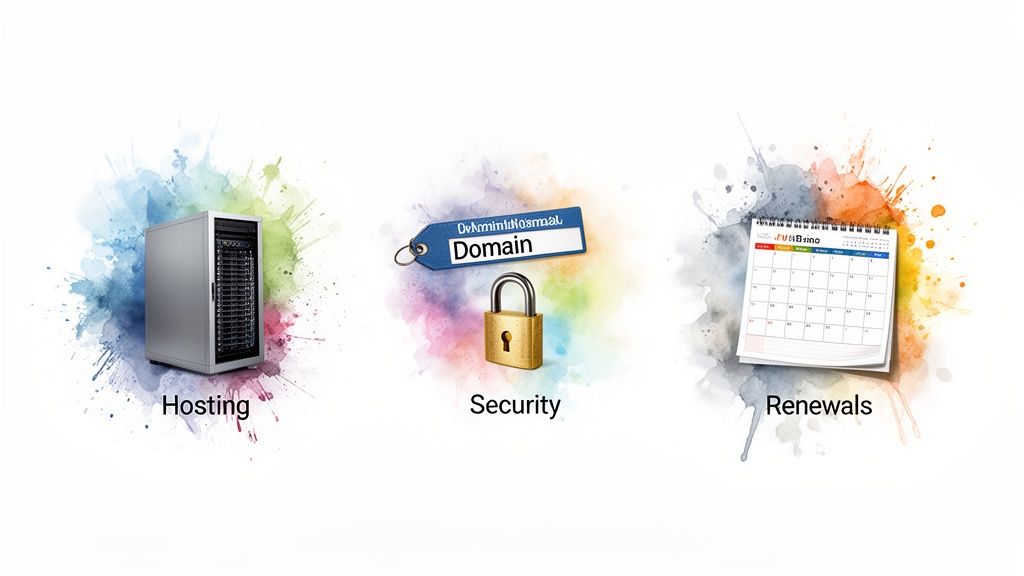
Let's start with the absolute non-negotiables. These are the bills you'll be paying every year just to keep the lights on. They're not glamorous, but they are essential.
Domain Name Renewal: This is your website's address on the internet (like yourbusiness.co.nz). You have to renew it annually, or you risk losing it. Think of it as renewing your business name registration. In NZ, this usually costs between $20 to $50 per year. It's a small price to pay.
Web Hosting: This is the 'rent' you pay for your website's little plot of land on the internet. It's the server space where all your files, images, and content live. Without hosting, your website has nowhere to exist. Knowing the ins and outs of website hosting in New Zealand can help you pick a plan that fits.
Think of it this way: your domain name is the address, but your web hosting is the actual house. You need both for people to find you and come inside.
Hosting costs can vary wildly. A basic shared hosting plan might only set you back $10-$30 per month, while more robust hosting for a high-traffic e-commerce site could be $80-$300+ per month.
Now we get into the really important stuff—the ongoing care and feeding of your website. This is where many businesses try to cut corners, and it often comes back to bite them.
A website, especially one built on a platform like WordPress, is made of many moving parts: the core software, themes, and plugins. These all need regular updates to patch security holes and fix bugs. A neglected website is an open invitation for hackers.
So, what does maintenance actually involve?
You could try to do this yourself, but it takes time and technical know-how. Most businesses opt for a monthly maintenance plan from their web agency. In New Zealand, you can expect to pay anywhere from $50 to $200 per month for this peace of mind.
It might seem like just another bill, but compared to the cost and reputation damage of a hacked website, it’s an absolute bargain. It's the insurance policy for your most valuable marketing asset.
Okay, you’ve seen what goes into the price tag and the ongoing bills. But knowing the numbers is one thing; controlling them is another. How can you be clever with your budget and manage your website creation cost without cutting corners you’ll regret later?
It’s not about being cheap. It's about being savvy—making a calculated investment that will actually pay you back.
You wouldn’t build a house without a blueprint, would you? The same logic applies directly to your website. The single biggest way to save money—and a ton of headaches—is to have a crystal-clear plan before a single line of code is written.
Ambiguity is expensive. When a developer has to guess what you want or you keep changing your mind mid-project, the hours (and the costs) stack up fast.
Here’s what a good plan looks like:
Here’s a little industry secret: content is often the biggest bottleneck in a web project. A developer can build a beautiful, empty shell of a website, but it’s useless without the words and images that fill it up.
Providing your own content—the text and photos for each page—is a direct way to trim the bill. If your budget is tight, handling this yourself is a huge help. Just be realistic. Writing for the web is a skill, so give yourself plenty of time. A great design with poorly written content will fall flat. But if you’re up for it, you’ll save a significant chunk of change.
Who says you need to launch with every single bell and whistle? A massive, all-at-once project can be overwhelming for your budget and your timeline. A much smarter approach is to think in phases.
Launch your "Minimum Viable Product" or MVP first. This is the core, essential version of your site that achieves your primary goal. Then, you can add the 'nice-to-haves' over time as your business grows.
This method gets you online faster, starts bringing in customers sooner, and spreads the total website creation cost over a longer period. It’s a clever way to build your digital presence without breaking the bank.
For instance, you might launch with a simple brochure site now. Then, in six months, you can add a blog. A year from now, you could integrate a full e-commerce store. It makes the entire project feel much more manageable.
Finally, who you choose to build your website matters immensely. You could go with a freelancer, a small local studio, or a larger digital agency. There’s no single "right" answer; it depends on your project's complexity and your budget.
A freelancer might be more affordable, but an agency often brings a wider range of skills to the table, like dedicated designers, developers, and SEO specialists. Find out more about how a skilled user experience designer can shape a project, as this expertise is crucial for building a site that actually converts visitors into customers.
Ask for references, check their past work, and make sure they communicate clearly. A good partner is a long-term investment in your business’s success.
It’s so easy to get fixated on the numbers, isn't it? We've been talking a lot about the website creation cost, and while that's absolutely crucial for budgeting, it's worth taking a step back to reframe the conversation.
Instead of just asking, "What does it cost?", a much more powerful question is, "What is it worth?".
Here’s the thing. A great website isn’t an expense in the same way your power bill is. It’s an asset. It's your 24/7 salesperson, your number one marketing tool, and often the very first impression a potential customer has of your brand.
Thinking of it purely as a cost is like a farmer viewing a new tractor as just another bill. Of course it's not. The tractor is a machine designed to generate a return far greater than its price tag. Your website does the exact same thing for your business.
So, how do we start thinking about the return on investment (ROI)? Let’s move beyond the upfront price and look at what a well-built website actually does for your business day in, day out.
A good website works tirelessly to bring in real, tangible value:
When you start to quantify these benefits, that initial cost starts to look very different. How much is one new client worth to your business? What about saving five hours of admin work every single week? Suddenly, a $5,000 website that brings in $20,000 of new business in its first year seems like an incredible deal.
When weighing up whether a feature is a cost or a smart investment, think about the specific returns it can generate. For example, adding clever features like interactive calculator tools as lead magnets can be brilliant for attracting and converting potential customers.
A simple tool like that might add to the initial build cost, but if it generates dozens of qualified leads every month, its value becomes obvious pretty quickly.
A website is a strategic business decision designed to drive growth. It's an engine, not an ornament.
Framing it this way makes the budget easier to justify. The real question isn’t whether you can afford to build a great website; it’s whether your business can afford not to. The right digital presence pays for itself, again and again.
Got a few things still rattling around in your head? You're not the only one. Diving into website costs can feel a bit like wading through mud, especially when all you want is a straight answer.
Here are some of the most common questions we get from Kiwi business owners just like you.
In a word? No. Not a professional one, anyway.
While platforms like Wix will dangle the "free" carrot, it always comes with strings attached. You'll have their branding plastered on your site, you'll get stuck with a clunky subdomain (think yourbusiness.wixsite.com), and you'll miss out on a bunch of features customers expect.
For any serious business in New Zealand, investing in your own domain name and a decent hosting plan is the bare minimum. It’s a small price to pay for credibility and tells your customers you’re the real deal.
Ah, the classic "how long is a piece of string?" question. But we can give you a pretty reliable ballpark.
For a standard small business website—we're talking 5 to 10 pages with the usuals like a homepage, services, and a contact form—you’re typically looking at somewhere between four to eight weeks from start to finish.
You know what the biggest variable is? Honestly, it's you. How quickly you can supply the content and give feedback to your web team will make all the difference.
Bigger, more complex projects, like an e-commerce store with hundreds of products, can easily stretch to 12 weeks or more to get everything just right.
Yes, one hundred percent. Skipping website maintenance is a bit like never getting a Warrant of Fitness for your car—it seems fine for a while, until it suddenly, catastrophically, isn't.
Think of it this way: your website is built on software, and that software needs constant updates to stay secure and run smoothly. A solid maintenance plan covers the essentials:
Ignoring this stuff can lead to your site getting hacked or just flat-out breaking. The emergency bill to fix that (not to mention the lost business) will always cost more than a simple monthly maintenance plan. It's basically an insurance policy for your most important digital asset.
Ready to get a clear, no-nonsense quote for your website project? The team at NZ Apps is here to help. We build professional, effective websites for Kiwi businesses that get real results. Get in touch for a free consultation today!