
Figuring out the price of a website is a bit like asking, "How much does a car cost?" You wouldn't expect a simple runabout to have the same price tag as a custom-built ute loaded with every possible feature. It's the same with websites. In New Zealand, a basic online presence might start from around $1,500, while a complex e-commerce store could easily set you back $25,000 or more.
Okay, let's get straight to the numbers, shall we?
Honestly, the final cost all comes down to what you need your website to do. Are you after a simple digital business card to show people what you do, or a high-performance selling machine designed to grow your business? Are we talking a straightforward site for your Christchurch-based service business, or a massive online store shipping nationwide from your Auckland warehouse?
This guide is here to give you a clear financial picture before we get into the details that push those numbers up or down. Think of it as your roadmap for budgeting.
The truth is, the price range is huge. A simple brochure website is one thing; a completely custom web application is another beast entirely. It’s not just about how it looks, but what it does behind the scenes.
Here's a simple breakdown showing how complexity, features, and cost stack up.
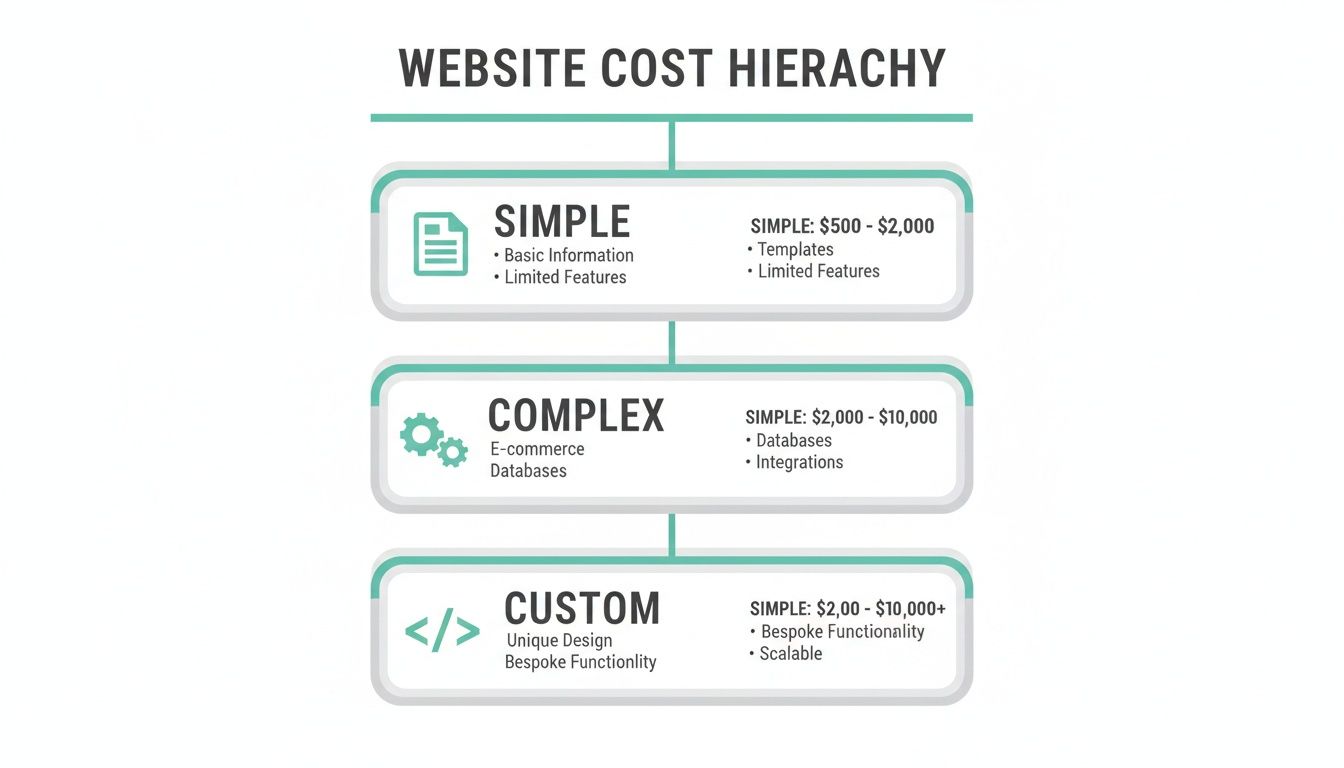
As you can see, there's a clear progression. The more features and customisation you need, the bigger the investment. This visual really drives home why a one-size-fits-all price just doesn't work for websites.
To give you a clearer starting point, here are some typical ballpark figures you can expect in New Zealand.
| Website Type | Typical Price Range (NZD, excl. GST) |
|---|---|
| Simple Brochure Website (3-5 pages) | $1,500 - $5,000 |
| Small Business Website (CMS, 5-15 pages) | $5,000 - $12,000 |
| E-commerce Store (Basic) | $8,000 - $20,000 |
| Custom Designed E-commerce/Web App | $25,000+ |
Remember, these are just starting points. The final cost will depend on the specific features and level of customisation you need.
The price isn't just for a pretty design. It covers a whole range of specialist work that goes into building a successful website.
To help clients get a feel for costs, some agencies provide tools to map out different features. You can even play around with a pricing calculator for website projects yourself to see how quickly things can add up. It's a great way to understand all the moving parts.
Now that we've got the overview sorted, let's talk about the unsung hero of the Kiwi business scene.

Honestly, for a huge number of businesses, this is the perfect place to start. It’s not about flashy bells and whistles; it’s about establishing pure, simple credibility.
Think of it as your digital business card, but a whole lot smarter. It's a clean, professional home online where customers can find you, learn what you do, and get in touch without any fuss. This is the ideal setup for a builder in Christchurch or a consultant working from their home office in Auckland.
The whole point is to build instant trust. When someone hears your name, what’s the first thing they do? They Google you. A sharp, well-made site immediately tells them you’re a serious, legitimate business. It just works.
So, when we talk about the website designing price for a brochure site, what are you actually paying for? It's not just a pretty picture online. Your investment covers all the essential design and development work to get you up and running properly.
Here's what this usually includes:
It’s everything you need and nothing you don’t. Just a solid foundation to build on.
A common mistake is thinking a simple site can't bring in serious business. A well-optimised brochure website can absolutely punch above its weight, bringing in high-quality local enquiries that turn into real jobs.
The focus here is always on clarity and professionalism. Your site needs to look great on a phone, load fast, and guide visitors straight to the information they need. No fuss, no friction, just results.
So, what’s the damage? For a standard brochure-style website in New Zealand—perfect for tradies, professionals, and small service businesses—you’re typically looking at a cost between NZD 1,000 and 3,000, excluding GST.
This price generally covers a straightforward 5-6 page site with all the essentials to build trust and get those enquiries rolling in. Industry data shows most small Kiwi business sites fall into this range, but it’s important to also factor in ongoing costs like hosting and your domain name. You can learn more about how Kiwi businesses budget for their online presence.
Think of this as an investment in a professional online presence that works for you 24/7. It’s your silent salesperson, always ready to answer questions and capture leads, even while you’re on the tools or meeting with a client. It’s a smart move.
And speaking of smart moves, what if you're ready to start selling online?

Ready to start selling your products online? This is where the whole game changes. An e-commerce site isn’t just a bigger, fancier brochure website—it's a proper sales engine.
It’s a machine designed to do some heavy lifting: manage products, handle customer accounts, process payments securely, and figure out shipping. It’s alive.
So, it's no surprise that the website designing price takes a significant leap when you step into e-commerce. You're not just showing people what you do; you're building an entire store, complete with a checkout counter, stockroom, and security system.
The real reason for the price jump is complexity. It’s the difference between building a garden shed and a fully plumbed, wired-up workshop. One is for storage; the other is for doing business.
Let’s be honest, you want a seamless experience for your customers, right? That smooth, trustworthy process is built on a mountain of technical work happening behind the scenes.
This includes things like:
Each of these features is a crucial moving part, and they all need to work together perfectly. If you want to get into the nuts and bolts, you can explore more about what makes a great online store in our detailed guide on designing an e-commerce website.
So, what are we looking at in terms of investment? In New Zealand, the cost for a solid e-commerce website has settled into a range of around NZD 5,000 to over $20,000.
This spectrum covers everything from a basic online shop to a more robust store with custom integrations. For businesses that need high-performing web apps and serious e-commerce muscle, entry-level projects often start around the $7,000 mark and can easily climb past $20,000. It’s a serious bit of kit, often costing three to five times more than a standard brochure site because of all the backend machinery.
Remember, a slow or clunky checkout process is the fastest way to lose a sale. Kiwis are shopping on their phones more than ever, so a flawless mobile experience isn't just a nice-to-have; it's absolutely essential.
It helps to see where the money actually goes. A bigger budget doesn't just mean a prettier design; it means more powerful features and a smoother ride for your customers. Here’s a quick look at how different features can impact the final price.
| Feature/Component | Typical Cost Impact | Why It Matters |
|---|---|---|
| Basic Product Listings | Low | Essential for showing what you sell, but simple to set up. |
| Custom Design Theme | Medium | A unique look that matches your brand builds trust and recognition. |
| Payment Gateway Setup | Medium | Non-negotiable for taking payments; requires technical configuration. |
| Automated Shipping Rules | Medium-High | Complex logic is needed to calculate rates accurately across NZ. |
| Inventory Sync with POS | High | Connects your online store with your physical shop's stock levels. |
| Customer Accounts & History | Medium-High | Encourages repeat business by making reordering easy. |
Ultimately, building an online store is about creating a smooth, reliable, and trustworthy experience that turns casual browsers into loyal, paying customers. It's an investment, but a good one can become your business's most valuable salesperson.
Right, let's step into a completely different world. We're moving beyond digital brochures and online shops into the realm of bespoke software. A custom web application isn't just a website; it’s a tailored piece of software that runs in a browser to solve a specific, and often complex, business problem.
Forget just displaying information. We're talking about doing things.
Think of a unique booking system that juggles complex schedules for a busy clinic, a secure client portal where customers can track their projects in real-time, or a powerful internal tool that automates your entire invoicing workflow. This is where a company like NZ Apps really comes into its own. It's about building a digital asset that gives your business a powerful, unique advantage.
The conversation around the website designing price shifts dramatically here. It's no longer about counting pages or picking templates. Instead, we’re discussing project scope, database architecture, third-party integrations, and crafting entirely new user experiences from the ground up.
Let's put it this way: a brochure website is like buying a high-quality, pre-built shed. An e-commerce site is like having that shed professionally kitted out as a workshop. A web application? That’s like hiring an architect and a construction crew to build a custom factory from scratch, designed specifically for your unique manufacturing process.
This isn't just about putting your business online; it's about building a tool that becomes a core part of your operations. It’s an investment in efficiency, growth, and a serious competitive edge.
So, what does this level of customisation cost? Brace yourself, because these projects command a premium for a very good reason. The expertise required to build secure, efficient, and well-performing web applications is immense.
These are not quick turnarounds. They involve deep-dive strategy sessions, complex coding, and rigorous testing to ensure everything works flawlessly from day one.
For custom web design and complex builds here in New Zealand, you're looking at a price range from $10,000 to over $50,000. This reflects the truly bespoke nature of the work, perfectly suited for established organisations in Auckland and Christchurch that need advanced features like database integrations and workflow automation. Interestingly, some reports show that about 30% of Kiwi firms investing over $20,000 in custom sites report growing twice as fast, thanks to performance optimisations and NZ-focused SEO. You can find more detail on these New Zealand web design price points and their impact.
The final figure depends entirely on the scope. A few key factors will heavily influence the cost:
Building a custom web application is a serious undertaking, but the return on investment can be massive. You're not just buying a website; you're commissioning a unique digital tool that solves your exact problems and helps your business run smarter.
Ever get a couple of quotes for a website and wonder why one is $3,000 and the other is $15,000 for what seems like the exact same thing? It’s a classic head-scratcher. Here’s the thing—the final website designing price is all in the details you might not even see at first glance.
It’s just like building a house. Two houses can look similar from the street, but one might have standard fittings while the other has a gourmet kitchen, custom joinery, and a smart wiring system. The price difference would be huge, right? Websites are exactly the same.
Let’s pull back the curtain on the variables that really move the needle on cost. Understanding these is your best defence against sticker shock and helps you get a quote that actually makes sense for what you need.
This is probably the biggest factor. Are we using a pre-made template as a starting point, or are we designing something completely from scratch, just for you? A template is like buying a suit off the rack—it’s faster and cheaper, but it might not be a perfect fit for your brand.
A custom design, on the other hand, is a bespoke suit. It’s tailored to your exact measurements, your style, and your business goals. It takes more time, more skill, and therefore, costs more. This includes creating unique layouts for different pages like your homepage, services page, and blog posts. The more unique page designs you need, the more the price will climb.
This is where things get really interesting. What does your website do? A simple site that just displays information is straightforward. But what if you need it to connect with other software you already use?
That’s called an integration, and it’s a major cost driver.
Each of these connections is a custom piece of work. Implementing advanced features like a Lead Generation Chatbot is another perfect example of how specific functionalities can significantly push your website's price up by adding layers of technical complexity.
This is a big one that often gets overlooked. A website is just an empty container without words and images. The question is, who is creating all that content?
Are you providing all the text and photos, ready to go? Or do you need the agency to handle copywriting and source professional images? Good content takes time and skill, so if it's included in the scope, it will be reflected in the price.
Then there's Search Engine Optimisation (SEO).
Just building a website doesn't mean people will find it. Proper SEO setup from the start is what helps you show up on Google when Kiwis are searching for what you offer.
This isn’t just about stuffing in a few keywords. It involves technical setup, local SEO for places like Auckland or Christchurch, and structuring your content properly. A basic setup is one thing; a comprehensive SEO strategy is a much bigger—and more valuable—investment. It's the difference between having a shop in a quiet back alley versus one on the main street. You're paying for visibility, and it's almost always worth it.
It’s incredibly easy to get fixated on the initial website designing price. You gather the quotes, pick a winner, launch the site, and… job done, right? Not quite.
Thinking of a website as a one-and-done project is one of the most common—and costly—mistakes a business can make. Your website isn’t a printed brochure; it’s a living, breathing part of your business. It’s much more like a car. You wouldn't buy a new ute and then just never change the oil, would you?
Your website needs that same kind of ongoing care to keep it running smoothly, securely, and effectively. Let's talk about the costs you need to plan for after the big launch.
There are a few non-negotiable costs that come with owning any website. These are the basics, the digital rent you pay to keep your online space open for business.
yourbusiness.co.nz). You have to renew it every year, which is usually a small but essential cost. Forget to pay, and your site simply goes dark.These are the absolute fundamentals. But to truly protect your investment, there's another layer to consider.
So, why would you pay an agency a monthly fee after they’ve already built your site? Here’s the thing: the software that powers your website—like WordPress and its plugins—is constantly being updated.
These updates aren't just for adding flashy new features. More often, they contain critical security patches to protect your site from hackers and fixes to stop things from breaking. A maintenance plan is your insurance policy.
A cheap website that brings in zero customers isn’t a bargain; it’s an expense. A pricier, well-maintained site that becomes your best salesperson is one of the greatest assets your business can own.
This monthly fee typically covers essential tasks like:
Without this, you’re flying blind. A hacked or broken site can cost thousands to fix and cause massive damage to your reputation. A small monthly fee for maintenance is a smart way to avoid a much bigger, more painful bill down the road. It’s about shifting your perspective from a one-off cost to an ongoing investment in a vital business tool.
When it comes to figuring out website design costs in New Zealand, a few questions pop up time and time again. Let's be honest, it can be a confusing space. Here are some straightforward answers to the things we hear most often.
That's a fair question, and for some people, it's absolutely the right move to get started. Platforms like Squarespace or Wix are great for very simple needs or when you're on a super tight budget. We'd never argue with that.
The catch, though, usually comes down to three things: flexibility, customisation, and room to grow. A professionally built website gives you something that’s 100% unique to your brand, is properly optimised for local Kiwi search (SEO), and is built on a solid foundation that can expand right alongside your business.
Think of it as the difference between a DIY flat-pack shed and an architect-designed workshop. Both give you a space to work, but one is built specifically for your tools and your workflow.
Great question. The better prepared you are, the more accurate your quote will be – and that saves everyone a bit of a headache later on. The best starting point is having a clear idea of what you want your website to actually do for your business.
Is its main job to pull in new leads? To sell your products directly? Or is it there purely to provide information and build your credibility?
Here’s a quick checklist of things that are incredibly helpful to bring to the table:
If you already have your logo and some of your text content ready, that's a massive bonus and can really get the ball rolling faster!
Almost never. The standard practice for most web design agencies here in New Zealand is to use a milestone-based payment structure.
A common approach is an initial deposit to get the project started—usually somewhere between 30-50% of the total. From there, you'll make further payments at key project stages, like when the design mockups are approved or just before the new site is launched.
This approach keeps everything moving and is fair to both you and the design team. Just make sure the payment schedule is clearly laid out in your project proposal before you sign anything. No one likes surprises when it comes to money.
Ah, the classic "how long is a piece of string?" question! It really does depend on what's being built.
As a rough guide, a simple brochure-style website might take 4 to 6 weeks from kickoff to launch. A more complex e-commerce site could easily be an 8 to 12-week project, and sometimes longer. Custom web applications are a whole different beast and can often take several months to design, build, test, and launch properly.
The final timeline always comes down to the complexity of the project, how quickly you can provide feedback and content, and the agency's own schedule. Good, consistent communication is the real secret to keeping everything on track.
Ready to get a clear, no-nonsense price for your project? The team at NZ Apps specialises in creating custom websites that deliver real results for Kiwi businesses. We’ll help you understand the costs and build a digital asset that drives growth.
Get a free consultation with NZ Apps today!